The King Gave His Son a Staff Against Fear
The boy would not step past the gate. Robbers waited in the hills, pirates on the water. His father sealed an amulet in a stick and pressed it into his palm.
Table of Contents
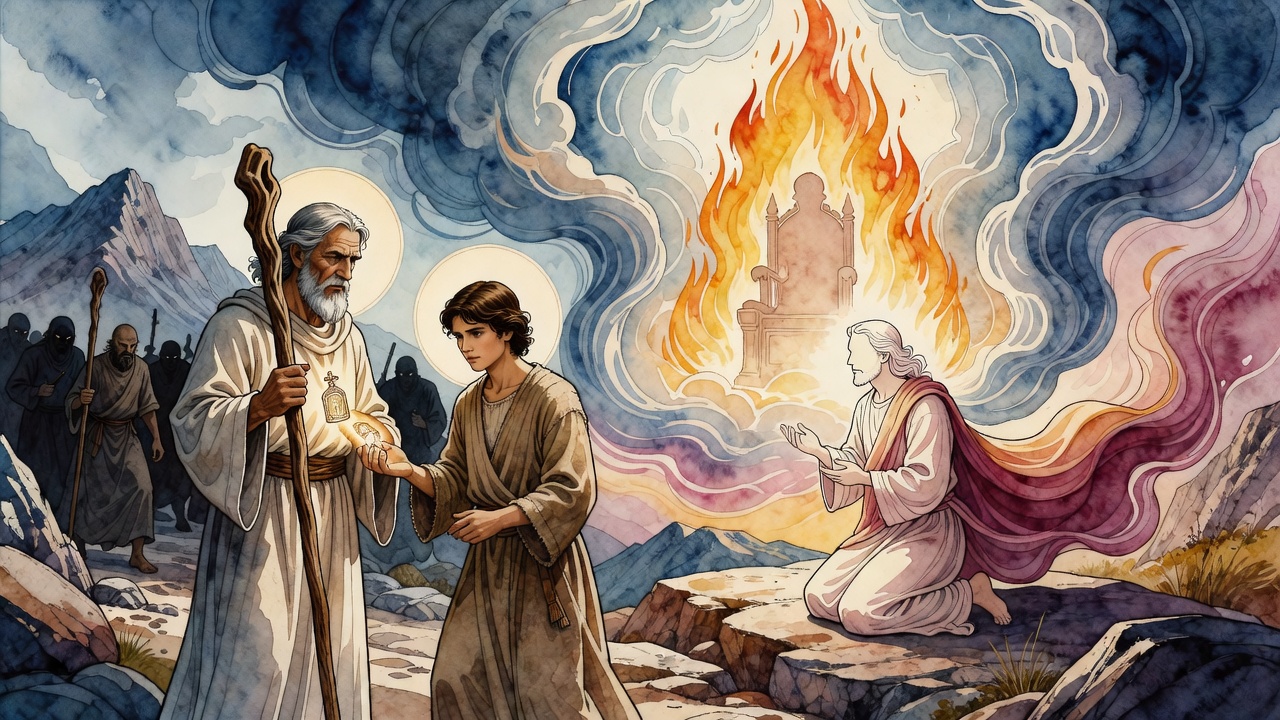
The king's son stood at the gate with empty hands. Trade roads waited beyond the walls, and the boy had heard what waited on them: robbers in the hills, pirates on the water, men who measured a traveler by the weight of his pack.
 Click for full size
"Go into business," the king said.
The son did not move. Fear had already closed his fingers.
So the king took a staff, hollowed it, and sealed an amulet inside the wood. He pressed the staff into the boy's palm until the knuckles whitened around it.
"Let this staff be in your hand," the king said, "and you will not fear anyone."
The Staff Moses Lifted for Israel
God spoke the same charge through a different mouth. He told Moses to tell Israel: engage in Torah, and you will not fear any nation. The staff was not iron. It was not a sword hung at the hip. It was the Tree of Life held where the hand could feel it (Proverbs 3:18).
Torah was not a daughter a desperate father tries to marry off to anyone who will take her. Rav Huna, in the name of Rabbi Aha, cut that pride at the root. Israel did God no favor by accepting the gift. The gift accepted Israel. "My son, if you would take my sayings and treasure my commandments with you" (Proverbs 2:1). The word "if" sat like a key. Merit opened the door. The sayings did not beg to be held.
On the road the son of the parable walked with wood against his palm. In the camp Israel walked with words against their fear. Both grips were the same motion: take hold, and keep holding when the night sounds rise.
Grasp, Do Not Only Toil
If the verse had said the Tree of Life belongs to those who toil in it, the enemies of Israel would have found no survivors among the weak. Toil is a mountain few climb. The verse said "grasp." Grasp means take it into the hand and the house. Grasp means uphold, not only recite.
"Cursed is the one who will not uphold the words of this Torah" (Deuteronomy 27:26). The curse does not fall first on the student who never opened a page. It falls on the one who will not hold the matter upright when the street demands a choice.
A man who stumbled and sinned came looking for a way back to life. The answer was not a single muttered verse. If he read one page of Scripture, he was told to read two. If he learned one chapter of Mishnah, he was told to learn two. If he could do neither, he was sent to stand for the community, to collect for the poor, to put his body where the needs were counted. Service became a second road to the same tree.
Wisdom sheltered like money shelters (Ecclesiastes 7:12). Both could keep a household from the wind. Neither worked if left in a chest while the door stayed shut.
The Hungry at the Door
Another pressure walked up the same street. Isaiah's voice cut through the market: "And offer your soul to the hungry" (Isaiah 58:10). Not a few coins tossed without looking. The soul. The face. The time that costs.
A householder stood with a purse and a closed heart. He could drop metal into a palm and keep his eyes on the wall. That was not the offering named in the verse. The hungry of Jacob waited for a person, not a rattle of silver.
If he would not give where the need was real, the midrash warned, he would give to the sated of Esau. In the days of the sages that name meant Rome, the power that emptied storehouses with a smile and a seal. What you refuse to open for your brother, the empire opens for itself.
"And bringing home the wretched poor" (Isaiah 58:7) did not stay a kindness done to strangers. It could become the shape of your own doorway when dignity left and tax men stood where guests should stand. Rabbi Yitzhak spoke of the blind called "full of light," a soft name for a hard life. The wretched poor were those who had lost property and face because they never stretched a hand when they still had one.
Soul, Wine, and the Scholar at the Table
Some of the wretched were mourners, mouths dry with grief. For them the verse reached past bread to "intoxicating drink for the desolate and wine for embittered souls" (Proverbs 31:6). Comfort was also an offering of the soul.
Some of the "wretched poor" were Torah scholars who entered a house empty of learning and filled it with purity and prohibition, with what is bound and what is free. Hosting such a guest was like bringing first fruits to the house of the Lord (Exodus 23:19). The table became an altar without smoke.
The son on the road tightened his grip on the hollow staff. Israel tightened its grip on the Tree. The householder who had tossed coins without a soul felt the knock of empire at his own gate. Three grips, one lesson: what you hold, and how you hold it, decides whether fear or famine walks in first.
The staff stayed in the hand. The hungry ate. The page doubled after the fall. Nothing irreversible had to be a curse. What changed for good was the choice to grasp.
← All myths