6 min read

A Forged Confession Saved a Starving Household

Someone wrote Hadrian a letter that hated life. A stand-in claimed the words, faced the sword, and bought his family bread.

Curated by Arthur · Told by Maggid ·
Table of Contents
  1. Three Hungers
  2. Other Ways to Hate Life
  3. Souls That Flee Reproof
  4. Borrowed Words, Real Body

The letter reached Hadrian without a signature and still cut. "I hated life." Then the blade turned toward the emperor: if you hate the circumcised, the Ishmaelites are circumcised. If you hate Shabbat keepers, the Cuthites keep Shabbat. It is this nation alone you hate, and its God will settle with you. The throne room went quiet in the way rooms go quiet when a truth has arrived wearing insolence.
A Forged Confession Saved a Starving Household Click for full size

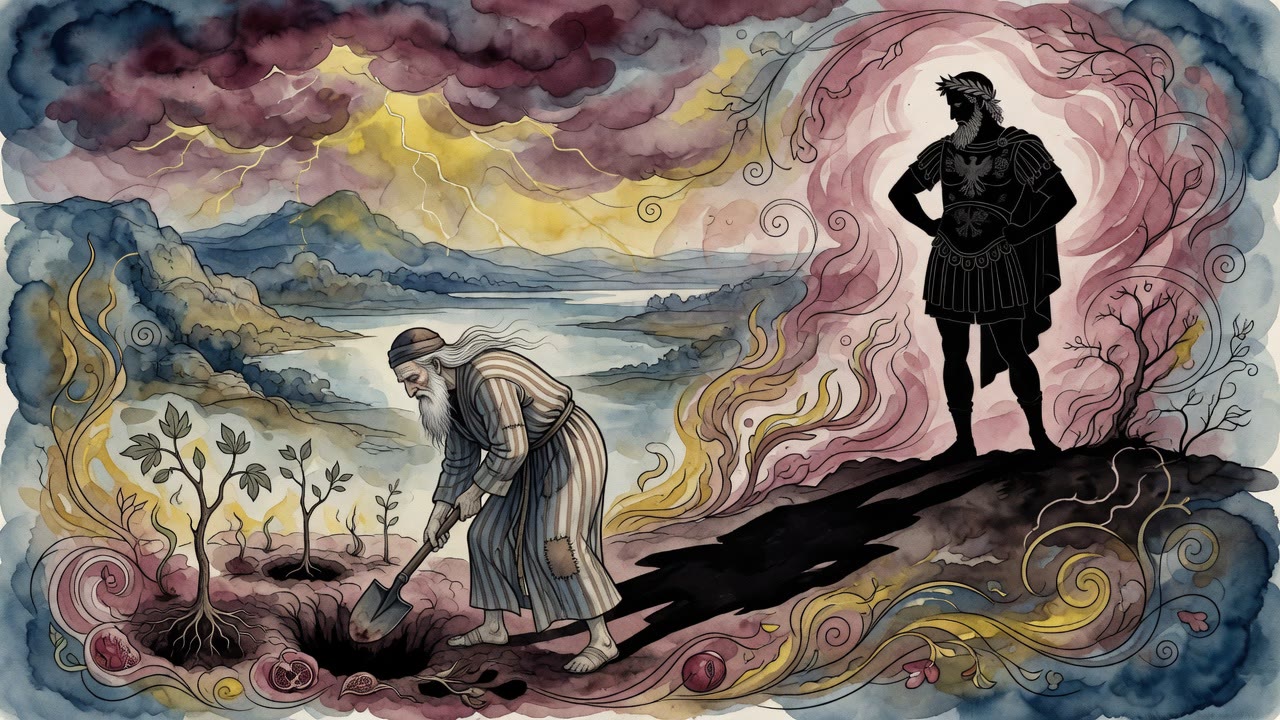
Hadrian announced that the writer should reveal himself for a reward. The community understood the other possibility: if no one stepped forward, collective punishment would invent a culprit list. A man who had not written the letter walked forward anyway. He borrowed the danger to spare the many. Hadrian ordered him beheaded, then paused long enough to ask why the accusation of baseless hatred.

Three Hungers

The stand-in did not give a political speech. He gave an inventory of poverty. This man's soul wants to eat morning and evening, and he has nothing to give it. Likewise his wife. Likewise his sons. Three hungers, one empty bag. He was explaining why death under a Roman sword might be lighter than another week of watching children ask for food he did not have.

Hadrian heard the arithmetic of misery and changed the sentence. Since he is living a bad life, let him go. The man walked out under the verse he had claimed: "I hated life, because the actions performed under the sun were distressing to me; as everything is vanity and herding wind" (Ecclesiastes 2:17). Kohelet's bleak line became a courtroom pass.

Other Ways to Hate Life

The midrash sets another body beside him. A glutton labored six days all year and still faced Shabbat without food. He put on his finest garments, climbed to a roof, and fell to his death, reciting the same hatred of life. Excess and lack can rhyme in despair. One man nearly dies under empire because he has nothing. Another dies under shame because the week would not yield a meal fit for rest.

Proverbs of the sages keep smaller knives of truth nearby. The ass complains of cold even in Tammuz. Some mouths will find a chill in midsummer. Few see their own faults. The liar's punishment is that when he finally tells truth, no one believes him. Use your best vase today; tomorrow it may be broken. Pray until the last shovelful of earth. These lines are not decoration. They are field notes from lives that already know Kohelet's weather.

Souls That Flee Reproof

Philo splits human interiors into two responses to correction. The gentle, consistent mind loves reproof and draws closer to the one who offers it. The stubborn soul turns malignant, hates the corrector, flees toward agreeable speech even when agreeable speech ruins. The angel's question to Hagar, whence do you come and whither do you go, becomes a mirror for any fugitive heart (Genesis 16:8).

Hadrian's court was a machine of power, not a house of study, yet the stand-in's speech worked like reproof the emperor could not entirely flee. It named hatred. It named hunger. It forced a choice between killing a man already half-killed by poverty and releasing him as a living indictment. The stubborn soul of empire blinked.

Borrowed Words, Real Body

He had not written the letter. He wore the words anyway. That theft was a gift to the unsigned author and to every neighbor who would have been rounded up. Truth, the proverb says, lasts. Falsehood vanishes. Here a false confession carried a true condition: a household starving under a regime that hated their stubborn particularity more than it hated generic difference.

When he left the court alive, the verse went with him like a second skin. I hated life. Not as fashionably dark poetry. As minutes without bread. As sons with open mouths. As a God still owed an accounting against an emperor who thought nations were toys.

Years later teachers place his story under Kohelet so no one can pretend "vanity" is only a mood for the comfortable. Vanity can be the taste of a week without a meal. It can be the roof edge. It can be a forged name spoken to save a street. The ass will still complain in Tammuz. The gentle soul will still lean into hard words. And somewhere a man who once faced Hadrian's sword will feed a child with bread bought by a lie that told the only truth that mattered that day.

On the walk home his legs shook with more than hunger. He had spoken as if the letter were his, and the universe had not struck him down for the theft. Truth lasts forever, the proverb says, but sometimes truth needs a false signature to enter a room guarded by spears. He would tell his wife a short version. He would not tell the children how close the sword had come. Bread first. Theology later.

Philo's stubborn soul would have flattered Hadrian and died of agreeableness another way. The gentle soul takes hard words in and grows. Empire rarely specializes in gentleness, yet even a hard court can be forced to hear a ledger of three empty stomachs. The ass will complain in Tammuz. The glutton will still find a roof. The stand-in will keep hating a life that starves children while emperors collect hates the way other men collect coins. Kohelet does not comfort him. It gives him a sentence strong enough to carry a body out of a throne room alive.


← All myths
From the tradition

Sources

3 sources

The texts behind this telling. Some cards carry a translation of the source; others are our own retelling of it, and each card says which. Every card links out to the original.

Kohelet Rabbah 2:16Kohelet Rabbah

Retold in our words. Read the original at the link below.The Sefaria Midrash Rabbah, 2022 · CC-BY

The book of Ecclesiastes, Kohelet in Hebrew, certainly grapples with that feeling. "I hated life," it says, "because the actions performed under the sun were distressing to me; as everything is vanity and herding wind" (Ecclesiastes 2:17). A pretty bleak outlook. But what does it mean?

The sages of the Talmud and Midrash (rabbinic interpretive commentary) never shied away from wrestling with difficult texts. And Kohelet Rabbah, a collection of rabbinic interpretations of Ecclesiastes, offers some fascinating insights into this verse.

One story it tells involves a letter. Imagine this: Someone, an anonymous writer, sends a scathing letter to the Roman Emperor Hadrian, saying, "I hated life." The emperor, understandably, wants to know who wrote it. “If it is the circumcised that you hate, there are the Ishmaelites. If it is those who observe Shabbat (the Sabbath) that you hate, there are the Cuthites," the letter pointedly says.

In other words, if Hadrian hated the Jewish people, why not hate others who also practiced similar customs? "Rather, it is only this nation alone that you hate; its God will exact retribution against that man," the writer boldly proclaimed, a clear jab at Hadrian himself.

Hadrian, wanting to know who dared to write such a thing, declared that the author should reveal himself, promising some kind of reward. But of course, nobody wanted to risk the Emperor's wrath! So, one brave soul stepped forward, falsely claiming authorship. Why? According to Midrash HaMevo’ar, there was concern that if no one confessed, the entire Jewish community would be punished.

Hadrian, not buying it, asked him, "Why did you say so? Why did you accuse me of baseless hatred?" The man's response is heartbreaking: "It is because you are relieving this man from three severe pains. This man’s soul wants to eat with him morning and evening, and he does not have anything to give it, and likewise regarding his wife and likewise regarding his sons.” He was saying, "I’m so poor, so burdened by providing for my family, that death is a release."

Hadrian, perhaps moved by this confession of utter desperation, let him go. The man, spared from execution, recited about himself: “I hated life.” What a powerful, and tragic, interpretation of the verse.

The Midrash goes on to share other stories connected to this sentiment. There's the tale of a glutton who worked tirelessly all week but had nothing to eat on Shabbat, the day of rest. Driven to despair, he climbed onto his roof and took his own life, uttering the same words: "I hated life."

Then there's the story of Rabbi Hoshaya. Someone reported to him that his judges were drinking wine in the marketplace – a sign of corruption and disregard for their duties. Initially, Rabbi Hoshaya didn't believe it. But when he witnessed it himself, he was so disheartened that he, too, declared, "I hated life," and died in peace. Rabbi David Luria suggests this emphasizes that, unlike the glutton, Rabbi Hoshaya did not resort to suicide. His anguish was such that he no longer wished to live, and his wish was granted.

Finally, Rabbi Huna offers a different perspective, drawing on (Genesis 2:7): “Man became a living soul, and He rendered him a slave to himself, for if he does not toil he will not eat.” He connects this to (Lamentations 1:14), interpreting the verse to mean that if one does not toil during the day, he will be unable to withstand the night. In other words, life is hard work, a constant struggle for sustenance.

So, what are we to make of all this? Is life a burden, a source of endless frustration? Is it a constant struggle against poverty and injustice? The Midrash doesn't offer easy answers. Instead, it presents different facets of the human experience, different reasons why someone might feel that life is unbearable.

Perhaps the point isn't to find a simple solution to the problem of suffering, but to acknowledge its reality, to recognize the pain that others (and perhaps we ourselves) experience. And maybe, just maybe, by acknowledging that pain, we can find ways to alleviate it, to make life a little less hateful, a little more bearable, for ourselves and for others.

Full source
Talmud (proverbs)Hebraic Literature (1901)

Retold in our words. Read the original at the link below.Project Gutenberg eBook #14368, Hebraic Literature · PD-US-pre-1929

The Talmud keeps a ledger of shorter sayings, proverbs worn smooth by repetition, each one a whole argument compressed into a sentence.

"Do not do to others what you would not have others do to you." Hillel's version of the whole Torah, said on one foot.

"The ass complains of the cold even in Tammuz." Mid-summer. Some people will always find a chill.

"First learn, then teach." The reverse ruins both.

"Few are they who see their own faults." A mirror is not enough.

"A single light answers as well for a hundred men as for one." Wisdom shared loses nothing.

"Victuals prepared by many cooks will be neither hot nor cold." A kitchen of committees.

"Truth lasts forever, but falsehood must vanish."

"This is the punishment of the liar, when he tells the truth nobody believes him."

"Use your best vase today, for tomorrow it may be broken."

"When Ha-Satan, the Accuser, cannot come himself, he sends wine as a messenger."

"Woe to the children banished from their father's table."

"A handful of food will not satisfy the lion; a pit cannot be filled with its own dust."

"Pray to God for mercy until the last shovelful of earth is cast upon your grave. Do not cease praying even when the knife is laid upon your neck."

The Rabbis believed that the last line, prayer even at the knife, was the hardest one and the one most worth remembering.

Full source
The Midrash of Philo 8:1The Midrash of Philo

Retold in our words. Read the original at the link below.The Works of Philo Judaeus, trans. C. D. Yonge, London, H. G. Bohn, 1854-1890 · Public Domain

The Midrash of Philo dives into this very question, exploring the human soul's capacity for growth and its resistance to it. It suggests that not every soul possesses the ability to truly respect and submit to beneficial discipline. The familiar version gives us people who seem to thrive on feedback, constantly seeking ways to improve. These are the souls, Philo argues, that are gentle, good-tempered, and consistent. They actually love reproof! And they grow closer to those who offer it.

Then there's the flip side. The stubborn soul. Ouch. Philo doesn't pull any punches here. He says the stubborn soul becomes malignant, hating those who try to correct them. They turn away, fleeing from anything that might challenge their perspective, preferring instead the easy comfort of agreeable words, even if those words lead them astray. The idea of actively running away from what's good for you.

That brings us to a fascinating question posed in the Midrash (rabbinic interpretive commentary): "Hagar, the handmaid of Sarah, whence comest thou, and whither goest thou?" (Genesis 16:8). Why did the angel single her out with this question? for a moment. In the biblical narrative, Hagar is fleeing from Sarah's harsh treatment. She's vulnerable, scared, and likely feeling lost. So, why does the angel choose this moment to essentially ask, "Where have you been and where are you going?"

Perhaps the angel's question isn't just about Hagar's physical location, but about her inner state. Is she running towards something, or simply away from something? Is she open to guidance, or is she determined to follow her own path, regardless of the consequences? The angel's words become a gentle nudge, a moment of reflection offered in the midst of her flight.

The Zohar, the foundational work of Jewish mysticism, often emphasizes the importance of self-reflection and the constant need to evaluate our motivations. It's not enough to simply react to our circumstances, we must also understand the underlying forces that drive our actions.

As we find in Midrash Rabbah, stories are not just narratives; they are opportunities for us to see ourselves in the characters and learn from their experiences. Hagar's story becomes a mirror, reflecting our own tendencies to embrace or reject correction, to seek truth or to settle for comfort.

So, the next time you find yourself bristling at someone's advice, or perhaps offering it to someone who isn't receptive, remember Hagar. Remember the stubborn soul and the gentle one. Ask yourself, "Where am I coming from, and where am I going?" The answer might just surprise you.

Full source