5 min read

A Second Soul Entered So That She Could Bear

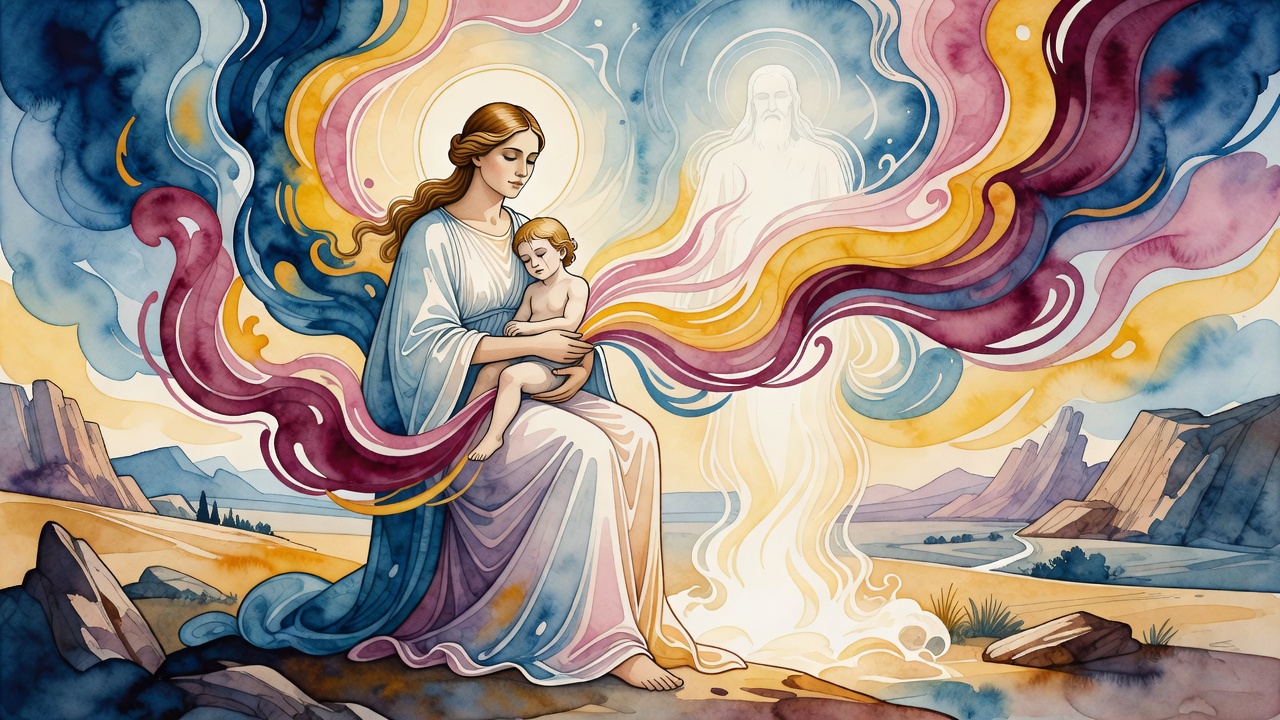
A woman carried a male soul and could not conceive until a feminine soul entered as a temporary guest. At birth the guest left her and stayed with the child.

Curated by Arthur · Told by Maggid ·
Table of Contents
  1. The Empty Months
  2. The Guest Who Came for One Task
  3. Why the Child Had to Be a Daughter
  4. What Stayed in the Mother
A Second Soul Entered So That She Could Bear Click for full size

The Empty Months

Leah counted moons the way other women counted blessings. Month after month her body prepared a room and no guest came. Her husband, Aron, never raised his voice. His silence became another wall. The neighbors offered herbs, amulets, advice from aunts who had never failed. Nothing opened. Leah scrubbed the same floor until the wood shone and still felt unclean with hope.

What none of them could see was the soul she already carried. It was a man's soul, returned for reasons the living do not get to audit in full. Sin, or something like a sin's shape, had bent the path. The soul wore her life with courage and confusion. It could pray. It could trade in the market without being cheated twice. It could love Aron with a loyalty that hurt. It could not, by itself, open the gate of pregnancy.

At night Leah pressed her palms to her belly and spoke to whoever might be listening. "If I am a locked house, send a key. If I am a wrong house, say so." No answer came in words. The months kept their empty arithmetic.

The Guest Who Came for One Task

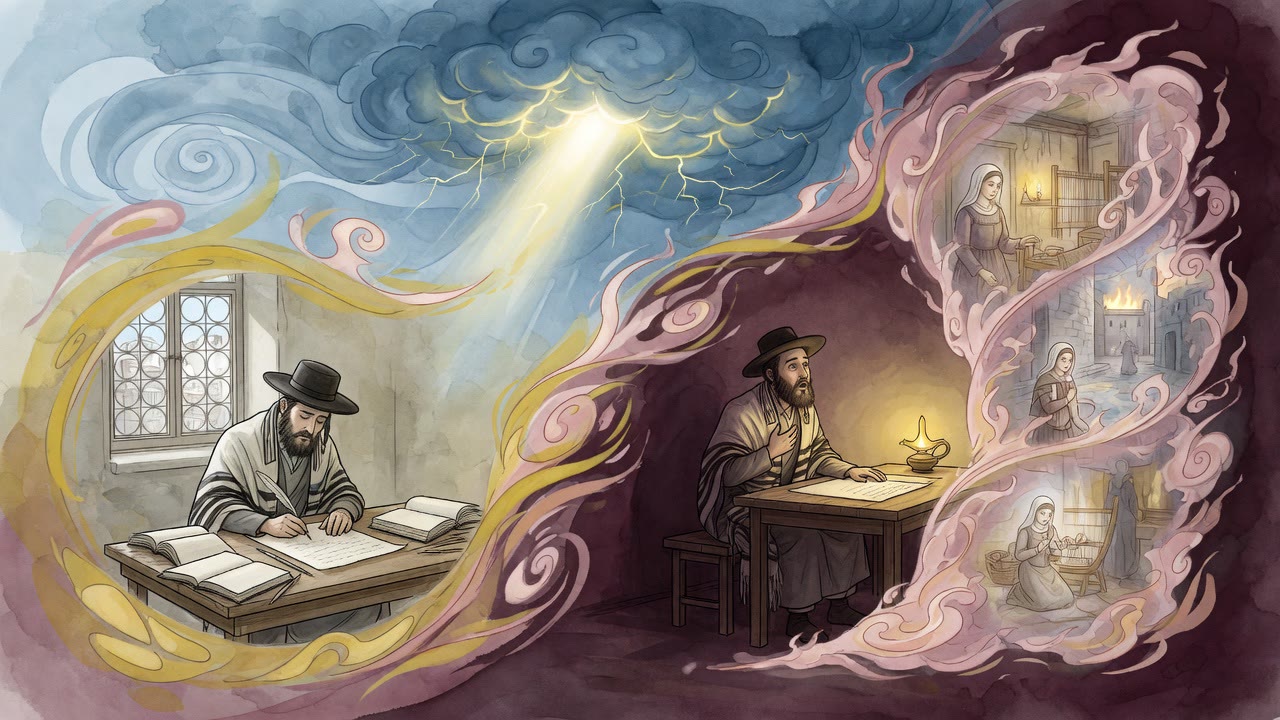
On a night of no special holiday, Leah woke with a second presence under her ribs. Not a child. A feminine soul, entered as ibur (עיבור), a temporary impregnation of soul into soul, sent to help her conceive. The guest did not take over her speech. It steadied a mechanism that had been fighting itself. Leah sat up in the dark and felt two pulses of intention where there had been one.

Within weeks her body changed. Aron wept when she told him. Leah touched her belly and felt two kinds of waiting: the child's, and the guest's. The feminine soul had not come to stay as Leah. It had come to midwife a birth from the inside. Leah dreamed of a woman she did not know braiding bread dough with sure hands, then vanishing when the loaves entered the oven.

The sources are precise and strange. A woman who carries a male soul may need this help to become pregnant at all. The helping soul does not remain without reason after the birth. Its work has a clock. Leah did not know the clock. She only knew the morning sickness felt like company.

Why the Child Had to Be a Daughter

Leah feared a son the way some fear a decree. The teaching pressed on her dreams: when the mother is, in soul, male like the father, the ordinary path favors daughters. The verse about a woman putting forth seed and bearing a male child (Leviticus 12:2) sat in the study house like a lock. In her case the lock had a different key, and the key was not hers to force.

When labor came, the feminine guest moved. At the moment the infant girl left Leah's body, the helping soul left Leah too and entered the child as a full gilgul (reincarnation), no longer a temporary ibur (a temporary soul impregnation). Leah felt the departure as a sudden lightness and a sudden grief. She held a daughter who already carried the woman-soul that had made the birth possible. The midwife saw only a living child and praised God in the ordinary way. Leah praised God twice, once for the child and once for the guest who had kept her appointment and then moved on.

Aron saw only a living child. Leah saw a relay race of souls and bit her tongue until she could speak ordinary joy. "Her name is Chava," she said. The name tasted like a beginning that had already traveled far. She nursed and wept and laughed in the same hour, a weather no neighbor could classify.

What Stayed in the Mother

Leah's own male soul remained. The work of its repair was not finished by childbirth. She still walked with a configuration heaven had assigned, and the assignment was not a curse she was allowed to hate without limit. It was a path. Some days she hated it anyway. Honesty is also a mitzvah (a commandment) of the interior. Aron, who never learned the map, still learned to ask softer questions when her eyes went distant.

She watched Chava grow and saw flashes of the guest's temperament: quick mercy, a refusal of false praise, a laugh that belonged to someone who had once been only a helper and was now a life. When Chava turned toward Torah with fierce hunger, Leah understood that the birth had not been only for Leah's arms. It had been for a soul that needed a body of its own.

In later years a hidden teacher told her a piece of the map. Souls climb Nefesh, then Ruach, then Neshama (the higher soul) across lives. A blemish at a higher stage does not always drag the lower stage back into mud. Gilgul is accounting with mercy and memory. Leah asked if her configuration would follow her forever. The teacher said, "Forever is God's word. Your word is the next right act."

She went home and braided Chava's hair. The empty months were over. The crowded metaphysics of one household continued, quiet, under ordinary bread. When Chava asked, years later, why her mother sometimes looked at her as if seeing a traveler, Leah said, "Because you arrived already knowing how to help." It was not the full truth. It was enough truth for a kitchen.


← All myths
From the tradition

Sources

3 sources

The texts behind this telling. Some cards carry a translation of the source; others are our own retelling of it, and each card says which. Every card links out to the original.

Sha'ar HaGilgulim 9:2Sha'ar HaGilgulim

Retold in our words. Read the original at the link below.Sefaria Community Translation · CC-BY

The Kabbalists certainly did, and they developed intricate systems to explain it. One of the most fascinating? The concept of gilgul (the reincarnation of souls), or reincarnation.

Specifically, what happens when a male soul, for whatever reason, finds itself in a female body? According to the Sha'ar HaGilgulim (the reincarnation of souls), this could be the result of a sin, or perhaps some other cosmic imbalance. Now, hold on. this isn't just a theoretical exercise. The text suggests this has real-world consequences.

The most immediate? A woman carrying a male soul may struggle to conceive. if the core essence within is male, it disrupts the natural order of things. So, what's the solution? Well, according to this line of thinking, she needs help. A feminine soul, an ibur, needs to enter her.

What's an ibur? It literally means "impregnation," but in Kabbalistic terms, it refers to a soul that temporarily attaches itself to a living person to assist them in some way. In this case, the feminine soul acts as a catalyst, enabling conception and pregnancy to occur.

But here's the kicker: even with this assistance, the Sha'ar HaGilgulim states that this woman can only give birth to daughters. Why? There are two reasons given.

First, there's the verse from Leviticus (12:2): “…If a woman puts forth seed, and a male child is born." The text argues that, in this scenario, the woman is essentially male at her core, “just like her husband.” Therefore, she cannot bring forth a male child.

Second, and perhaps more subtly, the feminine soul's role is temporary. It’s there as an ibur, a short-term assist to facilitate pregnancy and birth. Once the child is born, its job is done. As the moment of birth arrives, this feminine soul doesn't just vanish. Instead, it enters the fetus itself, but this time not as a temporary ibur, but as a full-fledged gilgul – a reincarnation. And that, the text explains, is why the child must be female.

Now, the text continues beyond this, outlining scenarios where even a male child might be born – perhaps if the original male soul within the mother enters the child at birth. It’s complex, intricate, and, frankly, a little mind-bending.

What are we to make of all this? It's easy to get lost in the specifics, but perhaps the bigger picture is what's truly important. The concept of gilgul, of souls transmigrating and potentially inhabiting different bodies, reflects a deep belief in the interconnectedness of all things, and the enduring nature of the soul's journey. The Sha'ar HaGilgulim challenges us to consider the complexities of identity, the fluidity of gender, and the profound mysteries that lie beyond our understanding.

Whether you take these ideas literally or figuratively, they offer a powerful lens through which to explore the human condition, our place in the cosmos, and the enduring questions that have haunted us for millennia. What does it mean to be male or female? What is the nature of the soul? And what happens to us after we die? These are questions that continue to resonate, even centuries after the Ari and his followers contemplated the secrets of gilgul.

Full source
Sha'ar HaGilgulim 2:1Sha'ar HaGilgulim

Retold in our words. Read the original at the link below.Sefaria Community Translation · CC-BY

Kabbalah, the mystical heart of Judaism, delves deep into these questions, offering a fascinating, intricate map of the soul. And in the Sha'ar HaGilgulim (the reincarnation of souls) – the "Gate of Reincarnations" – we find a particularly compelling piece of that map.

The Sha'ar HaGilgulim isn't just about reincarnation as a simple concept. It's about the journey of the soul, its evolution, and the different layers that compose our very essence. It suggests that

So, what are these forces? Kabbalah speaks of three primary components: Nefesh (the vital soul), Ruach, and Neshama. Think of them as nested levels, each building upon the previous one. According to the Sha'ar HaGilgulim, these enter a person in stages.

First, the Nefesh. This is often translated as "soul," but it's more accurately the life force, the vital spark that animates the body. The Sha'ar HaGilgulim tells us that the Nefesh enters the body at birth, the moment we take our first breath. It's our connection to the physical world, our basic instincts, and our drive to survive.

But we’re more than just survival machines. That's where the Ruach comes in. The Ruach, often translated as "spirit," is the seat of our emotions, our intellect, and our moral compass. According to the Sha'ar HaGilgulim, a person merits the Ruach around the age of 13 – the age of Bar or Bat Mitzvah, when we become responsible for our actions under Jewish law – if their actions are deemed "kosher," or righteous. It's a powerful idea: that our moral choices directly influence the spiritual development of our soul. Only through ethical living do we fully embody our Ruach.

And then, there's the Neshama. The highest level. The Neshama is the "soul" in its purest form, the divine spark that connects us to the infinite. The Sha'ar HaGilgulim, citing Sabba de-Mishpatim, suggests that the Neshama enters around the age of 20. But, and this is a big but, it's not automatic. It's contingent on rectifying the Ruach. If we fail to refine our character, to live a life of meaning and purpose, the Neshama remains… above. Out of reach.

Imagine it: a ladder, with each rung representing a stage of spiritual growth. If we skip a rung, we can't reach the top. If we don't fully develop our Ruach, we remain incomplete, lacking the full potential of our Neshama. And similarly, as the Sha'ar HaGilgulim emphasizes, if the Nefesh isn't rectified, we might not even merit the Ruach.

So, what does it all mean? Is this a literal, step-by-step process? Or is it a metaphor for the ongoing work of self-improvement? Perhaps both. Kabbalah often speaks in symbols, inviting us to interpret its teachings on multiple levels.

What the Sha'ar HaGilgulim offers us is a powerful reminder: we are works in progress. Our souls are not static entities, but dynamic forces that evolve and grow through our choices, our actions, and our commitment to living a life of meaning. It's a call to action, an invitation to become more fully ourselves, to strive for the heights of our spiritual potential. Are we ready to climb?

Full source
Sha'ar HaGilgulim 2:3Sha'ar HaGilgulim

Retold in our words. Read the original at the link below.Sefaria Community Translation · CC-BY

The Kabbalists, especially in texts like Sha'ar HaGilgulim (the reincarnation of souls), the "Gate of Reincarnations," offer a fascinating, intricate, and ultimately hopeful perspective on the journey of the soul.

Let's The familiar telling remembers the Nefesh (the vital soul), Ruach, and Neshama. Think of them as layers, or perhaps stages, of spiritual development. The Nefesh is often understood as the life force, the vital spark. The Ruach is the spirit, the seat of emotions and morality. And the Neshama? That's the soul, the higher intellect, our connection to the Divine.

So, imagine someone comes into the world, works hard to purify their Nefesh, to live a good, meaningful life on a basic level. And then, perhaps to continue their spiritual growth, they return in another gilgul – another incarnation – to receive their Ruach. The goal this time around? To rectify, to perfect, their Ruach.

Here’s where it gets interesting. According to Sha'ar HaGilgulim, if, in this particular gilgul dedicated to perfecting the Ruach, the person messes up? If they sin? The good news is, they don't undo all the work they did on their Nefesh in the previous life. Phew! If they did, the text implies, their gilgulim could potentially continue forever!

Instead, the damage is confined to the Ruach. It's the Ruach that becomes blemished. And what does that mean? It means more gilgulim, as many as are needed, to set things right again. During these subsequent incarnations, the Nefesh and Ruach will inhabit the body together, working in tandem, until the Ruach is finally rectified. This process, by the way, is what's known as Tikkun (spiritual repair) haRuach, the rectification of the spirit.

But the story doesn't end there. Once the Ruach is finally perfected, when that person dies, they will eventually return in a new gilgul with their Nefesh, their Ruach, and their Neshama, all together in one body. This time, the mission is to complete the rectification of the Neshama. And, just like before, if they stumble, if they sin, it's only the Neshama that suffers.

What does this all tell us? It suggests a profound patience built into the very fabric of existence. A system designed not to punish, but to provide endless opportunities for growth and repair. It’s a reminder that our journey is rarely a straight line, that setbacks are inevitable, but that ultimately, we are all moving towards wholeness, towards the full realization of our soul's potential. And isn't that a comforting thought?

Full source