Parshat Acharei Mot6 min read

Aaron Paid Double When His Sons Fell Silent

After Nadab and Abihu died, God read the calf back to Aaron as ox, donkey, lamb, and lost thing. Double payment fell.

Curated by Arthur · Told by Maggid ·
Table of Contents
  1. Ox, Donkey, Lamb, Garment
  2. Double to His Fellow
  3. Whoever Raises Himself Goes to the Fire
  4. Sixty Myriads at a Door Too Small
  5. What Remained Standing

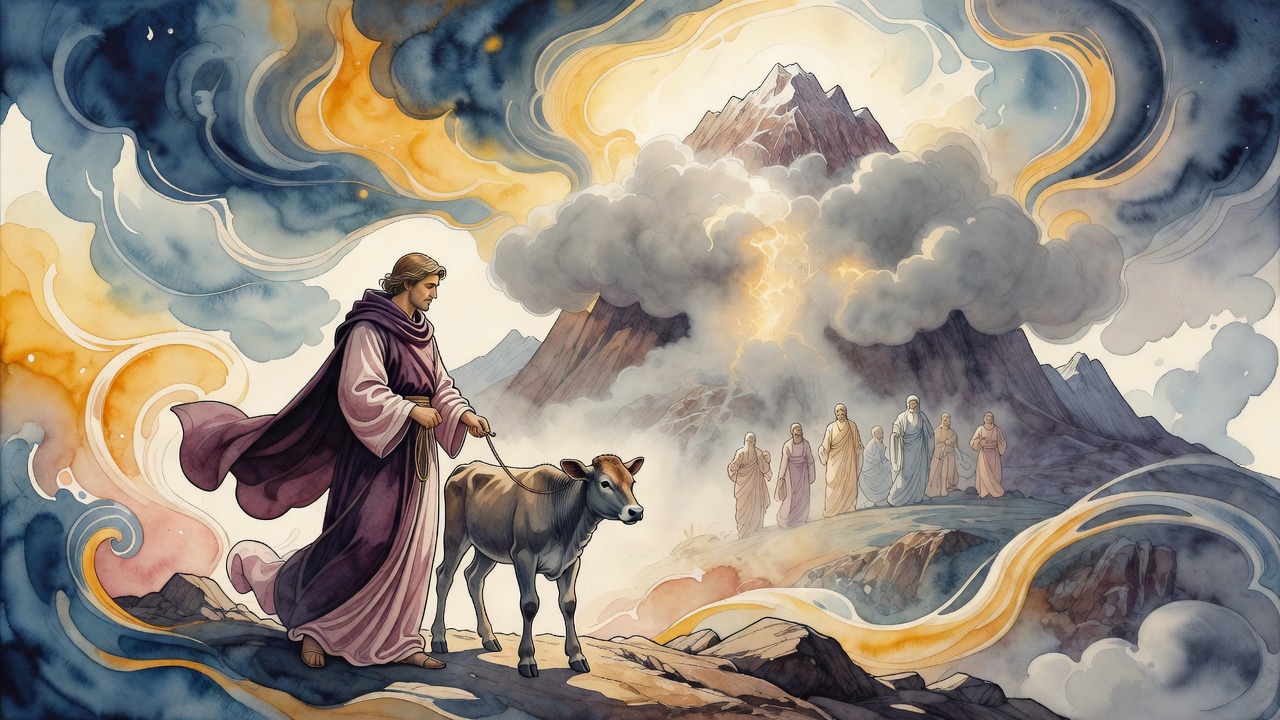
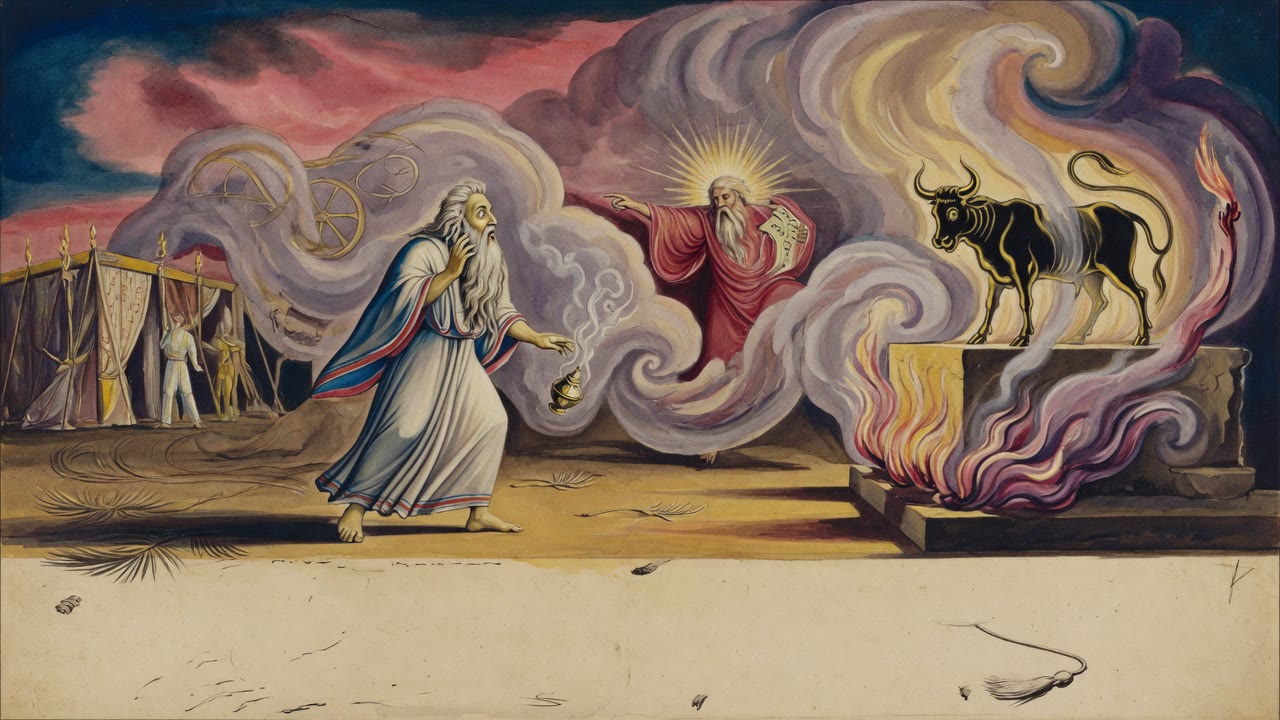
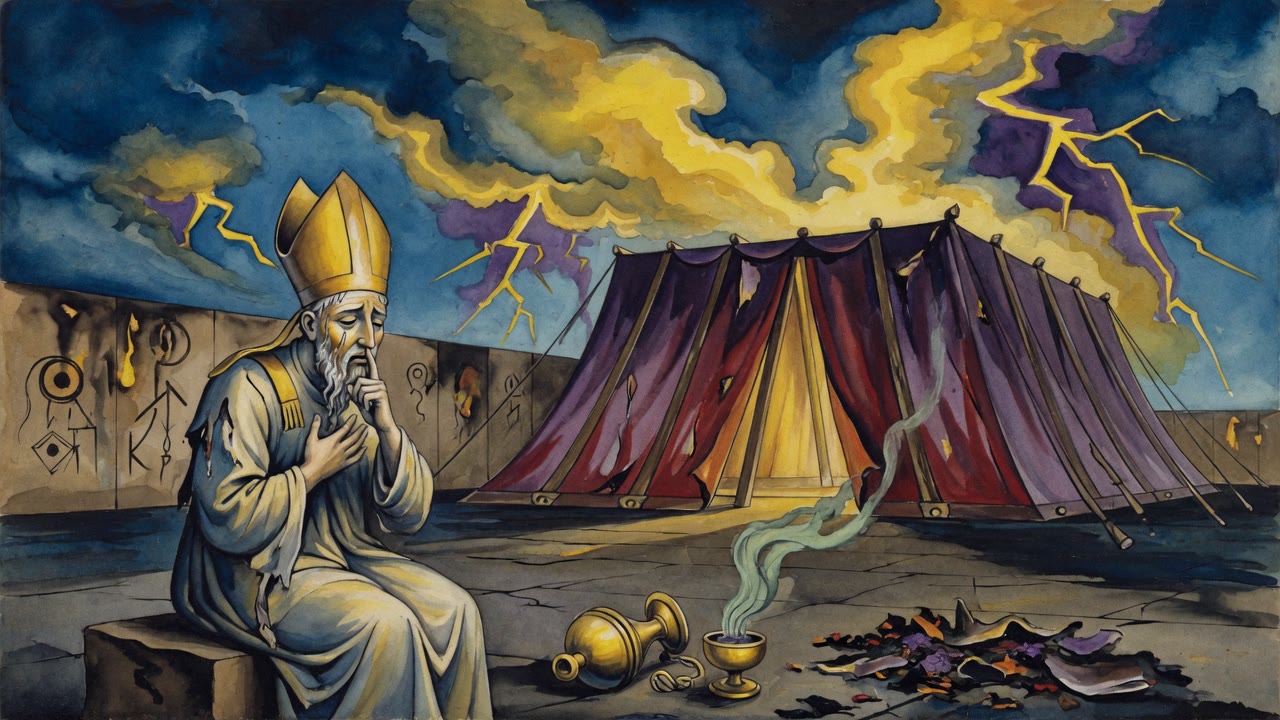
When Aaron's two sons fell silent forever, the Holy One did not open with comfort alone. He opened a ledger. "Aaron," He said, "did I not write it plainly in My Torah? For every matter of trespass, for an ox." Do you not remember what you did with the ox? They exchanged their glory for the likeness of an ox.

Aaron Paid Double When His Sons Fell Silent Click for full size

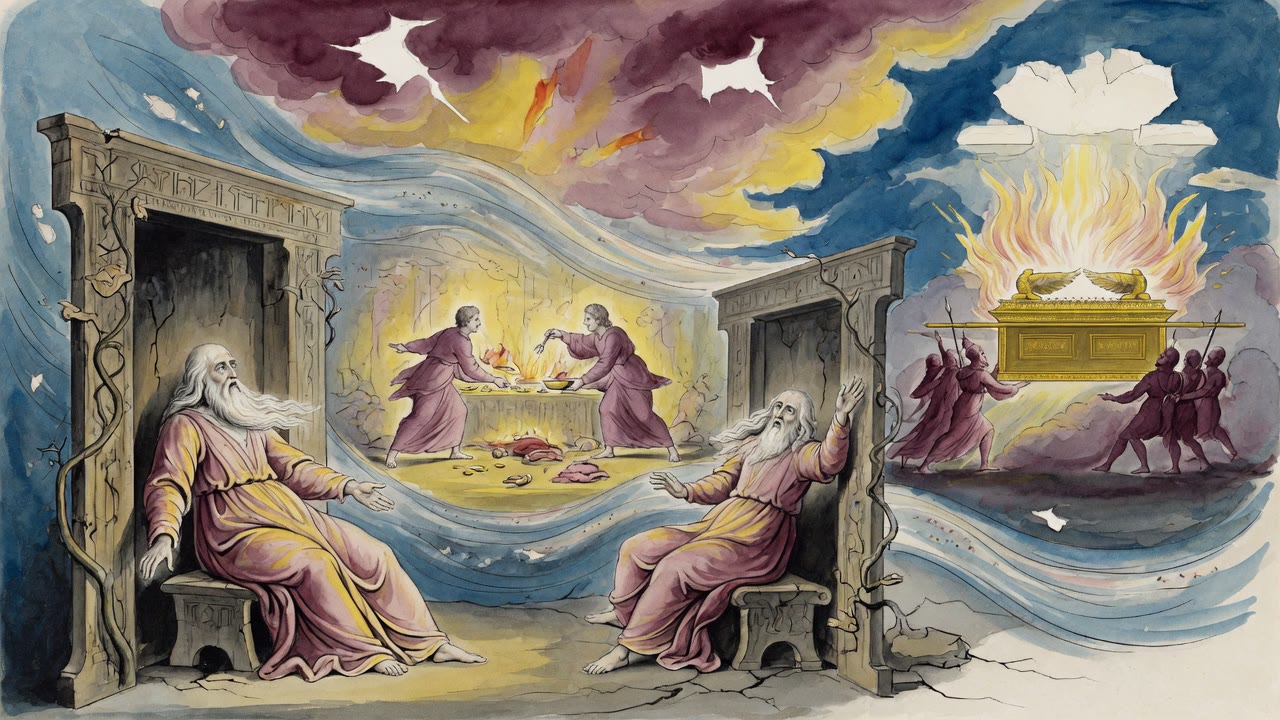
The calf from the mountain returned in the grammar of damages. Verse by verse, the old night at Sinai was read back into the death of Nadab and Abihu. Grief sat in the tent. Accounting sat beside it.

Ox, Donkey, Lamb, Garment

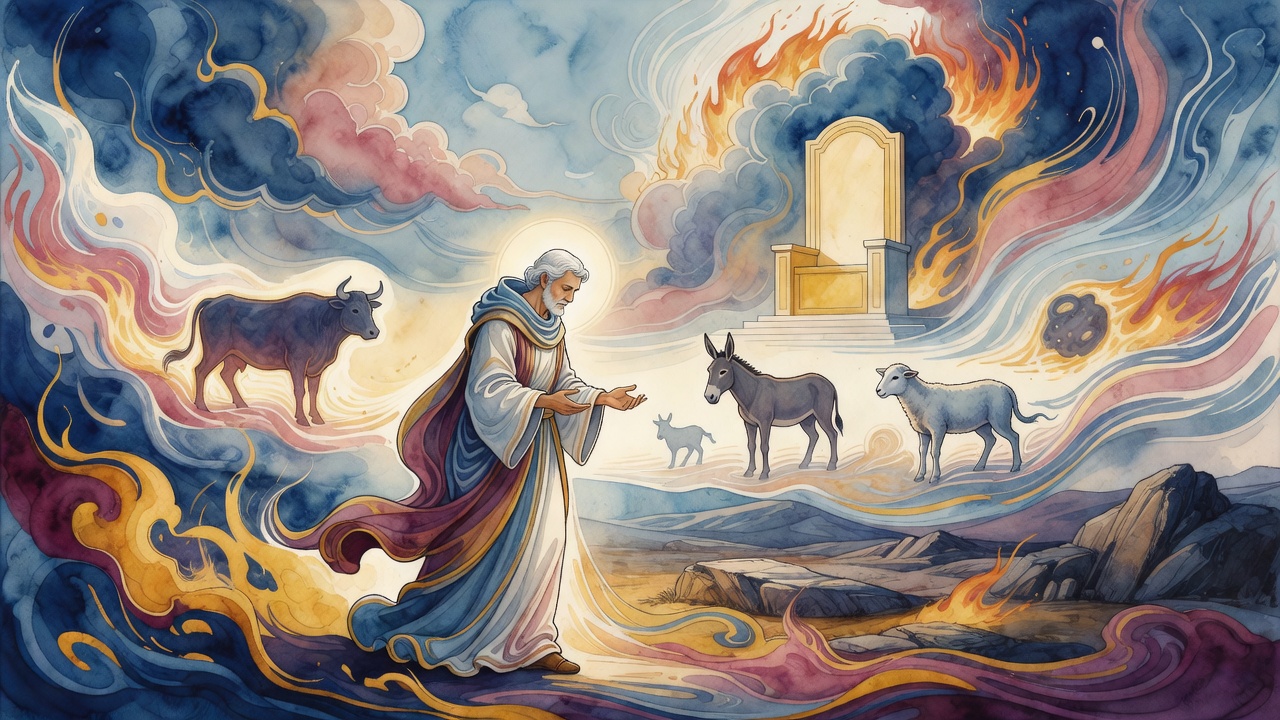
For an ox, the glory of Israel traded for a molten beast that could not speak. For a donkey, the rabble whose flesh the prophets would later compare to donkey flesh, the mixed crowd that cried for a god it could touch. For a lamb, Israel itself, a scattered flock bleating for a shepherd of gold. For a garment, the one they would crown as a ruler when the mountain delayed. For any lost thing, My people, lost sheep. Of which one says, "This is it," the mouths that shouted, "These are your gods, O Israel."

Each clause of the trespass law found a body in the camp. The golden calf was not a single sin. It was a catalog. Aaron heard the catalog after the fire had already taken his firstborn line of priesthood in a single strange offering.

Double to His Fellow

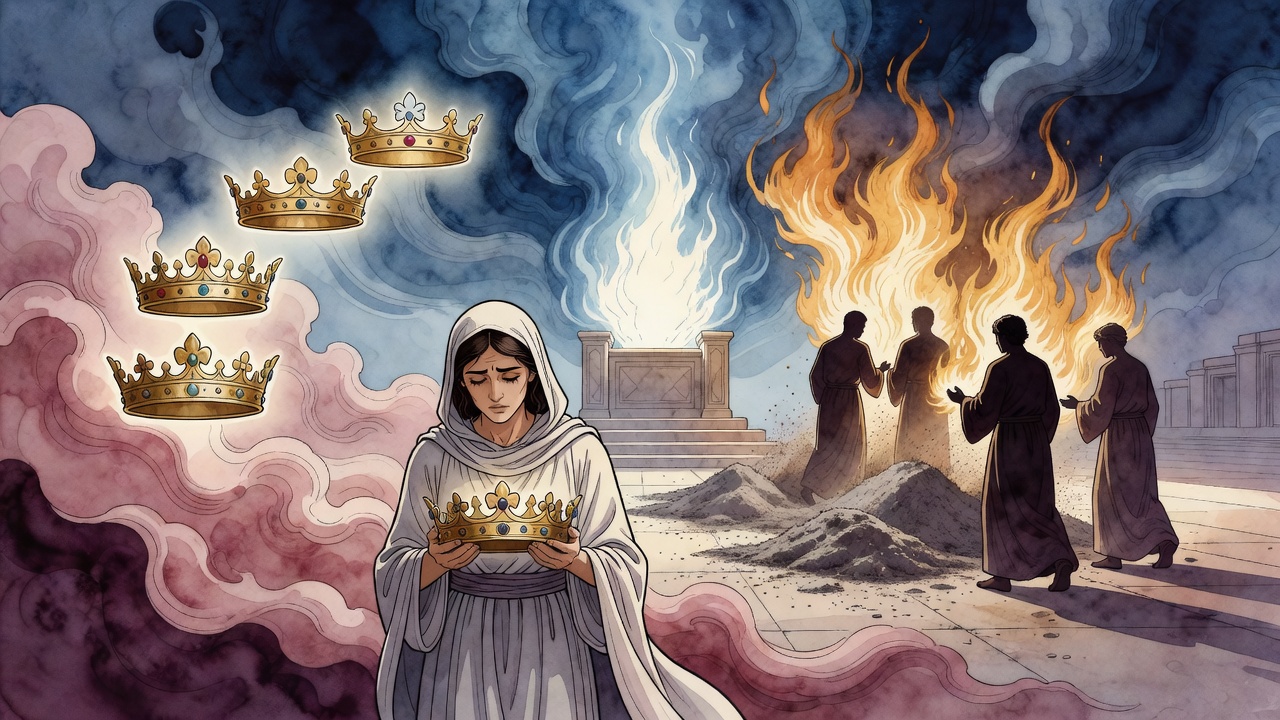
Then came the verdict line. The cause shall come before the judge. That judge was Moses, once made as a god to Pharaoh, who sat and judged the people. Whom the judges condemn, the judges of Israel. And he shall pay double to his fellow. The double payment was the two sons of Aaron. Thus the scroll opens where it must open: after the death of Aaron's two sons.

Heaven did not invent a new punishment for that hour. Heaven collected on a debt written when the ox stood in the camp and the tablets shattered. The silence of Nadab and Abihu was the sound of a double restitution that no gold could buy back.

Whoever Raises Himself Goes to the Fire

"Command Aaron," the Torah says when it teaches the law of the one who ascends, the olah, the offering that goes up. The Holy One folded a warning into the root. Whenever someone raises himself up, his end is to go in the fire. The flood generation asked what the Omnipresent was that they should serve Him, and heat consumed their remnant. Sodom lifted its face and met brimstone. Pharaoh said, "Who is the Lord," and called the Nile his own making, and the burning place waited for him in the song of coals and hail. Sennacherib boasted that he had ascended the heights of Lebanon, and an angel struck his camp in a single night.

Aaron's sons had brought strange fire. Strange fire is also a raising. The altar that receives the olah is the same grammar that judges the one who climbs without leave. Command Aaron was not only ritual craft. It was a fence against the climb that ends in flame.

Sixty Myriads at a Door Too Small

When Moses was told to assemble the whole congregation at the door of the tent of meeting, he balked at the arithmetic. Sixty myriads of adults and sixty myriads of the young. The doorway was the size of a field that takes two seah of seed. How could they stand?

The Holy One answered with the sky. Are the heavens not like a film on the eye, and yet I stretched them from end to end? Sinai had already expanded under the chariots of God. Zion would enlarge in the world to come until the risen dead would cry that the place was too crowded, and Heaven would widen it still. The crowd at Aaron's door was not a logistics problem. It was a public witness. No private anointing. No secret priesthood. The man who would serve after paying double would serve where every eye could measure the space and still find room.

What Remained Standing

Aaron did not argue the ledger. He stood in the silence his sons left and heard the ox, the donkey, the lamb, and the lost thing named again. The camp learned that strange fire and molten glory share a root. Both climb. Both burn. Only one climb is invited.

At the small door that held a nation, the priest who had survived the double payment took up the command. The altar waited for offerings that go up by law, not by impulse. Behind him the calf's echo still lowed in the text. Ahead of him the fire waited for whoever forgot the difference.

The day Nadab and Abihu died, the oil of anointing was still new on Aaron's line. Fire had accepted their father's appointment and then rejected the sons' improvisation. The camp smelled of celebration turned to ash. Moses told Aaron to keep silence, and the silence became the room in which the ox was named again.

Years later, every "Command Aaron" would carry that room inside it. Raise the offering. Do not raise yourself. Assemble the people so no rebel of the heart can claim the priesthood was stolen in a corner. The double payment had already been taken. What remained was a life of careful climbs.

Aaron's garments still chimed when he walked. The bells did not sound like innocence. They sounded like a man still moving after the ledger closed harder than any gold calf had cost.


← All myths

From the tradition

Sources

3 sources

The texts behind this telling. Some cards carry a translation of the source; others are our own retelling of it, and each card says which. Every card links out to the original.

Midrash Tanchuma Buber, Achrei Mot 12:2Midrash Tanchuma Buber, Achrei Mot

Translation of the source text.Midrash Tanchuma (Buber), Public Domain, on Sefaria · CC-BY-SA

[After the death of Aaron's two sons (Leviticus 16:1).] The Holy One, blessed be He, said to him: Aaron, did I not write thus in My Torah, "For every matter of trespass, for an ox [etc.]" (Exodus 22:8)? Do you not remember what you did with the ox, as it is said, "And they exchanged their glory for the likeness of an ox" (Psalms 106:20)? "For a donkey", those Egyptians, of whom it is written, "whose flesh is the flesh of donkeys" (Ezekiel 23:20); you made for them a calf so that they might bow down to it, [as it is said,] "And the mixed multitude that was in their midst" (Numbers 11:4). "For a lamb", these are Israel, as it is said, "Israel is a scattered lamb" (Jeremiah 50:17). "For a garment", that one of whom it is written, "You have a garment, come, be a ruler over us" (Isaiah 3:6). "For any lost thing", for of them it is written, "My people were lost sheep" (Jeremiah 50:6). "Of which one says, 'This is it'", those who said, "These are your gods, O Israel" (Exodus 32:8). "The cause of both parties shall come before the judges [God]", this is Moses, of whom it is written, "See, I have made you a god to Pharaoh" (Exodus 7:1); Moses sat and judged them. "Whom the judges [God] condemn", these are the judges, of whom it is written, "You shall not revile the judges [God]" (Exodus 22:27). "He shall pay double to his fellow", these are the two sons of Aaron. Thus, "After the death of Aaron's two sons."

Full source
Midrash Tanchuma, Tzav 2Midrash Tanchuma

Retold in our words. Read the original at the link below.Townsend 1989 translation of Midrash Tanhuma, S. Buber Recension · CC-BY

Another interpretation (of Lev. 6:2), “Command Aaron.” What is the function of Aaron here? Israel was bringing offerings whereas Aaron is mentioned, and Scripture says here, “Command Aaron.” But note, it is written (in Numb. 28:2), “Command the Children of Israel, and say unto them, ‘My offering, My bread,’” but here it says (in Lev. 6:2), “Command Aaron […], ‘This is the Torah of the one who ascends (h'lh).’” The Holy One, blessed be He, said (to warn Aaron and his sons), “Whenever someone raises (rt. 'lh) himself up, his end is to go in the fire.” It is so stated (in Lev. 6:2, cont.), “that is the one which ascends upon the burning place.” The generation of the flood [suffered] because of what they said (in (Job 21:1)5), “What is the Omnipresent that we should serve Him?” For that reason they were sentenced to the fire (of Gehinnom (the place of spiritual purification after death)), as stated (Job 6:17), “at the time that they were heated, they were burnt in His heat,” and it is written (Job 22:20), “and the fire consumed their remnant.” And likewise the Sodomites, [as stated] (in Gen. 19:24), “Then the Lord rained down upon Sodom and upon Gomorrah brimstone and fire.” When Pharaoh said (in Exod. 5:2), “Who is the Lord, [that I should heed His voice],” he exalted (rt. 'lh) himself and said (in Ezek. 29:3), “my Nile is my own and I made it myself.” [He is] therefore (in the words of Lev. 6:2) “upon the burning place.” For so it says (in Ps. 18:14), “The Lord thundered in the heavens,” (Ps. 18:13), "From the illumination in front of Him, His clouds were pierced by hail and coals of fire.” And also when Sennacherib exalted (rt. 'lh) himself and said (in II (Kings 19:23) = Is. 37:24), “it is I who have ascended (rt. 'lh) the mountain heights to the remotest parts of Lebanon.” And what happened to him? (II (Kings 19:35):) “The angel of the Lord went out and smote [one hundred and eighty-thousand] in the camp of Assyria.” He had blasphemed (according to II (Kings 19:23): cf. 18:17–35) through a messenger (mal'akh); therefore (in II (Kings 19:35) = Is. 37:36 // II Chron. 32:21) “the angel (mal'akh) of the Lord went out and smote.” What did he do to him? (Is. 10:16), “And under his glory there shall burn a burning like the burning of fire.” What is the meaning of “under his glory?” That it burned them from within and left alone their clothes on the outside, since a person's glory is his garment. And why did the Holy One, blessed be He, leave their clothes behind? Because they were descendants of Shem, as stated (in Gen. 10:22), “The sons of Shem are Elam, Asshur (Assyria)….” The Holy One, blessed be He, said, “I am indebted to their father Shem, because he took the garment and covered his father's nakedness, as stated (in Gen. 9:23), “Then Shem and Japheth took the garment… [and they covered their father's nakedness].” Therefore, the Holy One, blessed be He, left their clothes alone and burned [only] their body. This is as it is written (Lev. 6:2), “that (i.e. the person who exalts himself) is the one which ascends (ha'oleh) upon the burning place.” And so too Nebuchadnezzar exalted (rt. 'lh) himself and said (in Is. 14:14), “I will ascend (rt. 'lh) upon the heights of a cloud; I will become like the Most High (rt. 'lh).” The Holy One, blessed be He, said to him, “Upon your life, was it not enough that you said in your heart (in vs. 13), “I will ascend (rt. 'lh) to the heavens; above the stars of God I will set my throne,” but that you should say (in vs. 14), “I will ascend (rt. 'lh) upon the heights of a cloud, I will become like the Most High (rt. 'lh)?” And so he (i.e., Nebuchadnezzar) said to Hananiah and his friends (in Dan. 3:15), “’Now who is the God who shall deliver you out of my hand?’ I have burned His house and exiled His people. He did not stand against me in His house; so will He overcome me in my house?” What did he do? He threw them into the fiery furnace. What did the Holy One, blessed be He, do? He gave a sign to the furnace and it became a highway. Whoever was designated to be burned was not burned and whoever was not designated to be burned was burned. So the fire went forth and burned half of the peoples. Thus you find, when they assembled for the dedication of the image, at first there were eight peoples, as stated (in Dan. 3:3), “Then the satraps, the prefects, and the governors, the counselors, the treasurers, the judges, the magistrates, and all the provincial officials assembled.” That makes eight peoples; but when they came in to see Hananiah and his friends, there were only four peoples written there (in vs. 27), “The satraps, the prefects, the governors, and the royal companions assembled.” So where were [the other] four peoples?] It is simply that (in vs. 22) “the flame of the fire slew them.” Now Nebuchadnezzar also was burned by the fire, and the fright (i.e., repulsiveness) of [a body disfigured by] burning was put upon him. Why was all of him not burned? The Holy One, blessed be He, said, “Leave this evil man half of himself so that he may know against Whom he blasphemed.” The Holy One, blessed be He, said to him, “O wicked one, did you not say, ‘I do not want to live with the children of Adam, but (in Is. 14:14), “I will ascend (rt. 'lh) upon the heights of a cloud?”’ By your life, (according to Dan. 4:22) ‘You shall be driven away from humans and your domicile will be with the wild animals outside.’” Just as He brought the plagues upon Pharaoh and upon Egypt, so did He bring [punishment] upon Nebuchadnezzar. It is so stated (in Dan. 3:32), “The signs and wonders which the most high God has worked for me [it seemed good to me to make known].” This fright of [a body disfigured by] burning fell upon him. Therefore it is stated (in Lev. 6:2), “that is the one which ascends (h'lh) upon the burning place.” (Lev. 6.2) “That is the one which ascends upon the burning place.” This is the kingdom of Edom (Rome), which exalted (rt. 'lh) itself, as stated (in Obad. 1:4), “Though you make [your abode] as high as the eagle, and though [your nest is set] among the stars,” and will be judged by fire, as stated (in Dan. 7:11), “I looked on until the beast was slain and its body destroyed, given over for burning in the fire.” The Holy One, blessed be He, said (in Obad. 1:18), “The House of Jacob shall be fire, and the House of Joseph a flame, and the house of Esau shall be straw; [… for the Lord has spoken].” And what did he say? Through Moses (in Lev. 6:2), “that is the one which ascends (ha'olah, rt. 'lh) upon the burning place.” Then after that [Scripture says] (in Obad. 1:21), “Then saviors shall come up on Mount Zion to judge the Mountain of Esau.” Sisera also [was punished by fire] because he blasphemed. Thus it is written about him (in Jud. 4:3), “and he oppressed the Children of Israel with might,” [i.e.] with blasphemies and invectives. He was therefore punished by fire, as stated (in Jud. 5:20), “The stars fought from the heavens; from their courses they fought with Sisera.” And in the world to come, when the Holy One, blessed be He, comes to exact retribution from Esau, what [will] Esau do? Wrapped in a prayer shawl like an elder, he comes and takes his seat beside Jacob. It is so stated, (in Obad. 1:4), “and though your nest is set among the stars.” Stars can only mean Israel, since it is stated (in Gen. 15:5), “look toward the heavens and count the stars …; so shall your seed be.” Jacob says to him, “My brother ('hy), you shall not be like me.” Thus it is stated (in Hos. 13:14), “my brother ('hy), your words are death; my brother ('hy), your descent (qtb) is to Sheol.” Your words are decrees which you decreed over me. You decreed two-edged decrees against me, that I should serve idols. If I had done so, I would have been condemned to death at the hands of Heaven; and if I had not served them, you would have killed me. Ergo (in Hos. 13:14), “my brother, your words are death.” (Ibid., cont.) “My brother ('hy), your descent (qtb) is to Sheol.” [Qtb] is a Hellenistic word, meaning to descend to Sheol. When Esau descends to Sheol, Jacob will remain by himself. It is therefore stated (in Zech. 13:8), “And it shall come to pass throughout all the land, says the Lord, that two-thirds in it shall be cut off and die, but one-third shall remain in it.” Now the one-third can only be Israel, since it is stated (in Is. 19:24), “Israel shall be a third.” So Israel – because they made themselves despised and lowly, as stated (Malachi 2:9), “And I also made you despised and lowly” – are avenged and redeemed by fire; as stated (in Zech. 2:9), “And I Myself, says the Lord, will be a wall of fire around it (i.e., around Jerusalem).” When Esau departs from the world, the Holy One, blessed be He, and Israel remain, as stated (in Cant. 6:9), “[Only] one is my dove, my perfect one.” It also says (in Deut. 32:12), “The Lord alone did lead him, and there was no foreign God with Him.”

Full source
Midrash Tanchuma, Tzav 12Midrash Tanchuma

Retold in our words. Read the original at the link below.Townsend 1989 translation of Midrash Tanhuma, S. Buber Recension · CC-BY

(Lev. 8:3:) “And assemble the whole congregation.” He said to him, “Where?” He said unto him, “Unto the door of the tent of meeting.” Moses our master said to him, “Master of the world, [there are] sixty myriads of adults and sixty myriads of young people. How will I have them stand at the opening of the tent of meeting? [The area is] only the size of a field requiring of two seah of seed; yet you are saying (in Lev. 8:3:), ‘And assemble the whole congregation?’” The Holy One, blessed be He, said to him, “Are you surprised about this thing? Are the heavens not like a cataract on the eye? And [yet] I made them [to stretch] from one end of the world to the other, as stated (in Is. 40:22), “Who has stretched out the heavens like a curtain [and spread them out like a tent to dwell in].’ And also in the world to come I will do likewise for Zion. How will all those populations from the first Adam until the dead rise [have room to] stand? Then they are going to say (in Is. 49:20), ‘The place is too crowded for me; make room for me to dwell.’ What shall I do for them? I shall enlarge it, as stated (in Is. 54:2), ‘Enlarge the site of your tabernacle.’” From where do you learn [so]? From Mount Sinai. When the Holy One, blessed be He, appeared upon it, it immediately expanded, as stated (in Ps. 68:18), “The chariots of God are myriads, thousands upon thousands; [the Lord is among them on Sinai].” R. Avdimi of Haifa said, “I have learned in my mishnah (the earliest code of rabbinic law): When the Holy One, blessed be He, appeared on Mount Sinai to give the Torah, twenty-two thousand chariots came down with him. R. Berekhyah the Priest said, “[It was] since the Holy One, blessed be He, foresaw that none would remain in their faith except the tribe of Levi. He therefore came down [with a number] corresponding to the camp of the Levites (according to Numb. 22:39).” R. Jannay said to him, “If so, it must be written about the tribe of Levi, ‘The chariots of God are myriads, thousands upon thousand.’ What is [then] the meaning of, ‘The chariots (rt. rkb) of God are myriads?’ It is simply that twenty-two thousand chariots came down with the Holy One, blessed be He, with each and every chariot like the chariot which Ezekiel saw (Ezek. 1:19–21). And [yet] it (i.e., Mt. Sinai) contained them? Indeed the event was a miracle. The Holy One, blessed be He, said, “Become wider (rt. rhb) and longer to receive My children, [who are] faithful children.” And so you find in the world to come, that the Holy One, blessed be He, will widen (rt. rhb) Jerusalem, as stated (in Ezek. 41:7), “And it became wider (rt. rhb) as it wound about higher (lm'lh),” until it was rising to the heavens. Now, “higher (m'lh)” can only mean heaven (shmym). Thus it is stated [(in Ps. 108:5), “For Your kindness is great, above (m'l) [heaven (shmym)”]. When it (i.e., Jerusalem) reaches the heavens, it says (in Is. 49:20), “The place is too crowded for me.” Nevertheless, the Holy One, blessed be He, brings clouds and raises it up from the heavens to the firmament, [from the second (heaven) to the third, from the third to the fourth, from the fourth to the fifth, from the fifth to the sixth, and from the sixth to the seventh.] R. Eliezer ben Jacob said, “[The elevation of Jerusalem continues] until it reaches the throne of glory. But how are they (the Israelites) to ascend? By the time the higher one goes up, the lower one [needs to] eat and drink and sleep. So what does the Holy One, blessed be He, do? He will bring clouds and will have them fly, as stated (in Is. 60:8), ‘Who are these that fly like a cloud?’” Then each and every one of the righteous will have a canopy (huppah) for himself. Thus it is stated (in Is. 4:5), “for over [all] the glory there shall be a canopy (huppah).” When it reaches the throne of glory, the Holy One, blessed be He, shall say to them, “I and you shall walk through the world [together], as stated (in Lev. 26:12), “And I will walk among you.” The Holy One, blessed be He, will dwell in the middle and the righteous shall point to Him with their finger. It is so stated (in Is. 25:9), “In that day they shall say, ‘See, this is our God; we waited for Him, and He delivered us […].’” It also says (in Ps. 48:15), “For this is God, our God, for ever and ever; He will lead evermore.” Because the nations say (in Deut. 32:37), “And He will say, ‘Where are their gods’”; Israel shall therefore say in the future (in Ps. 48:15), “For this is God, our God, for ever and ever; He will lead evermore.”

Full source