5 min read

Abraham Fell on His Face Twice and the Second Time He Laughed

God asked for a man with no stain on him. What hit the ground when Abraham dropped was everything his eyes and mouth had dragged in.

Curated by Arthur · Told by Maggid ·
Table of Contents
  1. What Went Down With Him
  2. He Could Not Look
  3. One Stands, Everything Else Falls
  4. The Second Fall and the Laugh

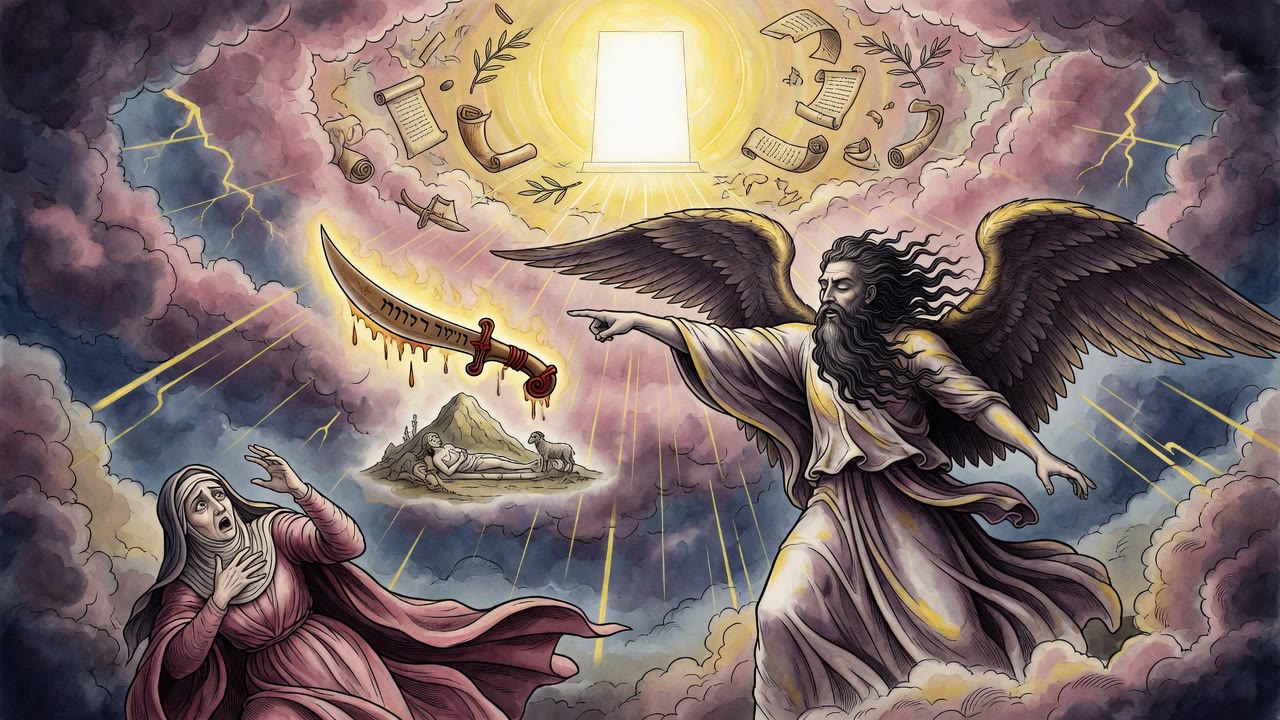
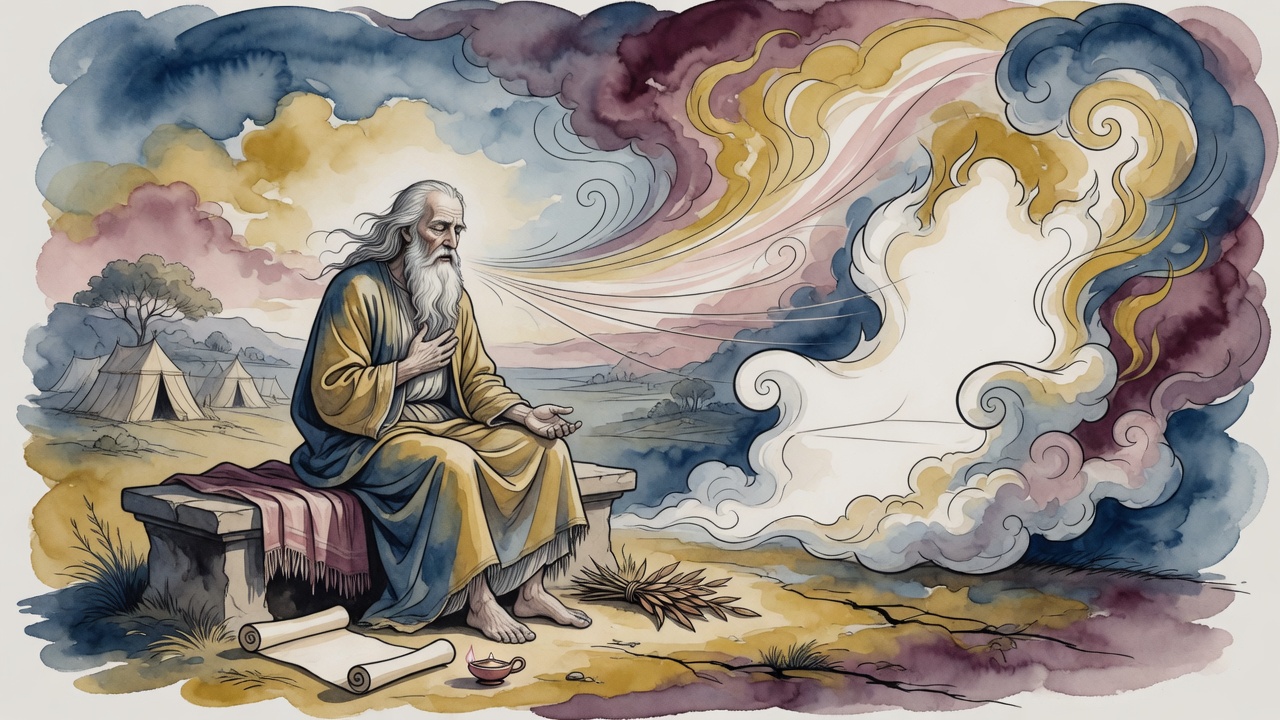
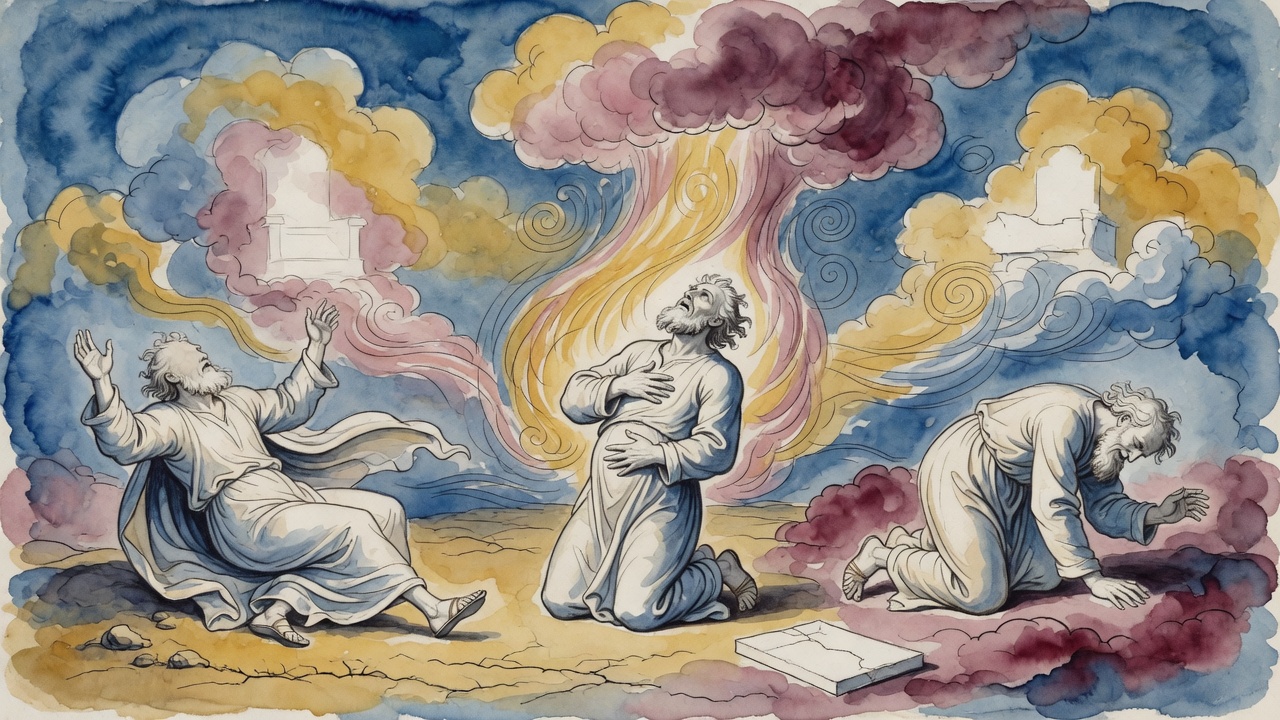
Abraham was ninety-nine years old, standing in the open with his shadow short beneath him, when the voice came. Then he was not standing. His knees went, his hands went out, and his face fell into the dust (Genesis 17:3).
Abraham Fell on His Face Twice and the Second Time He Laughed Click for full size

He did not choose the ground. The ground took him.

What Went Down With Him

Before the promise there had been a command, and the command had been short. "Walk before me," God had said, "and be unstained." A man with nothing clinging to him. Abraham had lived seventy-five years in Ur and Haran before he ever set out toward Canaan, and nobody lives that long without collecting things through his eyes and his ears and his mouth.

That is what the fall shook loose. Everything the senses had dragged into him went to the bottom, the way silt drops when a jar stops being carried. The senses are where the passions start. They are the door, and every appetite that ever ruined a man came in through it. When Abraham's face hit the dirt, the door was on the floor and the man was lying on top of it.

He stayed there with grit against his cheek and both palms flat, and for once nothing in him was reaching for anything.

He Could Not Look

There was also the plain matter of what stood over him.

The living God had appeared, and had appeared without a dream or a night vision to soften the arrival. Abraham's eyes could not hold it. Fear moved through him faster than thought, and his body did the only reasonable thing a body can do in front of something it will not survive looking at. It got low. It stayed low. Worship and terror came out of him as one gesture, and he could not have said where either began.

Sand blew past his mouth on a little wind. He kept his face where it was.

One Stands, Everything Else Falls

And there was a third thing in that fall, and it was the largest.

Lying in the dust, Abraham knew what he was lying under. God does not vary. God does not lean, or tire, or drift a hand's width in either direction from one hour to the next. Everything that has ever been made does exactly that. Stone crumbles toward the ground. Water runs downhill. A man rises in the morning and by evening has slipped somewhere he never meant to go, and rises again, and slips again.

Made things fall. They fall toward the place that belongs to them, which is the earth.

So the old man on his face was not performing humility. He was doing what a made thing does in front of the one thing that never does it. His body had gone where its own nature sent it, and its nature sent it down.

The Second Fall and the Laugh

Later in the same encounter God spoke about Sarah. She would have a son. Kings would come out of her. She was eighty-nine years old and had been barren for every one of those years.

Abraham went down a second time. Twice in one afternoon the ground had him, and this time, with his face already in the dirt, he laughed (Genesis 17:17).

"Shall a child be born to a man a hundred years old," he said inside himself, "and shall Sarah, ninety years old, bear?"

It has the shape of a man calling the promise absurd. It was the opposite. The laugh came out of him because the thing was already settled and he knew it. He had just seen the one who exists without variation, and had seen in the same breath what he himself was, a creature always stooping, always going back down. Once a man knows which of the two is making the promise, hope stops being work. It turns into something closer to relief, and relief in an old man with his face in the sand comes out as laughter.

He was not doubting Sarah's womb. He was already tasting the year.

When he got up there was dust in his beard and dust in the lines of both hands, and a son was one year away.


← All myths

From the tradition

Sources

4 sources

The texts behind this telling. Some cards carry a translation of the source; others are our own retelling of it, and each card says which. Every card links out to the original.

The Midrash of Philo 3:1The Midrash of Philo

Retold in our words. Read the original at the link below.The Works of Philo Judaeus, trans. C. D. Yonge, London, H. G. Bohn, 1854-1890 · Public Domain

The Midrash of Philo asks: What is the meaning of "Abraham fell on his face"? (Genesis 17:3).

The source holds the question on the gesture. Covenant dialogue is not supplied here.

Full source
The Midrash of Philo 3:2The Midrash of Philo

Retold in our words. Read the original at the link below.The Works of Philo Judaeus, trans. C. D. Yonge, London, H. G. Bohn, 1854-1890 · Public Domain

The Midrash of Philo turns to Ruth Speaks for God.

The passage starts by talking about keeping oneself "free from stain." What does that even mean? Well, according to this midrash (rabbinic interpretive commentary), it’s all about our senses. It suggests that our senses, the "outward sense," are the very origin, the source of our passions. And if those passions aren’t kept in check, they can lead us astray. When someone "falls on his face," it's not just a literal tumble. It's a symbolic act, showing that he’s letting go of those sensory-driven temptations and dedicating himself to "all good works." He's pushing those "offences caused by the outward senses" to the bottom, where they belong. He's getting his priorities straight.

There’s more to it than just resisting temptation.

The midrash offers a second layer: sheer awe. encountering the living God! The individual "was so struck by the manifest appearance of the living God that he was scarcely able to behold him through fear." It's an overwhelming experience, a moment of such intense reverence that all one can do is fall to the ground in adoration. Who wouldn’t be overwhelmed in that situation?

And finally, a third layer of understanding. This falling to the ground isn't just about fear or resisting temptation. It's about recognizing Truth. It's about contrasting the unwavering constancy of God with the ever-changing, often disappointing, nature of the created world. The midrash says, the individual "fell to the ground on account of the revelation thus made to him, at the form of his appearance by the living God who exists alone, whom he knew and regarded as truth opposed to created nature."

Think of it this way: God is constant, eternal, unshakeable. The world, on the other hand, is in a constant state of flux, always shifting and changing, ultimately returning to the earth from which it came. To fall to the ground, then, is to acknowledge this fundamental difference, to recognize the ultimate reality of God in contrast to the fleeting nature of the world around us. It is an acknowledgement of truth, and an act of humility.

So, next time you find yourself feeling overwhelmed, whether by beauty, by awe, or even by difficulty, maybe there’s a lesson here. Maybe it's a chance to re-evaluate what truly matters, to ground yourself in something constant and true, and to let go of the fleeting distractions that keep us from connecting with the Divine.

Full source
The Midrash of Philo 17:1The Midrash of Philo

Retold in our words. Read the original at the link below.The Works of Philo Judaeus, trans. C. D. Yonge, London, H. G. Bohn, 1854-1890 · Public Domain

The Midrash of Philo asks: Why did Abraham fall on his face and laugh? (Genesis 17:17).

The source holds the question. It does not decide whether the laugh was joy, doubt, or both.

Full source
The Midrash of Philo 17:2The Midrash of Philo

Retold in our words. Read the original at the link below.The Works of Philo Judaeus, trans. C. D. Yonge, London, H. G. Bohn, 1854-1890 · Public Domain

That image – of falling on one's face – becomes incredibly potent when we explore the story of Abraham. The Midrash of Philo, an ancient commentary attributed to Philo of Alexandria, offers a unique perspective on Abraham’s journey and his relationship with God. It's a perspective that asks us to consider not just what Abraham did, but why.

Philo suggests that Abraham's prostration, his falling on his face, signifies a couple of really profound things. First, it's an act of pure adoration, born out of an overwhelming divine ecstasy. The sheer, unadulterated joy and reverence pouring out of him, leading to this physical surrender.

There’s more to it than just that.

The Midrash (rabbinic interpretive commentary) also connects Abraham’s posture to a larger cosmic harmony. It suggests that his act acknowledges a fundamental truth: that GOD alone exists in a state of continuous and unchanging being. Everything else, everything that's been created, is subject to the ebb and flow of time, to change, to a kind of…imperfection. We, as creatures of creation, rise and fall, we make mistakes and hopefully learn from them, constantly striving to return to some original, ideal form. The Midrash beautifully describes this as "stooping and falling," a constant process of correction.

And this brings us to a fascinating point: Abraham’s laughter. Remember the moment when God promises Abraham that he and Sarah, in their old age, will have a child? Abraham laughs.

The Midrash of Philo offers a different lens through which to view this laughter. It wasn't disbelief, necessarily. Instead, it suggests that Abraham was filled with such profound hope, such certainty that the promise would be fulfilled, precisely because he had received a "manifest revelation." He had caught a glimpse of the unchanging, eternal God.

This encounter, this revelation, deepened Abraham’s understanding of both the Divine – who exists eternally, without variation – and the nature of creation, which is continually "stooping and falling."

So, what does this all mean for us? Perhaps it's an invitation to consider our own relationship with the Divine. Are we striving for that constant, unchanging connection? Are we willing to surrender to the overwhelming joy and awe that such a connection can bring?

And maybe, just maybe, it's a reminder that our own "stooping and falling," our imperfections and stumbles, are not failures, but rather part of the journey back towards that original, ideal form. A journey guided by the promise, and the hope, of something greater than ourselves.

Full source