Parshat Lech Lecha5 min read

Abraham Fought Nine Kings from Midnight to Dawn

One man against royal armies. Abraham cried that without God's glory he was nothing, and the night itself split so he could slaughter enemies until morning.

Curated by Arthur · Told by Maggid ·
Table of Contents
  1. News of a Captive Nephew
  2. A Cry Made of Letters
  3. The Night That Divided Itself
  4. Sodom Watched and Learned Nothing
  5. A Sign for Descendants
Abraham Fought Nine Kings from Midnight to Dawn Click for full size

News of a Captive Nephew

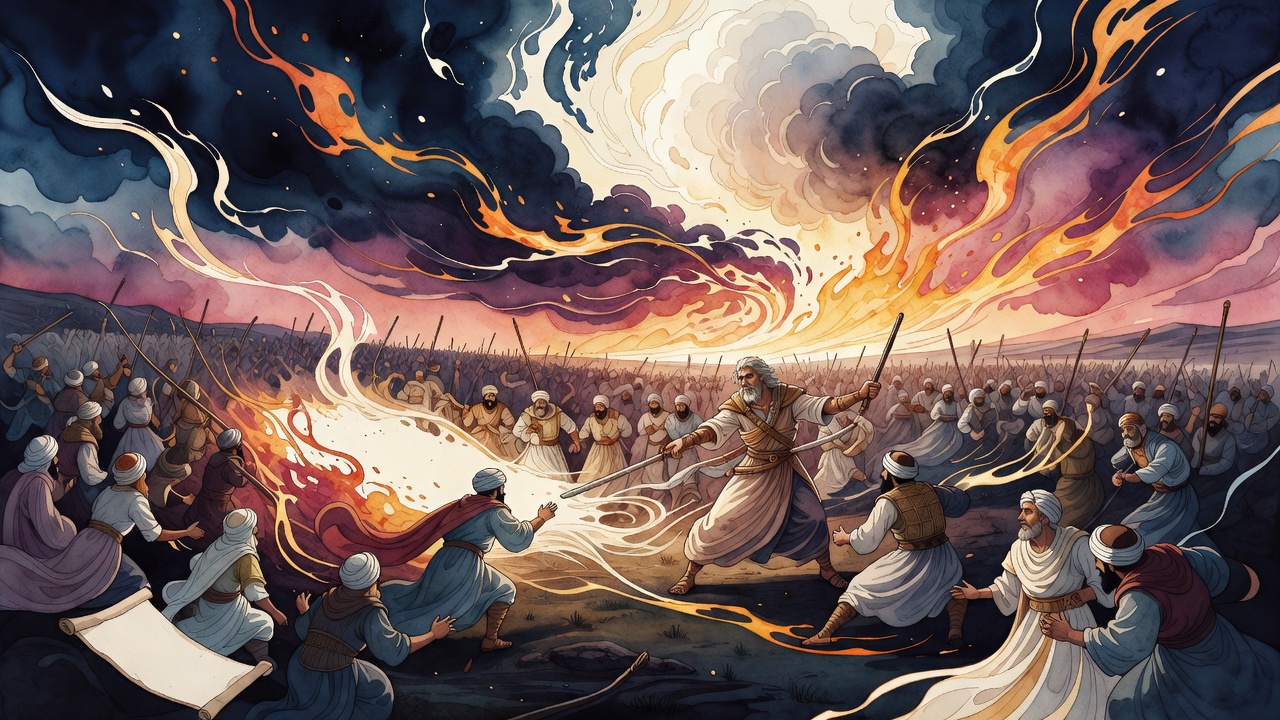
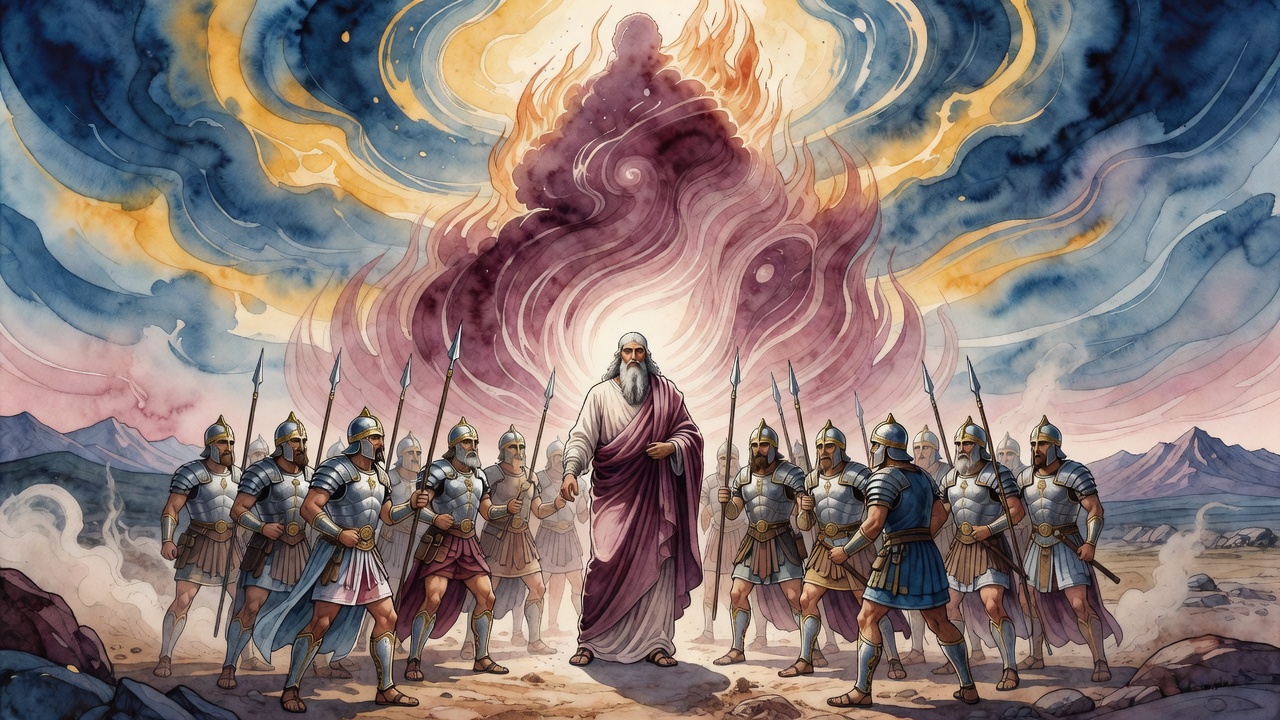
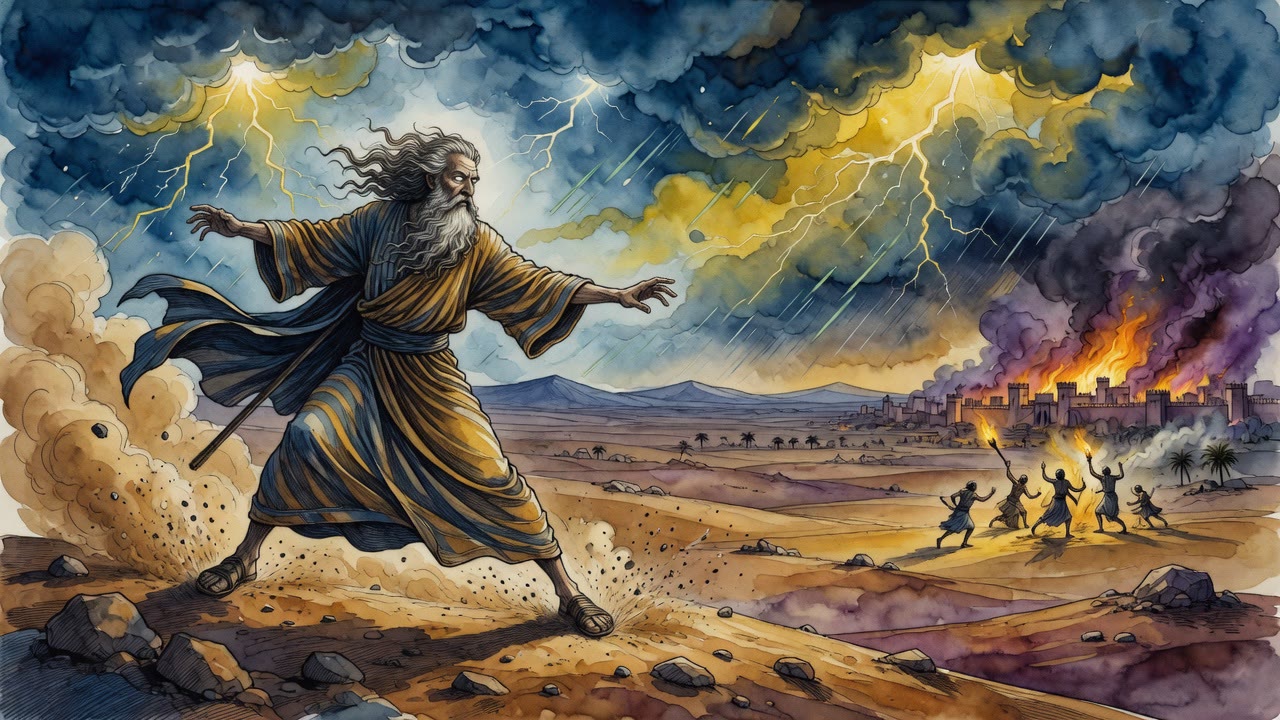
The kings had already torn the plain. Amraphel and his allies had crushed the cities of the vale, seized goods, and dragged Lot away as spoil among the cattle and the gold. Word reached Abraham like a blade slipped between ribs. He did not call himself a general. He counted trained men of his household and found three hundred eighteen. Against nine kings and their forces, the number was a joke written in flesh and loyalty.

He armed them anyway. Spears, knives, the hard silence of men who had eaten Abraham's bread for years. Dust rose from the camp of Mamre as they moved out under a sky that had not yet decided whether to favor a shepherd who spoke with God. Lot had chosen the green of the Jordan and the company of Sodom. Abraham still went after him. Blood does not wait for a nephew to become wise.

Somewhere ahead, royal tents glittered with stolen wealth. Abraham walked toward them with a prayer already forming like a weapon he could not forge alone.

A Cry Made of Letters

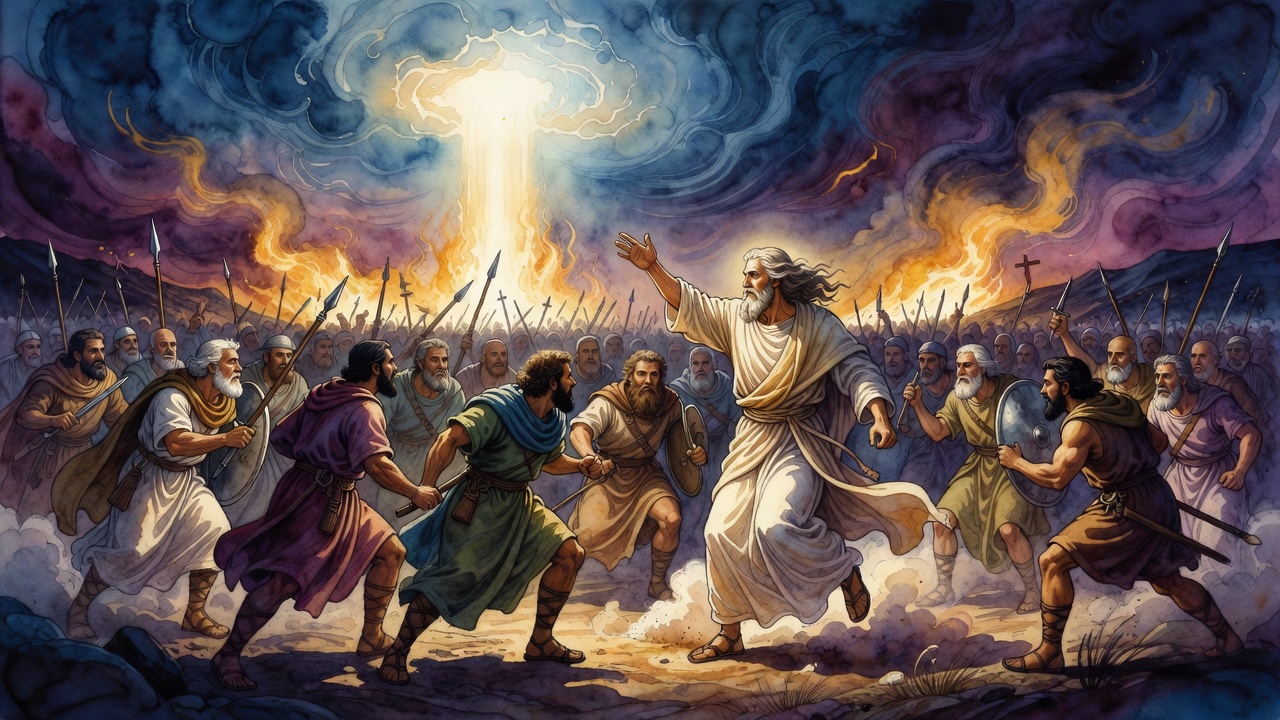
"Master of the Universe," Abraham cried, "if Your glory does not go with me, what can one man do against nine kings and their armies?" The midrash hears in his plea the twenty-two letters of the Torah, the bet and khaf of bekha, "through Thee," adding toward the full alphabet by which the world is spoken. Power, he said, comes to some by chariot and to others by horse. He would lift his horn only through the Name.

The servants heard a man speaking to empty air and kept marching. They had seen enough of Abraham's empty air becoming instruction. The answer was not a speech. It was a night that changed its shape. Hours thickened. The dark itself seemed to take a breath and wait for orders from above the stars.

The Night That Divided Itself

Some sages say the night split of its own accord. Rabbi Benjamin says the Holy One, who knows hours to the thickness of a hair, divided the dark with that precision. Abraham and his servants struck in the cut of midnight, fell on the camp, smote the enemy, and chased them as far as Hobah, left of Damascus. From the middle of the night until morning he slaughtered those who had risen against the cities of the plain and against his blood.

Confusion did the work of ten thousand. Kings who had laughed at a pastoral household discovered that heaven can temporarily enlist one household as an army. God spoke into that victory a promise larger than one rescue. "You killed My enemies from midnight to morning. So I will strike the enemies of your children from midnight to morning." Generations later, at another midnight, the firstborn of Egypt would fall while Israel ate in haste. The war of the kings became a template pressed into Israel's future like a seal into wax.

Dawn found Abraham exhausted, hands sticky, Lot free, and the road home long.

Sodom Watched and Learned Nothing

The men of Sodom escaped the kings because of Abraham's sword, then returned to their old work as if rescue were a weather event with no moral claim. The midrash names them wicked toward one another, sinful in lewdness, blasphemers before the Lord, shedders of blood. When the Holy One later asked whether to hide the judgment of Sodom from Abraham, the memory of this war still hung in the air. Abraham had saved them once with night and steel. They filled their bellies with violence until fire filled them in return, brimstone answering a city that had treated mercy as an accident.

Lot was free. The plain was not healed. Abraham returned the goods and refused a king of Sodom's reward, unwilling to let a wicked city say it had made him rich. "I have lifted my hand to the Lord," he said in effect, and kept his hands clean of Sodom's gold even as Sodom's people walked free because of him.

A Sign for Descendants

Rabbi Joshua of Sikhnin taught that whatever happened to Abraham would happen to his seed. Chosen from his father's house, he became the pattern. Chosen from seventy nations, his children would walk the same arc of danger, midnight, and rescue. The war was not only about Lot. It was a rehearsal for Exodus, written early in a shepherd's exhausted arms and in a night split thinner than a hair.

Abraham washed blood from his hands in the gray before full day and knew that one man's night, cut open by heaven, had changed the calendar of redemption. Kings would rise again. Midnights would return. The Name that answered bekha would still be the only math that made three hundred eighteen larger than empires.


← All myths
From the tradition

Sources

2 sources

The texts behind this telling. Some cards carry a translation of the source; others are our own retelling of it, and each card says which. Every card links out to the original.

Midrash Tanchuma, Lech Lecha 9Midrash Tanchuma

Retold in our words. Read the original at the link below.Townsend 1989 translation of Midrash Tanhuma, S. Buber Recension · CC-BY

And it came to pass in the days of Amraphel (Gen. 14:1). Scripture says elsewhere in reference to this verse: Through Thee do we push down our adversaries, through Thy name do we tread them under that rise up against us (Ps. 44:6). R. Isaac said: In the word bekha (“through Thee”) the letter bet equals two and the khaf twenty, corresponding to the twenty-two letters of the alphabet with which the Torah was given. Abraham cried out: Master of the Universe, if Your glory does not accompany me and assist me in this struggle, what can one man do against nine kings and their forces?

He giveth power to the faint (Isa. 40:29); to some by means of a chariot and to others with horses (Ps. 20:8), but I lift up my horn through Your name. How do we know that He did so? It is so written: And he divided himself against them, he and his servants by night, and he smote them, and pursued them unto Hobah, which is on the left of Damascus (Gen. 14:15). Our sages maintained: The night divided itself of its own accord, while R. Benjamin held: The Holy One, blessed be He, who knows its hours and its moments, computed the night to the thickness of a single strand of a hair and divided it. The Holy One, blessed be He, said to Abraham: You slaughtered My enemies from the middle of the night until morning, so be assured I will bring death to the enemies of your descendants from the middle of the night until the morning. I shall exact retribution from them at that time, as it is written: And it came to pass at midnight that the Lord smote all the firstborn in the land of Egypt (Exod. 12:29). Hence Scripture says: And it came to pass in the days of Amraphel.

R. Joshua of Sikhnin was of the opinion that the Holy One, blessed be He, gave Abraham a sign that whatever happened to him would likewise happen to his descendants. He chose Abraham from among all those in his father’s house, as it is said: Thou art the Lord God who didst choose Abraham, and brought him forth out of Ur of the Chaldees, and gavest him the name of Abraham (Neh. 9:7). And He selected Abraham’s sons to be His chosen ones among the seventy nations, as is said: For thou art a Holy people unto the Lord thy God, and the Lord hath chosen thee to be His own treasured nation out of all the peoples that are upon the face of the earth (Deut. 14:2). He said to Abraham: Get thee, and to Abraham’s sons, He said: I will bring you up out of the affliction of Egypt unto the land of the Canaanite, and the Hittite, and the Emorite, etc. (ibid. 3:17). He promised Abraham: And I will bless thee, and make thy name great; and be thou a blessing (Gen. 12:2), and He told his sons: The Lord bless thee, and keep thee (Num. 6:24). To Abraham He said: I will make thee a great nation (Gen. 12:2), and to his descendants He said: And what great nation is there (Deut. 4:8). Concerning Abraham it is written: Abraham was one (Ezek. 33:24), and of Israel it is said: And who is like thy people Israel, a nation one in the earth (I Chron. 17:21). In reference to Abraham it is said: and hunger was in the land (Gen. 12:10), and about his descendants it is said: When they returned to Egypt, hunger was already in the land (ibid. 43:1). Abraham descended to Egypt because of famine, and his sons, also, descended because of famine, as is said: And Joseph’s ten brethren went down to buy corn from Egypt (ibid. 42:3). When Abraham descended the Egyptians approached him, and the Egyptians beheld the woman that she was very fair (ibid. 12:14), and concerning his descendants, the Egyptians declared: Come, let us deal wisely with them lest they multiply, and it come to pass, that when there befalleth us any war, they also join themselves unto our enemies, and fight against us, and get them up out of the land (Exod. 1:10).

The four kings attacked Abraham, and in the future all the kings will war against Israel, as it is said: Why are the nations in an uproar, and why do the peoples mutter in vain? (Ps. 2:1), and it says elsewhere; The kings of the earth stand up, and the rulers take counsel together against the Lord, and against His anointed (ibid., v. 2). Just as in the case of Abraham, the Holy One, blessed be He, waged war against those who hated him, as it is said: Who hath raised up one from the east, at whose steps victory attendeth? He giveth nations before him, and maketh him rule over kings; his sword maketh them as the dust, his bow as the driven stubble (Isa. 41:2), so too the Holy One, blessed be He, will wage war in the future in behalf of his descendants, as is said: Then shall the Lord go forth and fight against those nations, as when he fighteth in the day of battle (Zech. 14:3).

Full source
Midrash Tanchuma, Vayera 7Midrash Tanchuma

Retold in our words. Read the original at the link below.Townsend 1989 translation of Midrash Tanhuma, S. Buber Recension · CC-BY

And the Lord said: “Shall I hide from Abraham?” (Gen. 18:17). Scripture states elsewhere in reference to this verse: It shall be for the filling of his belly; He shall cast the fierceness of His wrath upon him, and shall cause it to rain upon him into his flesh (Job 20:23). The retribution that befell the Sodomites bloated their bellies because they had filled their bellies previously through their transgressions, violence, and robbery. Hence, the punishment imposed upon them filled their bellies, as it is said: He shall cast the fierceness of His wrath upon him. R. Meir said: Scripture states concerning the rain that fell in Sodom: He shall cause it to rain upon him into his flesh (ibid.) and also: And the Lord caused to rain upon Sodom and upon Gomorrah brimstone and fire (Gen. 19:24). Why into his flesh? Because of the wars they waged with the Holy One, blessed be He, as it is said: The men of Sodom were very wicked and sinful before the Lord (ibid. 13:13). The word wicked implies toward each other; sinful indicates that they were guilty of lewdness; before the Lord means that they blasphemed and reviled the Lord and practiced idolatry; and very (m’od) signifies that they shed blood (dom).

R. Judah the son of (R.) Shalum said in the name of R. Judah the son of Simon: At the time that Amraphel and his allies fought the Sodomites, they seized Lot; Abraham heard about it and set out to do battle with them. After he slew the kings, the Sodomites escaped, as it is said: And he divided himself against them by night (Gen. 14:15), and Now the vale of Siddim was full of slime-pits; and the kings of Sodom and Gomorrah fled (ibid., v. 10). Abraham reflected upon the matter, saying to himself: The kings that attacked the Sodomites have been slain, while they (the Sodomites) have fled, as is said; And they that remained fled to the mountains (ibid.). Surely if they had been unworthy, they would not have been allowed to escape. The Holy One, blessed be He, replied: The fate of those that fled is alluded to in the verse: If he flee from the iron weapon, the bow of brass shall strike him through. He draweth it forth, and it cometh out of his body; yea, the glittering point cometh out of his gall; terrors are upon him; all darkness is laid up for his treasures; a fire not blown by man shall consume him; it shall go ill with him that is left in his tent (Job 20:24–26). Where was all the darkness laid up? It was in the area north of Sodom, which is at the right (south) of Jerusalem, as it is said: And thy younger sister, that dwelleth at thy right hand, is Sodom and her daughters (Ezek. 16:46). What is meant by the words It shall go ill with him that is left in his tent? They mean that the fugitive who escaped will suffer misfortune in his tent. Who was one such? The wife of Lot, as it is said: But his wife looked back from behind him, and she became a pillar of salt (Gen. 19:26).

Full source