6 min read

Adam Was Charged to Keep What Needed No Hoe

The garden had no weed to pull and no thief to watch for. Adam cut trenches around the roots anyway, and later he heard something walking.

Curated by Arthur · Told by Maggid ·
Table of Contents
  1. The Two Ways a Plot Goes Bad
  2. The Pattern for Everyone Who Came After
  3. There Was Work in It After All
  4. The Sound in the Cool of the Day
  5. Nobody Was Walking

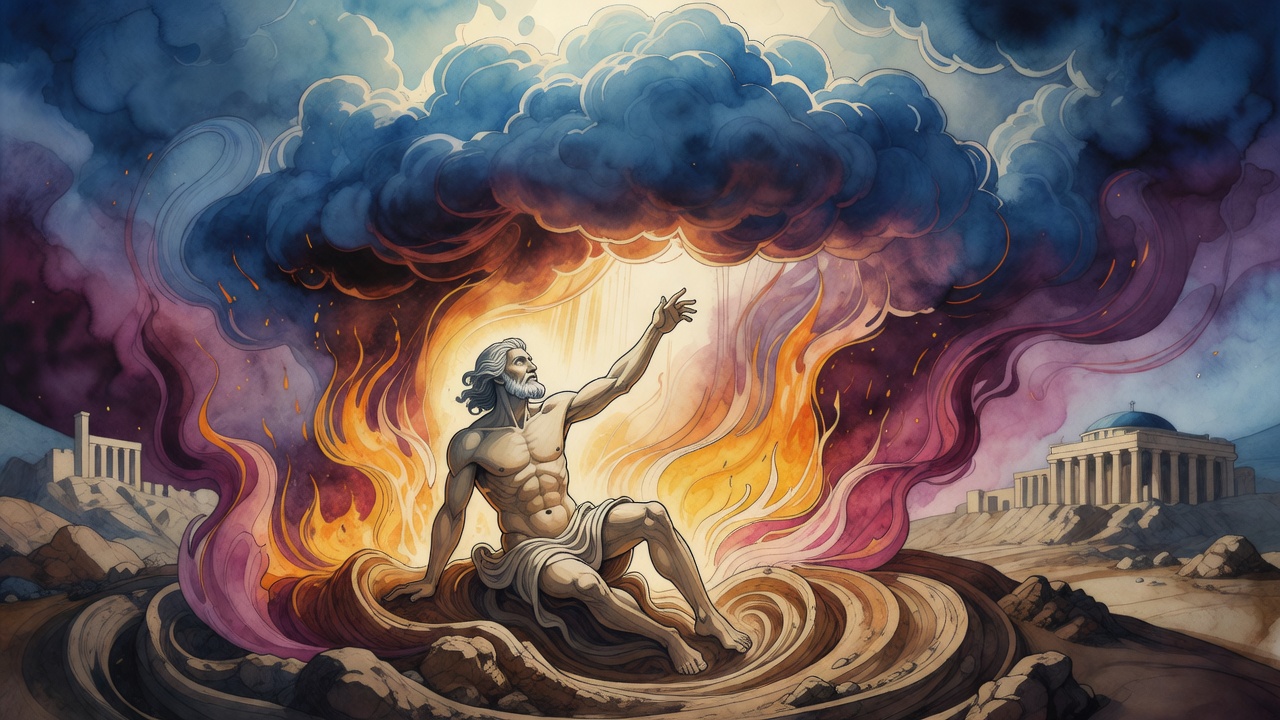
Adam stood in the middle of a garden looking for something to do.
Adam Was Charged to Keep What Needed No Hoe Click for full size

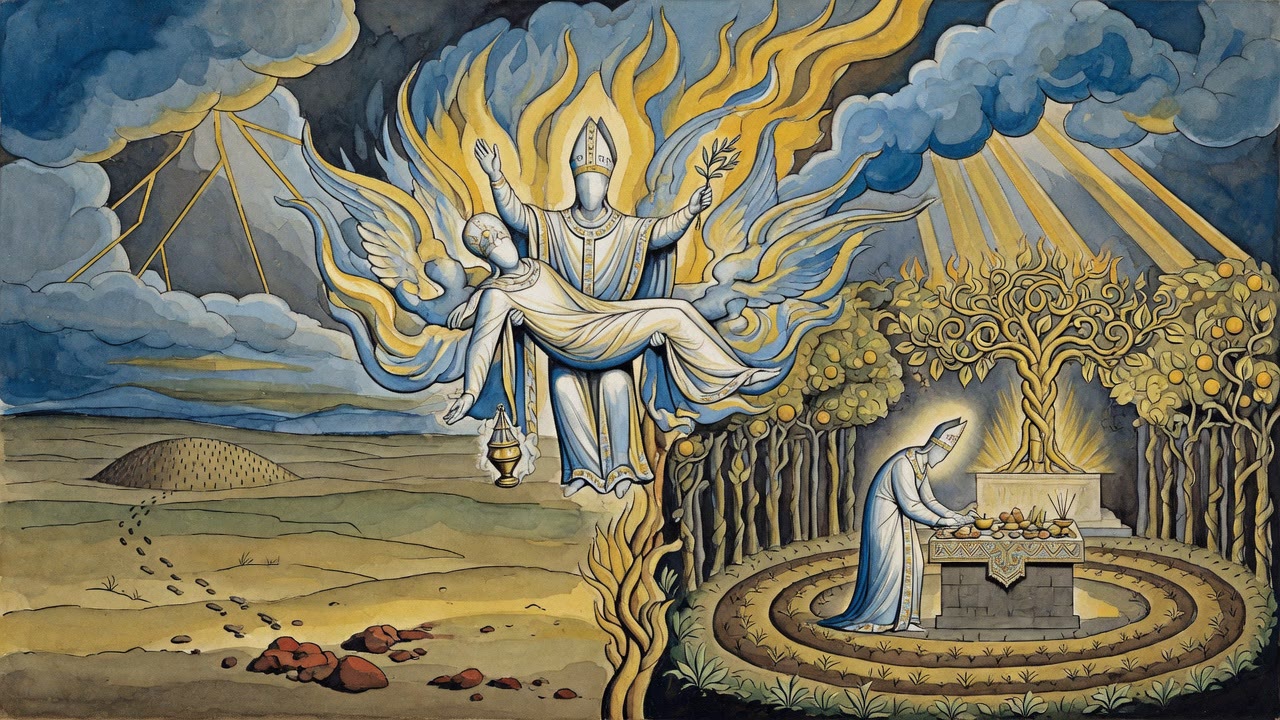
The order had been plain enough. Work it, and keep it (Genesis 2:15). He had walked the whole plot that morning with his hands open and found no weed to pull, no branch snapped in a storm, no gap in any hedge. Fruit hung at the height of a man's mouth. The soil lay dark and already loose. He had not been given a hoe, and there was nothing here a hoe would have improved.

The Two Ways a Plot Goes Bad

Anyone who works land knows there are exactly two jobs and that both are required. The first is the working: ground has to be handled or it goes to ruin out of plain neglect. The second is the watching: whatever grows has to be defended or something walks in and strips it. Skip either and the year is gone. A lazy man loses a field as surely as a raided man does.

So the charge had come in two halves, work and keep, because a charge over land always does. The strange part was that this ground appeared to need neither.

The Pattern for Everyone Who Came After

Adam was the first person ever handed the care of ground. Whatever he did here, in a plot that asked nothing of him, would stand as the shape of the work for every man after him who took up ground that asked everything.

He was not being kept busy. He was being written down. Somebody had to be the first to bend at the waist over a row, and whatever that first man did with his hands would become the law of what hands do.

So he bent.

There Was Work in It After All

The garden was full, and full is not the same as finished. He dug around the roots and broke the crust until the soil went soft again. He cut trenches, small ones, following the fall of the land. He let water into them and watched it walk down the rows and stop where he had told it to stop.

The keeping turned out to be real as well. No man was coming to raid the place, but animals lived here, and an animal has no interest in a boundary. More than beasts, the danger came out of the air and the water. Let a dry spell settle in and the trenches had to run full. Let the weather turn heavy and the same trenches had to be cut away and the streams sent off somewhere else before the roots stood in it and rotted.

The work had not been invented to give him something to do. It was the work. There was simply nobody to blame yet when it went undone.

The Sound in the Cool of the Day

Then there was fruit, and a mouth, and a second mouth, and their own skin looked wrong to them for the first time. They sewed leaves together with hands that would not hold still.

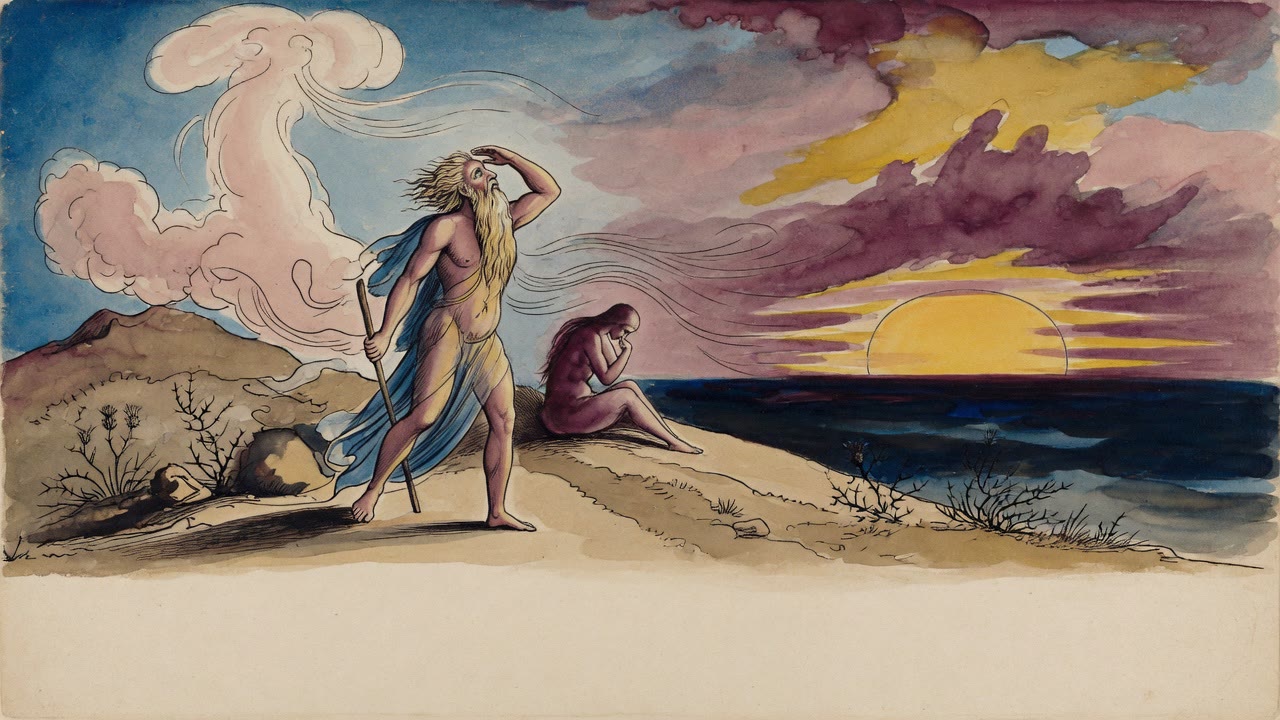
Toward evening the air went cool, and they heard the sound of the Lord God walking in the garden (Genesis 3:8). Adam took Eve by the arm and pulled her back off the open path into the thick growth, and they crouched there with damp leaves against their ribs while the sound came on between the trunks, unhurried, the way something moves when it knows every path in the place.

Nobody Was Walking

The lights in the sky travel. They go round and round on a track and never leave it, and anyone standing in a field can watch them do it. The one above them does not travel at all. He is fixed. He does not cross a garden, because there is nowhere he is not already standing.

And still there was a sound, and the sound was real. He is heard without a mouth opening. Later men would stand in open country and hear him plainly with nothing in the air to carry it, a voice arriving inside the ear by some power that needs no throat. If he can be heard without sound, he can give the sense of walking without taking a step.

There was another reason the two of them heard feet that evening, and it had nothing to do with him.

That morning they had been steady. Constant, quiet, of one piece the whole way through, and while they were like that they had known him for what he is, unmoving. By evening there was cunning in them, and a man measures with whatever ruler he happens to be holding. They had turned into things that shift, so they handed him the shifting. They heard a walk because they had just learned how to wander, and they hid from a God who had not moved an inch.

"Where are you?" he said. Adam answered from the bushes, and the answer was about a fig leaf and a fear, and the garden that had never needed a guard now had two people hiding in it from the one who set them there.


← All myths
From the tradition

Sources

4 sources

The texts behind this telling. Some cards carry a translation of the source; others are our own retelling of it, and each card says which. Every card links out to the original.

The Midrash of Philo 15:1The Midrash of Philo

Retold in our words. Read the original at the link below.The Works of Philo Judaeus, trans. C. D. Yonge, London, H. G. Bohn, 1854-1890 · Public Domain

The Torah tells us in (Genesis 2:15) that God placed man in Paradise "to till it and keep it." But...why?

The Garden, Gan Eden (the Garden of Eden, paradise), was, well, perfect. It was planted by God Himself. What did it need tilling for? Everything was already flourishing! And keep it? From whom? Was there some rogue band of squirrels planning a heist of the pomegranate trees? It just doesn't seem to add up, does it?

This apparent contradiction is something that the ancient sages wrestled with. And one fascinating explanation comes from the Midrash of Philo. Now, Philo of Alexandria, who lived in the first century, was a Jewish philosopher who sought to harmonize Jewish scripture with Greek philosophy. His writings offer a unique perspective on these well-known stories.

So, what's Philo's take? He suggests that the Garden didn't actually need tending in the literal sense. It wasn't about weeding or pruning. Rather, the instruction to "till and keep" was a metaphor. It was about something deeper, something about Adam's purpose.

Perhaps, Philo suggests, God was giving Adam a task to engage his mind and spirit. To cultivate his own inner garden, so to speak. And to guard against the temptations and negative influences that might threaten his spiritual well-being. The "keeping" wasn't about protecting the physical space, but about protecting his own soul. We are all, in a way, placed in our own "gardens." We have talents, opportunities, and relationships that need tending. We have to cultivate our minds, nurture our spirits, and protect ourselves from negative influences. Maybe the story of Adam in the Garden of Eden isn't just a historical account, but a timeless lesson about the human condition. A lesson about the responsibility we each have to cultivate our own inner paradise.

Full source
The Midrash of Philo 15:2The Midrash of Philo

Retold in our words. Read the original at the link below.The Works of Philo Judaeus, trans. C. D. Yonge, London, H. G. Bohn, 1854-1890 · Public Domain

In Midrash of Philo, there's a deeper lesson woven into the very act of tending the Garden.

Cultivating the land involves two crucial elements: working the earth and safeguarding its bounty. Lazy hands or destructive forces can easily ruin the land’s potential. But consider this: Paradise, in its very essence, lacked nothing. It was a realm of perfect abundance. So, why would Adam, dwelling in such a place, need to exert himself?

Philo suggests that Adam served as a "pattern and law" for all future workers. He was meant to be an example, a model for how we should interact with the world around us. Even in a place of perfection, there was still room for industry, for active engagement.

Think of it this way: the Garden, though brimming with everything, still demanded care. There was digging to be done, tending to be attended to, and softening of the soil to consider. Trenches needed to be dug, and irrigation systems managed.

It wasn't just about cultivating the earth, but also about protecting it. Even though there were no marauding beasts to ravage the Garden (or at least, not yet!), there was still the need to safeguard it. Philo emphasizes the importance of managing the elements – ensuring proper hydration during droughts and controlling excess moisture during heavy rains by redirecting streams.

Adam's role in the Garden wasn't about creating something that was lacking, but rather about actively participating in its flourishing, about responsibly stewarding the gifts he had been given. It was about engaging with the world, even a perfect world, in a way that honors and sustains it.

Perhaps it's a reminder that even when we find ourselves in seemingly abundant circumstances, we still have a responsibility to cultivate, to protect, and to engage with the world around us. Perhaps Adam's task in the Garden is a timeless call to mindful stewardship, a call that resonates just as strongly today as it did in the beginning.

Full source
The Midrash of Philo 8:1The Midrash of Philo

Retold in our words. Read the original at the link below.The Works of Philo Judaeus, trans. C. D. Yonge, London, H. G. Bohn, 1854-1890 · Public Domain

The familiar story is this: the serpent, the forbidden fruit, the expulsion. But what about that strange line in (Genesis 3:8), "They heard the sound of the Lord God walking in the garden in the cool of the day"? What kind of sound was it? What did it mean?

Was it literally the sound of God's footsteps? And if so… does God have feet?

These are exactly the kinds of questions that the midrash (rabbinic interpretive commentary) – that beautiful, imaginative, and often delightfully strange form of Jewish biblical interpretation – loves to confront. And, as it turns out, Philo of Alexandria, that fascinating first-century Jewish philosopher who lived in Egypt, had some thoughts on the matter.

The question Philo poses – and it's a doozy – is this: "What is meant by the statement that the sound was heard of God walking in the Paradise? Was it the sound of his voice, or of his feet? And can God be said to talk?" The idea of God The midrash isn't afraid to wrestle with these seemingly absurd images, to dig beneath the surface and find deeper meaning.

So, what's the answer? Well, Philo doesn't give us a straightforward one. He leaves us to ponder the possibilities, to consider the limitations of human language when trying to describe the divine. Was it the sound of God's voice, a divine utterance echoing through the garden? Or was it something else entirely, something beyond our comprehension?

The beauty of midrash lies in its openness, its willingness to entertain multiple interpretations. It invites us to engage with the text, to bring our own questions and insights to the table. Maybe the "sound of God walking" isn't meant to be taken literally at all. Perhaps it's a metaphor for God's presence, a way of describing the feeling of being in the divine presence.

Perhaps it's a reminder that even in moments of transgression, even after Adam and Eve have disobeyed, God is still there, still present in the garden. That even when we stumble, even when we make mistakes, we are not alone. The divine presence is always with us, even if we can only hear it as a faint echo, a whisper in the wind.

And maybe, just maybe, that whisper is enough.

Full source
The Midrash of Philo 8:2The Midrash of Philo

Retold in our words. Read the original at the link below.The Works of Philo Judaeus, trans. C. D. Yonge, London, H. G. Bohn, 1854-1890 · Public Domain

Philo, a Jewish philosopher who lived in Alexandria in the first century CE, grappled with how to reconcile Greek philosophy with Jewish tradition. His writings, known as The Midrash of Philo, offer unique interpretations of the Torah. In one particularly insightful section, Philo tackles the nature of God’s immobility.

He starts by contrasting the perceived motion of the "gods who are in heaven" – the celestial bodies, perhaps – with the steadfastness of the "Supreme Cause," that is, God. These lesser deities, visible to our eyes, move in circles, ever changing. But God, according to the ancients, is immovable.

Philo suggests that even though God is inherently still, He sometimes gives the impression of motion. How? Through the prophets! Even without speaking aloud, God communicates. Prophets hear Him "by a certain virtue of some diviner voice sounding in their ears." It's as if God, while remaining fixed, still manages to convey a sense of dynamic presence. readers often imagine God acting, intervening, even "walking" among us. But Philo challenges us: is that really God we're seeing, or a reflection of our own restless nature?

Philo argues that before humanity tasted "wickedness" – before the Fall, perhaps? – they were "stable and constant, and immoveable and tranquil." In that state of purity, they would have perceived God as He truly is: immoveable. But once cunning entered the picture, once humans became prone to change and variation, they projected those qualities onto God. They "began to strip him of his attributes of immobility and unchangeableness, and conjectured that he too was subject to variation and change."

In other words, our own instability leads us to believe that God is also unstable. We see the world as a swirling vortex of change, and we assume God must be caught up in it too. But Philo suggests that this is a profound misunderstanding.

So, what are we to make of this? Is God truly immobile, a fixed point in the universe? Or is Philo pointing to something deeper about the human condition: our tendency to create God in our own image? Perhaps the real journey isn't about understanding God's nature, but about understanding our own. And maybe, just maybe, finding that stillness within ourselves allows us to perceive the true, unwavering nature of the Divine.

Full source