Parshat Balak5 min read

Balak Sent for a Curse Before Israel Arrived

Balak's oracle-bird scorched as Israel rose. He hired Balaam because prayer, not numbers, was conquering kings he could not match.

Curated by Arthur · Told by Maggid ·
Table of Contents
  1. The Bird by the Window
  2. Hire the Mouth That Heaven Hears
  3. Elders Who Read Hesitation
  4. Night Speech Only
  5. What Prayer Looked Like From Moab
Balak Sent for a Curse Before Israel Arrived Click for full size

The Bird by the Window

Balak had not been born to a throne. He had been Zur, a vassal of Sihon, until death opened a seat his father never held. They called him Balak, Destroyer. They called him son of Zippor, Bird, because he flew toward a curse on Israel as a bird flies toward grain.

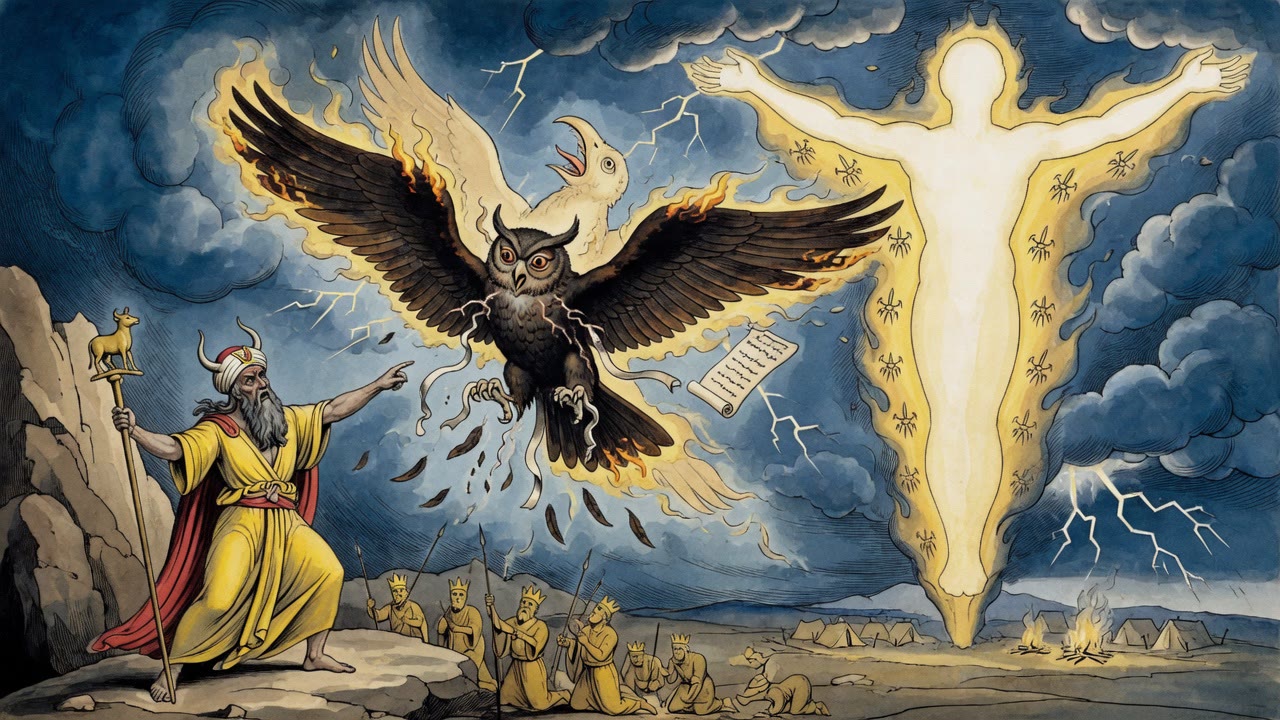
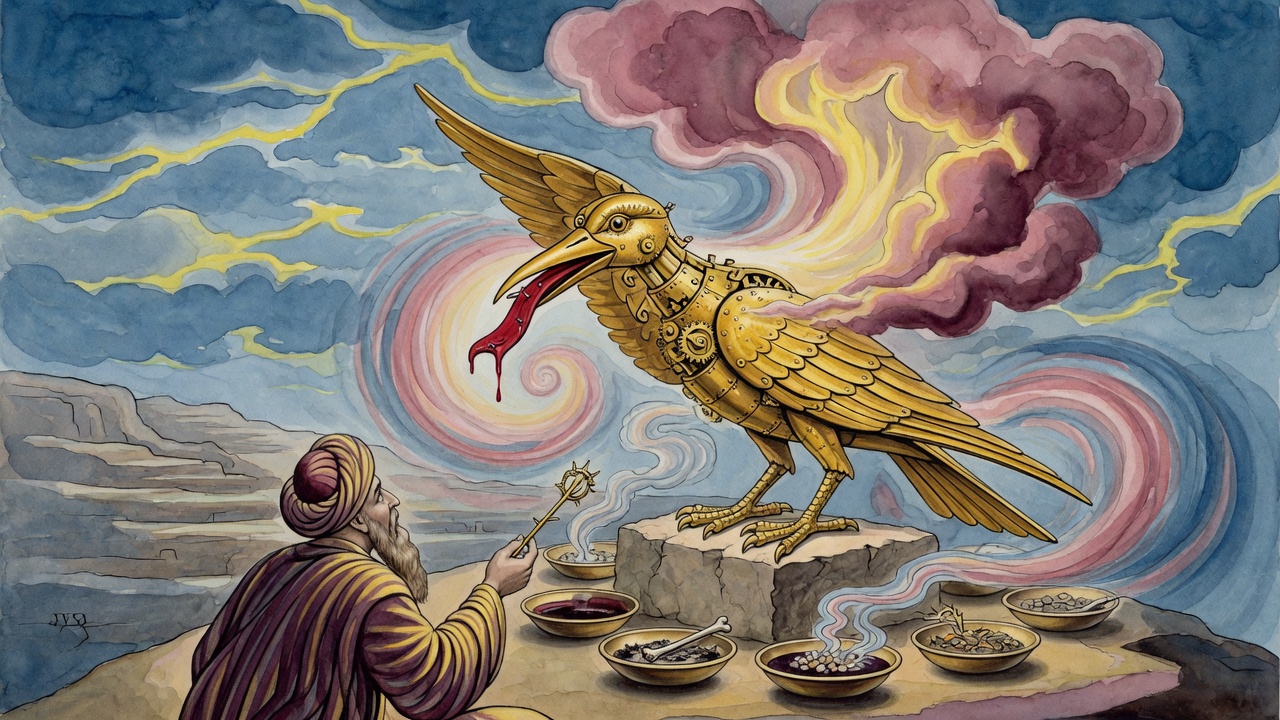
His prized tool was a mechanical bird: feet, body, and head of gold, mouth of silver, wings of bronze, and for a tongue the tongue of the rare Yadu'a. He set it by a window under sun and moon, offered burnt offerings for seven days, and waited for the tongue to move. A golden needle would then prick secrets from it.

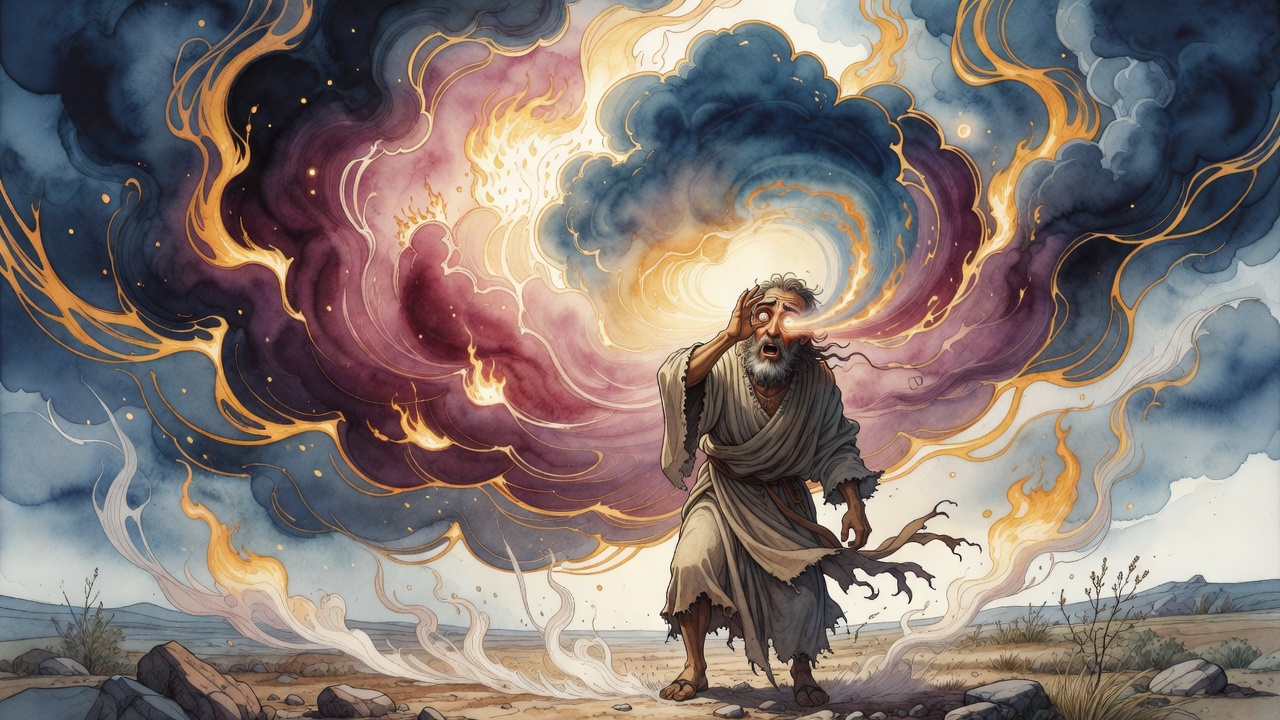
One day flame singed the wings. Balak read the scorch as Israel's rising power fouling his oracle. Magic that had answered him began to smell like panic.

Hire the Mouth That Heaven Hears

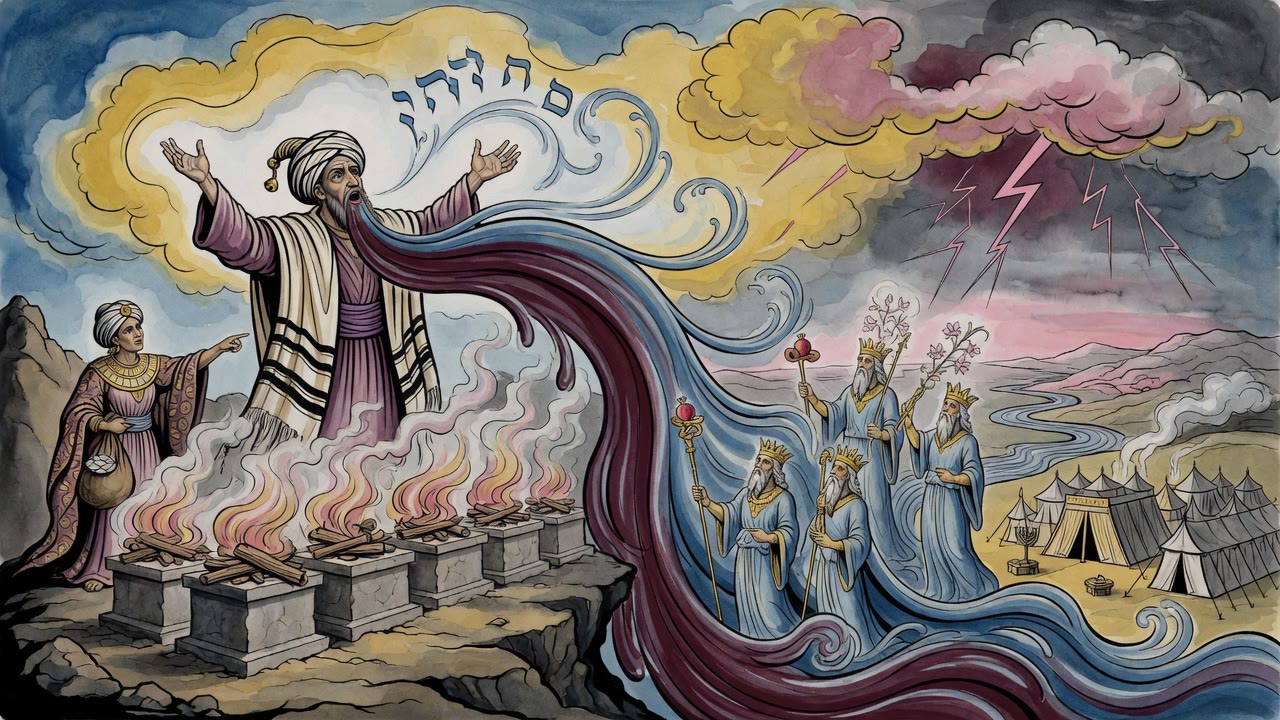
His army would not be enough. His strategies would not be enough. He sent for Balaam, the non-Israelite prophet whose words could tilt nations. The message was bait for ambition. Curse this people, and Egyptians and Canaanites will honor you. Sihon and Og, the eyes that guarded the land, had already fallen to Israel's open lips in prayer. "They are not greater heroes than we," Balak admitted, "nor are their host more numerous than ours. But they conquer as soon as they open their lips in prayer, and that we cannot do."

He did not need total ruin on the first day. A twenty-fourth part led to destruction might be enough. Slow mastery. A percentage of souls peeled away.

Elders Who Read Hesitation

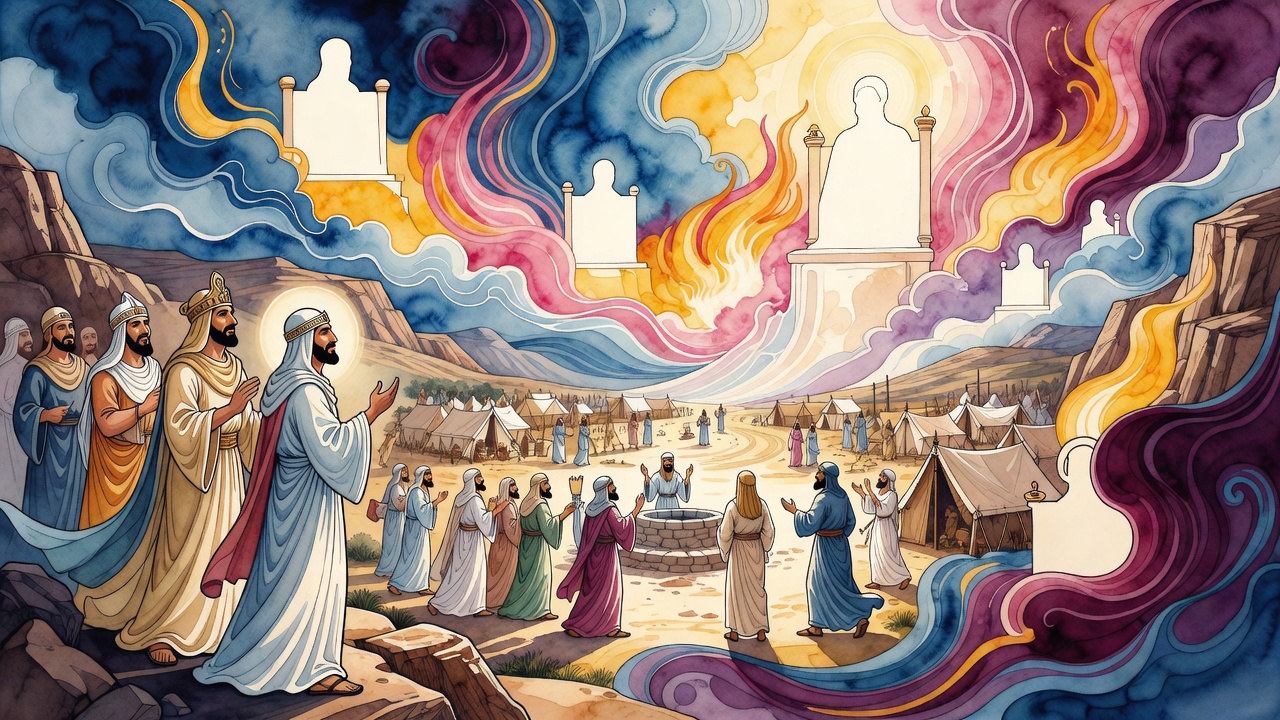
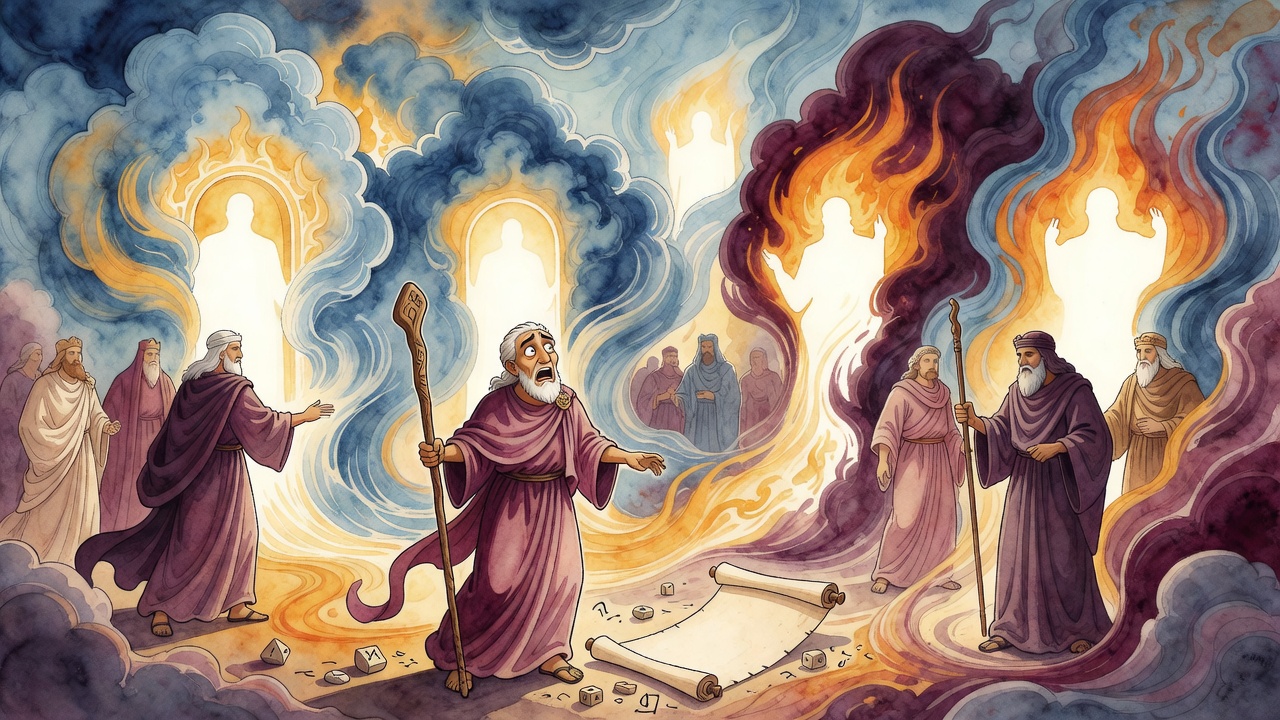
The elders of Moab and Midian who rode to Balaam were magicians themselves. Their craft said: if Balaam agrees at once, the mission lives. If he hesitates, leave. Balaam told them to stay the night and wait for an answer. The Midianites left immediately. A father does not hate his son, they reasoned. God is Israel's father. Would He turn love to hatred for Balaam's fee?

Balak himself, some say, was a greater diviner than Balaam, yet he could not parse his own vision: he would somehow cause twenty-four thousand Israelites to die, but the how stayed fogged. He hired a curse to force the how into being.

Night Speech Only

Balaam hated Israel no less than Balak, the legends claim, and would have gone at once if the choice were only his. He waited for night because, the tradition holds, the Holy One appears to non-Israelite prophets in the dark. "Who are these people with thee?" the question came, as if the king of Moab's gold had not already answered.

The bird by the window had burned. The elders of Midian had walked away. The prophet still bargained with sleep and dawn for a permission that would never be a clean yes.

What Prayer Looked Like From Moab

From Balak's ridge, Israel was not a rabble of escaped slaves. It was a noise that toppled Sihon and Og, the eyes of the land, without needing Moab's kind of numbers. Prayer, he admitted, was their artillery. He could field chariots. He could not field a people whose mouths opened and kings fell.

So he reached for a mouth for hire. Balaam's fame was international in the way fear is international. Balak's envoys carried not only gold but a theory of gradual ruin: peel off a twenty-fourth, corrupt a percentage, master them in slices. Total war is loud. Percentage war is patient.

The Midianite elders who left at the first night's delay understood theater better than Balak hoped. Hesitation meant the father of Israel had not sold the son. Their exit was a vote against the mission before Balaam finished bargaining with darkness.

The mechanical bird with the Yadu'a tongue is the king's private Sinai, a counterfeit revelation that burned when the real camp drew near. Flame on bronze wings is a small apocalypse on a windowsill. Balak read it correctly as threat and incorrectly as something a hired curse could reverse.

Night came. The question came. "Who are these people with thee?" The gold already knew. Heaven asked anyway, because non-Israelite prophecy in this telling is a narrow door that opens after sunset and does not open into easy hatred of Jacob's children.

Moab watched the camp and heard singing that sounded like strategy. Balak's fear was precise: not that Israel had better armor, but that Israel had better access. A people who open their lips and topple Sihon cannot be met only with spears. They must be met with a rival speech, a counter-prayer, a hired holiness. That is why Balaam mattered more than any captain.

The night question from heaven stalled the easy plot. Elders walking away in the dark were already a small defeat. The scorched bird was another. Balak still pushed, because destroyers by name do not retire when their tools smoke. He would learn, as the larger story tells, that the mouth he hired would not stay a weapon aimed only one way.


← All myths
From the tradition

Sources

3 sources

The texts behind this telling. Some cards carry a translation of the source; others are our own retelling of it, and each card says which. Every card links out to the original.

Legends of the Jews 6:6Legends of the Jews

Retold in our words. Read the original at the link below.The Legends of the Jews by Louis Ginzberg (1909) · Public Domain

He knew his army wasn't strong enough, his strategies weren't clever enough. He needed an edge, something… supernatural.

So, he turned to Balaam.

Balaam was no ordinary sorcerer. He was, according to tradition, one of the few non-Jewish prophets who actually possessed the gift of prophecy. He was renowned throughout the ancient world. Balak sent messengers to Balaam with an urgent plea. But it wasn't just a plea for help; it was a carefully crafted argument designed to entice the prophet.

"Don't think I'm just asking you to help me for my own sake," Balak's message went. "It's not just about what I can offer you. Think bigger! If you can curse Israel, if you can help me destroy them, all the nations will honor you. Egyptians, Canaanites – they'll all be at your feet!"

Balak paints a picture of global adoration and power, contingent on Balaam's success. It's a powerful motivator, preying on Balaam's ego and ambition.

But Balak wasn't done. He continued, "This people that came out of Egypt, they’ve already conquered Sihon and Og." the verse says, these kings were not just rulers but the "eyes that guarded the whole land." As Ginzberg recounts in Legends of the Jews, these figures were seen as giants, almost mythical in their strength. The Israelites had utterly vanquished them.

And now, Balak lamented, the Israelites were threatening to destroy Moab as well.

"They are not, greater heroes than we, nor are their host more numerous than ours," Balak confessed. "But they conquer as soon as they open their lips in prayer, and that we cannot do."

Did you catch that? Balak acknowledges that the Israelites' power doesn't come from military might or superior numbers. It comes from their connection to God, from the power of their prayers. This is key. Balak understood that to defeat Israel, he had to somehow sever or corrupt that connection.

So, he proposes a chilling strategy: "Try now to see if I may not gradually become their master, so that I may at least lead a certain per cent of them to destruction, be it only a twenty-fourth part of them."

Balak wasn’t aiming for total annihilation, at least not initially. He understood that perhaps he could only corrupt some of the Israelites, leading a fraction of them – even just a twenty-fourth – astray. This subtle approach, a slow erosion of their spiritual strength, might be enough to weaken them and make them vulnerable.

It’s a fascinating insight into the mind of Balak, and a reminder that sometimes, the greatest threats aren't the most obvious ones. The battle against external forces is sometimes a battle against internal corruption, a slow chipping away at our faith and values. The question becomes: How do you defend against an enemy that seeks not to destroy you outright, but to subtly lead you down a path of self-destruction?

Full source
Legends of the Jews 6:8Legends of the Jews

Retold in our words. Read the original at the link below.The Legends of the Jews by Louis Ginzberg (1909) · Public Domain

Take the tale of Balak and Balaam. It's more than just a simple request to curse a nation. It’s a clash of egos, a battle of wills, and a whole lot of ancient magic.

Ginzberg, in his Legends of the Jews, paints Balak, the king of Moab, as even more of a skilled magician and diviner than Balaam himself! But here’s the catch: Balak, despite his power, couldn’t quite decipher his prophetic visions. He knew, through his sorcery, that he would somehow be responsible for the death of twenty-four thousand Israelites. But how? That's the question that plagued him.

So, what does he do? He hires Balaam to curse Israel, hoping that this curse would prevent them from entering the Promised Land.

Balak’s messengers weren’t just random guys off the street. They were the elders of Moab and Midian, and, according to the legends, they were skilled magicians in their own right. They used their magic to determine that if Balaam immediately agreed to Balak’s request, their mission against Israel would be successful. But if he hesitated, even for a moment? Forget about it.

When they arrived at Balaam’s place and he told them to stay overnight to await his answer, the Midianite elders immediately left. Why? Because they knew they had lost. They understood that Balaam's hesitation was a sign he wouldn't fully commit. They reasoned: "Is there such a father as hates his son? God is the father of Israel, He loves them. Shall He now, owing to a curse from Balaam turn His love into hatred?"

According to the Legends of the Jews, if it had been up to Balaam alone, he would have accepted Balak’s invitation immediately. He supposedly hated Israel even more than Balak did! And Balak's elders even brought along all the necessary magical tools, so Balaam wouldn't have any excuses.

But, of course, Balaam had to play it cool. He needed to find out if God would even permit him to go to Balak. That’s why he told the Moabite messengers to stay the night, because, as the tradition goes, God only appears to non-Jewish prophets at night.

And so, as Balaam anticipated, God appeared that night and asked him, “Who are these people with thee?” It's a classic divine inquiry, setting the stage for the moral and spiritual drama that's about to unfold.

What does this all tell us? Perhaps that even the most powerful figures, armed with magic and political might, are ultimately subject to a higher power. Maybe it's a reminder that hatred, even when cloaked in sorcery, can't ultimately overcome divine love. Or perhaps it’s just a fascinating glimpse into a world where magic and prophecy were intertwined with political intrigue. Whatever your takeaway, it's a story that continues to resonate across the ages.

Full source
Legends of the Jews 5:121Legends of the Jews

Retold in our words. Read the original at the link below.The Legends of the Jews by Louis Ginzberg (1909) · Public Domain

It wasn't always through armies and diplomacy. Sometimes, they turned to magic. Take Balak, for instance, the King of Moab. He wasn't just any king. The Torah introduces him as the one who summons Balaam to curse the Israelites (Numbers 22). But who was he really?

Legends paint a richer picture. According to Ginzberg's retelling in Legends of the Jews, Balak wasn't born to royalty. He was once a vassal of Sihon, another king, and known as Zur. After Sihon's death, he somehow rose to the throne – a position his father never held.

Why "Balak"? The name itself hints at his intentions. It signifies "destroyer," and that's precisely what he set out to do to the Israelites. He was also called the son of Zippor, which means "bird," because, as the text says, he "flew as swiftly as a bird to curse Israel." This gives us a clue about his magical practices.

Balak, wasn't just a ruler. He was a powerful magician. And like any good magician, he had his tools. His most prized possession? A mechanical bird of incredible craftsmanship! Imagine this: Its feet, body, and head were crafted from gold, its mouth from silver, and its wings from bronze. And for a tongue? The tongue of a rare bird called Yadu'a.

This wasn't just a pretty ornament. Balak placed the bird by a window, where it could bask in the light of the sun by day and the moon by night. For seven days, he offered burnt offerings and performed elaborate ceremonies before it. The goal? To awaken its power.

At the end of the week, if all went according to plan, the bird's tongue would begin to move. And if Balak pricked it with a golden needle, it would reveal hidden secrets. This mechanical bird was Balak's oracle, his source of occult wisdom. A king relying not on advisors, but on a magical, mechanical bird.

But here's where the story takes a turn. One day, a sudden flame erupted and singed the bird's wings. Can you imagine Balak's reaction? Panic! He believed that the Israelites' growing power had somehow corrupted his magical instrument. Their mere presence threatened his source of knowledge and, therefore, his power.

What does this tell us? Perhaps that even the most powerful kings, even those who dabble in magic, are vulnerable. That even the most elaborate tools are fallible. And that sometimes, the greatest threat comes not from armies, but from the unseen forces of belief and destiny.

Full source