6 min read

Broken Lights Sent Each Soul to Gather Sparks

When the Nekudim shattered, sparks scattered through the worlds. God counted souls to the number needed, each with a tikkun, a repair, no other soul can finish.

Curated by Arthur · Told by Maggid ·
Table of Contents
  1. Fire Above, Water Below, Air Between
  2. The Count Came Out Exact
  3. A Body Cut for One Lock
  4. The Hour of Bending
  5. What the Other Side Still Holds

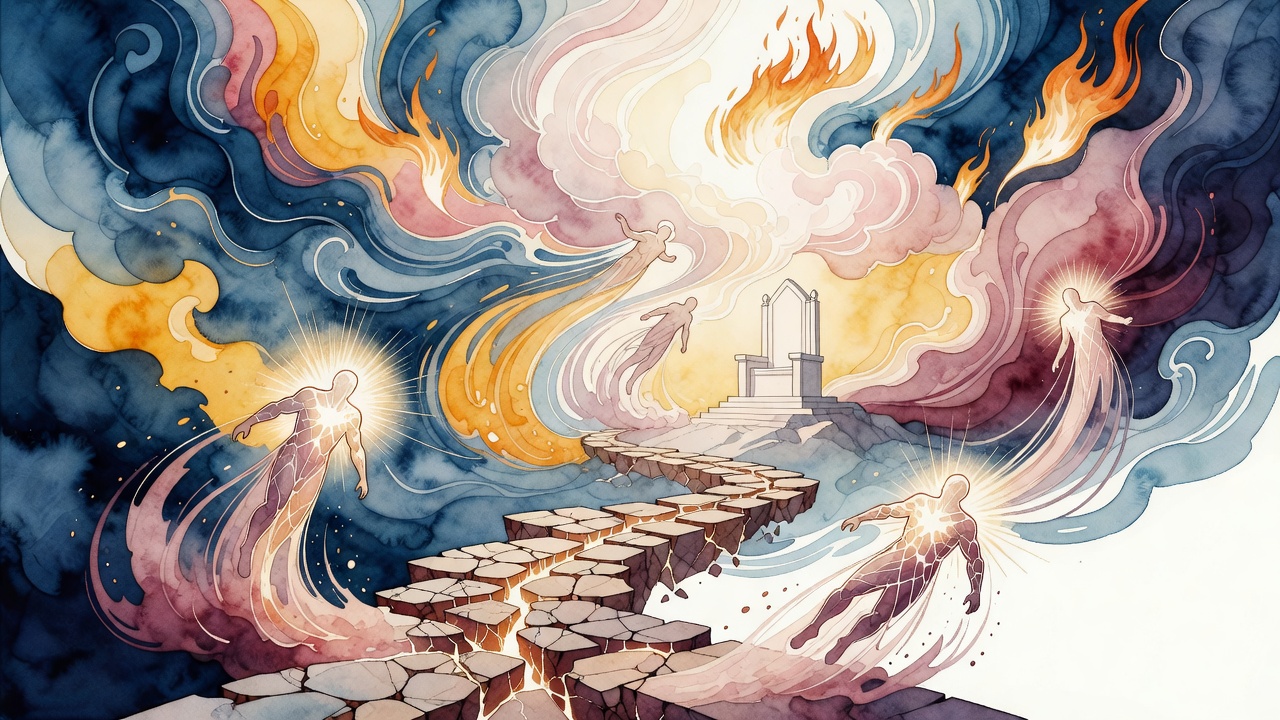
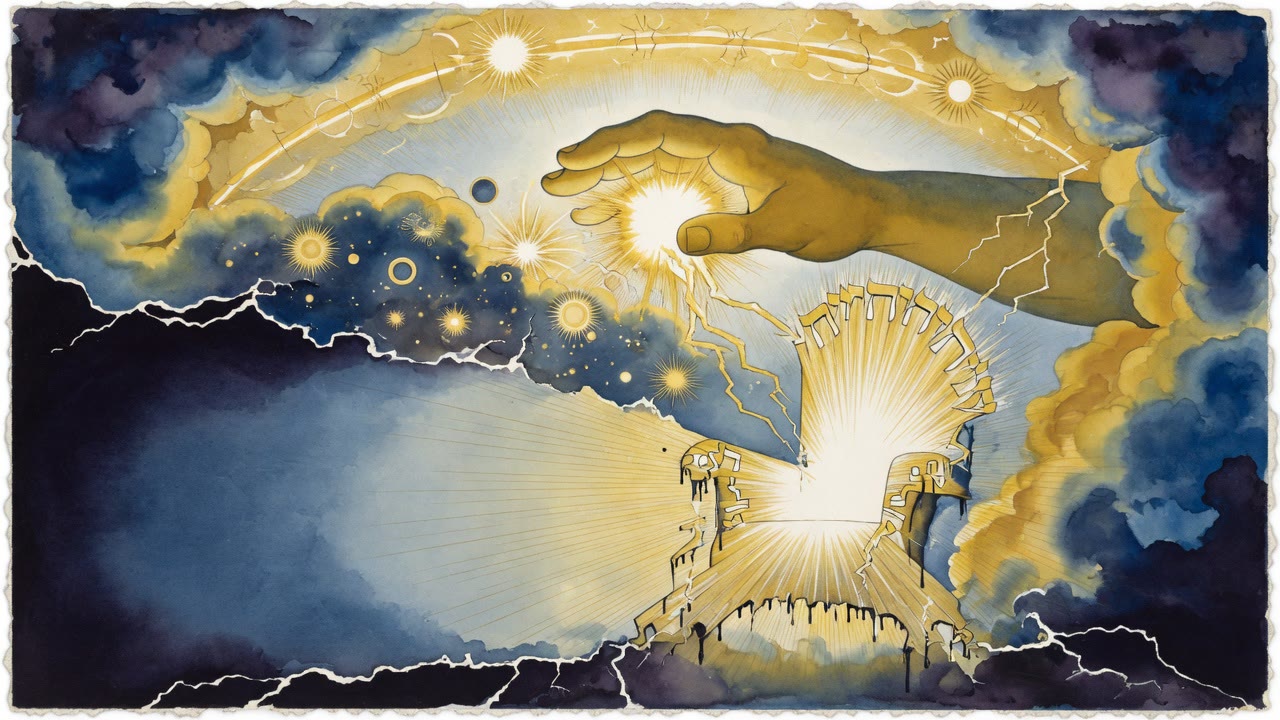
The vessels of Nekudim stood in a row and took the light the way a cup takes water. The light kept coming. Their seams went white, then thin, then gone, and the row came apart down its whole length in one long crack that nobody stood close enough to hear.
Broken Lights Sent Each Soul to Gather Sparks Click for full size

Shards fell through floors no eye has mapped. Every one of them carried a burning crumb down with it.

Below, the Other Side moved toward the falling pieces. The Sitra Achra had never made light and could not make it now. It gathered what dropped. It closed on the sparks the way a starving man closes on bread, and out of broken lights that had been divine a moment earlier it grew itself a floor to stand on.

Fire Above, Water Below, Air Between

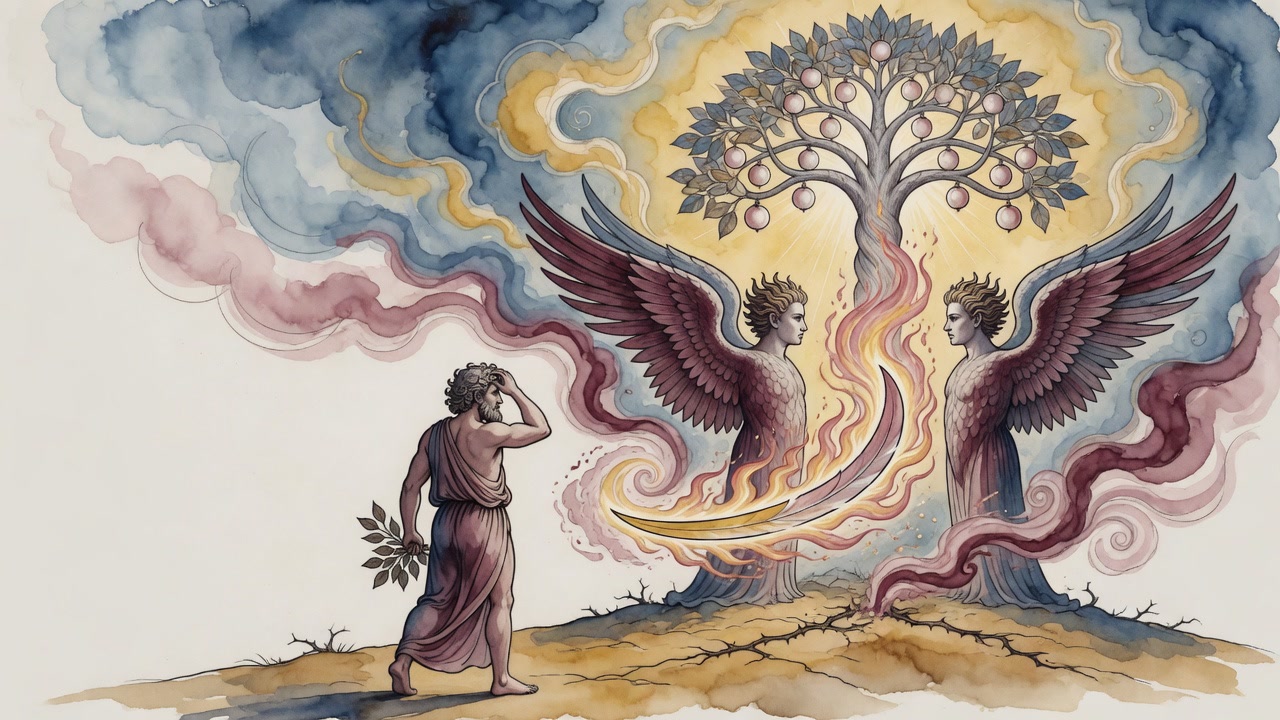
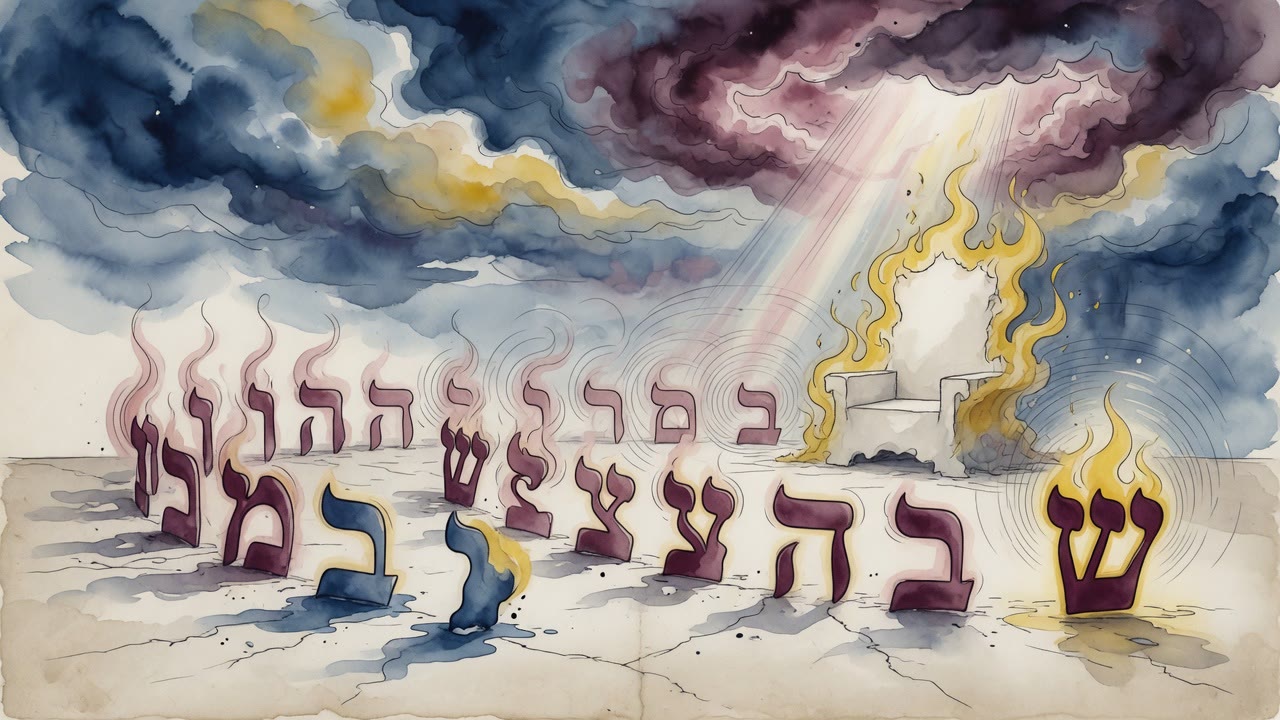
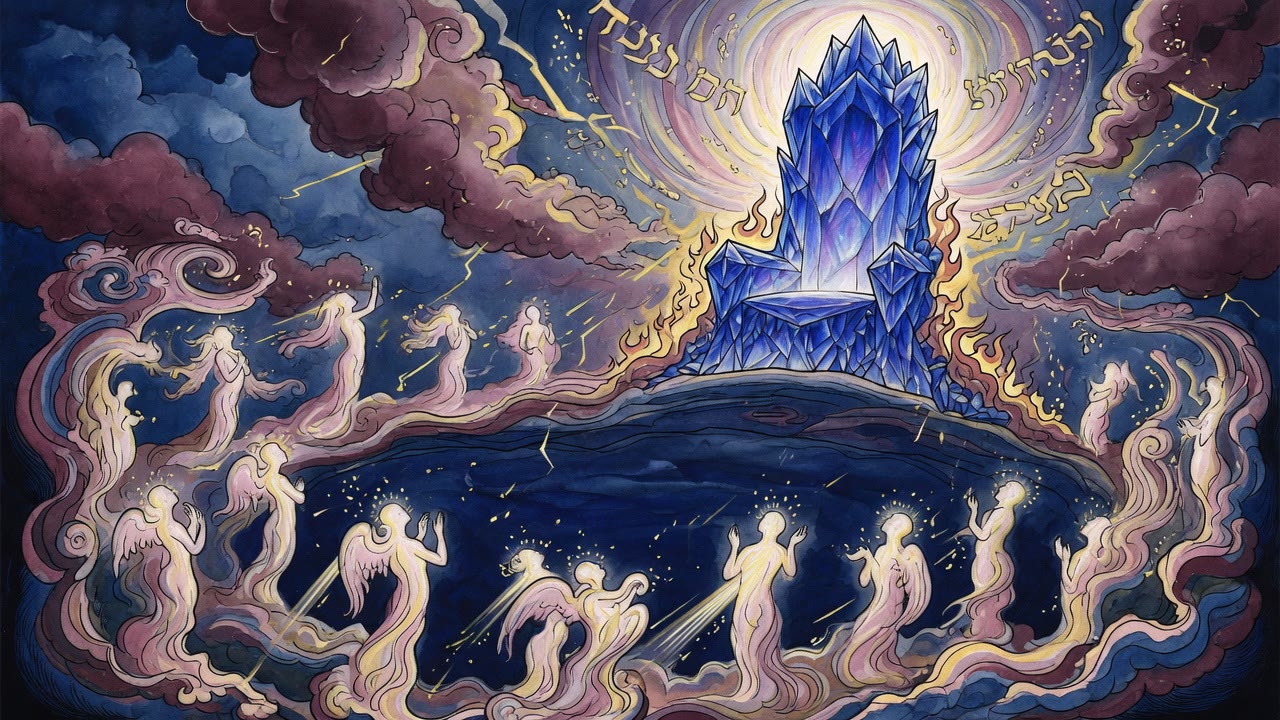
The Name came before any of that. God spoke the four letters, YHWH, Lord of Hosts, exalted, existing through the ages, whose Name is holy, and out of the Name stepped three fathers. Fire climbed and stayed up. Water sank and stayed down. Air God drove into the gap between them, and air refused to take a side. It lay against the fire without burning off and on the water without drowning, and it carried heat downward and cold upward and kept the two ends of the world from finishing each other.

From the three came seven. God opened seven heavens and set armies inside them. Then twelve, the limits of the universe, driven into place like tent pegs, with twelve constellations posted above to rule whatever lived underneath. Tali the dragon lay down in a ring around the outside of all of it and closed his coil, and inside that coil the year started to turn.

Three witnesses were left standing to testify that the pattern held: Universe, Year, and the human being. Two of those cannot be argued with. The third one has a name and a countable number of years.

The Count Came Out Exact

God counted souls the way a builder counts nails before closing up a wall. The number came out equal to the sparks waiting in the dark, to the last one. No soul was held back as a spare. No spark was left in the mud with nobody assigned to lift it.

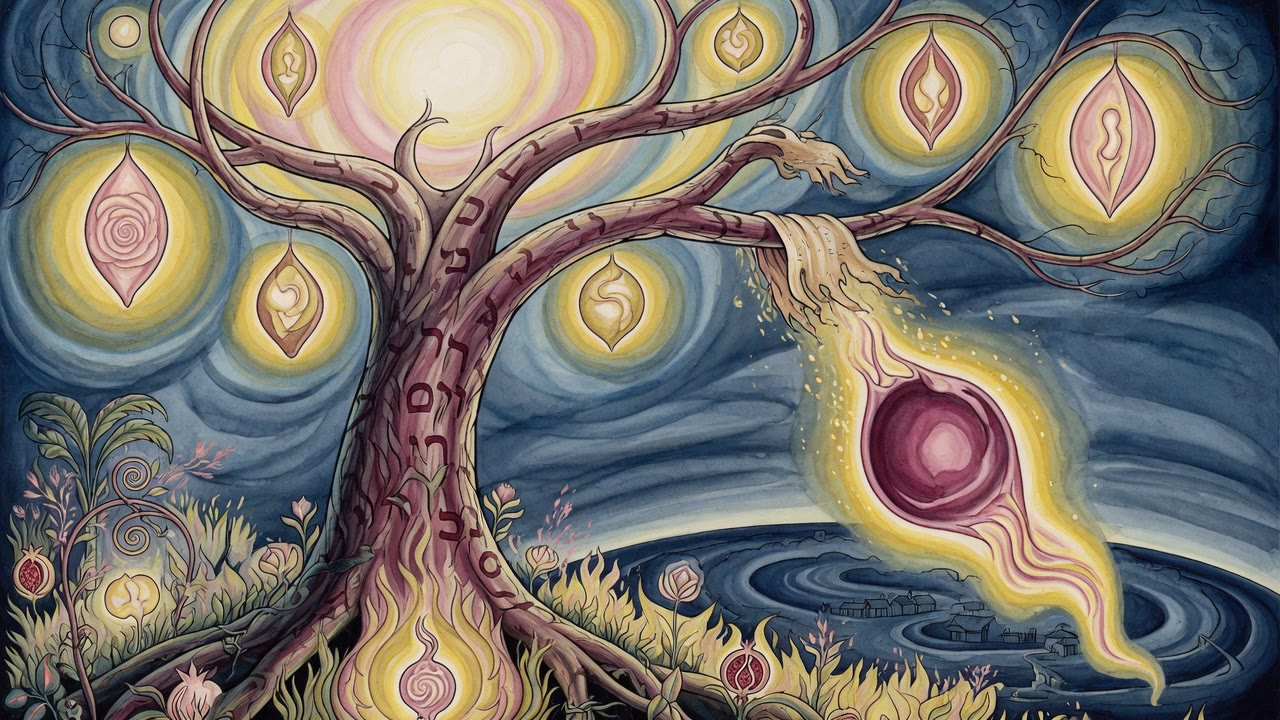
Adam Kadmon stood at the head of the count, the first human shape, and the souls took root in him. The Yechidah, the highest and most singular part of a soul, took hold in that primal body the way a graft takes in a living trunk. MaH and BaN, two configurations of the divine names, twisted together into a single line, and down that line the souls were sent out into time, each one carrying a tikkun (תיקון) written for it alone. A soul that finished somebody else's repair would still leave its own lying where it fell.

A Body Cut for One Lock

Every soul came down with a body attached, and the body was not a costume. Hands that go numb in cold water. A back that will bend a certain number of times and then stop bending. A mouth that can bless a loaf or lie about a neighbor.

The form was cut like a key, and the wards it had to match were the commandments this one life could actually keep. This hand on this doorpost. This coin into this palm. This Friday lamp lit by this woman while the room goes gold and the street outside stays dark. A soul with other hands would reach a different spark and step over the one lying here.

Creation was arranged around that work and served it. Grain came up, rivers held their channels, the seven armies kept their stations in their heavens, and the government of the worlds ran through souls before it ran anywhere else, spreading outward from them into everything that had been made.

The Hour of Bending

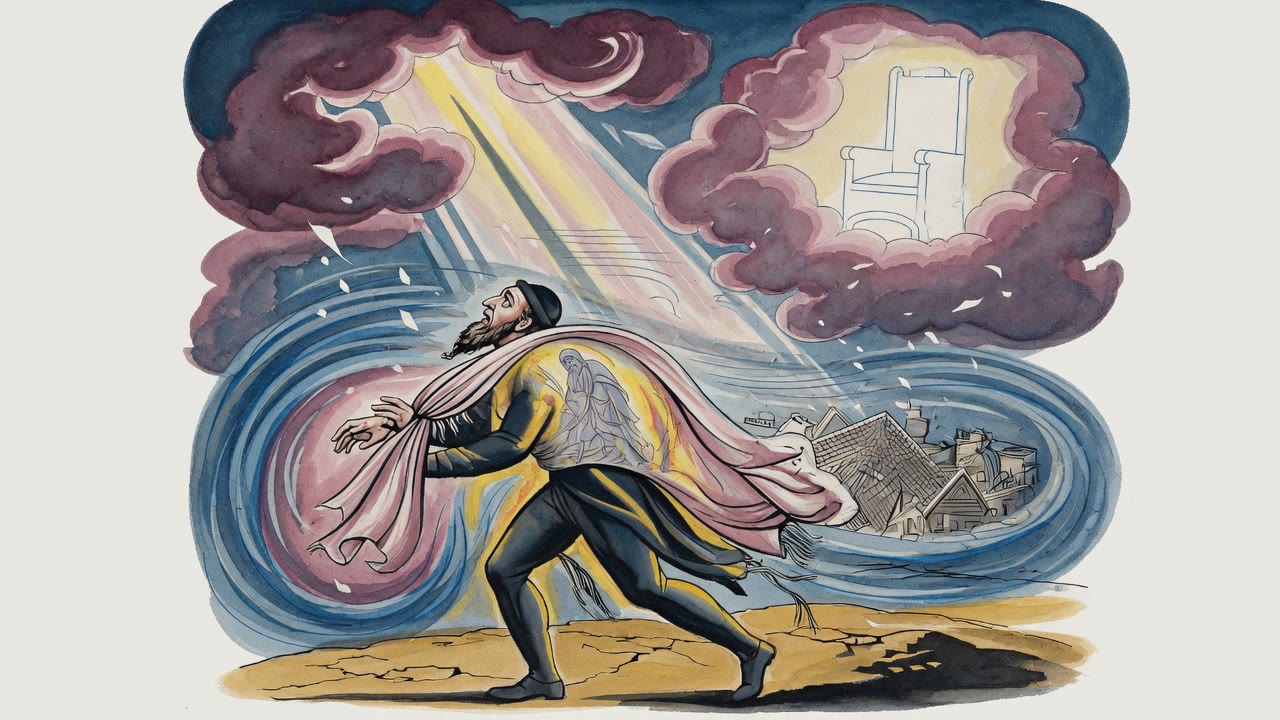
Gathering a spark looks like almost nothing from the outside. A man walks home after dark and stops because there is a coat in the road that belongs to somebody. He is tired. He does not want it. He picks it up anyway, and the spark that had been lying inside that small errand since the row of vessels came apart lifts out of the mud and goes up through floors he will never see.

It does not always go up. Sparks stay down when nobody bends for them. A soul can live within arm's reach of the single repair cut to its measure for sixty years and never put a hand out, and the spark keeps its place in the wet ground, and the Other Side goes on eating.

Presence sits under that floor in pieces, near enough that the ache of it comes up through the boards, too far to reach without a body willing to stoop.

What the Other Side Still Holds

The surge that raised the vessels was the same surge that split them. Nothing came in from outside to break them. The light that made them possible arrived stronger than the shape they had been given, and the shape gave way, and the breaking opened room for a finer light later, a light that vessels could hold once they had learned what holding costs.

So the pieces lie where they landed. Down in the dark the Other Side stands on its floor of stolen crumbs and counts what it has taken. Up in the road the tired man shakes the mud out of the coat before he hands it back, and one spark fewer remains in the count below, and the row of broken vessels waits, and the light waits over the row for a shape that can hold it the second time.


← All myths
From the tradition

Sources

3 sources

The texts behind this telling. Some cards carry a translation of the source; others are our own retelling of it, and each card says which. Every card links out to the original.

Kalach Pitchei Chokhmah 37:6Kalach Pitchei Chokhmah

Retold in our words. Read the original at the link below.138 Openings of Wisdom, trans. Rabbi Avraham Greenbaum, Azamra Institute (2005) · CC-BY

That’s because, in a way, it is. Jewish mystical tradition grapples with this paradox all the time, especially when it comes to understanding creation itself. readers often assume creation is all about kindness and generosity – the flowing abundance of chessed. And destruction? That's got to be rooted in strict judgment, in din. But what if I told you that the very act of creation contains within it the seeds of destruction? What if the lights themselves, the very energies that bring things into being, can also negate and break?

That's the mind-bending concept we find explored in the Kalach Pitchei Chokhmah, a Kabbalistic text that explores the deepest mysteries. It challenges our assumptions about the neat separation of creation and destruction. It asks, how can something be both at once?

It seems logical that creation and destruction should only apply to created things. The power of destruction doesn’t negate the power of creation. But then we have the story of the Sefirot (the divine emanations) of Nekudim.

The Sefirot are the ten emanations of God, the building blocks of reality. But the Sefirot of Nekudim? They existed, we are told. and then they were negated and broken. Broken! How can something so fundamentally divine be shattered?

And here's another puzzle: the Sitra Achra, the "Other Side," often understood as the source of evil. Where did it come from? According to the Kalach Pitchei Chokhmah, it emerged from these very same broken Sefirot! How can destruction possibly spring forth from creation itself?

It’s a challenging idea. It flies in the face of our desire for simple answers and clear-cut categories. But maybe that’s the point. Maybe the universe isn't a simple equation. Maybe creation and destruction aren't opposing forces, but two sides of the same coin. Maybe, just maybe, the breaking of the vessels is essential to their ultimate repair. Perhaps the shattering allows for a new, more refined light to emerge.

Full source
Kalach Pitchei Chokhmah 82:5Kalach Pitchei Chokhmah

Retold in our words. Read the original at the link below.138 Openings of Wisdom, trans. Rabbi Avraham Greenbaum, Azamra Institute (2005) · CC-BY

Jewish mysticism offers a fascinating perspective: that each of us is a soul with a unique mission, a piece of a much larger puzzle being put back together.

This idea of "repair," or tikkun (spiritual repair), is central. The Kabbalah teaches that the universe, in its original state, underwent a kind of shattering. Our job, as individual souls, is to gather those scattered pieces and restore wholeness.

The Kalach Pitchei Chokhmah, a key text in Kabbalistic thought, tells us that the Supreme Mind – God – created precisely the number of souls needed for this task. Not one too many, not one too few. It’s all perfectly calibrated. Why? Because the human form itself is a key! Our very bodies, our capabilities, and even the ways we are called to observe the mitzvot, the commandments of the Torah, are interconnected.

It's like a lock and key. The human form is the key, and the way we serve God and fulfill the commandments is the lock it's designed to open. And here’s the really mind-bending part: the human form is also the key to understanding how souls themselves are ordered!

Each soul, according to this teaching, has its own unique tikkun, its own specific repair to carry out. And this individual work contributes to the larger, ongoing repair of all of existence. It's a ripple effect. Your actions, your growth, your striving towards good – it all matters. It affects everything.

But where does this mission come from? The text points to the interconnection of MaH and BaN, referring to specific configurations of divine names that represent different aspects of God’s creative energy. Souls are rooted in higher spiritual levels. Shaarey Kedushah (3:2) states that "the Yechidah (the singular, highest level of the soul) is from Adam Kadmon," referring to the primal, archetypal human. From these root levels, each soul receives its unique mission.

The Kabbalists believed that the entire governmental order of the universe operates primarily through and for souls. And from there, the influence extends to all of creation, all the worlds. As it says in Midrash Rabbah, "The entire creation serves man." Creation itself is arranged to support the service required of souls.

So, what does this mean for you and me, living our lives here and now? It suggests that our struggles, our passions, our very existence are not random. They are part of a grand design, a cosmic repair project in which we are all essential players. It invites us to consider: What is my unique piece of the puzzle? What repair am I called to make? How can I contribute to the healing of the world, one small action at a time?

Full source
Sefer Yetzirah 6:1Sefer Yetzirah

Retold in our words. Read the original at the link below.Sefaria-hosted English translation · CC-BY

The Sefer Yetzirah, the "Book of Creation," offers a mind-bending blueprint. It's a short but incredibly dense text of Jewish mysticism, traditionally attributed to the patriarch Abraham. And within it, we find a fascinating breakdown of the 22 letters of the Hebrew alphabet and their role in creation.

There are three "mothers," seven "double," and twelve "simple" letters. These aren't just letters; they're primal forces.

In Sefer Yetzirah, the very name of God, the Tetragrammaton – ה–ו–ה–י (YHWH) – is key. This is "our Lord of Hosts," the text proclaims, "exalted, and existed in the ages, whose Name is Holy." From this divine name, God created three "fathers": fire, spirit (or air), and water.

These aren't just elements in the periodic table sense. They’re foundational, archetypal forces from which everything else springs. That God then progressed beyond these three fathers to create "seven heavens with their armies of angels; and twelve limits of the universe." The entire cosmos, built upon these elemental forces, themselves derived from the divine name.

But how can we know this is true?

The Sefer Yetzirah offers a compelling argument: Proof lies in the Universe, the Year (time), and Man himself – the microcosm. These three things – Universe, Time, and Humanity – act as witnesses to what the text calls the Triad, the Heptad, and the Dodecad. That's the groups of three, seven, and twelve we just discussed.

The twelve constellations, which rule the world, the Dragon Tali (a serpent-like figure which some understand as the ecliptic, or the path of the sun), which encircles the universe, and human beings – all these reflect the same fundamental structure. It's a microcosm mirroring the macrocosm, a pattern echoing throughout existence.

The text elaborates on the triad: fire above, water below, and air in the midst. But here's the clever part: air is a "participator" with both. It bridges the gap, mediating between the extremes of fire and water. This suggests a dynamic interplay, a constant flow and exchange between these fundamental forces.

What does it all mean?

Perhaps the Sefer Yetzirah is telling us that the universe isn't just a random collection of matter and energy. It's a carefully constructed system, built upon a divine blueprint, with patterns and connections that run deep. And maybe, just maybe, by understanding these patterns, we can gain a deeper understanding of ourselves and our place in the cosmos.

To think that the very letters we use to communicate, the elements that make up our world, and even the structure of time itself are all interconnected, all pointing back to a single, divine source. The Sefer Yetzirah invites us to explore these connections, to explore the mysteries of creation, and to find our own meaning within the grand cosmic design.

Full source