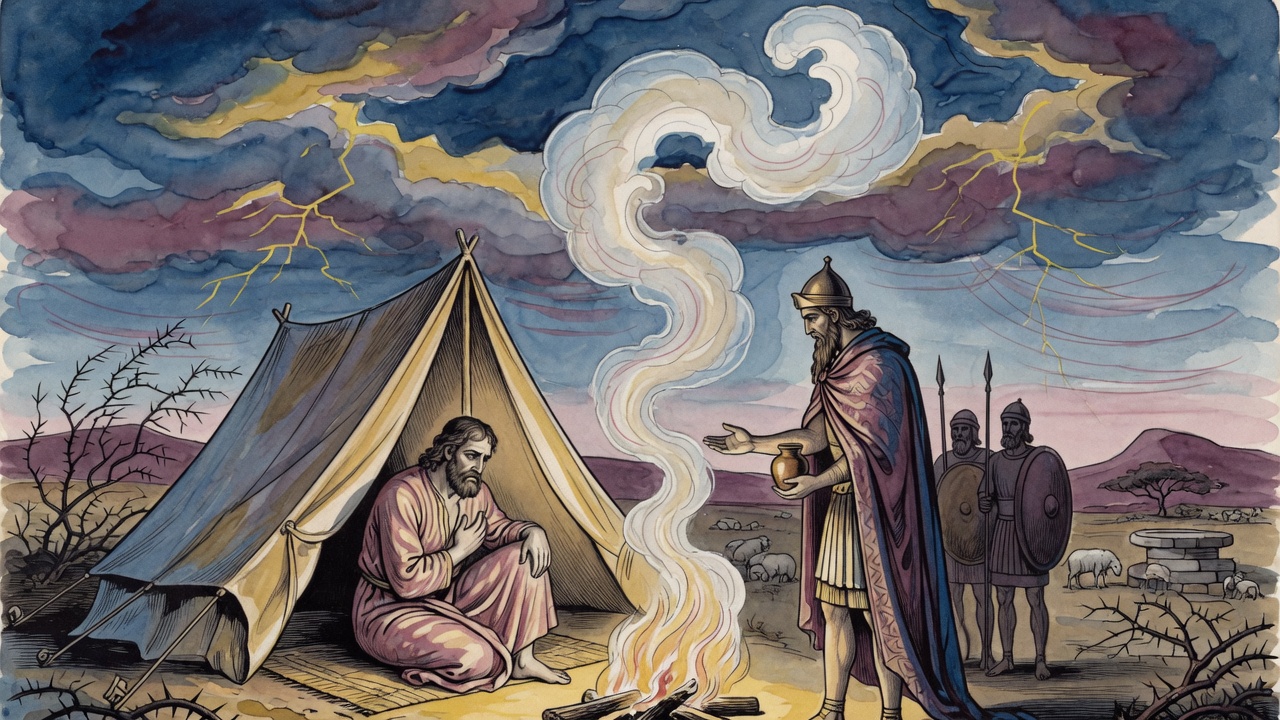
Chiya Lied Quietly to Fix His Mother's Kitchen War
Rav asked for lentils and got beans until his son quietly reversed every order. Peace returned to the table, and Rav ordered the lying stopped.
Table of Contents
Rav sat at his table in Babylonia and asked for lentils. The bowl that arrived held beans. He asked for beans the next day. Lentils came. He learned the pattern the way a man learns weather: without winning. He ate what arrived and kept the house from war.
 Click for full size
The Boy Who Reversed the Orders
Their son, Rabbi Chiya, watched the daily comedy until he was old enough to carry messages between the rooms. He studied his mother's contrariness the way a student studies a difficult sugya (a Talmud passage). When Rav asked for lentils, Chiya told his mother that Rav wanted beans. She cooked lentils. For the first time in years, the dish on the table matched the wish in the father's mouth.
Rav was amazed. "Your mother has changed," he said. Chiya explained the trick, proud of the peace he had manufactured. Rav looked at him carefully. "Stop," he said. "Your intention is beautiful. You wanted shalom bayit, peace in the home. But if you keep speaking the opposite of what you mean, even for a good reason, your mouth will learn to lie. A mouth that practices falsehood for dinner will use it later for worse. Stop now, while you still remember which word was which."
A Feast Built on the Wrong Desire
Another child once sat at a feast that looked like Torah and was not. Elisha ben Abuyah, later called Acher, "Other," told of his brit milah. His father Abuyah made a great celebration. Guests sang and danced. The rabbis at the table did neither. They sat and spoke of God's wisdom and the mysteries of Torah. Abuyah listened and was pleased for the wrong reason. He said, when my son grows, teach him so that he becomes like you, and my name will be famous through him.
Elisha looked back on that hour with grief. He had not been made a student of Torah lishmah, for its own sake. He had been made an investment. In his latter days he became an apostate, and he traced the crack to that first feast. A child raised on glory will grow up to doubt every verse he ever learned. Motive is half the Torah.
Chiya's kitchen lie and Abuyah's feast stand on the same fault line. Both seek a good outer result. Both train the next generation in a crooked instrument.
Three Things That Cut Life Short
Rav, the same teacher who corrected his son, also warned in his teacher's name of three refusals that shorten a person's days. One: being handed a Torah scroll to read in public and declining, for Torah is "your life and the length of your days." Two: being offered the cup of blessing after a meal and refusing to recite the grace. Three: lording over others. Joseph died before all his brothers though he was not the eldest, the sages say, because he carried himself with the authority of a master and let the trappings of rule spend his years.
Power that enjoys itself, like a lie that "works," spends the future. Chiya's small deceit would have bought afternoon calm at the price of a mouth trained wrong. Joseph's authority bought Egypt's grain stores at the price of shortened days. The pattern is not superstition. It is moral physics: the instrument you use becomes the person you are.
What Peace Is Allowed to Cost
Shalom bayit is a high value. Rav did not praise chaos. He simply refused a peace built on daily falsehood. Better a wrong dish on the table than a son who no longer knows how to tell the truth when the stakes rise. Better a feast given for love of Torah than a feast given for the family name. The house that is calm only because no one speaks straight is already preparing its next crisis.
Chiya stopped. The beans and lentils went back to their old war. Rav ate. The mouth of the next generation stayed clean enough to learn.
Years later the story was told not as a recipe for marriage advice but as a warning about tools. A tool that works once becomes a habit. A habit becomes a character. Chiya's inverted messages would have trained him to treat speech as a lever instead of a witness. Rav, who built Babylonian learning on careful words, could not let his son's mouth become a lever.
Elisha's father wanted fame through a son's learning. That desire is understandable. It is also a poison poured into the first cup of Torah the child tastes. When the grown Elisha broke, he blamed the cup, not only the later storms of philosophy and pain. Motive sits in the grain of the wood. You cannot sand it out after the table is built.
Joseph's shortened life under the weight of mastery is the third mirror. Authority spent him. The world needed his grain. Heaven still counted the cost of how he carried himself. So too a household that needs calm. Calm is good. Calm purchased with daily falsehood spends the child's future. Calm purchased with glory-motives spends the student's soul. Calm purchased with domination spends the ruler's days.
Rav went back to beans when he asked for lentils. He preferred the honest mismatch. Honesty is a dish that does not always taste good. It keeps the eater alive for harder meals.
← All myths