Parshat Vayishlach5 min read

David Called His Son Absalom Out of Gehinnom

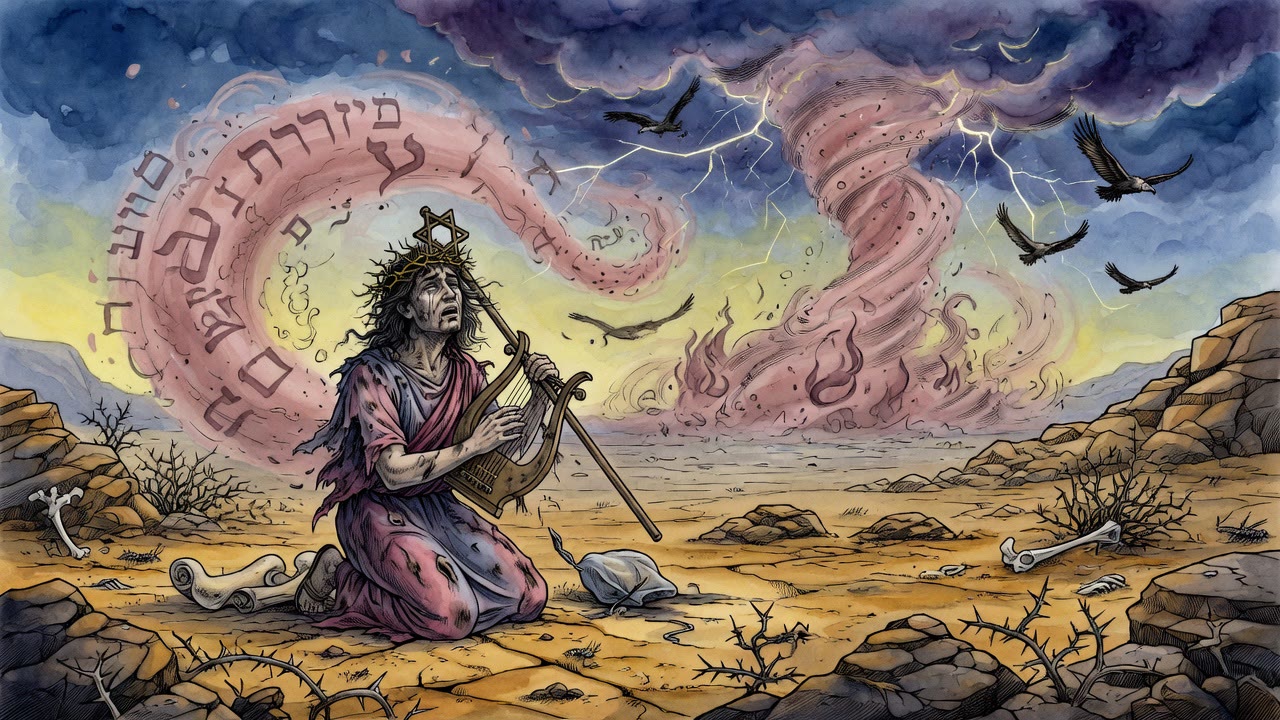
David repeated Absalom's name in grief, and the midrash counts each cry as one door opened in Gehinnom for his lost son.

Curated by Arthur · Told by Maggid ·
Table of Contents
  1. Absalom Fell Through Five Doors
  2. The Father Said My Son Five Times
  3. The Last Two Cries Lifted Higher
  4. The Throne Did Not Harden Him
  5. Gehinnom Heard a Parent's Voice

David did not stop at mourning.

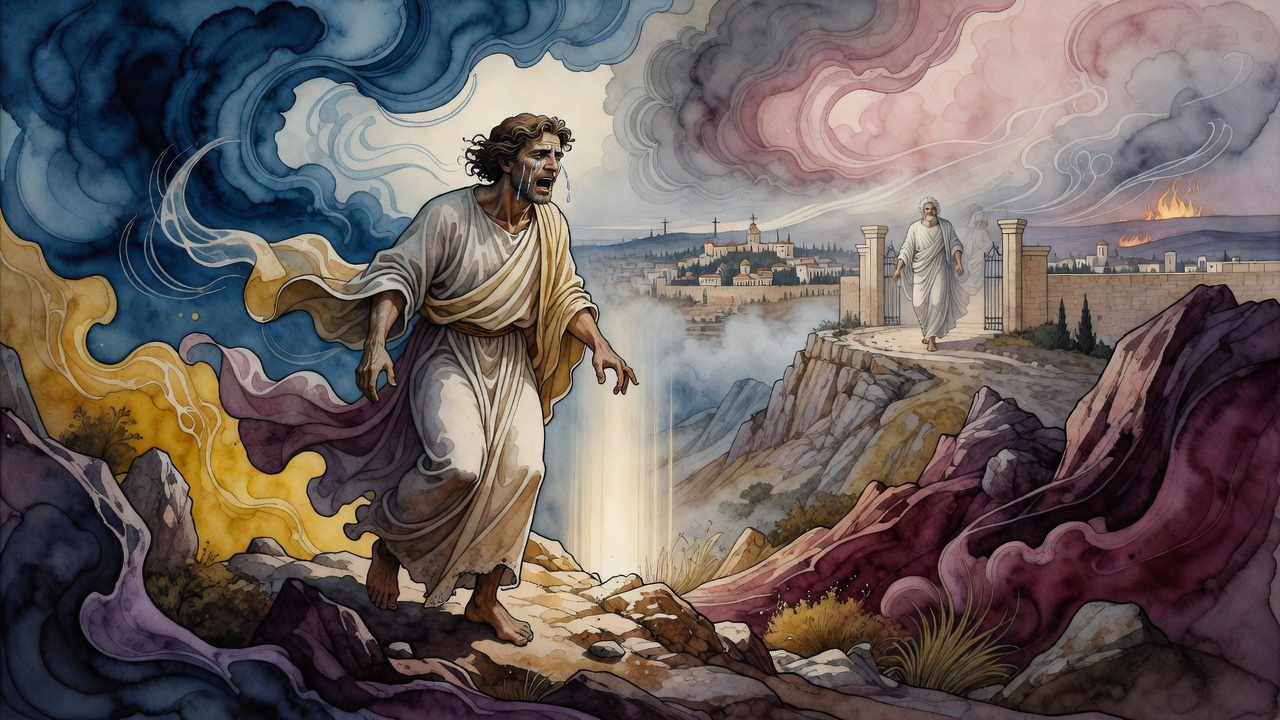
Absalom had betrayed him, hunted him, shamed his house, and died hanging between heaven and earth. The messenger brought news that should have sounded like relief. The rebellion was over. The throne was safe. The son who tried to become king was dead.

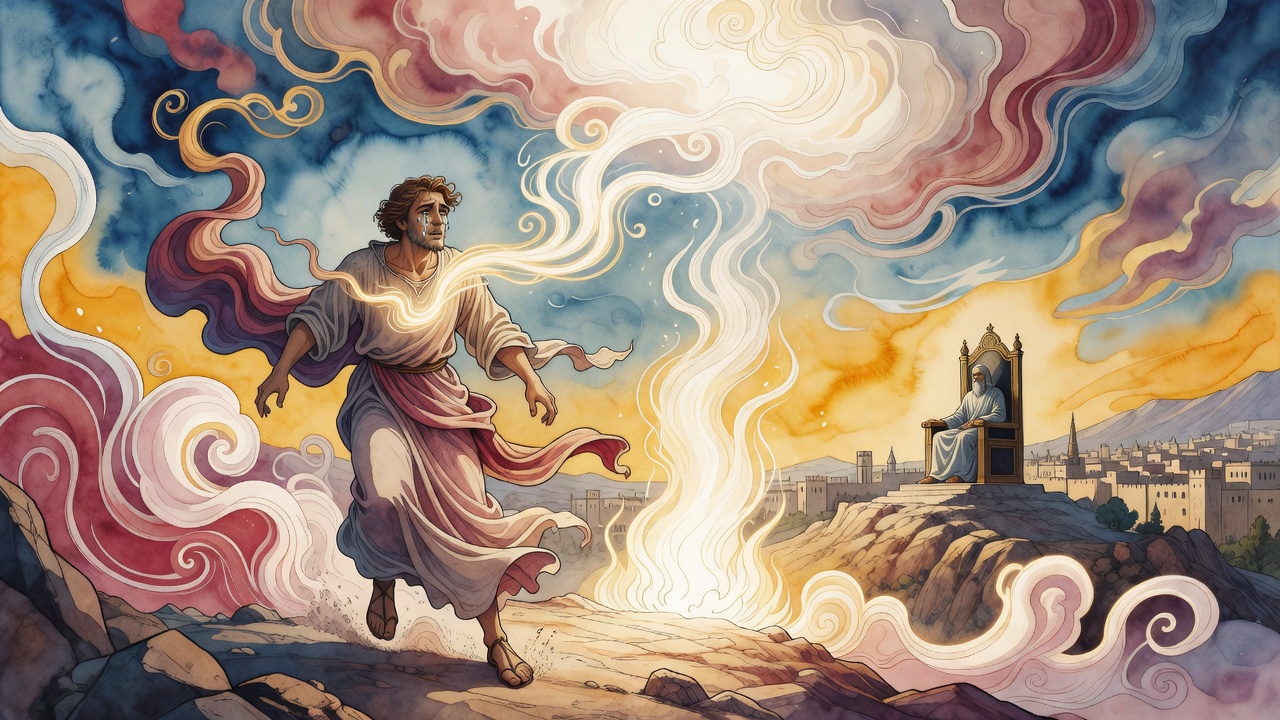
David heard the news and broke open. He cried for his son again and again, and the midrash counted every repetition.

Absalom Fell Through Five Doors

Pirkei DeRabbi Eliezer imagines Gehinnom with seven doors.

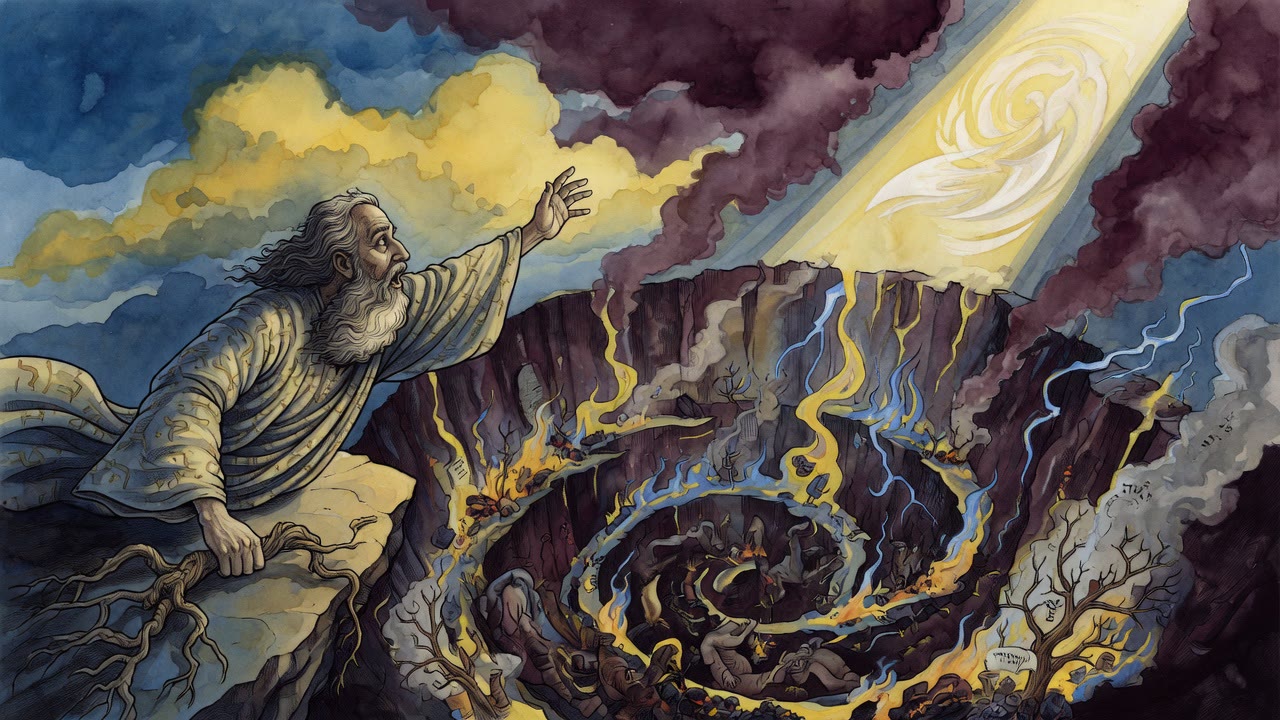
Absalom had descended through five of them. His rebellion was not treated as a misunderstanding. He had torn at his father's kingdom and violated the house from which he came. He belonged in judgment. The midrash does not rescue him by pretending his sin was small. It sends him downward first, door after door, into the place where a soul meets the truth of what it has done.

Then David's voice reaches him.

The Father Said My Son Five Times

David called him my son.

Each cry did work. One utterance raised Absalom from one door. Another from the next. Five cries, five doors. Grief became motion in the unseen world. The father who had been betrayed still knew the son as son, and that knowledge had power beyond the battlefield.

The words did not cancel justice. They moved through it. David's love did not deny Absalom's guilt, but it would not let guilt be the last name spoken over him.

The Last Two Cries Lifted Higher

David did not stop when the five doors had opened.

He cried twice more. Those final cries did more than pull Absalom out from the lower depth. They lifted him toward the radiance of God. The midrash's arithmetic is bold: five cries for rescue, two cries for elevation. David's mourning becomes a ladder, and every rung is made from the same impossible word, son.

The king could not save Absalom in battle. The father still reached him after death.

The Throne Did Not Harden Him

A different king might have blessed the corpse.

Absalom's death solved a political problem. It ended civil war and returned stability to David's camp. But David was never only a king in this scene. He was the father whose heart had not accepted the calculation that the kingdom was worth the child. His grief embarrassed his soldiers, but the midrash makes that grief cosmic.

The throne needed victory. The soul needed mercy. David chose to speak where mercy could still hear him.

Gehinnom Heard a Parent's Voice

The scene is frightening because speech matters after speech seems useless.

Absalom cannot answer. David cannot undo the rebellion. The army cannot reverse the death. The father says the name, and in the hidden court the name becomes an opening. A parent may fail in life, a child may fail worse, and the damage may become public, political, and bloody. Still, the cry of relationship can enter places law alone would leave closed.

David's psalms taught Israel how to pray. His grief taught even Gehinnom how to release.

The counting is severe because it refuses vague comfort. David does not simply feel love, and heaven does not simply wave away Absalom's revolt. The cries are numbered against doors. The movement upward corresponds to spoken grief. The midrash makes mercy measurable so that it cannot become sentimental.

Absalom's body had been caught in a tree, suspended between the ground and the sky while the battle moved around him. His soul is then imagined as suspended in another way, trapped between judgment deserved and mercy still possible. David's voice crosses that distance. The father who could not prevent the death can still refuse to let the son's final motion be only downward.

For a king, Absalom was a rebel. For David's mouth, he remained my son, and that phrase became stronger than the doors.

The repetition of my son also reverses Absalom's rebellion. During the revolt, Absalom tried to define himself apart from David, as rival, claimant, and replacement. David's lament names him back into relationship. The words do not restore the kingdom's dead bodies, but they deny Absalom the final loneliness of being remembered only as an enemy.

That is the terror and mercy of the midrashic count: a word spoken in love can travel where armies, messengers, and royal decrees cannot.


← All myths
From the tradition

Sources

6 sources

The texts this telling draws on, in full. Open a card to read inline, or expand it for a wider, quieter read.

Pirkei DeRabbi Eliezer 53:10Pirkei DeRabbi Eliezer

The ancient text Pirkei DeRabbi Eliezer, a fascinating collection of stories and interpretations, gives us a glimpse into just that possibility. It tells a powerful, almost unbelievable story about King David and his rebellious son, Absalom.

The familiar story centers on Absalom. He led a revolt against his own father, a heartbreaking betrayal. And ultimately, Absalom met a tragic end. But what happened to his soul?

Rabbi José, in Pirkei DeRabbi Eliezer 53, paints a dramatic picture. He says there are seven doors to Gehinnom (the place of spiritual purification after death) – often translated as Hell, but perhaps better understood as Gehinnom, the place of spiritual purification in Jewish tradition. Absalom, burdened by his sins, descended into this realm. He reached the fifth door. Can you imagine the depths of despair and regret he must have felt?

Here's where the story takes an extraordinary turn.

David, upon hearing of his son's fate, is overcome with grief. He weeps, he laments, he cries out "Absalom! My son!" five times. The verse from (2 (Samuel 18:3)3) echoes through time: "And the king was much moved, and he went up to the chamber over the gate, and wept: and as he went, thus he said, O my son Absalom, my son, my son Absalom! would God I had died for thee, O Absalom, my son, my son!"

That raw, visceral cry of a father's love… according to Pirkei DeRabbi Eliezer, it wasn't just an expression of grief. It was an act of profound spiritual intervention. David's love, his anguish, his desperate plea, it reached into the depths of Gehinnom itself.

That Absalom was brought back from those five doors because of David’s cries. Pulled back from the brink.

And what happens then? Absalom, spared from further descent, begins to praise and glorify his Creator. He recognizes the miracle that has occurred. He says, "Shew me a token for good; that they which hate me may see it, and be ashamed: because thou, Lord, hast helped me, and comforted me" (Psalm 86:17). David interprets this, saying, "Thou hast helped me" out of the war of Absalom, and "thou hast comforted me" in my mourning for him.

Is it a literal account? A metaphor? A glimpse into a deeper truth about the power of parental love and repentance? Perhaps it's all of those things. It certainly pushes us to consider the boundless nature of compassion and the possibility of redemption, even in the darkest of circumstances. It suggests that even after death, the bonds of family, particularly the fierce love of a parent, can have an unimaginable impact. It makes you wonder what other unseen forces are at play in the universe, responding to the cries of our hearts.

Full source
Midrash Tehillim 28:4Midrash Tehillim

The Midrash (rabbinic interpretive commentary) opens with a simple plea: “I call to You, O Lord, to you I raise my voice.” It’s a moment of connection, a reminder that even in the midst of life’s complexities, we can always turn to something greater than ourselves.

Then it hits you with a powerful proverb: "Better to be lowly in spirit along with the oppressed than to share plunder with the proud.” (Proverbs 16:19). Is it better to align yourself with power and privilege, even if it means compromising your values? Or is there a deeper satisfaction in standing with those who are struggling, even if it means sacrificing some of your own comfort?

The Midrash makes it pretty clear where its allegiance lies. “Blessed is the person who takes care of the oppressed and behaves humbly.” There’s a real sense of reward in that statement, a sense that true fulfillment comes not from material gain, but from acts of kindness and compassion.

What about those who choose the other path? What about those who embrace wickedness and exploit others for their own benefit? The Midrash doesn’t mince words: “Woe to the person who takes care of the wicked, for they take what is theirs and depart from the world.” There’s a harshness to this, a warning that ill-gotten gains are fleeting and ultimately meaningless. As it says in Psalms (37:10), "A little while, and the wicked will be no more."

It almost sounds like a divine reckoning. The Midrash even quotes God, saying that in a single hour, the wicked will consume their worldly possessions only to descend into hell, along with all their enablers. Talk about a swift downfall! The prophet Jeremiah (49:10) echoes this sentiment, prophesizing the utter desolation and ruin of the city of Bozrah as a symbol of divine judgment.

So, what’s the takeaway? For David, the Psalmist, the choice was clear. "I will not eat at their table, nor will I sit with them," he declares. He refuses to partake in the spoils of the wicked, choosing instead to remain true to his own moral compass.

It's a powerful statement. A call to action. A reminder that we all have a choice to make. Will we pursue power and wealth at any cost? Or will we choose the path of humility, compassion, and justice? The answer, of course, is up to each of us. But the Midrash Tehillim suggests that the true rewards lie not in what we accumulate, but in what we give.

Full source
Midrash Tehillim 86:5Midrash Tehillim

King David certainly did. And in the book of Psalms, specifically Psalm 86, we find him pleading: "My Lord, guide me in Your path."

In Midrash Tehillim, a collection of rabbinic teachings on the Psalms, David is saying something profound: "If You see me deviating from Your path, it is for You that I do so." It's a mind-bending idea, isn't it? That even our missteps, our moments of straying, can somehow be part of a larger divine plan.

Rabbi Yitzhak, in the name of Rabbi Chanina bar Abba, offers a powerful parable to illustrate this. Imagine a farmer with two cows. One is a hardworking plow cow, the other… not so much. So, what does the farmer do? He takes the yoke from the diligent cow and places it on the lazy one, forcing it to plow. He makes the unwilling cow work.

The parallel, of course, is to our own internal struggles. Our yetzer hara (יֵצֶר הָרַע), the "evil inclination," that voice inside us that whispers temptations and pulls us away from what we know is right. We can't just let it run wild. We have to take control, to "guide it to where it desires not to go," as the Midrash (rabbinic interpretive commentary) puts it. We must force it to plow.

The Midrash continues, “Guide me in Your path, Lord.” I will thank You, Lord, with all my heart, both with the yetzer tov (יֵצֶר טוֹב), the good inclination, and with the yetzer hara, that I may not be ensnared by them.” David understood that even the negative impulses could, paradoxically, lead to a deeper appreciation of the good. It’s through overcoming temptation that we truly strengthen our character.

Rabbi Chiya raises another crucial point, questioning the phrase: "And You saved my soul from the lowest depths?" Rabbi Yudan answers with a stark image: "The path of adulterers is set in the depths of Sheol" (שְׁאוֹל), the underworld, a place of darkness and separation from God.

So, David isn't just asking for guidance in a general sense. He's pleading for rescue from the most dangerous, most soul-crushing pitfalls. He acknowledges that God's kindness is immense, that He has the power to lift us out of the deepest despair. "Guide me," David prays, "for Your kindness is great upon me, and You have saved my soul from the depths of Sheol."

What resonates so powerfully in this passage from Midrash Tehillim is the raw honesty about the human condition. We’re not perfect. We struggle. We stumble. But the key is to recognize those struggles, to acknowledge the pull of the yetzer hara, and to actively seek guidance. To yoke that recalcitrant part of ourselves and force it to work towards good. And ultimately, to give thanks for both the good and the difficult, knowing that even our darkest moments can be transformed into opportunities for growth and a deeper connection with the divine.

Full source
Midrash Tehillim 101:1Midrash Tehillim

" This reminds us of (Isaiah 5:16): "And the Lord of hosts will be exalted in justice." The text goes on to say, "If in justice, then the Lord of hosts will be exalted in justice. If in righteousness, the Holy God will be sanctified in righteousness." It's a fascinating echo – suggesting that God's justice and righteousness are not just abstract concepts, but something that elevates and sanctifies.

Rabbi Huna, quoting Rabbi Acha, beautifully captures this duality: "If in kindness, I will sing. If in justice, I will sing. To you, Lord, I will sing praises." See, it's not an either/or. Whether we experience kindness or justice, the response is the same: praise to the Divine.

What about when things aren’t so rosy? What about when life throws us curveballs?

Rabbi Yehuda bar Shila brings in a quote from Job (1:21): "The Lord gave, and the Lord has taken away." That's a tough one. It's acknowledging the pain and loss that are part of life. But the rabbi adds, "Whether He gives or takes, blessed be the name of the Lord. In any case, to you, Lord, I will sing praises." Even in the face of adversity, there’s room for praise. The point isn't to deny the pain, but to find a way to connect with the Divine even within it.

Rabbi Berechiah, quoting Rabbi Levi, offers another perspective, drawing from (Psalm 92:9): "You are exalted, Lord, forever." It's a declaration of God's eternal presence and power. He adds, "Your hand, Lord, is lifted high for justice." It's a powerful image, suggesting that justice, even when it's difficult to understand, is ultimately in God's hands. And then comes a poignant statement: "Blessed be the good and benevolent One for the good, and concerning evil, one says, 'Blessed be the true Judge.'" This isn’t about sugarcoating the bad. It's about acknowledging that even in the midst of suffering, there's a deeper truth and a Divine judgment at work.

Rabbi Tanhuma bar Rabbi Yudan then ties it all together, referencing (Psalm 56:11) ("In God I will praise His word") and (Psalm 52:11) ("In the Lord I will praise His word"). He says, "If judgment comes upon me, I will praise His word. If mercy comes upon me, I will praise His word. In any case, I will praise His word." Whether it's judgment or mercy, the response is the same: praise. It’s about finding the Divine thread running through all of our experiences.

Finally, the rabbis bring in (Psalm 116:3-4): "The sorrows of death encompassed me, and the pains of hell got hold of me; I found distress and sorrow. Then I called upon the name of the Lord; 'O Lord, I beseech You, deliver my soul!'" This is a raw, honest expression of pain and desperation. The text then adds, "I will lift up the cup of salvation, and call upon the name of the Lord. In any case, to you, Lord, I will call out (sing praises)." Even in the darkest moments, when we're surrounded by sorrow and distress, the act of calling out to God, of offering praise, can be a lifeline.

So, what does all this mean for us today? It's an invitation to find praise in every aspect of our lives, the good, the bad, and the everything in between. It's a reminder that even when we don't understand what's happening, we can still connect with the Divine. It's about recognizing that kindness and justice, joy and sorrow, are all part of a larger tapestry, and that praise is a way to acknowledge the weaver. Can we learn to sing, even when the tune is a little off-key? Can we find the song within the silence?

Full source
Legends of the Jews 1:26Legends of the Jews

On the second day of Creation, God didn't just whip up one thing, but four: the firmament, hell, fire, and the angels.

This firmament isn't just the "heavens" we talked about on the first day. Oh no, this is something else entirely. It's from this firmament that the heavens get their light, much like the earth gets its light from the sun.

Its job isn't just to be pretty. This firmament is a shield, a cosmic partition. It prevents the earth from being completely swamped by the waters above. Imagine a world without that protection! According to this legend, it's the divider between the waters above and the waters below.

So, how did this crystal canopy come to be? Well, according to the Legends, it was forged by heavenly fire. This fire, bursting forth, solidified the surface of the firmament, making it the barrier it is. This idea of fire creating division – separating the celestial from the terrestrial – is echoed later, during the revelation at Mount Sinai. It's a recurring motif, fire acting as a boundary between the divine and the earthly.

And here’s the kicker: this massive firmament, holding back unimaginable amounts of water, is supposedly only three fingers thick! I know. It's hard to wrap your head around. Yet, it separates the "waters below" – the foundations of the netherworld – from the "waters above," which form the foundations of the seven heavens, the Divine Throne, and the home of the angels. for a second. This incredibly thin barrier is holding back the very foundations of existence, both above and below. It's a powerful image, isn't it?

It makes you wonder about the unseen forces, the hidden structures, that are constantly at play in our world, holding things together in ways we can barely comprehend. What other "firmaments" are out there, protecting us from forces we don't even know exist? What invisible shields do we create, in our own lives, to work through the chaos and uncertainty around us?

Full source
Midrash Tehillim 39:2Midrash Tehillim

Midrash Tehillim turns to David at the Dawn of Creation.

Let me tell you one, found in Midrash Tehillim, a collection of homiletic interpretations of the Book of Psalms. It's a wild tale, but stick with me, it has a point.

So, there was this Persian king. He was on his deathbed. The royal physicians, in their infinite wisdom, declared that the only cure was… lion's milk. Seriously!

You might be thinking, "Okay, that's impossible." Well, one brave (or maybe foolhardy) servant volunteered. He said, "Give me ten goats, and I’ll get you that milk!" The king, desperate, agreed.

The servant ventured into the wilderness, goat in tow, and eventually found a lioness nursing her cubs. Cautiously, he tossed her a goat from a distance. The next day, he got a little closer. Day by day, he repeated the process, earning the lioness’s trust until he was actually playing with her and, yes, milking her! Unbelievable. But here's where it gets even stranger. On his way back, the servant fell asleep and had this crazy dream. All his body parts were arguing! His legs boasted they were the most important because they carried him to the lioness. His hands claimed superiority because they milked her. The eyes argued that they guided him. The heart insisted it had come up with the whole goat-bribing scheme in the first place.

Then the tongue piped up: "What would you have done without me?"

The other body parts scoffed, "You? You're hidden away in a dark, shadowy place! You don't even have a bone!" The tongue, undeterred, retorted, "Today, you'll see that I am your king and ruler!"

The servant woke up, shaken. He delivered the milk to the king, but in his fear and confusion, he blurted out, "Here is the milk of a lion!"

Well, the king was furious. He heard "of a lion" instead of "from a lioness". He thought the servant was trying to poison him! He immediately ordered the servant to be hanged.

As he was being led to his execution, all his body parts were weeping. The tongue, ever the opportunist, said, "Didn't I tell you I was your king? If I save you, will you acknowledge my power?" They all agreed.

So, the tongue spoke up again. He pleaded with the king. The king, confused, asked why he'd ordered the execution. The tongue cleverly replied, "I said 'milk of a lion' because it would hasten your death."

The king, even more confused, said, "Why would you care? Let the milk kill you then!" He even added, "Furthermore, my name, Levya, means 'lion'.”

Then, they tested the milk, and guess what? It was, in fact, lioness milk! The king was cured. And the servant’s body parts finally acknowledged the power of the tongue.

The story ends with a powerful message: "Death and life are in the power of the tongue" (Proverbs 18:21). King David understood this. He vowed, "I will guard my ways, that I sin not with my tongue" (Psalm 39:1). The tongue, this story suggests, is more valuable than any sacrifice, as David also said, "I will praise the name of God with a song, and will magnify Him with thanksgiving. And it will please God more than an ox or a bull" (Psalms 69:31-32).

This midrash (rabbinic interpretive commentary), this interpretive story, isn’t just about a king, a lioness, and a talking tongue. It's about the immense responsibility that comes with the gift of speech. As the Midrash Rabbah points out on numerous occasions, our words have the power to build up or tear down, to heal or to harm. How often do we speak without thinking? How often do we underestimate the impact of our words? This ancient story reminds us that the tongue, though small, is mighty. It demands our constant vigilance, our careful consideration, and our unwavering commitment to using it for good. So, the next time you speak, remember the lion's milk and the power within you. What kind of world are you building with your words?

Full source