5 min read

David Learned Why Spiders, Wasps, and Counsel Matter

David dismissed spiders and wasps until they saved his life, while Ahithophel's rejected counsel became its own trap at the end.

Curated by Arthur · Told by Maggid ·
Table of Contents
  1. The Spider Answered First
  2. The Cave Mouth Stayed Closed
  3. The Wasp in the Camp
  4. Counsel Entered the Same Net
  5. The Last Words of a Broken Adviser

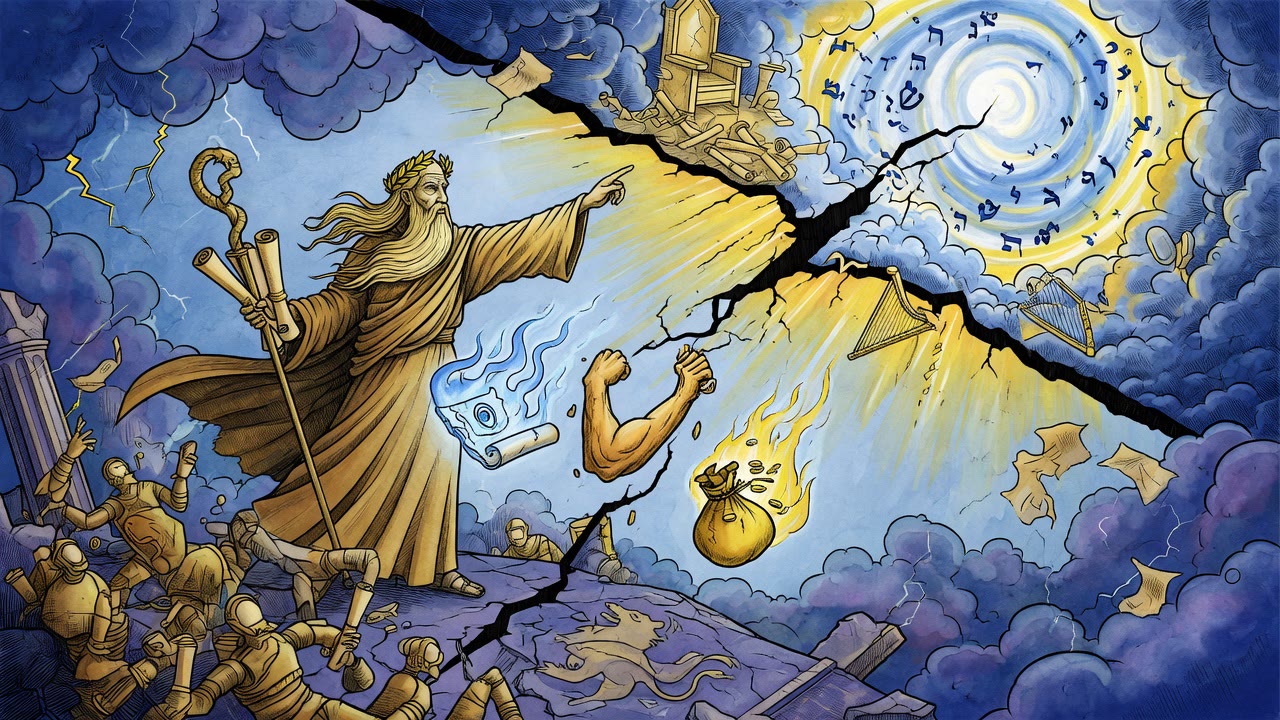
David once looked at creation with the impatience of a man who thought usefulness should announce itself.

A spider spun a web, and David saw thread without value. A wasp flew by, and David saw only a creature fit for breeding decay. The world was full of small things that did not explain themselves. David judged them too quickly.

The Spider Answered First

God did not argue with him then. The answer waited in a cave.

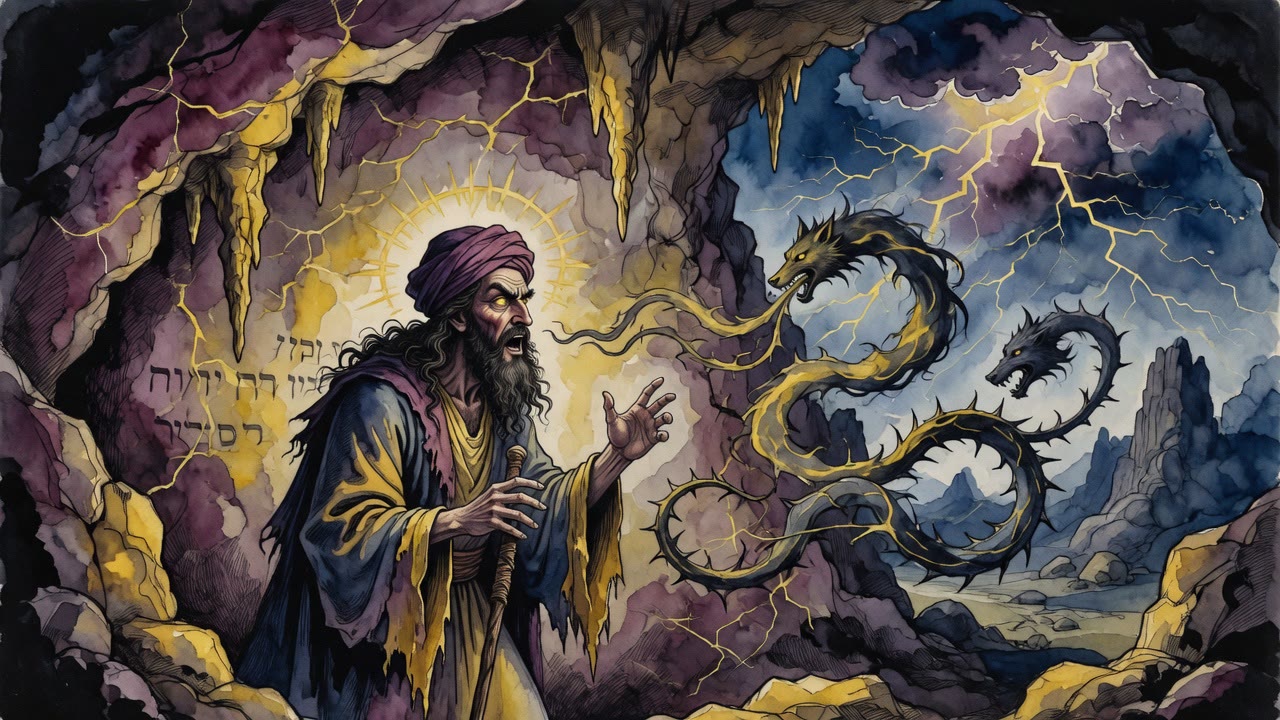
Saul was hunting him, and the hunt had narrowed to stone, dust, breath, and footsteps. David slipped into a cave with the king's men close behind. There was no army beside him, no throne, no harp, no public courage. Only rock walls, a dark mouth opening toward the path, and the sound of men who wanted him dead.

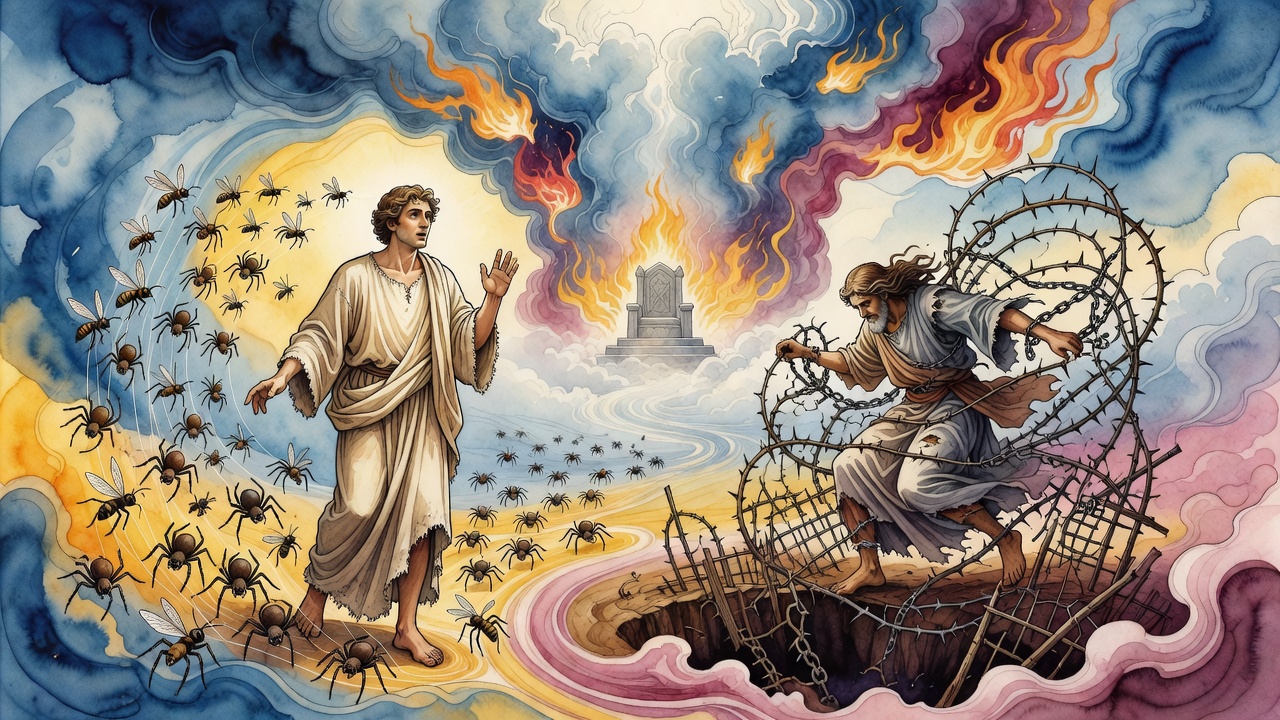
A spider crossed the entrance and began to work. Strand touched stone. Thread crossed thread. The small body moved with quiet insistence, laying a fragile door where no door had been.

The Cave Mouth Stayed Closed

Saul reached the cave and looked at the web.

No one had entered, he decided. If a fugitive had passed through that opening, the web would have torn. The king called off the search, and the soldiers moved away from the place where David held his breath in the dark.

The web had no strength against a sword. A child could have broken it with one finger. Its power was timing. It appeared in the exact place, at the exact moment, before the exact pair of suspicious eyes. The thing David had dismissed as useless became more useful than a fortress, because Saul believed it.

Inside the cave, David learned without a lecture. A web does not need to be iron to save a life.

The Wasp in the Camp

The wasp received its hour at night.

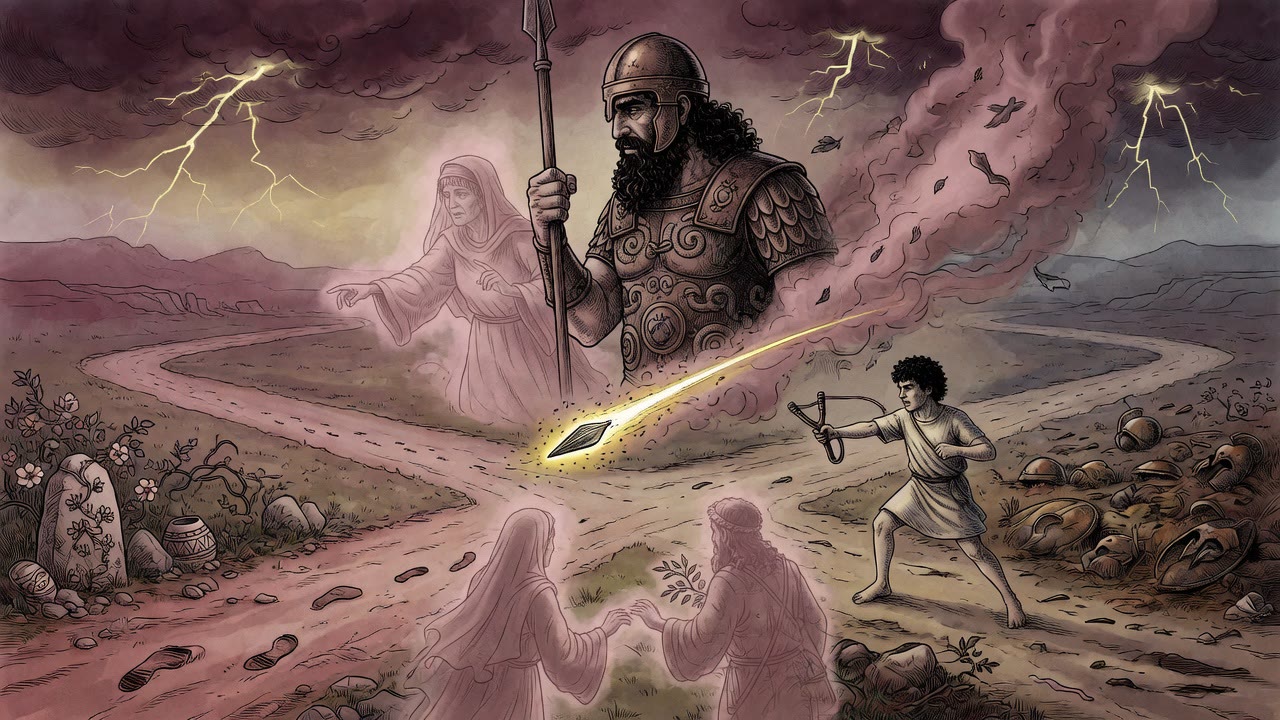
David slipped into Saul's camp while the king and his men slept. Abner, Saul's commander, lay like a giant barrier near the royal cruse of water. David wanted the cruse as proof. He could have harmed Saul and did not. He could enter the camp, take what stood near the king, and leave the sleeping enemy alive.

At first the way opened. Abner's knees were drawn up, and David reached the vessel without waking him. Then Abner stretched in his sleep. His legs came down like pillars and pinned David in place. The camp still slept, but death had only to open one eye.

A wasp stung Abner.

The sleeping commander shifted. His feet moved. David slid free with the cruse in his hand, alive because the creature he had scorned struck exactly where strength could not help him.

Counsel Entered the Same Net

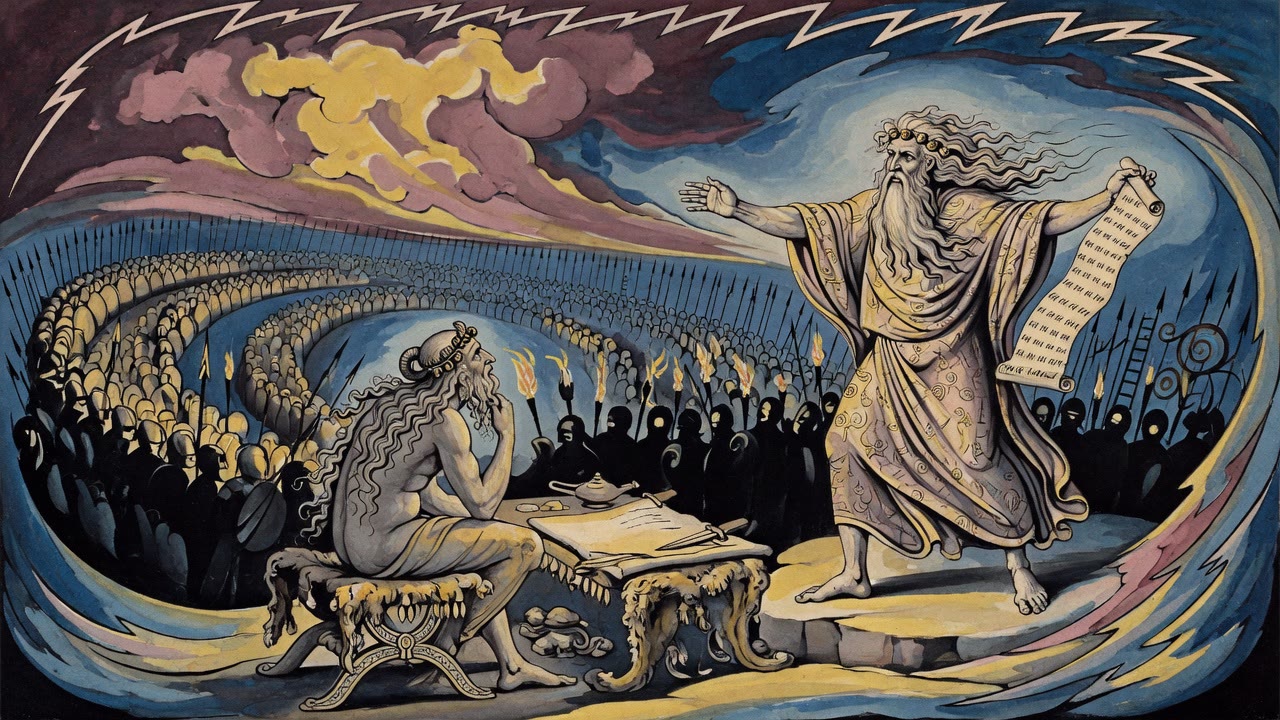
Ahithophel was not small. His counsel had the weight of an oracle. Men listened because his words usually found the road hidden inside confusion. When he stood with Absalom against David, the betrayal carried more than politics. A trusted mind had turned itself into a weapon.

David's prayer rose out of that wound: let Ahithophel's counsel become foolishness. Soon the sharpest adviser in Israel watched his advice fall to the ground. Absalom did not take it. Another voice prevailed. The man who had known how to guide kings could not move his own fate out of the trap.

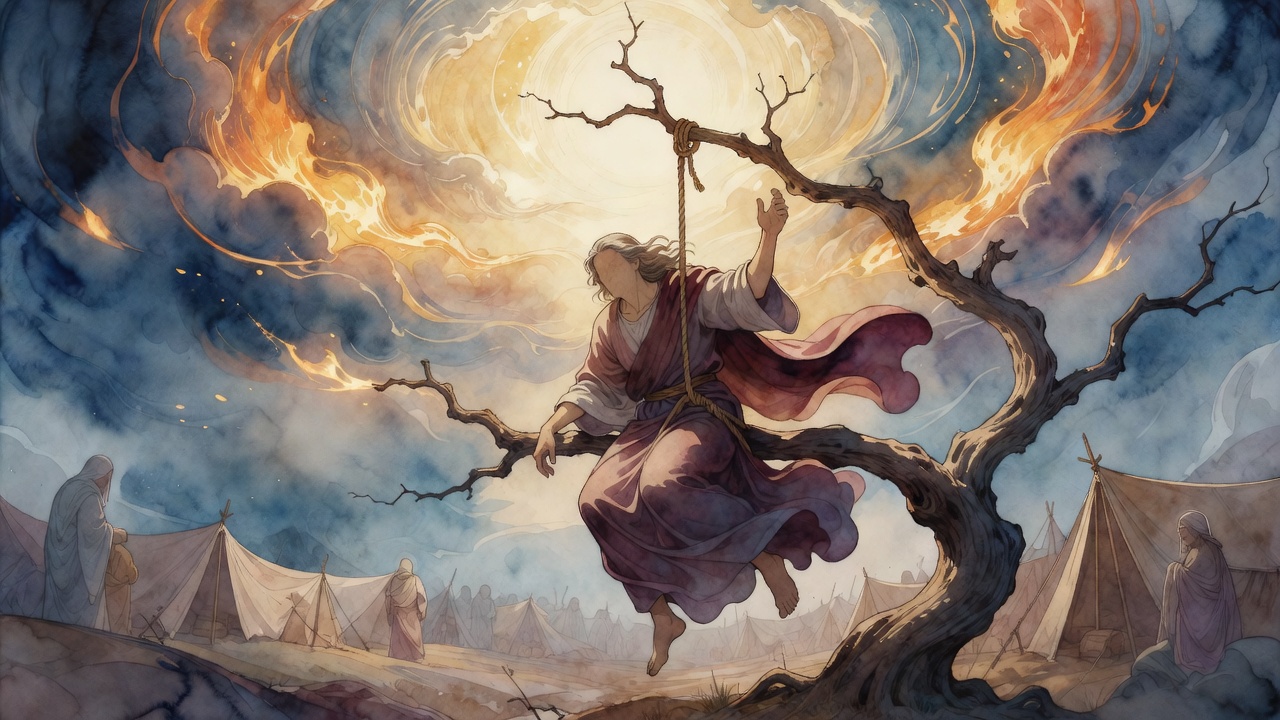
He went home, put his house in order, and hanged himself.

The Last Words of a Broken Adviser

Even at the end, Ahithophel left instruction behind. Do not act against one favored by fortune. Do not rise against the royal house of David. If Shavuot falls on a sunny day, sow wheat.

The first two lines sound like blood cooling into wisdom. He had lifted his hand against David and learned the cost. The third line keeps one foot in the field, where weather, grain, and timing still matter after kings betray and advisers die. His wisdom did not vanish. Only a small portion remained, scattered through odd channels, practical and dangerous at once.

David had mocked the spider. He had mocked the wasp. Ahithophel had trusted wisdom without obedience. The web kept its shape. The cruse left the camp. The rejected counsel returned to its owner. Nothing useless stayed useless for long.


← All myths

From the tradition

Sources

4 sources

The texts this telling draws on, in full. Open a card to read inline, or expand it for a wider, quieter read.

Legends of the Jews 4:23Legends of the Jews

King David did. And you know what? He got a divine smackdown for it – a gentle one, but a smackdown nonetheless.

David, in his younger days – before he was the celebrated king, the sweet singer of Israel – he had a bit of a blind spot. He looked at spiders, those eight-legged wonders, and scoffed. "What good are they?" he probably grumbled. "Spinning webs, catching flies... completely worthless!"

In Ginzberg's retelling in Legends of the Jews, David questioned God's wisdom in creating such seemingly useless creatures. They do nothing but spin a web that has no value, he thought.

Oh, but that opinion was about to change.

Picture this: David, on the run from the wrathful Saul, a king consumed by jealousy. He's a fugitive, desperate, seeking refuge in a cave. He ducks inside, heart pounding, hoping to evade capture.

Now, imagine Saul and his soldiers, hot on David's trail, closing in. They reach the cave, ready to storm inside. But then, a soldier stops. He points. And there, shimmering in the dim light, is a spiderweb, stretched across the cave entrance.

"No need to search here," Saul declares, his voice booming. "A spider's web! Clearly, no one has entered this cave recently."

And just like that, David is saved. All thanks to the humble spider and its "useless" web.

Talk about a divine intervention!

The Zohar tells us of the spider's crucial role in saving David's life. It's a stark reminder that what appears insignificant to us might hold immense value in the eyes of God.

It makes you wonder, doesn't it? How often do we dismiss things as worthless, only to discover later that they played a vital role? How many "spiders' webs" do we overlook in our daily lives? Maybe, just maybe, everything has a purpose, even if we can't see it right away. It’s a humbling thought.

Full source
Legends of the Jews 4:24Legends of the Jews

As retold by Ginzberg, David wasn't always so enlightened. He apparently had a bit of a scornful streak, especially when it came to wasps. He figured they were only good for breeding maggots – not exactly a ringing endorsement!

Life, as it often does, had a lesson in store for him.

The story goes that David found himself in a rather precarious situation. He had snuck into Saul’s camp one night, finding Saul and his men fast asleep. Remember, Saul wasn't exactly David's biggest fan at this point. David, ever the magnanimous one (or perhaps just trying to prove a point), decided to take a souvenir: the cruse, or water jug, that was sitting between the feet of Abner, Saul's general – a giant of a man, no less.

Abner was sound asleep, and his knees were conveniently drawn up, allowing David to snatch the cruse without disturbing him. So far, so good. Wrong.

As David was making his escape, Abner, in his sleep, stretched out his legs. And just like that, David was pinned, trapped as if held down by two immovable pillars. Talk about a close call! According to the tale, David's life was hanging by a thread.

What could possibly save him? An angel? A sudden burst of strength?

Nope. A wasp.

Yes, a humble wasp, the very creature David had so readily dismissed, stung Abner. In his sleep, Abner instinctively moved his feet, releasing David from his unexpected prison. David, needless to say, made a hasty retreat.

And just like that, David’s opinion of wasps did a complete 180. He learned a powerful lesson that day: even the smallest, seemingly insignificant creatures can play a crucial role. As this story from Ginzberg's retelling in Legends of the Jews shows us, it's a reminder that judging things too quickly can blind us to their true value.

It makes you wonder, doesn’t it? What "wasps" are we overlooking in our own lives? What seemingly insignificant things might actually be holding the key to our own salvation, our own breakthroughs? Maybe, just maybe, it's time to take a second look.

Full source
Legends of the Jews 4:38Legends of the Jews

The story of David and Ahithophel certainly makes you think so. We’ve talked before about their complex relationship – Ahithophel, the brilliant advisor whose counsel was once considered as wise as an oracle, and David, the king he served ((2 (Samuel 16:2)3)). But their bond shattered, and Ahithophel ultimately betrayed David by siding with Absalom in his rebellion.

What about that betrayal? It was more than just a political maneuver. It was a deep personal wound. And in his pain, David uttered a curse. A plea, really, to God to turn Ahithophel's wise counsel into foolishness ((2 (Samuel 15:3)1)).

It came to pass.

As the story unfolds, Ahithophel's advice to Absalom goes unheeded, setting in motion a chain of events that leads to his own demise. The weight of his betrayal, the sting of rejection – it all became too much. That Ahithophel ended his days by hanging himself.

But here's where it gets really interesting. The story doesn't end with his death. Instead, it offers us a glimpse into his final moments, his last will and testament, if you will. According to Legends of the Jews, Ahithophel left behind three rules of conduct:

1. "Refrain from doing aught against a favorite of fortune." Is this born from regret? Did he see David as someone touched by destiny, and warn against interfering with such a person? 2. "Take heed not to rise up against the royal house of David." This one is even more pointed. It's a direct acknowledgement of the consequences of his actions. A recognition, perhaps, that some things are bigger than personal ambition. 3. "If the Feast of Pentecost falls on a sunny day, then sow wheat." This last one seems a bit out of place, doesn't it? A practical piece of agricultural advice amidst these weighty moral pronouncements. Perhaps it's a reminder that even in the midst of grand schemes and political machinations, the simple rhythms of life continue. Pentecost, or Shavuot in Hebrew, is the celebration of the giving of the Torah.

What else did this brilliant, yet flawed, man know? Ginzberg, in Legends of the Jews, suggests that only a small portion of Ahithophel's wisdom has survived, and that little bit through two very different channels: Socrates, who was considered his disciple, and through a fortune-book attributed to him. Imagine that – the philosophical teachings of Socrates intertwined with the practical advice of a fortune-teller, all stemming from the mind of Ahithophel!

It leaves you wondering, doesn’t it? What other secrets, what other insights, were lost to time? And what can we learn from the story of Ahithophel? Perhaps it’s a reminder that even the wisest among us can fall prey to pride and ambition. Or maybe it’s a evidence of the enduring power of words, for good or for ill.

Perhaps it’s both.

Full source
Midrash Tehillim 34Hebraic Literature (1901)

King David, lying on his couch one evening, let his thoughts wander through the corners of creation he could not make sense of.

"Of what use is the spider in this world?" he asked himself. "It increases only dust and cobweb, makes places unsightly, and brings annoyance to anyone who cleans a corner."

Then he thought of a man he had passed that day, a person whose mind had been broken. "How unfortunate such a being is. I know all things are ordained by God with reason and purpose, yet this is beyond me. Why should men be born idiots, or grow insane?"

As he lay turning these questions, a whine rose beside his ear. Mosquitoes had come in through the window. David slapped and cursed and thought, "And what is the mosquito good for? What purpose does the world gain by its biting existence? It only disturbs our rest."

Years later, David would discover that each of these creatures, the spider, the mosquito, the man who appeared to be mad, had saved his own life at a crucial hour. A spider spun a web across the mouth of a cave where he hid from Saul, fooling the pursuers into thinking no one could have entered. A mosquito bit Saul's foot at the moment David reached to cut his robe, distracting the king from turning. And when David fled to the court of Achish of Gath, he feigned madness by scratching on the gate and letting his spit run down his beard. And Achish let him go, thinking, "Do I lack lunatics that you must bring me this one?"

The sages are teaching that when a human being questions creation's usefulness, he is usually asking too early. The spider he scorned and the mosquito he swatted were holding his life in reserve.

And then there is the other half of the teaching, also preserved here: "Wisdom resides with the aged, and understanding in length of days." (Job 12:12) A young disciple once freed a slave only after the slave had given him the counsel of years. Experience is the one coin that does not shrink with handling.

(From the 1901 Hebraic Literature anthology, drawing on Midrash Tehillim 34.)

Full source