4 min read

Doeg ben Yosef Was Weighed in Gold, Then Devoured

A mother once gave her son's weight in gold to the Temple. When Jerusalem starved, the siege turned that gift inside out.

Curated by Arthur · Told by Maggid ·
Table of Contents
  1. The Boy Became a Gift Each Year
  2. The Siege Reversed the Offering
  3. The Prophet Could Not Ask One Question
  4. The Gold Could Not Save the Body

Every year, Doeg ben Yosef's mother measured her son.
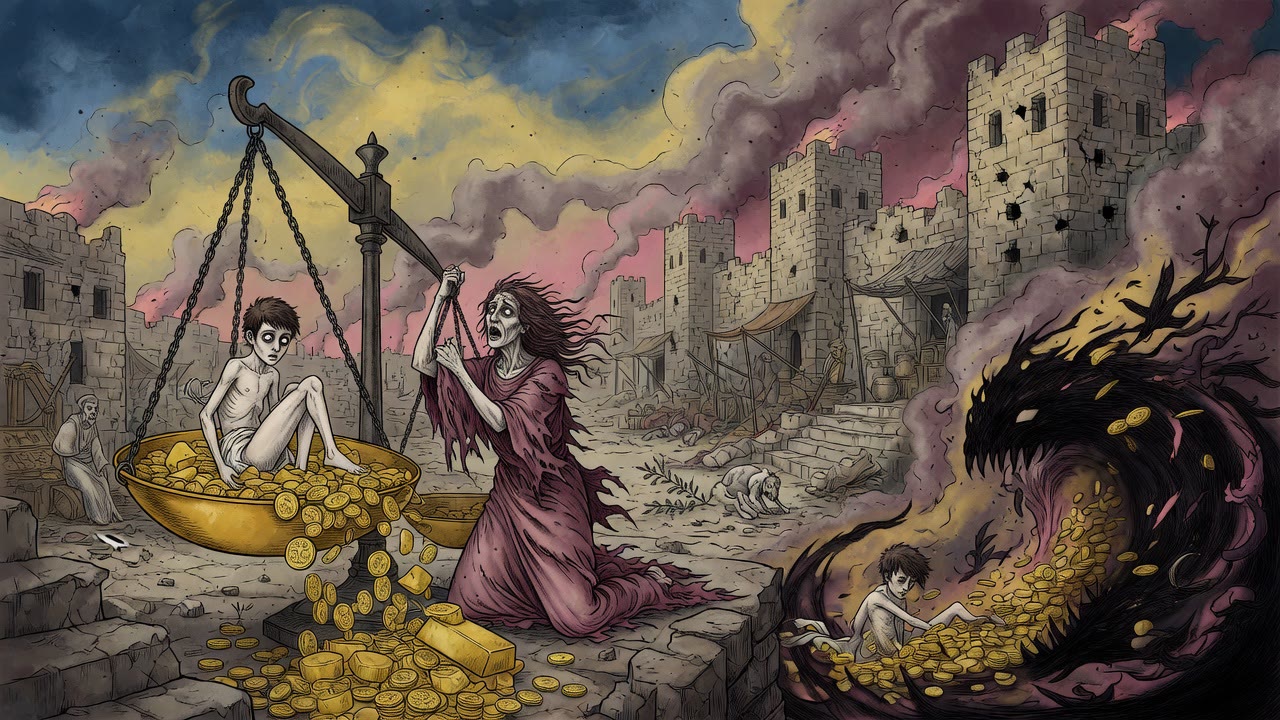
She watched the marks rise. A handbreadth, then another. A child becoming taller under her eyes. His father was gone, and the boy stood at the center of what remained to her. Each year she took his measure and gave his weight in gold to the Temple.

Then the siege closed around Jerusalem.

The Boy Became a Gift Each Year

Before hunger, the measuring was devotion. She did not look at her son and see expense. She saw offering. His growing body became a yearly summons to generosity, and the Temple received gold according to the weight of the child she loved.

That kind of giving is almost too tender to hold. A mother brings the growth of her son before God without surrendering the son himself. The boy remains alive in her house. The gold goes upward. The Temple stands. The city breathes. Love can afford magnificence when bread still exists.

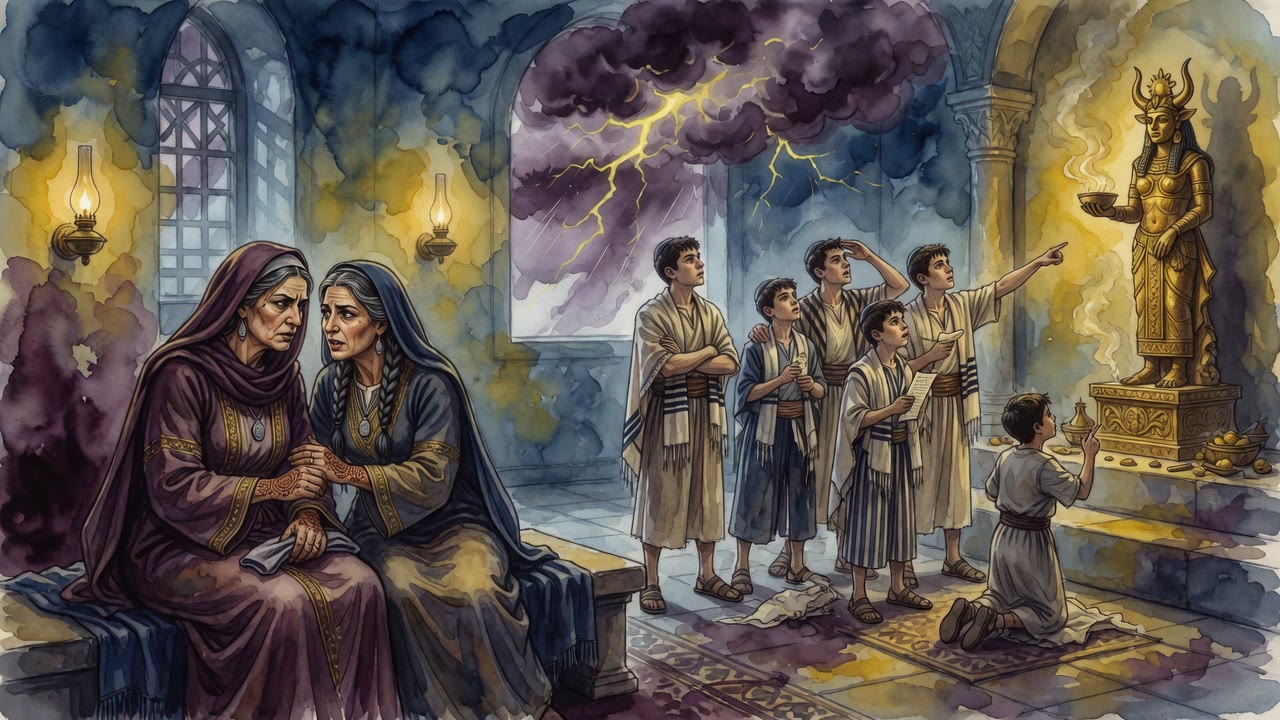
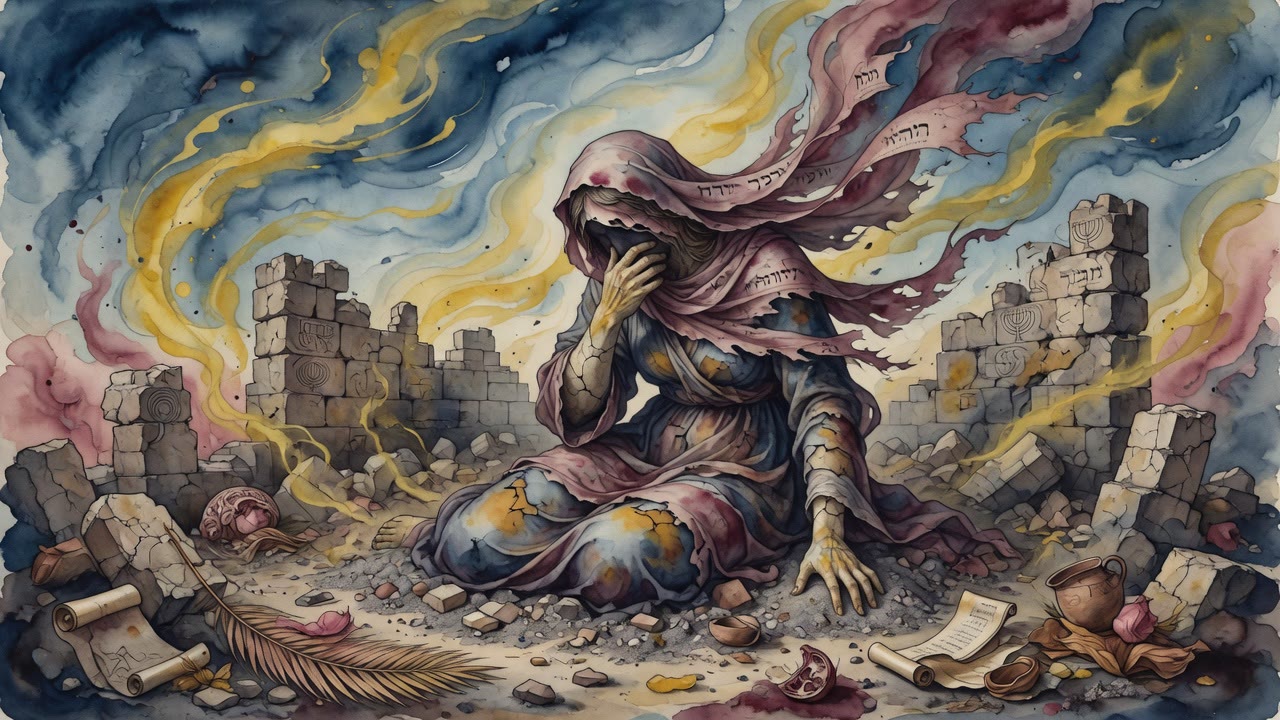
Then the armies tightened the ring around Jerusalem. Markets emptied. Fires went out. The city that had once held songs, courts, priests, and pilgrims became a throat closing around its own people.

The same mother who had weighed her son in gold began to watch another measure take over. Hunger counted ribs. Hunger counted days. Hunger counted what could still be eaten.

The Siege Reversed the Offering

When there was nothing left, she slaughtered him with her own hands and ate him.

The source says it without ornament because ornament would be obscene. The boy who had once generated gold for the Temple became food in the ruin of the city. The offering had been reversed. Instead of the mother's love rising toward the sanctuary, the collapse of the sanctuary drove her love into an act that made the prophet cry out.

Jeremiah stood before God with the verse that had become unbearable: shall women eat their fruit, the infants they nurtured?

The question did not stay alone. The Divine Spirit answered with another wound from the same verse: shall priest and prophet be slain in the Temple of the Lord? The city had not only devoured children. It had shed holy blood inside holy space. The horror below and the horror above answered one another.

The Prophet Could Not Ask One Question

Jeremiah wanted the child named. He wanted the mother named by the act no mother should have to approach. But heaven answered from the Temple floor, where Zechariah ben Jehoiada had been killed. The siege was not one crime. It was an accounting long in motion.

The city had broken at both ends. In the house, a mother consumed the child she had once honored with gold. In the sanctuary, priest and prophet had been killed where divine service should have protected life. The verse became a scale with two pans, and both were unbearable.

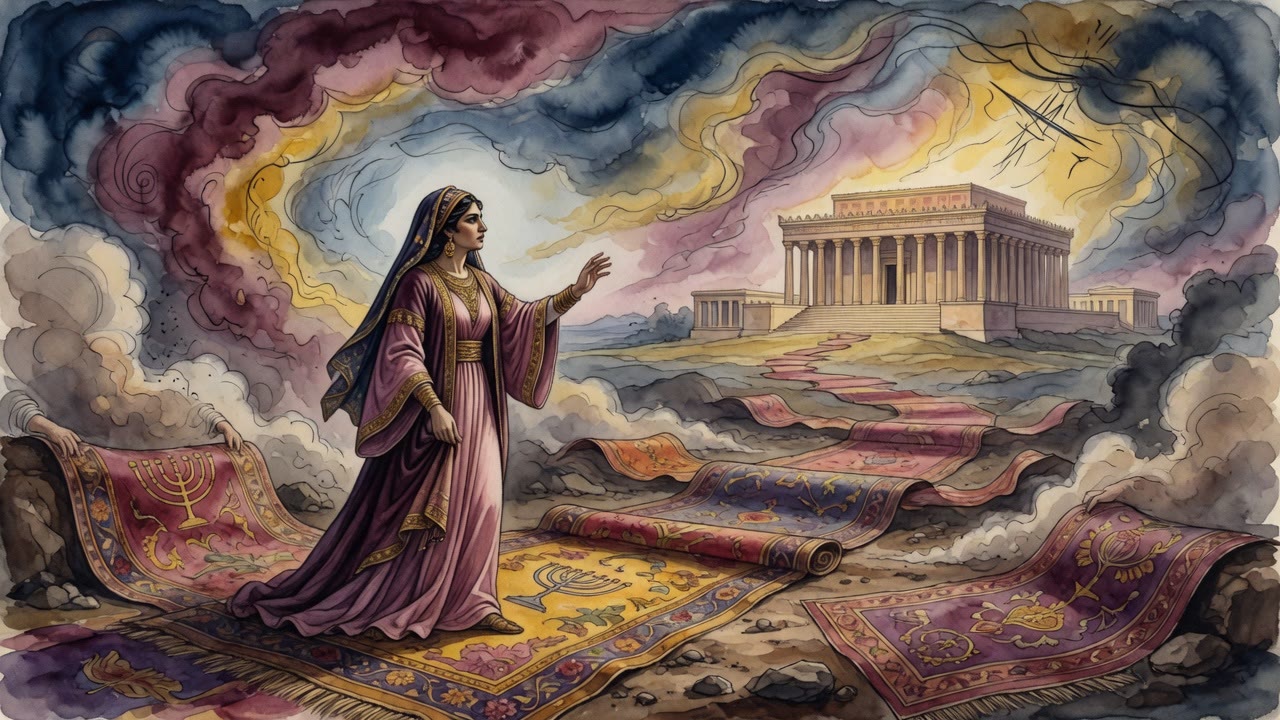
That is why the rabbis placed the incident inside lament rather than explanation. They did not rescue the image from disgust. They made the disgust testify. Jerusalem's fall was not only walls breached and kings blinded. It was motherhood inverted, priesthood profaned, prophecy silenced, wisdom departing, and the Divine Presence withdrawing.

The Gold Could Not Save the Body

The most painful detail remains the yearly gold.

If the mother had been merely hungry, the account would be terrible enough. But the gold makes the loss sharper. Once she had measured Doeg because his life overflowed into gift. During the siege, she met the same body under the opposite law. What had been abundance became desperation. What had been Temple offering became the collapse of all offering.

No one in the scene is clean enough to make a moral speech. Not the starving mother. Not the city. Not the generation that let blood reach the sanctuary. Jeremiah stands with a question so large that heaven answers it only by opening a second wound.

Even the name Doeg hurts. Another Doeg, remembered elsewhere as a slanderer in Saul's court, used speech to make bloodshed possible. This Doeg is only a child, and his name lands inside a different ruin. He does not betray anyone. He is betrayed by a city so famished that motherhood itself is driven past recognition.

Doeg ben Yosef had been weighed in gold. In the end, Jerusalem's hunger weighed more than gold.


← All myths
From the tradition

Sources

4 sources

The texts this telling draws on, in full. Open a card to read inline, or expand it for a wider, quieter read.

Eikhah Rabbah 1:51Eikhah Rabbah

There was an incident involving Doeg ben Yosef who died and left a young son to his mother. She would measure him in handbreadths and donate his weight in gold to the Temple182Literally, to Heaven. each and every year. When the siege encircled Jerusalem, his mother slaughterd him with her own hands and ate him: Jeremiah was lamenting before the Omnipresent and saying: “Shall women eat their fruit, the infants of their nurturing?” (Lamentations 2:20). The Divine Spirit responded to him: “Shall the priest and the prophet be slain in the Temple of the Lord?” (Lamentations 2:20). This is Zekharya ben Yehoyada.183See Eikha Rabba, Prologue, 23.Another matter, “for these I weep,” Rabbi Yehuda and Rabbi Neḥemya, Rabbi Yehuda says: For the departure of intelligence and for the departure of the Divine Presence. Is it possible that Zedekiah saw others plucking out his eyes and he did not have the intelligence to smash his head against the wall until his soul departed, but he rather caused his sons to be slaughtered before his eyes?184Nebuchadnezzar had Zedekiah’s sons slaughtered before his eyes, and then had Zedekiah’s eyes blinded (II Kings 25:7). According to the Sages, they first inserted iron rods into his eyes but had not yet blinded him; they finished blinding him only after he saw his sons slaughtered (Tanḥuma, Vaetḥanan 1). The midrash (rabbinic interpretive commentary) here asks why Zedekiah did not kill himself to spare himself this torture. Rather, regarding that moment it is stated: “The heart of the king and the heart of the princes will fail…” (Jeremiah 4:9). Rabbi Neḥemya said: For the departure of priesthood and kingship. That is what is written: “These are the two anointed men who attend the Lord of all the land” (Zechariah 4:14); these are Aaron and David. Aaron is demanding his priesthood and David is demanding his kingdom.Rabbi Yehoshua ben Levi said: For dereliction in the study of Torah.185This opinions interprets the verse “for these I weep” to mean due to these sins, namely the dereliction in the study of Torah. That is what is written: “These are the statutes and the ordinances” (Deuteronomy 12:1).186This verse is stated regarding the Torah. The word “these” in Lamentations is thus connected to the words of Torah, referred to as “these” in Deuteronomy. Rabbi Shmuel bar Naḥmani said: For idol worship. That is what is written: “These are your gods, Israel” (Exodus 32:4). Zavdi ben Levi said: For the abrogation of the offerings. That is what is written: “These you shall perform to the Lord on your appointed days” (Numbers 29:39). The Rabbis said: For the abrogation of the [non-priestly] watches.187The reference is to the groups of Israelites, corresponding to the twenty-four priestly watches, who would spend the week in prayer and Torah study so that the Temple service would be pleasing to God; see Taanit 26a. What benefit does the world have from the watches? On Monday they would fast on behalf of the seafarers. On Tuesday they would fast on behalf of the wayfarers. On Wednesday they would fast on behalf of the children, so that diphtheria would not afflict their mouths and cause them to die. On Thursday they would fast on behalf of the pregnant women, that they would not miscarry, and on behalf of the nursing women, that their children should not die. But is it not so that one may not fast on behalf of two matters simultaneously, as it is written: “We fasted and we requested from our God about this”? (Ezra 8:23). And a verse in Daniel says: “For them to request mercy from before the God of heaven regarding this secret” (Daniel 2:18), and not regarding two.188Both verses mention requesting from God regarding “this,” in singular. Rather, it is like that which Rabbi Ḥiyya bar Abba said: For drought and exile one fasts for both of them simultaneously.189They are related, because due to famine people wander from their homes in search of food. Similarly, miscarriage and the death of infants are closely enough related that one can pray regarding both simultaneously. However, one does not fast on the day before Shabbat (the Sabbath) or on the day following Shabbat, in deference to Shabbat.“My eye, my eye sheds water.” Rabbi Levi said: This is analogous to a doctor who had pain in one eye. He said: ‘Let my eye weep for my eye.’ So too, Israel is called the eye of the Holy One blessed be He. That is what is written: “For the eye of man and all the tribes of Israel is toward the Lord” (Zechariah 9:1). As it were, the Holy One blessed be He said: ‘Let My eye weep for My eye.’“For a comforter, restorer of my soul, has grown distant from me.” What is the name of the messianic king? Rabbi Abba bar Kahana said: The Lord is his name, as it is stated: “This is his name that they will call him: The Lord is our righteousness” (Jeremiah 23:6). As Rabbi Yehoshua ben Levi said: It is good for a province when its name is like that of its king, and the name of its king is like that of its God. It is good for a province when its name is like that of its king, as it is written: “The name of the city from that day shall be: The Lord is there” (Ezekiel 48:35). The name of its king like the name of its God, as it is stated: “This is his name that they will call him: The Lord is our righteousness” (Jeremiah 23:6).Rabbi Yehoshua ben Levi said: His name is Tzemaḥ, as it is stated: “Behold a man, Tzemaḥ is his name, and he will sprout [yitzmaḥ]” (Zechariah 6:12). Rabbi Yudan said: Menaḥem is his name, as it is stated: “For a comforter [menaḥem]…has grown distant from me.” Rabbi Ḥanina said: And they do not disagree; the numerical value of this equals the numerical value of that, Menaḥem equals Tzemaḥ.190Menaḥem: mem – 40, nun – 50, ḥet – 8, mem – 40 = 138. Tzemaḥ: tzadi – 90, mem – 40, ḥet – 8 = 138. The following supports that [statement] of Rabbi Yudan in the name of Rabbi Aivu: There was an incident involving a certain person who was plowing. One of his oxen lowed. A certain Arab passed near him and said to him: ‘What are you?’ He said to him: ‘I am a Jew.’ He said to him: ‘Unharness your ox, untie your plow.’ He said to him: ‘Why?’ He said to him: ‘The Temple of the Jews is destroyed.’191Therefore, you should mourn rather than work your field. He said to him: ‘How do you know?’ He said to him: ‘I know it from the lowing of your ox.’ While he was still conversing with him, it lowed again. He said to him: ‘Harness your ox, tie your plow, as the redeemer of the Jews was born.’ He said to him: ‘What is his name?’ He said to him: ‘His name is Menaḥem.’ ‘What is his father’s name?’ He said to him: ‘Hezekiah.’ He said to him: ‘Where do they live?’ He said to him: ‘In Birat Arva, that is in Bethlehem of Judah.’ That man sold his oxen, sold his plow, and became a seller of felt garments for children. He would enter a city and leave a city, enter a province and leave a province, until he arrived there.All of the women of the village came to purchase from him, but the mother of a certain child did not purchase from him. He said to her: ‘Why are you not purchasing children’s garments of felt?’ She said to him: ‘Because my child has a harsh fate.’ He said to her: ‘Why?’ She said to him: ‘Because upon his arrival, the Temple was destroyed.’192The Temple was destroyed on the day he was born. He said to her: ‘We rely on the Master of the universe that upon his arrival it was destroyed and upon his arrival it will be rebuilt.’ He said to her: ‘Take one of these felt garments for your child, I will come some time later to your house and collect your payment.’ She took it and she went. Some time later that man said: ‘I will go and see how that child is doing.’ He came to her, he said to her: ‘How is the child doing?’ She said to him: ‘Did I not say to you that he has a harsh fate? Even upon his arrival there was a foreboding omen. Since that time, winds and storms carried him away.’ He said to her: ‘Did I not tell you that upon his arrival it was destroyed and upon his arrival it will be rebuilt?’193He was carried away by the wind because he is destined to serve a purpose in a supernatural manner, and bring about the building of the Temple.Rabbi Avun said: Why must I learn this from Arabs, is it not an explicit verse? As it is written: “The Lebanon will fall by a mighty one” (Isaiah 10:34), and it is written immediately thereafter: “A branch will emerge from the trunk of Yishai and a shoot will sprout from his roots” (Isaiah 11:1).The school of Rabbi Sheila said: Shilo is the name of Messiah, as it is stated: “Until Shilo will come” (Genesis 49:10); Sheila is written.194The word Shilo in the verse is spelled with a heh at the end rather than a vav, such that it can also be read Sheila. This was stated by Rabbi Sheila’s students, who felt that if their generation was worthy, their mentor would be the messiah (Etz Yosef). The school of Rabbi Ḥanina said: Ḥanina is his name, as it is stated: “As I will not grant you clemency [ḥanina]” (Jeremiah 16:13). The school of Rabbi Yanai said: Yinon is his name, as it is written: “May his name be praised [yinon] as long as the sun shines” (Psalms 72:17). Rabbi Beivai of Sanegurya said: His name is Nehira, as it is stated: “Light [nehora] rests with Him” (Daniel 2:22), nehira is written. Rabbi Yehuda ben Rabbi Simon said in the name of Rabbi Shmuel ben Rabbi Yitzḥak: If the messianic king is from the living, his name is David, and if he is from the dead, his name is David. Rabbi Tanḥuma said: I will say his source: “He increases deliverance to His king, shows kindness to His anointed, [to David and to his descendants, eternally]” (Psalms 18:51). “And to David” is not written here, but rather “to David and his descendants.”195The verse says: To His anointed [meshiḥo], to David, identifying David as the messiah.“My children have become desolate, because the enemy has prevailed.” Rabbi Aivu said: Like that shell of the gourd; the more [the shell] grows, the smaller [the fruit] is.196The greater the percentage of the total fruit is shell, the smaller the edible fruit is (Arukh). The point is that the greater the success of the enemy, the greater the desolation of Israel. Rabbi Yehuda ben Rabbi Simon said: Like this pig; the more that its offspring grow, the smaller it gets.197Its energy is sapped by nursing its young (Matnot Kehuna).

Full source
Eikhah Rabbah 1:50Eikhah Rabbah

There was an incident involving Miriam daughter of the baker, who was taken captive with her seven sons. The emperor took them and placed them behind seven partitions. He brought the first and said to him: ‘Prostrate yourself to the idol.’ He said to him: ‘God forbid, I will not prostrate myself to the idol.’ He said to him: ‘Why?’ [He responded:] ‘Because so it is written in our Torah: “I am the Lord your God”’ (Exodus 20:2). Immediately, he took him out and executed him.He took out the second and said to him: ‘Prostrate yourself to the idol.’ He said to him: ‘God forbid, my brother did not prostrate himself and I will not prostrate myself.’ He said to him: ‘Why?’ He said to him: ‘Because so it is written in our Torah: “You shall have no other gods before Me”’ (Exodus 20:3). Immediately, he issued a decree against him and they executed him. He took out the third and said to him: ‘Prostrate yourself to the idol.’ He said to him: ‘I will not prostrate myself.’ He said to him: ‘Why?’ He said to him: ‘Because so it is written in our Torah: “For you shall not prostrate yourself to another god”’ (Exodus 34:14). Immediately, he issued a decree against him and they executed him. He took out the fourth and [the son] recited his verse: “One who sacrifices to gods shall be destroyed” (Exodus 22:19). He issued a decree against him and they executed him. He took out the fifth and he, too, recited his verse: “Hear Israel, the Lord is our God the Lord is one” (Deuteronomy 6:4). Immediately, he issued a decree against him and they executed him. He took out the sixth and he, too, recited his verse: “For the Lord your God is in your midst, a God great and awesome” (Deuteronomy 7:21). Immediately, he issued a decree against him and they executed him.He took out the seventh, who was the youngest of them all. He said: ‘My son, prostrate yourself to the idol.’ He said to him: ‘God forbid.’ He said to him: ‘Why?’ He said to him: ‘Because so it is written in our Torah: “You shall know this day, and restore to your heart, that the Lord, He is the God in the heavens above and upon the earth below, there is no other” (Deuteronomy 4:39). We took an oath to our God that we will not exchange Him for another God, as it is stated: “You have exalted the Lord today [to be your God]” (Deuteronomy 26:17). And just as we took an oath to Him, so He took an oath that He would not exchange us for a different nation, as it is stated: “The Lord has exalted you today [to be a people of distinction for Him]”’ (Deuteronomy 26:18).The emperor said to him: ‘Your brothers had full days, full lives, and experienced goodness, but you are young, you have not had full days, you have not had a full life, and you have never experienced goodness. Prostrate yourself to the idol and I will do good things for you.’ He said to him: ‘It is written in our Torah: “The Lord will reign forever” (Exodus 15:18). And it says: “The Lord is king forever, nations have been eliminated from His land” (Psalms 10:16). You will cease and His enemies will cease. Flesh and blood lives today and dies tomorrow, is wealthy today and poor tomorrow; but the Holy One blessed be He lives and persists forever and for all time.’ The emperor said to him: ‘See your brothers slain before you. I am casting my ring to the ground before the idol, lift it so everyone will know that you heeded my voice.’ He said to him: ‘It is a shame for you, emperor; if you fear people, who are your equivalent, will I not fear the King of kings, the Holy One blessed be He, the eternal God?’ He said to him: ‘Is there a God in the world?’ He said to him: ‘Woe are you, emperor, have you seen a world without a master?’He said to him: ‘Does your God have a mouth?’ He said to him: ‘Regarding your gods it is written: “They have a mouth but cannot speak” (Psalms 115:5). Regarding our God it is written: “By the word of the Lord the heavens were made; [by the breath of His mouth, all their hosts]”’ (Psalms 33:6).He said to him: ‘Does your God have eyes?’ He said to him: ‘Regarding your gods it is written: “They have eyes but cannot see” (Psalms 115:5). Regarding our God it is written: “They are the eyes of the Lord ranging throughout the land”’ (Zechariah 4:10).He said to him: ‘Does your God have ears?’ He said to him: ‘Regarding your gods it is written: “They have ears but cannot hear” (Psalms 115:6). Regarding our God it is written: “The Lord listened and heard”’ (Malachi 3:16).He said to him: ‘Does your God have a nose?’ He said to him: ‘Regarding your gods it is written: “They have a nose but cannot smell” (Psalms 115:6). Regarding our God it is written: “The Lord smelled the pleasing aroma”’ (Genesis 8:21).He said to him: ‘Does your God have hands?’ He said to him: ‘Regarding your gods it is written: “They have hands but cannot feel” (Psalms 115:7). Regarding our God it is written: “My hand, too, laid the foundation”’ (Isaiah 48:13).He said to him: ‘Does your God have feet?’ He said to him: ‘Regarding your gods it is written: “They have feet but cannot walk” (Psalms 115:7). Regarding our God it is written: “His feet will stand that day on the Mount of Olives”’ (Zechariah 14:4).He said to him: ‘Does your God have a throat?’ He said to him: ‘Regarding your gods it is written: “They cannot produce sound with their throats” (Psalms 115:7). Regarding our God it is written: “Sound emerges from His mouth”’ (Job 37:2).He said to him: ‘If there are all these attributes in your God, why does He not rescue you from my hand, like He rescued Ḥananya, Mishael, and Azarya from the hand of Nebuchadnezzar?’ He said to him: ‘Ḥananya, Mishael, and Azarya were upright, and Nebuchadnezzar was a king worthy of having a miracle performed through him. But you are not worthy, and we have been condemned to death at the hand of Heaven. If you do not execute us, there are many executioners for the Omnipresent, many wolves, lions, snakes, leopards, and scorpions to attack us and kill us. But ultimately, the Holy One blessed be He is destined to exact retribution from you for our blood.’ Immediately, he issued a decree against him to execute him.His mother said to him: ‘By the life of your head, emperor, give me my son and I will hug him and kiss him.’ He gave him to her, and she bared her breasts and nursed him with her milk. She said to him: ‘By the life of your head, emperor, execute me first and then execute him.’ The emperor said to her: ‘I will not heed you because it is written in your Torah: “An ox or a sheep, it and its offspring you shall not slaughter on one day”’ (Leviticus 22:28). She said to him: ‘You absolute fool, have you already fulfilled all the mitzvot (commandments) and only this one remains?’ Immediately, he commanded to execute [the son]. His mother fell upon him and was hugging him and kissing him. She said to him: ‘My son, go to Abraham your patriarch and say to him: So said my mother: Do not be overly impressed with yourself and say: I built an altar and sacrificed Isaac, my son. My mother built seven altars and sacrificed seven sons on one day. Yours was an ordeal, mine was an action.’181Your was a test to see if you were willing to sacrifice your son, but you did not actually sacrifice him. My sons were actually killed. While she was hugging him and kissing him, he issued a decree against him and they executed him upon her. When he was executed, the Sages calculated the age of that child and it was discovered that he was two years, six months, and six and one half hours. At that moment, all the nations of the world screamed out and said: ‘What is the God of these people doing to them that they are killed on His behalf all the time?’ In their regard it is written: “For we are killed all day long for You” (Psalms 44:23).Sometime later, that woman went mad and she fell from the roof and died, to realize what is stated: “She who bore seven is miserable” (Jeremiah 15:9). A Divine Voice was calling out, saying: “The mother of the children is joyful” (Psalms 113:9). The Divine Spirit was crying out and saying: “For these I weep.”

Full source
Exempla of the Rabbis, No. 69Exempla of the Rabbis (Gaster, 1924)

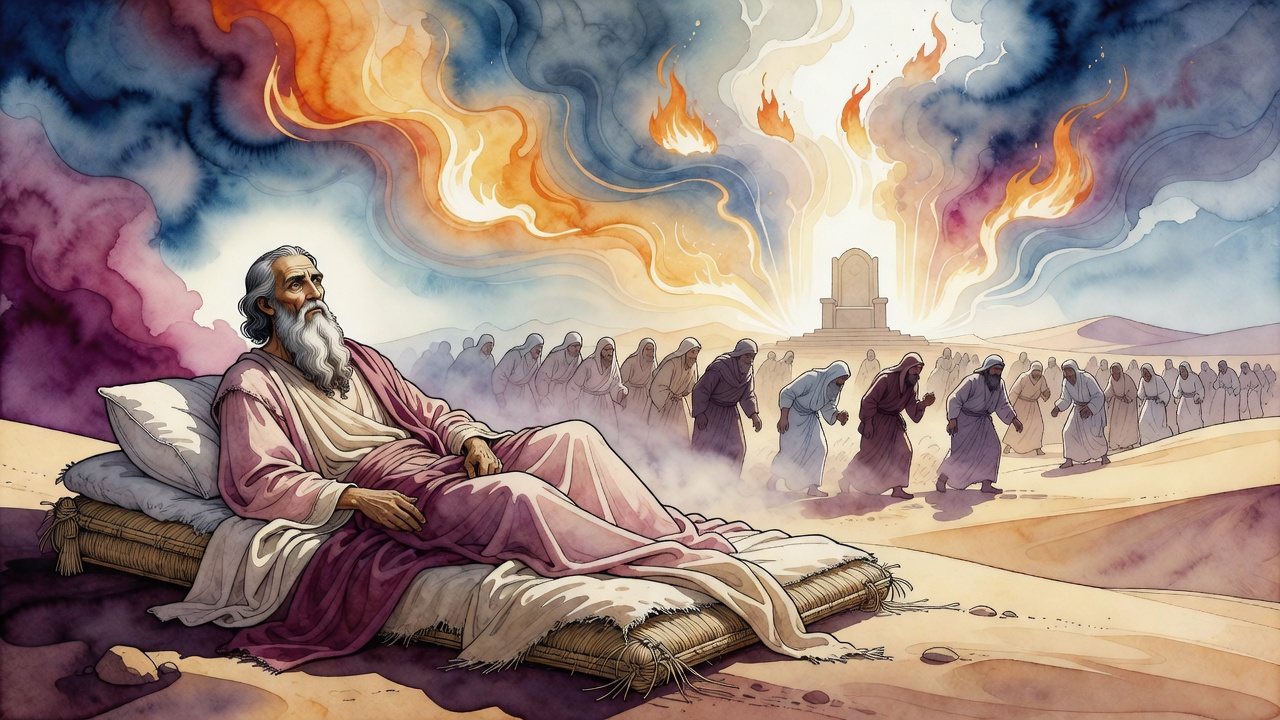
When the Roman siege tightened around Jerusalem, starvation became a weapon more terrible than any sword. Doeg ben Josef was a man of means, he offered a full measure of gold for a single loaf of bread. No one could sell him any. There was no bread left in the city. He died of hunger with gold in his hands and nothing in his stomach.

The true horror of the siege was what it did to his wife. She had been a woman of extraordinary piety. Every year, she would weigh her only child on a scale and bring the equivalent weight in gold as an offering to the Temple. Her son was her treasure, and she honored God through him with the most generous devotion imaginable.

Then the famine consumed everything. The streets of Jerusalem were littered with the dead. The living stumbled past corpses too numerous to bury. And this woman, this mother who had once measured her child's worth in gold offerings to the Temple, was driven by starvation to an act so monstrous that the Rabbis could barely bring themselves to record it. She devoured her own child.

The Rabbis told this tale not to horrify, but to testify. This was what the destruction of the Temple meant. This was the cost of the siege. The most devoted mother in Jerusalem was reduced to the most unthinkable act, a fulfillment of the terrible prophecy in (Deuteronomy 28:53), that in the siege, Israel would eat the flesh of its own children.

Full source
Eikhah Rabbah 2:23Eikhah Rabbah

“See, Lord, and look to whom You have done this. Shall women eat their fruit, the infants of their nurturing? Shall the priest and the prophet be slain in the Temple of the Lord?” (Lamentations 2:20).“See, Lord, and look.” There was an incident involving Doeg ben Yosef, who died and left a young son to his mother. She would measure him with handbreadths and would donate his weight in gold to Heaven each and every year. When the besieging armies surrounded Jerusalem, his mother slaughtered him with her own hands and ate him. Jeremiah was lamenting before the Omnipresent and saying: “[See, Lord…] to whom You have done this; shall women eat their fruit, the infants of their nurturing?” The Divine Spirit responded to him: “Shall the priest and the prophet be slain in the Temple of the Lord?” This is Zekharya ben Yehoyada.

Full source