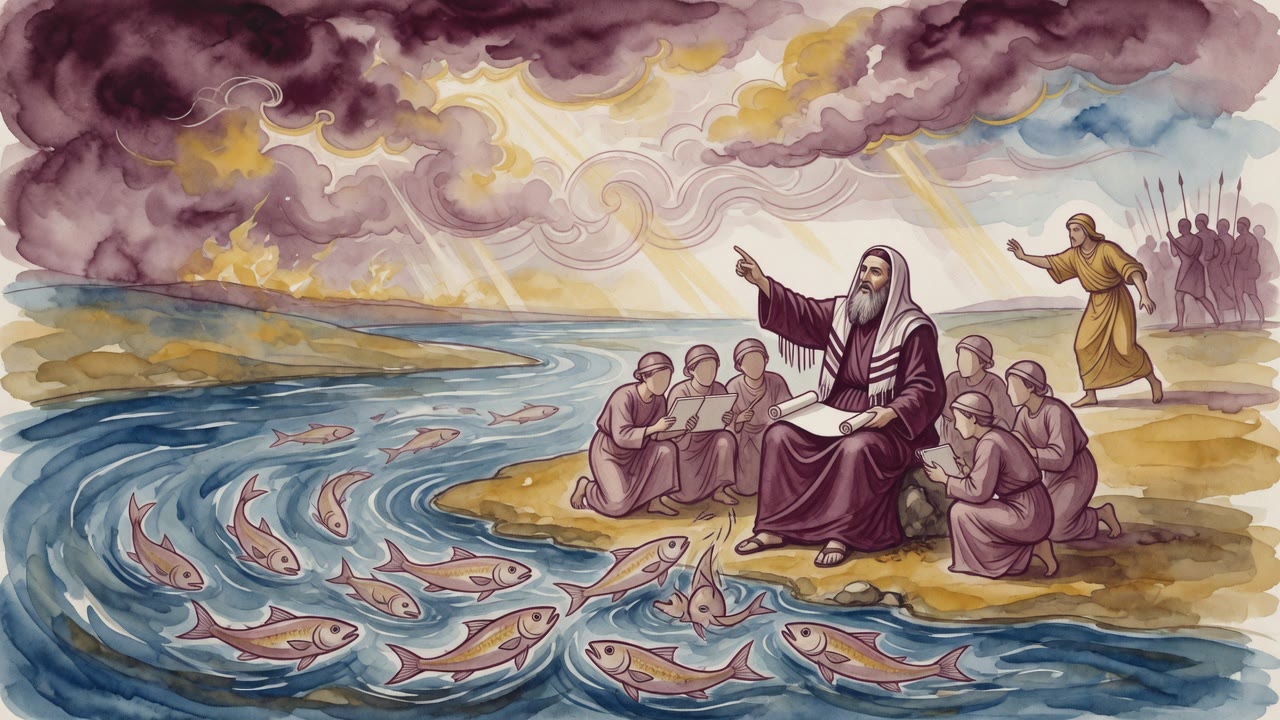
5 min read

Hannah and Miriam Watched Seven Sons Refuse the Idol

A tyrant killed seven sons one by one for refusing an idol. Their mother answered Abraham with seven altars before heaven replied.

Curated by Arthur · Told by Maggid ·
Table of Contents
  1. The Second Son Stood on the Next Word
  2. The Fifth Son Said the Shema
  3. The Youngest Would Not Lift the Ring
  4. The Mother Sent a Message to Abraham

The first son was brought out while his brothers could still hear him.
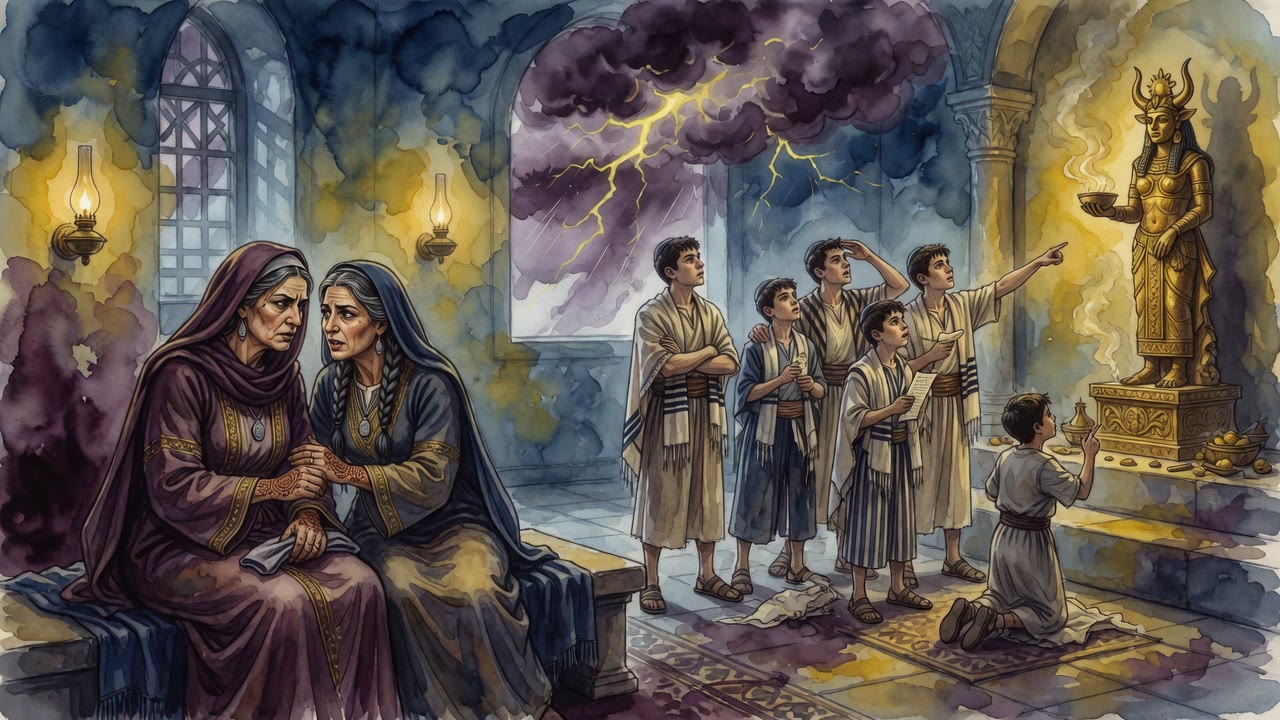
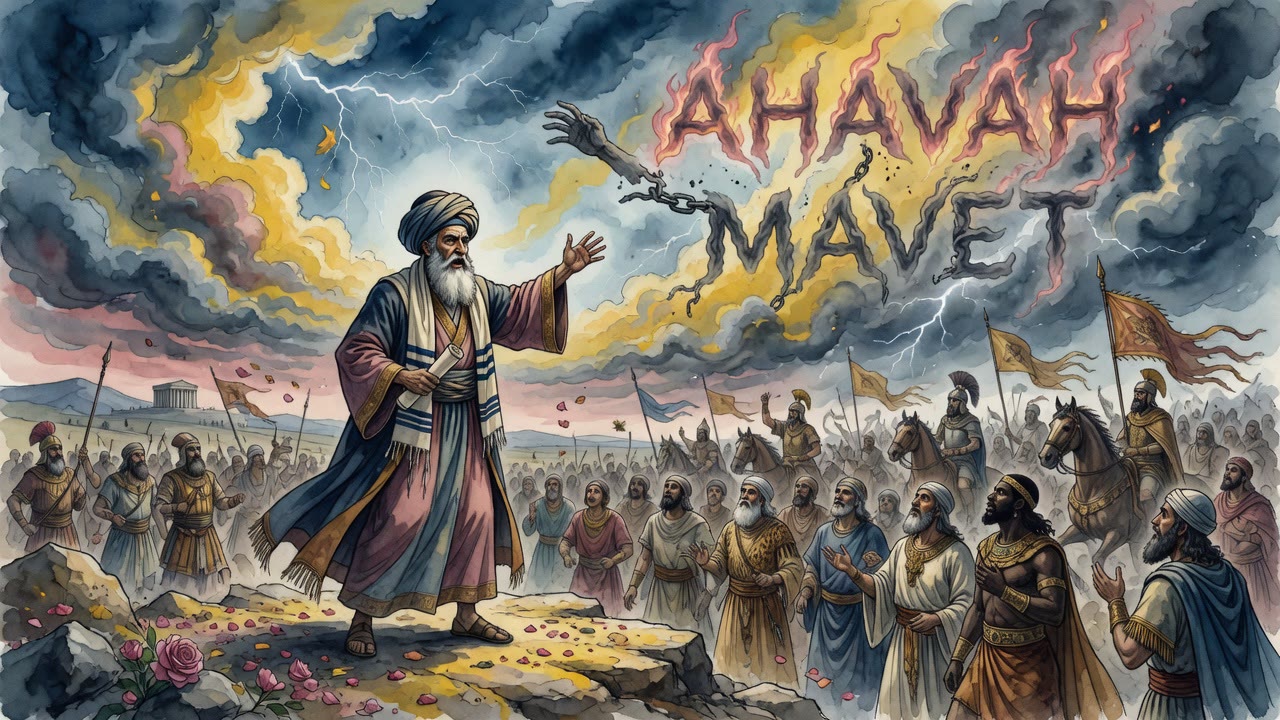
The tyrant sat before an image and ordered the boy to bow. The answer came from Sinai, not from panic. God forbid. The commandment had already spoken: I am the Lord your God. The boy would not bend to another.

They led him away and killed him.

The Second Son Stood on the Next Word

The second son did not ask what had happened to his brother.

He knew. The room still held the shape of it. The same order came. Bow. He refused with the next commandment: You shall have no other gods before Me. The king wanted a body lowered before an image. The child answered with a sentence older than the king's throne.

He was killed too.

The third came forward and spoke of the law against sacrificing to any god except the Lord. The fourth answered with the same iron. Each boy entered alone, but none of them stood alone. Every verse spoken by one brother became ground beneath the next brother's feet.

The Fifth Son Said the Shema

By the fifth son, the king had learned nothing.

The boy stood where four bodies had already gone and gave the answer Israel gives morning and night: Shema Yisrael, the Lord is our God, the Lord is One. The room had an idol in it. The boy filled the room with oneness. The king had soldiers, partitions, weapons, and time. The child had one line.

It was enough to die with.

The sixth son refused because the Lord was in Israel's midst, great and awesome. His body was small before the court. His sentence made the court small before heaven.

The Youngest Would Not Lift the Ring

Then the youngest was brought.

The tyrant softened his voice. The child had not lived long enough to taste much of the world. There could be gifts, years, sweetness, power. Then came a smaller trap. The king dropped his ring before the image and told the boy to bend only to pick it up. No worship. No confession. Just a gesture the crowd could misread.

The boy saw the trick.

If a king of flesh and blood cared so much that a child should appear to honor him, how much more should Israel guard the honor of the Holy One. The youngest refused the ring because even a false bow could become a lie in public.

The Mother Sent a Message to Abraham

His mother asked for one mercy.

Let her kiss the child before he died. She bent over the last son and sent him upward with a message. Tell Abraham our father that he built one altar for one son, but she had built seven. The words were not competition. They were smoke from a mother who had watched every child become an offering and still refused to let the king own the meaning of their deaths.

The boy was killed.

Then she climbed to the roof and fell.

A heavenly voice answered with a verse that sounds impossible until it breaks open: the joyful mother of children. Joy had not erased grief. The verse named the terrible radiance of a woman whose sons had not been taken into silence. They had answered one by one, each with Torah in his mouth.

Some tellings call her Hannah. Others call her Miriam, daughter of the baker. The names shift because the wound passed through more than one book, more than one community, more than one century of remembering. The room stays the same: a mother, seven sons, an image, a ring on the floor, and a refusal no blade could bend.

The king had wanted one bow.

He received seven verses and a mother who sent them all to Abraham.

The seven partitions in one version make the cruelty colder. Each boy is isolated before being brought out, as if the king believes courage can be separated from family by curtains and walls. But the verses pass through the partitions. The second son knows the first has refused. The fifth can still say the Shema as if all Israel is standing with him.

The mother does not interrupt the chain. She seals it. Her kiss does not pull the youngest back toward life at any price. It sends him forward with a message no emperor can answer.


← All myths
From the tradition

Sources

4 sources

The texts this telling draws on, in full. Open a card to read inline, or expand it for a wider, quieter read.

Gittin 57b; cf. 2 Maccabees 7Hebraic Literature (1901)

In the years after the fall of the holy city, a mother named Hannah and her seven sons were thrown into prison. One by one, in order of their ages, the tyrant brought the boys before him and commanded them to bow to his image and worship his gods.

The eldest, brought first, answered: "God forbid that I should bow to thy image. Our commandments say, I am the Lord thy God (Exodus 20:2); to no other will I bow." He was led out to execution.

The second son was asked the same. "My brother did not bow," he said, "and no more will I." "Why not?" the tyrant pressed. The boy answered, "Because the second commandment of the Decalogue says, Thou shalt have no other gods before me (Exodus 20:3)." He, too, was killed.

The third came before the throne: "My religion teaches me, He that sacrificeth unto any god, save unto the Lord only, he shall be utterly destroyed (Exodus 22:20). I welcome my brothers' fate before I bow to thee."

The fourth spoke the same verse with the same defiance. The fifth offered up his life with Israel's watchword on his lips: Shema Yisrael, Adonai Eloheinu, Adonai Echad, Hear, O Israel, the Lord our God, the Lord is One (Deuteronomy 6:4).

"Why so stubborn?" the tyrant demanded of the sixth. "Because," the boy answered, "The Lord thy God is in the midst of thee, a mighty and terrible God (Deuteronomy 7:21)." He, too, died for the words.

Then the seventh and youngest boy was brought. The tyrant softened. He spoke kindly. He offered the child his life.

The story in this source breaks off here, mid-sentence. But every Jewish reader for the last two thousand years has known what the youngest son said. Seven sons, one mother, one Echad. And the refusal that turned a cell into a Temple.

Full source
Gittin 57bHebraic Literature (1901)

Tractate Gittin (folio 57, column 2) preserves one of the most devastating martyrdom stories in all of rabbinic literature, a Jewish mother and her seven sons dragged before a Roman Caesar and ordered to bow to the imperial idols.

One by one the sons refused. Each justified his disobedience with a verse of Torah, quoting Scripture as the foundation beneath his feet, and each was led out and killed.

When the seventh boy, the youngest, was brought forward, Caesar softened, for appearance's sake. He dropped his signet ring on the ground and told the child to simply bend and pick it up; then his life would be spared. The boy refused. "Alas for you, O Caesar," he said. "If you are so zealous for your honor that you would have a child stoop to lift a ring, how much more zealous must we be for the honor of the Holy One, blessed be He."

He too was led away. But first the mother begged one favor: a farewell kiss. And as she bent over her last son, she whispered, "Go, my child, and say to Abraham our father: You built one altar for the sacrifice of one son (Genesis 22:9), but I have erected altars for seven."

Then she climbed to the roof and threw herself down. And a bat kol, a heavenly voice, echoed through the streets, quoting the Psalmist: "The joyful mother of children" (Psalm 113:9).

The verse is grim and radiant at once, every altar she built was also a song.

Full source
Eikhah Rabbah 1:50Eikhah Rabbah

There was an incident involving Miriam daughter of the baker, who was taken captive with her seven sons. The emperor took them and placed them behind seven partitions. He brought the first and said to him: ‘Prostrate yourself to the idol.’ He said to him: ‘God forbid, I will not prostrate myself to the idol.’ He said to him: ‘Why?’ [He responded:] ‘Because so it is written in our Torah: “I am the Lord your God”’ (Exodus 20:2). Immediately, he took him out and executed him.He took out the second and said to him: ‘Prostrate yourself to the idol.’ He said to him: ‘God forbid, my brother did not prostrate himself and I will not prostrate myself.’ He said to him: ‘Why?’ He said to him: ‘Because so it is written in our Torah: “You shall have no other gods before Me”’ (Exodus 20:3). Immediately, he issued a decree against him and they executed him. He took out the third and said to him: ‘Prostrate yourself to the idol.’ He said to him: ‘I will not prostrate myself.’ He said to him: ‘Why?’ He said to him: ‘Because so it is written in our Torah: “For you shall not prostrate yourself to another god”’ (Exodus 34:14). Immediately, he issued a decree against him and they executed him. He took out the fourth and [the son] recited his verse: “One who sacrifices to gods shall be destroyed” (Exodus 22:19). He issued a decree against him and they executed him. He took out the fifth and he, too, recited his verse: “Hear Israel, the Lord is our God the Lord is one” (Deuteronomy 6:4). Immediately, he issued a decree against him and they executed him. He took out the sixth and he, too, recited his verse: “For the Lord your God is in your midst, a God great and awesome” (Deuteronomy 7:21). Immediately, he issued a decree against him and they executed him.He took out the seventh, who was the youngest of them all. He said: ‘My son, prostrate yourself to the idol.’ He said to him: ‘God forbid.’ He said to him: ‘Why?’ He said to him: ‘Because so it is written in our Torah: “You shall know this day, and restore to your heart, that the Lord, He is the God in the heavens above and upon the earth below, there is no other” (Deuteronomy 4:39). We took an oath to our God that we will not exchange Him for another God, as it is stated: “You have exalted the Lord today [to be your God]” (Deuteronomy 26:17). And just as we took an oath to Him, so He took an oath that He would not exchange us for a different nation, as it is stated: “The Lord has exalted you today [to be a people of distinction for Him]”’ (Deuteronomy 26:18).The emperor said to him: ‘Your brothers had full days, full lives, and experienced goodness, but you are young, you have not had full days, you have not had a full life, and you have never experienced goodness. Prostrate yourself to the idol and I will do good things for you.’ He said to him: ‘It is written in our Torah: “The Lord will reign forever” (Exodus 15:18). And it says: “The Lord is king forever, nations have been eliminated from His land” (Psalms 10:16). You will cease and His enemies will cease. Flesh and blood lives today and dies tomorrow, is wealthy today and poor tomorrow; but the Holy One blessed be He lives and persists forever and for all time.’ The emperor said to him: ‘See your brothers slain before you. I am casting my ring to the ground before the idol, lift it so everyone will know that you heeded my voice.’ He said to him: ‘It is a shame for you, emperor; if you fear people, who are your equivalent, will I not fear the King of kings, the Holy One blessed be He, the eternal God?’ He said to him: ‘Is there a God in the world?’ He said to him: ‘Woe are you, emperor, have you seen a world without a master?’He said to him: ‘Does your God have a mouth?’ He said to him: ‘Regarding your gods it is written: “They have a mouth but cannot speak” (Psalms 115:5). Regarding our God it is written: “By the word of the Lord the heavens were made; [by the breath of His mouth, all their hosts]”’ (Psalms 33:6).He said to him: ‘Does your God have eyes?’ He said to him: ‘Regarding your gods it is written: “They have eyes but cannot see” (Psalms 115:5). Regarding our God it is written: “They are the eyes of the Lord ranging throughout the land”’ (Zechariah 4:10).He said to him: ‘Does your God have ears?’ He said to him: ‘Regarding your gods it is written: “They have ears but cannot hear” (Psalms 115:6). Regarding our God it is written: “The Lord listened and heard”’ (Malachi 3:16).He said to him: ‘Does your God have a nose?’ He said to him: ‘Regarding your gods it is written: “They have a nose but cannot smell” (Psalms 115:6). Regarding our God it is written: “The Lord smelled the pleasing aroma”’ (Genesis 8:21).He said to him: ‘Does your God have hands?’ He said to him: ‘Regarding your gods it is written: “They have hands but cannot feel” (Psalms 115:7). Regarding our God it is written: “My hand, too, laid the foundation”’ (Isaiah 48:13).He said to him: ‘Does your God have feet?’ He said to him: ‘Regarding your gods it is written: “They have feet but cannot walk” (Psalms 115:7). Regarding our God it is written: “His feet will stand that day on the Mount of Olives”’ (Zechariah 14:4).He said to him: ‘Does your God have a throat?’ He said to him: ‘Regarding your gods it is written: “They cannot produce sound with their throats” (Psalms 115:7). Regarding our God it is written: “Sound emerges from His mouth”’ (Job 37:2).He said to him: ‘If there are all these attributes in your God, why does He not rescue you from my hand, like He rescued Ḥananya, Mishael, and Azarya from the hand of Nebuchadnezzar?’ He said to him: ‘Ḥananya, Mishael, and Azarya were upright, and Nebuchadnezzar was a king worthy of having a miracle performed through him. But you are not worthy, and we have been condemned to death at the hand of Heaven. If you do not execute us, there are many executioners for the Omnipresent, many wolves, lions, snakes, leopards, and scorpions to attack us and kill us. But ultimately, the Holy One blessed be He is destined to exact retribution from you for our blood.’ Immediately, he issued a decree against him to execute him.His mother said to him: ‘By the life of your head, emperor, give me my son and I will hug him and kiss him.’ He gave him to her, and she bared her breasts and nursed him with her milk. She said to him: ‘By the life of your head, emperor, execute me first and then execute him.’ The emperor said to her: ‘I will not heed you because it is written in your Torah: “An ox or a sheep, it and its offspring you shall not slaughter on one day”’ (Leviticus 22:28). She said to him: ‘You absolute fool, have you already fulfilled all the mitzvot (commandments) and only this one remains?’ Immediately, he commanded to execute [the son]. His mother fell upon him and was hugging him and kissing him. She said to him: ‘My son, go to Abraham your patriarch and say to him: So said my mother: Do not be overly impressed with yourself and say: I built an altar and sacrificed Isaac, my son. My mother built seven altars and sacrificed seven sons on one day. Yours was an ordeal, mine was an action.’181Your was a test to see if you were willing to sacrifice your son, but you did not actually sacrifice him. My sons were actually killed. While she was hugging him and kissing him, he issued a decree against him and they executed him upon her. When he was executed, the Sages calculated the age of that child and it was discovered that he was two years, six months, and six and one half hours. At that moment, all the nations of the world screamed out and said: ‘What is the God of these people doing to them that they are killed on His behalf all the time?’ In their regard it is written: “For we are killed all day long for You” (Psalms 44:23).Sometime later, that woman went mad and she fell from the roof and died, to realize what is stated: “She who bore seven is miserable” (Jeremiah 15:9). A Divine Voice was calling out, saying: “The mother of the children is joyful” (Psalms 113:9). The Divine Spirit was crying out and saying: “For these I weep.”

Full source
Exempla of the Rabbis, No. 57Exempla of the Rabbis (Gaster, 1924)

Miriam [Hannah) & Her Seven Sons Martyr*.

II Bk. Maccabees, ch. VII.

IV Bk. Maccabees ch. VIII, ff. Ketubot, f. 64.

J. Ketubot, V, II. Gittin, f. 56 b.

Pesik. R. Rabati,XLIII. Tana debe Eliahu R. ch. 30.

Midr. Hagadol, Deut. Ki Tabo.

Lament. R. I §47, 50; I, v. 16.

Josippon III, 5 § 2. Midr. Decalogue.

No. II, 3.

Midr. Ele Ezkera.

Ben Atar, No. 3.

Yalk. §938.

Jellinek, B. H. I, p. 70.

Heb.-Arab. Kissat.

*

Hanah.

197

Zunz, G. V.2 II, i. cf. p. 150 note a.

Graetz, Geschichte2 II, P- 317-

Ben Gorion II, p. 84, 341.

Origen, Exhort, ad Mart, ch. 22, 27.

Cedrenus, vol. I, p. 223.

Malala, Chronograph,

VIII, p. 206.

Rampolla, Martyre et Sepulture des Mac- chabees.

Wace, Apocrypha, ad loc.

Cod. Br. M. 27 189, f. 26b.

Codd. G. 97 (Jerah- meel) f. 769; 185, No. 10; Homilies of Abraham, son of Maimoni- des, Gen. Vayesheb.

Full source