Parshat Chayei Sarah7 min read

The Cloud, the Candle, and Rebekah at Sarah's Tent

Sarah's tent had gone dark and empty. Then Isaac led Rebekah inside, and the cloud returned, the candle relit, the bread rose.

Curated by Arthur · Told by Maggid ·
Table of Contents
  1. Eliezer Returns in Three Hours
  2. Rebekah Sees Him in the Field
  3. The Tent That Sat Dark
  4. Isaac Brings Her Inside
  5. The Signs Come Back

The field outside Hebron was going gold in the late afternoon when the man in it lifted his head. He had walked out alone, the way he did every day at that hour, to be quiet and to speak the words no one had taught him yet, words he was making as he went. The sun sat low. His shadow stretched long across the dry grass. And he saw, far off, a string of camels coming faster than camels should come.
Eliezer Returns in Three Hours

It should not have been possible. The servant Eliezer had set out for Haran weeks back, a journey of seventeen days each way, to find a wife for his master's son. He had left at noon. It was barely past noon still, the same day, and here he was in the valley below Hebron, dust rising off the lead camel, the light just tilting toward the afternoon prayer. Three hours. The road had folded under him like cloth. A hand the eye could not see had pulled Haran and Hebron together until they nearly touched, and now the whole company poured down toward the tents as if the distance had never been.

Isaac did not run to meet them. He stood in the field with his lips still moving. He had begun a thing that hour, the standing and the speaking at the turn of the day, the words that bend a man's spine toward heaven when the sun starts down. He was inside that when the camels came.

Rebekah Sees Him in the Field

On the lead camel a woman saw him first. She saw a man standing motionless in a gold field with his head bowed and his hands open, and something in her went still. He was beautiful, but that was not the thing. The thing was the bearing of him, the way he seemed to be listening to someone she could not hear. She slid down from the camel before anyone reached up to help her, and she covered her face with her veil, and she asked who he was, already knowing the answer was going to change the shape of her life.

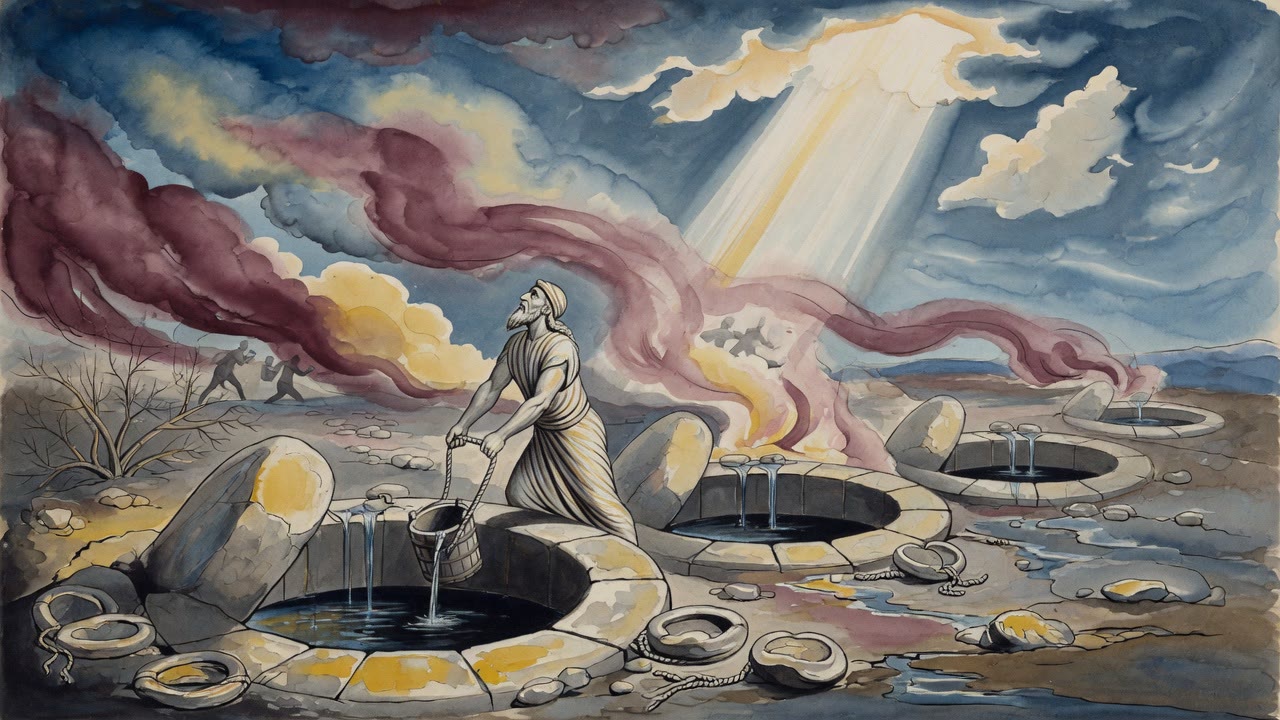
This was Rebekah, drawn from a well in a far country, chosen for the kindness of her hands when she drew water for a stranger and all his thirsty animals besides (Genesis 24:18-20). She had said yes to a road she could not see the end of. Now the end of it stood in a field and prayed, and she understood she had not come to a man only. She had come to a house, and the house was waiting to see whether she belonged in it.

The Tent That Sat Dark

There was a tent at the center of the camp that no one entered anymore. It had belonged to Sarah, Isaac's mother, dead now and buried in the cave at Machpelah, and since the day they carried her out the tent had simply stopped. While she lived, three things had marked it, and any traveler crossing the hills could have read the camp by them. A cloud hung over her tent, low and steady, not weather but presence, a soft weight of cover the way a hand rests on a shoulder. A lamp she kindled at the edge of Shabbat, the seventh day, burned. It did not burn for an evening. She lit it once a week and it stayed lit straight through to the next kindling, seven days on a single small flame, the dark never once closing over her doorway. And her dough rose under a blessing that did not run out, so that the bread she set out fed whoever came and there was always more under the cloth.

When Sarah died, the cloud lifted and did not come back. The lamp guttered and went black. The dough fell flat and stayed flat. The tent went cold and dim and empty, and the camp learned to walk around it the way you walk around a grave. For three years the doorway stayed dark.

Isaac Brings Her Inside

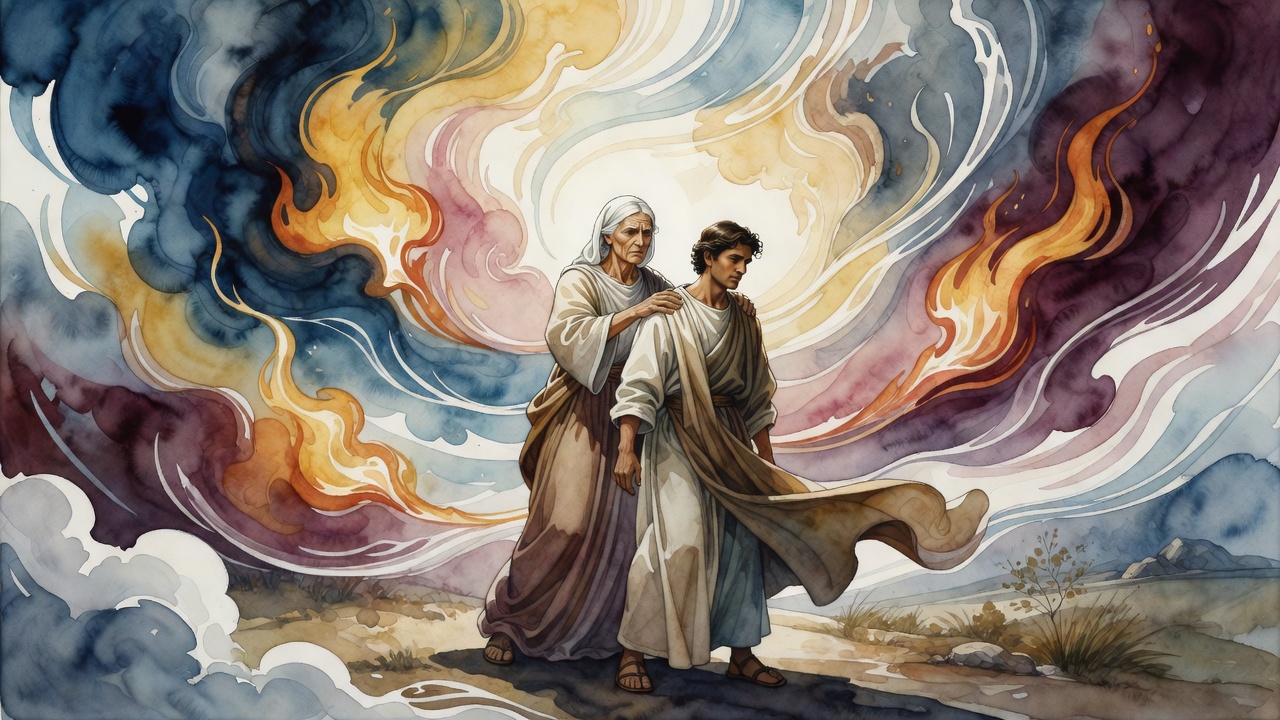
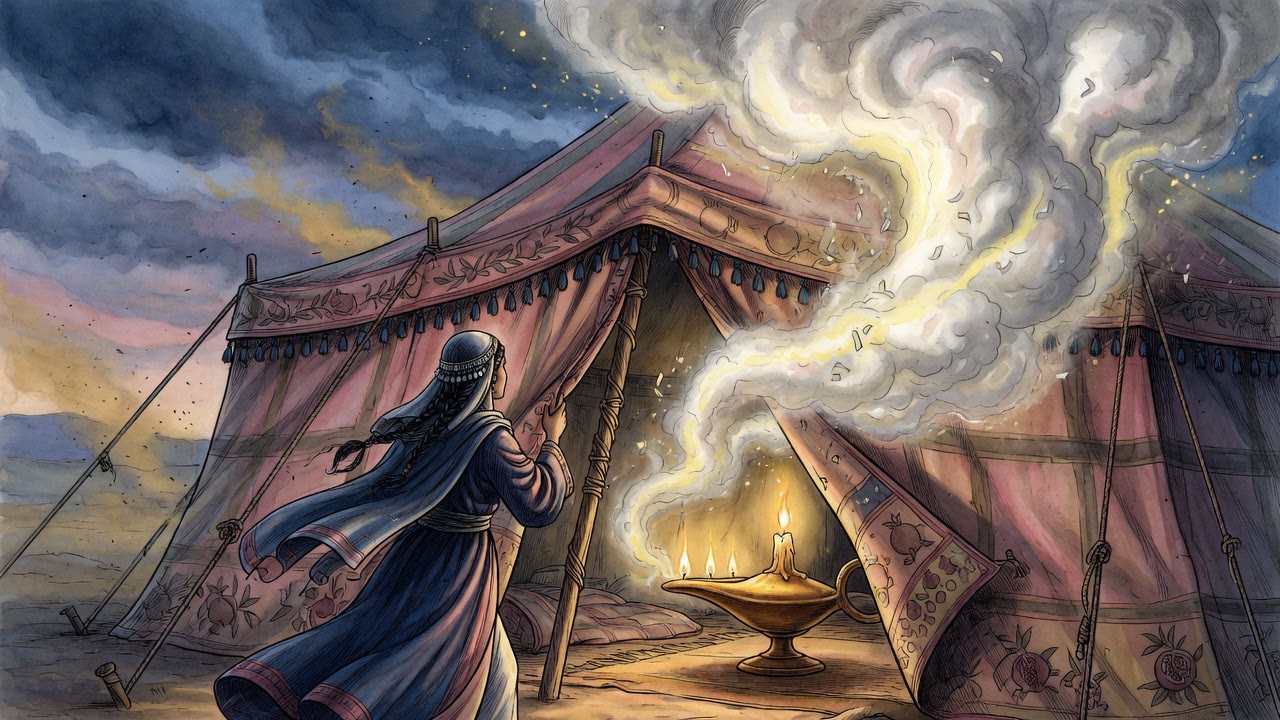
Isaac took Rebekah by the hand and did not lead her to a new tent raised for a new bride. He led her to the dark one. He pulled back the flap of his mother's tent and brought her in across the threshold that had not been crossed since the burial. The words that tell it leave out a small joint of grammar on purpose, so that the sentence does not quite say he brought her into the tent of his mother Sarah. It says, almost, that he brought her into the tent, Sarah his mother (Genesis 24:67). As if the tent and the woman were becoming the same word. As if Sarah had been waiting inside the canvas for someone to step into her exactly.

Rebekah stepped in.

The Signs Come Back

The cloud came first. It gathered out of nothing over the canvas, low and patient, the old soft weight settling back onto the roof of the tent as though it had only been holding its breath these three years. Then the lamp. The wick that had been cold and black caught of itself at the next Shabbat and held, hour after hour, day after day, the small flame standing upright through the whole week the way it had in Sarah's time, the doorway lit again from inside. And the dough. Rebekah set it out and covered it, and it rose past the rim of the bowl and kept rising, fed under the cloth by the same blessing that had never truly died, only waited, so that the bread was enough and then more than enough for every mouth that came to the tent.

No sea split. No fire fell from the sky. A cloud, a candle, a loaf of bread. The camp read them the way they had always read them, and they knew before anyone said a word that the gap was closed. What one woman had carried and set down when she died, another woman had taken up. Isaac stood in the doorway of his mother's tent in the new light of it, and the long ache of her absence loosened in him at last. He had been comforted after his mother (Genesis 24:67), not by forgetting her but by watching her life walk back in through the door in someone else's body.


← All myths
From the tradition

Sources

4 sources

The texts this telling draws on, in full. Open a card to read inline, or expand it for a wider, quieter read.

Bereshit Rabbah 60:16Bereshit Rabbah

The Torah gives us a glimpse, a tantalizing hint, when describing Isaac bringing Rebecca into his mother Sarah’s tent.

(Genesis 24:67) tells us, “Isaac brought her into the tent of his mother Sarah; he took Rebecca, she became his wife, and he loved her, and Isaac was comforted after his mother.” But there's something subtle, almost hidden, in the original Hebrew. The word "of" is missing, so a more literal reading might be: "Isaac brought her into the tent. Sarah his mother." Why is that little detail so important?

Well, according to Bereshit Rabbah, a classical collection of Rabbinic interpretations, that seemingly missing word unlocks a beautiful understanding. It suggests that Rebecca didn’t just enter a physical space; she stepped into a legacy, a continuation of Sarah's extraordinary influence. The Rabbis saw in Rebecca a revival of the miraculous blessings that had graced Sarah’s life.

"All the days that Sarah was alive," the text says, "there was a cloud suspended over the entrance to her tent." A visible sign of divine presence, a constant reminder of God's favor. When she died, that cloud vanished. But when Rebecca arrived, the cloud returned. Isn't that incredible?

And it wasn't just the cloud. "All the days that Sarah was alive, the doors were kept wide open [for guests]." Hospitality was a hallmark of her home. That openness ceased with her passing, only to be rekindled by Rebecca’s arrival. The generosity, the welcoming spirit, lived on.

Then there’s the blessing in the dough. "All the days that Sarah was alive, there was [divine] blessing bestowed upon her dough." Every baking day was touched by the divine. When she died, that blessing disappeared. But guess what? "When Rebecca came, it returned." Can you imagine the aroma of bread, infused with something truly special?

And finally, "All the days that Sarah was alive, there was a lamp kindled from Shabbat (the Sabbath) night until Shabbat night." A continuous light, a symbol of enduring faith. (Shabbat, of course, refers to the Jewish Sabbath). When Sarah died, that lamp went out. But with Rebecca’s arrival, it was lit once more.

The text emphasizes that Isaac "brought her into the tent because she was just like Sarah in her righteousness." He recognized in her the same qualities that had made his mother so exceptional. She separated ḥalla in purity (ḥalla is the portion of dough traditionally given to the Kohen (a priest) or priest), and shaped loaves from her dough in purity. She embodied the same spirit of devotion and generosity.

So, what does this tell us? It tells us that righteousness isn't just about grand gestures; it's about the consistent, everyday acts of kindness, hospitality, and faith. It's about creating a home filled with light, warmth, and divine blessing. It's about carrying on a legacy of goodness.

There's even a lesson here about family priorities! Rabbi Yudan points out that the Torah subtly teaches us a valuable lesson: If you have adult children who are unmarried, prioritize their marriage before seeking your own. How do we learn this? From Abraham. First, "Isaac brought her into the tent of his mother Sarah," and then, "Abraham took another wife, and her name was Ketura" (Genesis 25:1).

So, the next time you read about Isaac bringing Rebecca into Sarah’s tent, remember that it wasn’t just a change of address. It was a powerful moment of inheritance, a continuation of a legacy of light, blessing, and unwavering faith. It makes you wonder, doesn't it? What kind of legacy are we building, and what blessings will we pass on?

Full source
Legends of the Jews 5:291Legends of the Jews

Legends of the Jews turns to Sarah, Rebecca and the Patriarchs.

The weight of expectation! After all, she wasn’t just moving into any tent. She was moving into the tent of Sarah, Abraham's wife, a matriarch whose very presence had been marked by miracles.

The story, as told in Legends of the Jews by Louis Ginzberg, paints a vivid picture. Isaac, having listened to Eliezer's incredible tales of how Rebekah was chosen, brought her to Sarah's tent. But It wasn't enough for Rebekah to simply be there. She had to become a successor.

How did that manifest? Well, the signs reappeared! Remember the cloud that had hovered over Sarah's tent, a symbol of divine presence? It returned. This wasn't just about nostalgia; it was about a renewed blessing.

And then there's the light. Sarah, each week, would light a candle at the coming in of Shabbat, the Sabbath. And miraculously, that light would burn throughout the entire week. With Sarah’s passing, the light had gone out. But with Rebekah's arrival, it shone again, illuminating the tent and, symbolically, her path forward.

But it doesn’t stop there. According to Ginzberg, the blessing that had hovered over the dough Sarah kneaded – ensuring abundance and nourishment – also returned with Rebekah.

And perhaps most touchingly, the gates of the tent, which had been open wide to the needy during Sarah's lifetime, were once again flung open. This wasn’t just about physical sustenance; it was about a spirit of generosity, of welcoming the stranger, of embodying the very essence of compassionate hospitality – Hachnasat Orchim.

What does this all mean? It's more than just a quaint story about signs and miracles. It speaks to the enduring power of legacy, and the possibility of not just filling someone’s shoes, but of walking in their path, embodying their values, and continuing their work in the world. Rebekah didn't just inherit a tent; she inherited a responsibility, a sacred trust, and she rose to the occasion, becoming a matriarch in her own right. Pretty inspiring, isn't it?

Full source
Legends of the Jews 5:290Legends of the Jews

Remember, Eliezer had journeyed to Haran to find a suitable wife for Isaac. Now, his return was nothing short of miraculous.

The Midrash (rabbinic interpretive commentary) tells us that what should have been a seventeen-day journey took him only three hours! Can you imagine? He left Haran at noon and arrived in Hebron at three in the afternoon. Three hours! It's the kind of detail that makes you pause and wonder.

Why so fast? What's the significance of this rapid return? It speaks to the divine hand guiding events, ensuring that fate unfolds as it should.

Get this: he arrived just in time for the Minhah prayer, the afternoon service. According to tradition, it was Isaac himself who introduced this very prayer! So, Eliezer arrives, finds Isaac in prayer, and everything clicks into place. It's all so perfectly timed, isn't it?

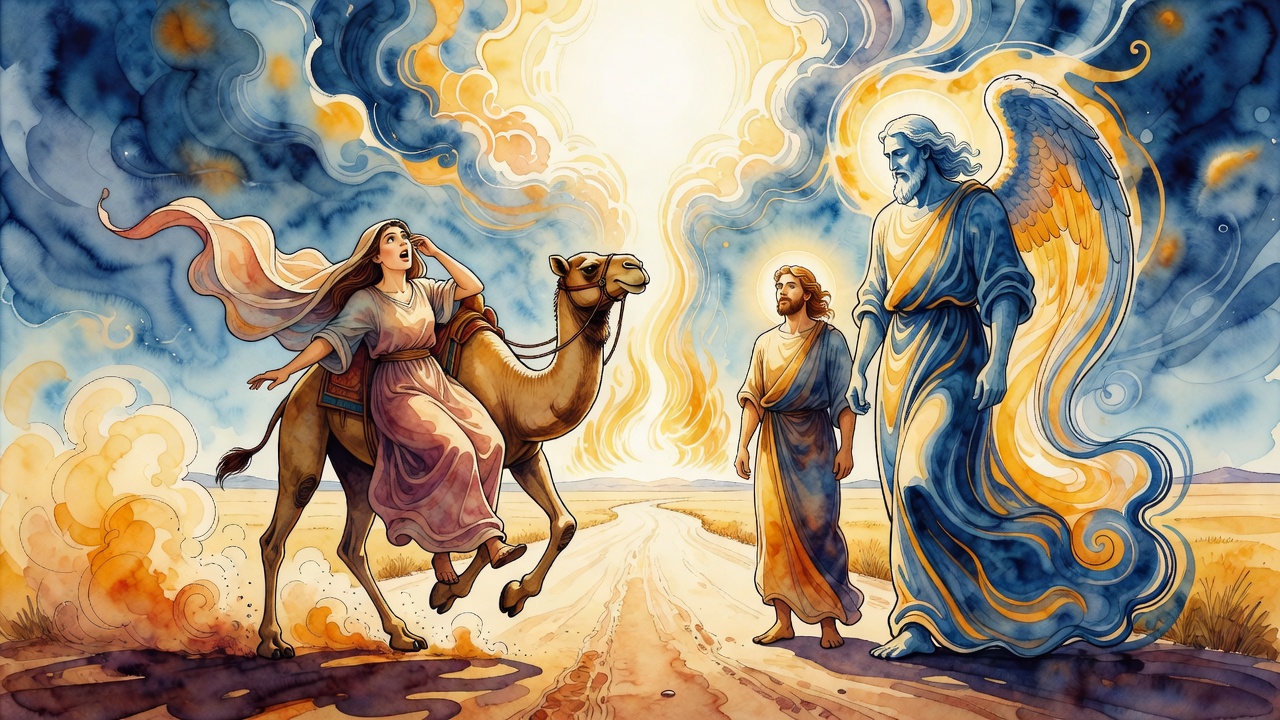
As Rebekah approached, she saw Isaac deep in prayer. The text says she immediately knew he wasn't just anyone. She noticed his unusual beauty, and even more remarkably, she saw an angel accompanying him! Talk about making an impression! It wasn't mere curiosity that prompted her question about who he was. She knew something was different.

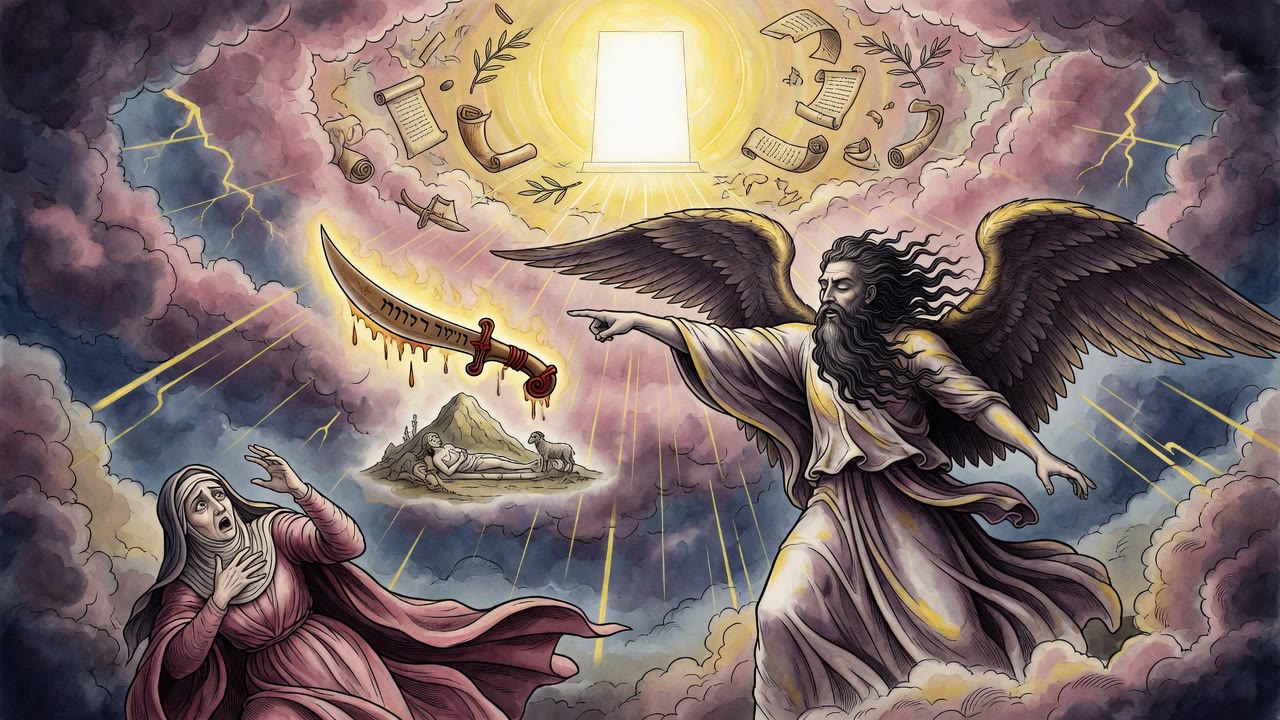
But here's where the story takes a darker turn. The Zohar tells us that at that very moment, Rebekah, through the ruach (spirit) hakodesh, the holy spirit, realized something terrifying: she was destined to be the mother of the wicked Esau.

Imagine the shock, the dread that must have washed over her. The realization that she would bring such a problematic figure into the world. The text says terror seized her.

Overwhelmed, she trembled and fell from her camel, even injuring herself in the process. image: a woman, poised on the cusp of a new life, suddenly struck by a profound and disturbing prophecy.

It's a reminder that even in moments of great joy and promise, there can be shadows lurking. Rebekah's story isn't just about finding love; it's about confronting the complexities of fate, the weight of responsibility, and the knowledge that even the most blessed unions can bring forth unexpected challenges.

What do you think this moment meant for Rebekah? How did this early knowledge shape her relationship with her sons, Jacob and Esau? It's a question that lingers long after the journey ends.

Full source
Pirkei DeRabbi Eliezer 16:8Pirkei DeRabbi Eliezer

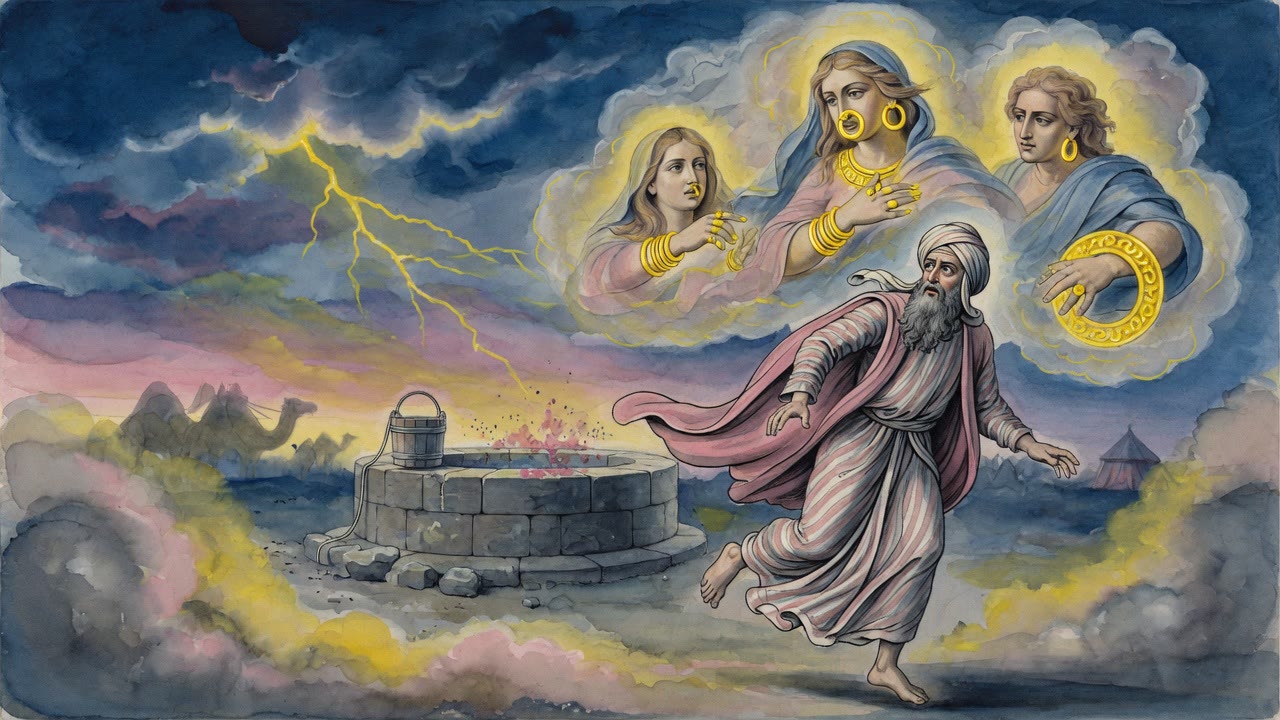
Our sages certainly thought so, and they had some amazing stories to illustrate just that. to one, found in Pirkei DeRabbi Eliezer, specifically chapter 16. It tells of Eliezer, Abraham's trusted servant, and his mission to find a wife for Isaac. A journey of seventeen days, from Kirjath Arba (Hebron) to Haran. Seventeen days! Can you imagine? But get this: Eliezer arrives in Haran in just three hours.

He’s understandably bewildered. As the verse says, "And I came this day unto the fountain" (Gen. 24:42). I mean,

So, how did this happen? Rabbi Abbahu offers a beautiful explanation. The Holy One, blessed be He, wanted to show loving-kindness, chesed (Lovingkindness), to Isaac. And how did He do it? By sending an angel ahead of Eliezer, shortening the journey. It’s a reminder that sometimes, divine assistance is working behind the scenes, smoothing our path in ways we can't even imagine.

The story doesn't end there. Remember, Eliezer was looking for a very specific kind of woman. He needed someone special, someone destined to be Isaac's wife. And here's where it gets truly remarkable. A daughter of kings, a princess who had never had to draw water in her life, goes out to the well at that very hour. The text emphasizes that this woman, who we know to be Rebecca, didn't even know who Eliezer was! Yet, she agrees to his proposal – a proposal that would change her life forever. Why? Because, as our sages say, she had been destined for Isaac from birth. As it says in Psalms (62:10), "In the balances they will go up, they are together lighter than vanity." This verse, according to the Midrash (rabbinic interpretive commentary), speaks to the preordained connection between Isaac and Rebecca. They were meant to be, weighed in the heavenly scales, and found perfectly balanced for one another.

Isn't that incredible? It’s a powerful reminder that some things are simply meant to be. That even in a world of free will and choices, there are connections, destinies, that are divinely orchestrated.

What does this story tell us? Perhaps that we should be open to the unexpected, to the seemingly impossible. Maybe we should trust that even when things seem to happen too quickly, too perfectly, there might be a greater plan at work. Maybe, just maybe, we're all part of a story much bigger than ourselves.

Full source