5 min read

Laban Ran to the Well Because He Saw Gold

Laban looked like a gracious host when he ran to greet Abraham's servant. Bereshit Rabbah says he was chasing the jewelry.

Curated by Arthur · Told by Maggid ·
Table of Contents
  1. Rebecca Went to Her Mother's House
  2. The White Name Turned Dark
  3. The Spring Sounded Like the Eye
  4. The House Was Cleared for Profit
  5. The Villain Learned to Smile Early

Laban ran like a host and arrived like a merchant.
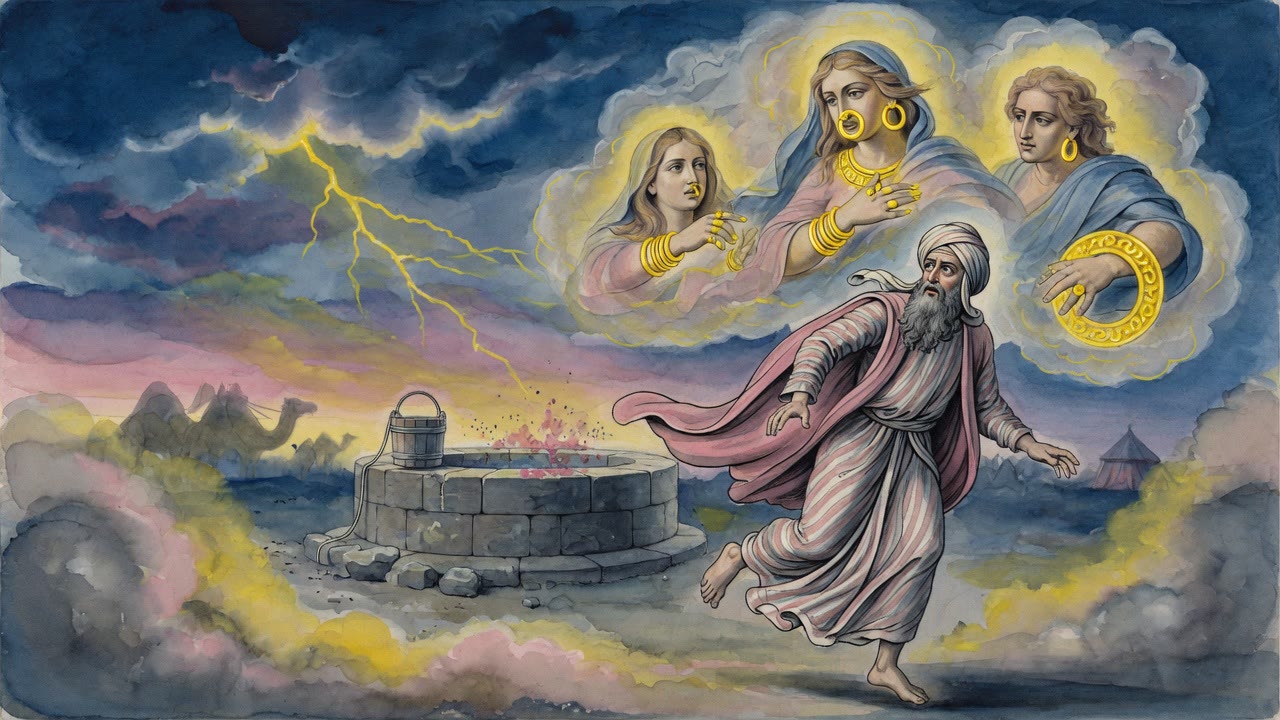
Rebecca had returned from the well with gold on her body and a story in her mouth. A stranger had come with camels, gifts, and a mission from Abraham's house. The Torah shows Laban rushing out to the spring and calling the man blessed. He sounds generous. He sounds ready to open his home.

Bereshit Rabbah watches his feet and asks what made them move so fast.

Rebecca Went to Her Mother's House

The midrash begins before Laban speaks.

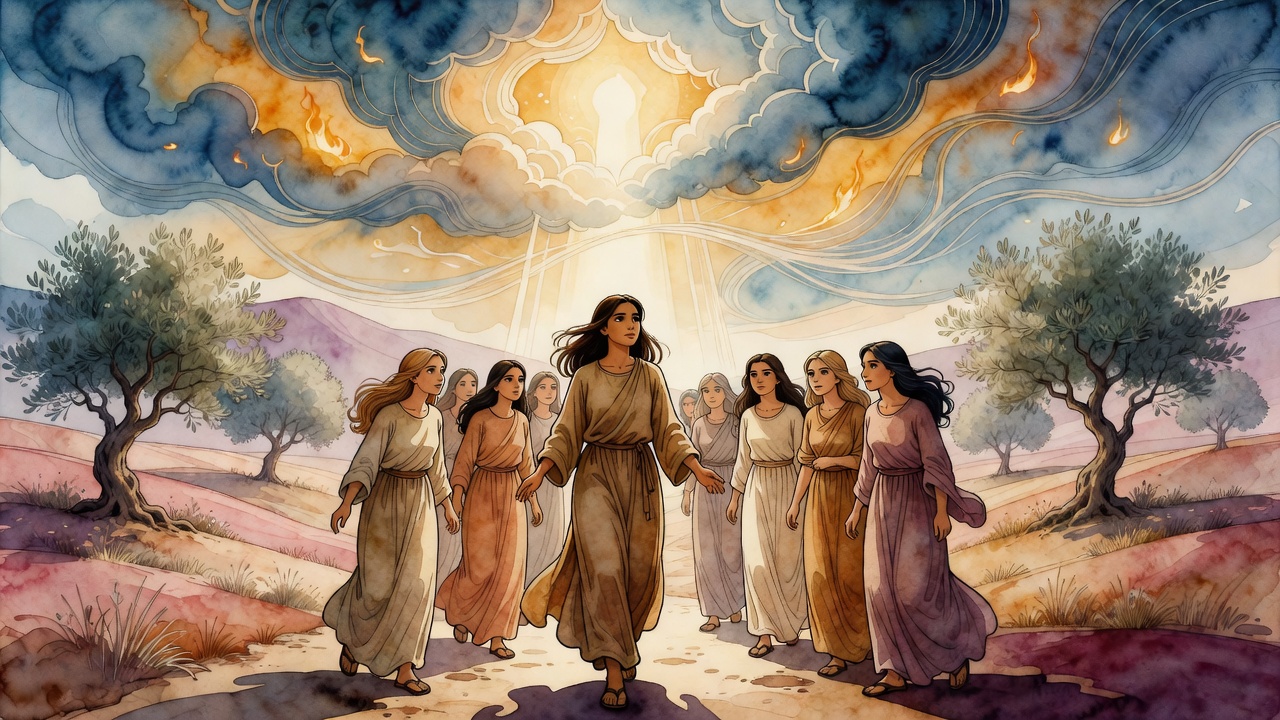
Rebecca ran and told her mother's household. Rabbi Yohanan made a social observation from that detail: a woman goes to her mother's house. The line is small, but it gives the scene its first structure. Rebecca does not vanish into her brother's story. She belongs to a household where her mother matters, where news travels first through the women's side of the family.

When Rachel later tells her father about Jacob, the midrash answers the objection simply. Rachel's mother had died. Rebecca still had one.

The White Name Turned Dark

Then Laban appears.

His Hebrew name, Lavan, means white. Rabbi Yitzhak offered the generous reading: perhaps he was fair in complexion. Rabbi Berekhya chose the harsher reading: white in wickedness. The name did not soften him. It exposed him. There are people whose corruption is muddy and confused, and there are people whose corruption is polished until it almost looks clean.

Laban belonged to the second kind. His welcome came dressed in brightness, but the midrash saw the stain under the cloth.

The Spring Sounded Like the Eye

The Torah says Laban ran to the man at the spring.

The Hebrew for spring can sound like the word for eye, and the rabbis pounced on the echo. Laban was not running toward water. He was running because his eye had seen the jewelry. The nose ring and bracelets had done their work. Gold had called him more loudly than hospitality, kinship, or the mention of Abraham's God.

He said the right words when he arrived. The midrash measured the desire that got him there.

The House Was Cleared for Profit

Laban told the servant he had cleared the house.

On the surface, that sounded like preparation. The rabbis heard something more specific: he had cleared out idolatry. Even that possible virtue remains suspicious in Laban's hands. A man can remove idols because truth has reached him. He can also remove them because a wealthy guest has arrived and piety has become useful.

Laban's house knew how to rearrange itself around opportunity. If Abraham's servant brought gifts, the room could become respectable very quickly.

The Villain Learned to Smile Early

This is Laban before Jacob.

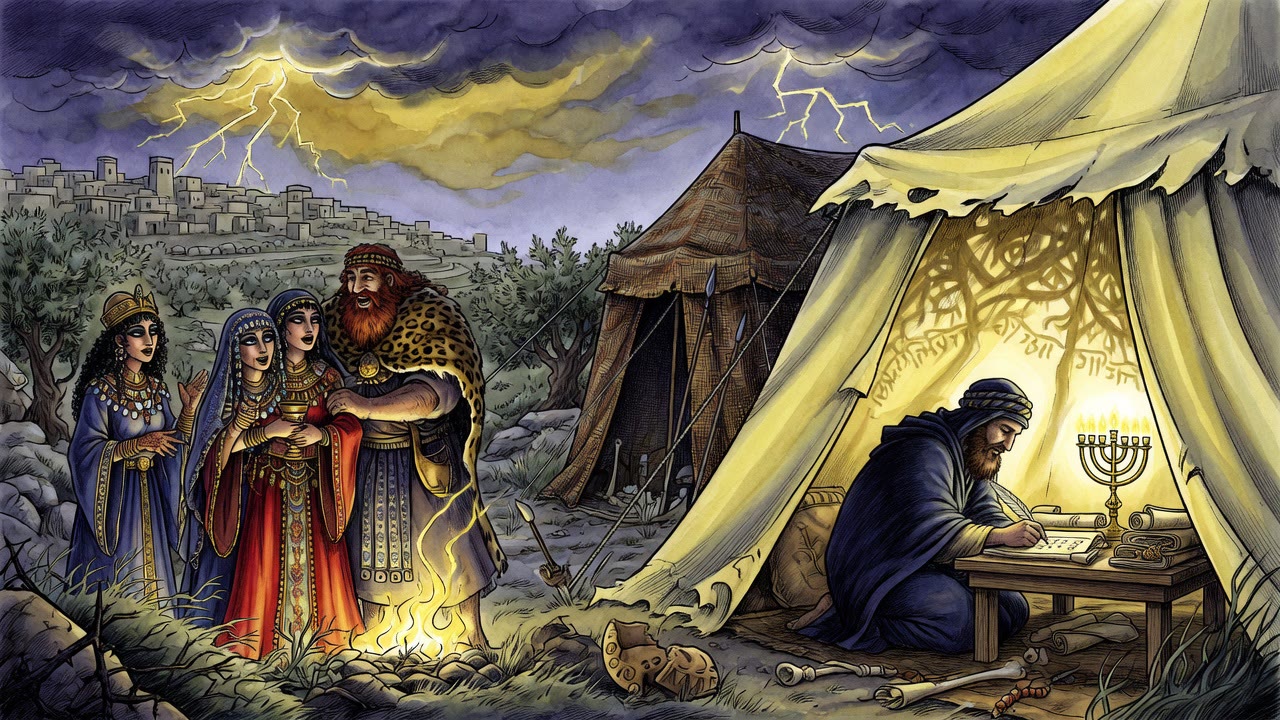
Before the swapped daughters, the changed wages, the twenty years of calculation, the pursuit into the hills, the man is already visible at the well. He runs toward money. He blesses what benefits him. He can make greed sound like welcome. The later deceiver does not appear from nowhere. He is introduced with gold shining in his eye.

Rebecca's generosity drew water for a stranger and his camels. Laban's generosity counted bracelets. The family line split at the well before anyone called it a test.

The contrast with Rebecca is what makes Laban's entrance so damning. She sees a stranger and gives water until the camels have finished drinking. That is heavy work, and she does it before she knows how the story will reward her. Laban sees the reward before he sees the stranger. The same household produces two kinds of speed: Rebecca runs to serve, and Laban runs to inspect the profit.

Bereshit Rabbah reads character through movement. People reveal themselves by what makes them hurry. Rebecca hurries toward responsibility. Laban hurries toward glitter. Later he will slow Jacob's life for twenty years with bargains, substitutions, and shifting wages, but his first motion is already honest. His legs tell the truth before his mouth starts blessing.

The well therefore becomes more than a meeting place. It is a test of desire, and both siblings arrive with their desires exposed.

That exposure explains why the servant's mission must be handled with such precision. Abraham's house is seeking covenantal kindness, not merely a suitable address. Rebecca's act at the well reveals the quality Eliezer prayed to find. Laban's rush reveals the quality Jacob will later have to survive. The same doorway shows the bride and the danger.


← All myths
From the tradition

Sources

4 sources

The texts this telling draws on, in full. Open a card to read inline, or expand it for a wider, quieter read.

Bereshit Rabbah 60:7Bereshit Rabbah

The story begins with Rebecca, who, upon meeting Eliezer at the well, "ran and told her mother’s household all about these matters" (Genesis 24:28). Now, Rabbi Yoḥanan makes an interesting observation: "A woman frequents only her mother’s household." It's a comment on the social norms of the time, the close bonds between women and their mothers. But then, someone raises an objection: what about Rachel, who, in (Genesis 29:12), tells her father Laban about Jacob? Rabbi Yoḥanan has a quick answer: Rachel's mother had died. To whom else would she have turned? It's a simple explanation, but it highlights the implied importance of the mother-daughter relationship.

Next, we meet Laban. "Rebecca had a brother and his name was Laban, and Laban ran out to the man, to the spring" (Genesis 24:29). Now, Lavan, in Hebrew, means "white." Rabbi Yitzḥak offers a favorable interpretation, suggesting that Laban was fair in complexion. But Rabbi Berekkya isn't buying it. He offers a much less flattering take: Laban was "white… in wickedness."

What was Laban really up to? The text continues: "Laban ran out to the man, to the spring [haayin]." Rabbi Berekkya sees something deeper here, a play on words. He connects haayin (the spring) to the verb me’ayen, meaning "assessing." Laban, he suggests, was assessing Eliezer, trying to figure out if he could get some money out of him. Clever. And it doesn't stop there. "He was standing beside the camels at the spring [haayin]" (Genesis 24:30). Again, the rabbis see a double meaning. Laban wasn't just standing there; he was also assessing himself (again, me’ayen), wondering if he could deceive Eliezer for his own benefit. It paints a picture of a man driven by self-interest.

Laban then says to Eliezer, "Come, blessed of the Lord; why are you standing outside, and I have cleared the house and place for the camels?" (Genesis 24:31). He's laying on the hospitality thick, but what's the real motivation?

"Come, blessed of the Lord," Laban says. According to one interpretation, Laban thought Eliezer was Abraham himself, because he resembled him. Talk about mistaken identity! But Rabbi Yosei ben Dosa has another idea, linking Eliezer to Canaan, who was cursed by Noah (Genesis 9:25). He suggests that Eliezer, through his faithful service to Abraham, moved from the ranks of the cursed to the blessed. What a powerful transformation!

Rabbi Yaakov, in the name of Rabbi Yoḥanan of Beit Guvrin, uses this as a parting thought: if Eliezer could be elevated through service, then surely the people of Israel, who perform acts of kindness, will be blessed all the more. It’s a beautiful message about the power of service and kindness to elevate us.

And finally, "Why are you standing outside?" Laban asks. It's not fitting for someone of Eliezer's stature to be outside, he implies. "And I have cleared the house," he continues, "from the filth of idol worship." Was Laban truly a changed man? Or was it all just a performance? The text leaves us to wonder.

So, what do we take away from all this? It's more than just a simple story about finding a wife for Isaac. It's a glimpse into the complexities of human nature, the motivations that drive us, and the potential for transformation through service and kindness. And it reminds us that even in the most familiar stories, there are always hidden depths waiting to be explored.

Full source
Book of Jubilees 28:1Book of Jubilees

His story, preserved in texts like the Book of Jubilees, is a fascinating glimpse into the ancient world of faith, family, and promises.

The passage It's a moment of profound significance for Jacob. He's on a journey, a difficult one, and he's seeking divine favor. What does he do? He makes a vow. He says, "…so that I come again to my father's house in peace, then shall the Lord be my God, and this stone which I have set up as a pillar for a sign in this place, shall be the Lord's house, and of all that thou givest me, I shall give the tenth to thee, my God."

A bit. Jacob is essentially saying, "If God brings me back safely, then I will acknowledge Him as my God." It's a conditional promise, a quid pro quo. "If you do this for me, then I will do this for you." And what is "this"? Well, first, he'll acknowledge God. Seems pretty important. Second, he designates the stone he uses as a pillow as a sacred place, beit el, a "House of God." Finally, he promises to tithe – to give a tenth of everything he receives back to God.

Think about the implications of that stone. It wasn't just any rock. It was a marker, a tangible symbol of his encounter with the Divine. It's a reminder that even the most ordinary objects can become imbued with sacred meaning. This is echoed in many Jewish traditions, where everyday items are used for ritual purposes, transforming the mundane into the holy.

And then there’s the tithe. Giving a tenth of one's possessions back to God is a recurring theme in the Hebrew Bible. It's a way of acknowledging that everything we have ultimately comes from a higher power. It's an act of gratitude and a way of supporting the religious institutions and those in need.

So, Jacob makes his vow, seals the deal, and then what? The verse reads, "And he went on his journey, and came to the land of the east, to Laban, the brother of Rebecca.." This is the next chapter, literally and figuratively. He's off to face new challenges, new relationships, and ultimately, to fulfill his destiny.

But the vow remains. It's a thread that runs through the rest of Jacob's story. It shapes his decisions, his relationships, and his understanding of his place in the world.

What does this story tell us today? Maybe it's a reminder that our relationship with the Divine is often a journey, filled with promises, challenges, and moments of profound connection. Maybe it's a call to examine our own vows, both spoken and unspoken. What promises have we made? What commitments have we undertaken? And how are we living up to them?

And maybe, just maybe, it's a reminder that even a simple stone can become a House of God, a place where we can connect with something larger than ourselves.

Full source
Targum Pseudo-Jonathan on Genesis 24:30Targum Pseudo-Jonathan on Genesis

Rivekah had only just finished her story, gold still on her hand, when her brother Laban moved. The Torah's text is brief, but Targum Pseudo-Jonathan on (Genesis 24:30) notices the sequence carefully: Laban saw the ring. Laban saw the bracelets. Laban heard Rivekah. And Laban ran.

The order matters. The sages were not shy about what moved Laban first. The eye before the ear. The gold before the story. Later he will welcome the stranger with the language of blessing, but the momentum began with the weight of metal.

This is Laban's first appearance in the Torah, and the Targum is already sketching the outline of the man Jacob will spend twenty years working for (Genesis 29-31). A host of generous words built on a foundation of calculation. A man whose hospitality is real but never disinterested.

Yet, here is the mercy, God uses him anyway. Laban's hurry, whatever drove it, gets the servant into the house. The messenger of Abraham finds shelter because a calculating brother saw the shine of gold. The same providence that brought Rivekah to the well is capable of steering mixed motives toward holy ends.

When you encounter a Laban in your own story, take the Targum's quiet comfort: God's plan does not require purity in every hand the plan passes through. It only requires that you, like Rivekah, carry the pitcher with clean intent.

Full source
Legends of the Jews 5:287Legends of the Jews

It happens to the best of us, and as we’ll see, it certainly happened to Laban in the story of Rebekah and Eliezer.

Rebekah, you'll recall, had just met Eliezer, Abraham's trusted servant, and had shown incredible kindness and hospitality by drawing water for him and his camels. Impressed, Eliezer presented her with valuable jewels. Now, picture Rebekah returning home, laden with these gifts, and showing them to her mother and brother, Laban.

That's where things take a turn.

Laban, seeing the jewels, is immediately consumed by avarice. According to Legends of the Jews, Ginzberg's masterful retelling of Jewish lore, Laban’s first thought wasn’t of his sister’s good fortune, but of how he could get his hands on Eliezer's wealth! His initial plan? To kill Eliezer. Can you imagine?

But Laban quickly realizes he's in over his head. He soon understands that Eliezer is no ordinary traveler. the verse says Laban realized he "would not be able to do much harm to a giant like Eliezer." That's quite an assessment!

And there's more to it than just physical strength.

As Laban approaches Eliezer, something extraordinary happens. Because of Eliezer's striking resemblance to Abraham, Laban thinks he sees Abraham himself! It's a moment of mistaken identity, fueled by Laban's own guilt and perhaps a touch of the divine. for a second. Laban, intending violence and theft, is suddenly confronted with the image of Abraham, a symbol of righteousness and faith. The effect is immediate.

Laban’s greed melts away, replaced by a veneer of hospitality. He greets Eliezer with false warmth: "Come in, thou blessed of the Lord! It is not becoming that thou shouldst stand without, I have cleansed my house of idols." It's a complete reversal! He invites Eliezer in, claiming to have rid his house of idols – a pretty bold-faced lie, most likely!

What does this little snippet of the story tell us? Perhaps it's a reminder that appearances can be deceiving, and that greed can blind us to reality. Or maybe it’s a evidence of the powerful legacy of Abraham, whose very image could inspire (or perhaps, terrify) even the most avaricious of hearts. Whatever the interpretation, it's a fascinating glimpse into the complex characters and moral lessons woven throughout Jewish tradition. We see how quickly appearances can shift and how human beings are so easily swayed by both greed and fear.

Full source