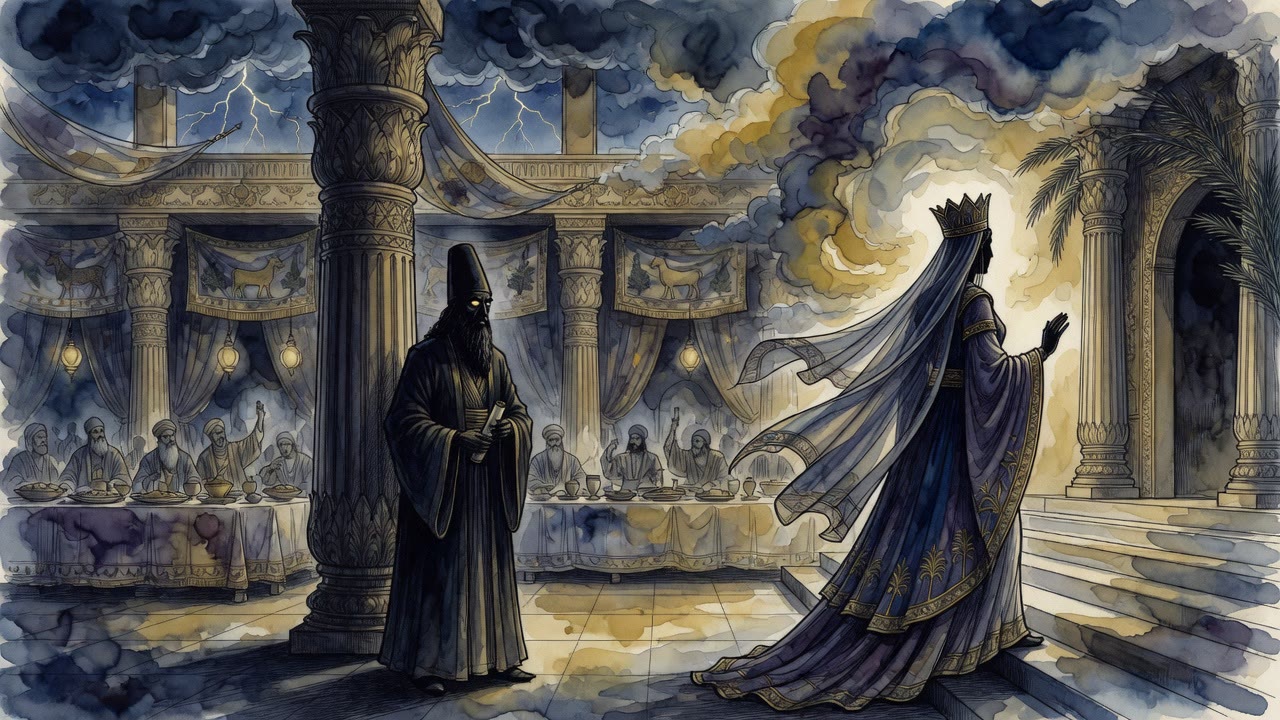
Miriam Bat Baitus Walked on Carpets to the Temple Mount
The richest woman in Jerusalem lays carpets from her door to the Temple so her feet never touch the ground, until one day they must.
Table of Contents
 Click for full size
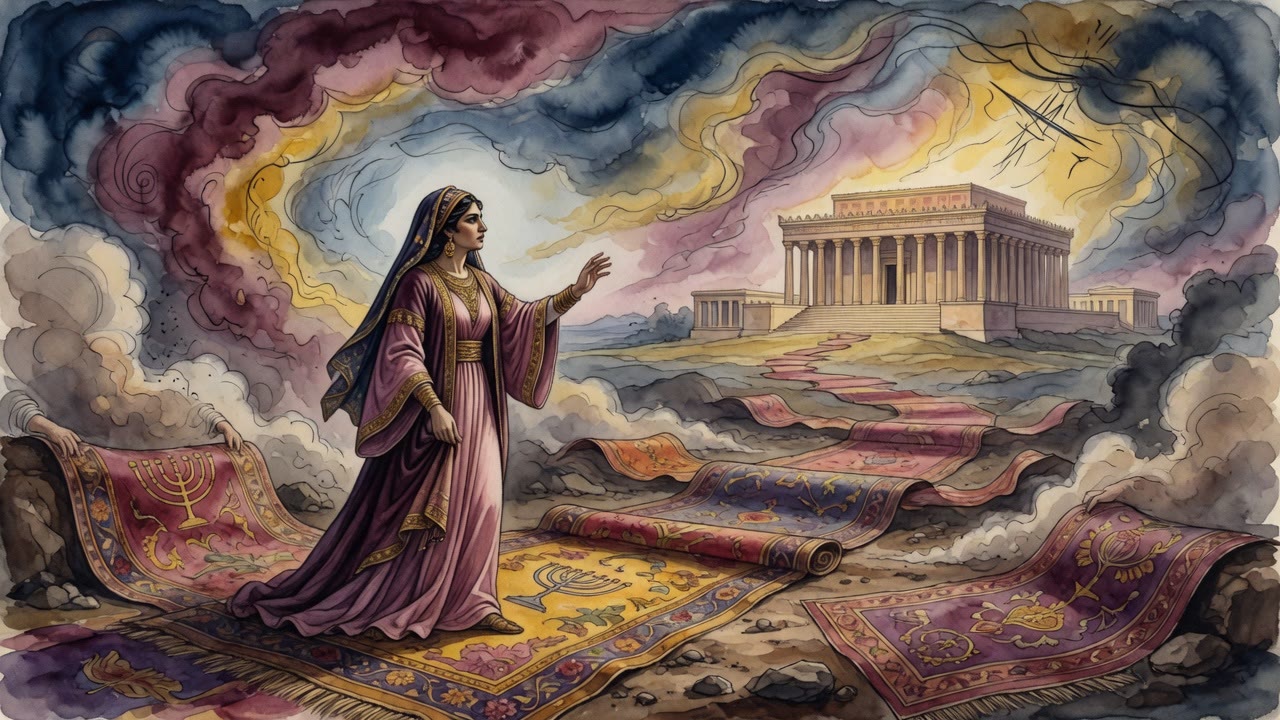
Carpets From the House to the Temple
She would not walk on the ground. That was the beginning of the story.
Miriam bat Baitus was the wealthiest woman in Jerusalem, the wife of a High Priest, the daughter of a family so prominent that her name appears in the Talmud as a standard of impossible luxury. When she wanted to go see her husband read the Torah on Yom Kippur, the holiest day of the year, she did not simply walk through the streets. Her servants laid carpets from the entrance of her house all the way to the entrance of the Temple Mount, so that her feet would not be irritated by the road.
From one set of gates to another, the city of Jerusalem became a carpet. She walked on it without her feet once touching stone.
The Husband Who Was Not Enough Without Her Money
Her husband, Yehoshua ben Gamla, had not become High Priest through scholarship or lineage alone. He had become High Priest because Miriam had purchased the appointment. The position was available for the right price, and she had paid it. She dressed him in the priestly garments with her own hands, and that act of dressing him was the last thing standing between her understanding of their marriage and the ruins it was about to become.
On the Yom Kippur she had laid the carpets for, something happened to Yehoshua. The text says he became disqualified. The precise nature of the disqualification is not spelled out in the Talmudic account, only that he was replaced at the last moment by a different priest who served in his place through the holiest day of the year.
Miriam's husband had not read the Torah on Yom Kippur. He had not stood in the place she had paid for him to occupy. She had laid carpets across Jerusalem for a ceremony her husband did not perform.
The Petition and the Fig
She went to the Sages with a petition. The Talmud does not record her exact words, only the phrase she used to describe her loss, and then the test they gave her.
The Sages told her: a fig. They sent word that she should be given a dried fig from their provisions, one ordinary dried fig, as a kind of symbolic share in their communal meal. The gesture was formal, a way of establishing that she had standing before them, that she was recognized as a member of the community whose complaint would be heard.
She refused it. A dried fig from the Sages. She had fed Jerusalem with her excess. She had bought a High Priesthood. She had carpeted the road to the Temple Mount. A dried fig was not what she had come for, and she said so in terms the text records as a woman who had not yet understood what she was about to lose.
The Sages gave her nothing more.
Jerusalem Falls and She Follows
When Rome came and Jerusalem burned, Miriam bat Baitus was still in the city. The Talmudic account records what happened to her then in terms that function as a deliberate reversal of everything the carpet story established. She went out and picked barley from between the hooves of horses. Not wheat. Not bread. Barley from the ground, from the dirt under animals, the lowest thing available in a starving city, gathered with her own hands on the same roads her servants had once carpeted so her feet would not be irritated.
Some versions of the account say she died from the shock of it. Not from hunger, not from the siege, but from the collision of who she had been and what she had become. The distance between the carpet and the barley was a distance her body could not cross.
What the Sages Saw Coming
The Talmud presents the account without moral commentary. It does not say Miriam deserved what happened to her. It does not say the fig was a warning she should have heeded. It places the two scenes side by side, the carpets and the barley, and leaves them there. The distance between them does the work of measuring itself.
But the fig carries something. When the Sages offered her that ordinary dried fig, they were offering her the same thing they offered everyone else: a portion of what there was. She had spent her life refusing to receive what other people received. She had made herself exceptional at every point, from the carpeted road to the purchased priesthood. The fig was the moment she could have stepped off the carpet and become something other than what she was. She refused it, and the carpet ended where it ended.
← All myths