Parshat Shemot7 min read

Egypt Forgot Joseph and Crowned a Cubit-Tall Pharaoh

Levi's coffin closed, the elders warned that Israel had grown mightier than Egypt, and a king a cubit tall took the brick tally in hand.

Curated by Arthur · Told by Maggid ·
Table of Contents
  1. The Coffin They Carried Out of Goshen
  2. The Elders Counted Israel and Were Afraid
  3. Wages First and Then the Whip
  4. The Small King Counted the Bricks Himself
  5. What They Put Into the Wall
Egypt Forgot Joseph and Crowned a Cubit-Tall Pharaoh Click for full size

The Coffin They Carried Out of Goshen

Levi died at a hundred and thirty seven, the last of the twelve brothers to go, and his children laid him in a coffin and kept it in the house. No procession north, no cave in Canaan yet. The box stayed in Goshen, on land a king had once handed to the sons of Jacob for nothing.
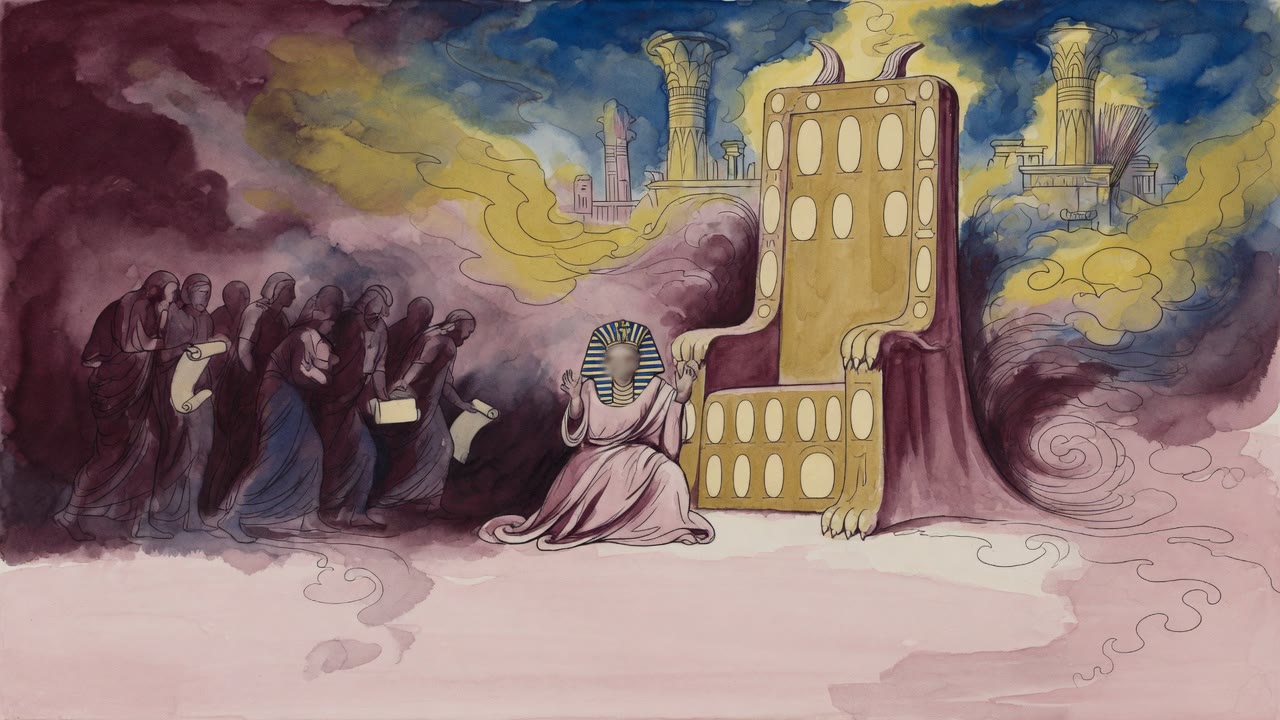
The reason behind that gift was buried too. Joseph had kept Egypt breathing through seven years when the Nile gave nothing, and Egyptians had sold him their fields for bread, then their cattle, then themselves. His brothers came down from famine country and were given the best pasture in the kingdom for it.

The men who had knelt for that bread were dead now, and their grandsons had forgotten the famine along with the Hebrew who ended it. They rode past Goshen and counted foreigners on good soil.

The taking started small. A field here, a house there, a well dug by Hebrew hands that was suddenly not theirs. Whoever argued about it got beaten in the road and went home without the well. Within a few years the sons of Jacob were worn thin enough that living itself had become a weight they carried.

The Elders Counted Israel and Were Afraid

The old king died and Melol took the throne, and the counselors and elders of Egypt came into the hall together.

"Behold, the people of the children of Israel is greater and mightier than we are," they said.

They had the fights in mind. Small parties of Hebrews had gone into Egyptian companies many times their size and come out the far end still walking. Put a war on the border, the elders argued, and men like that choose a side, and the side will not be Egypt. They will take the country and then leave it as its owners.

Melol did not order a massacre. He had something slower, and it began with money.

Wages First and Then the Whip

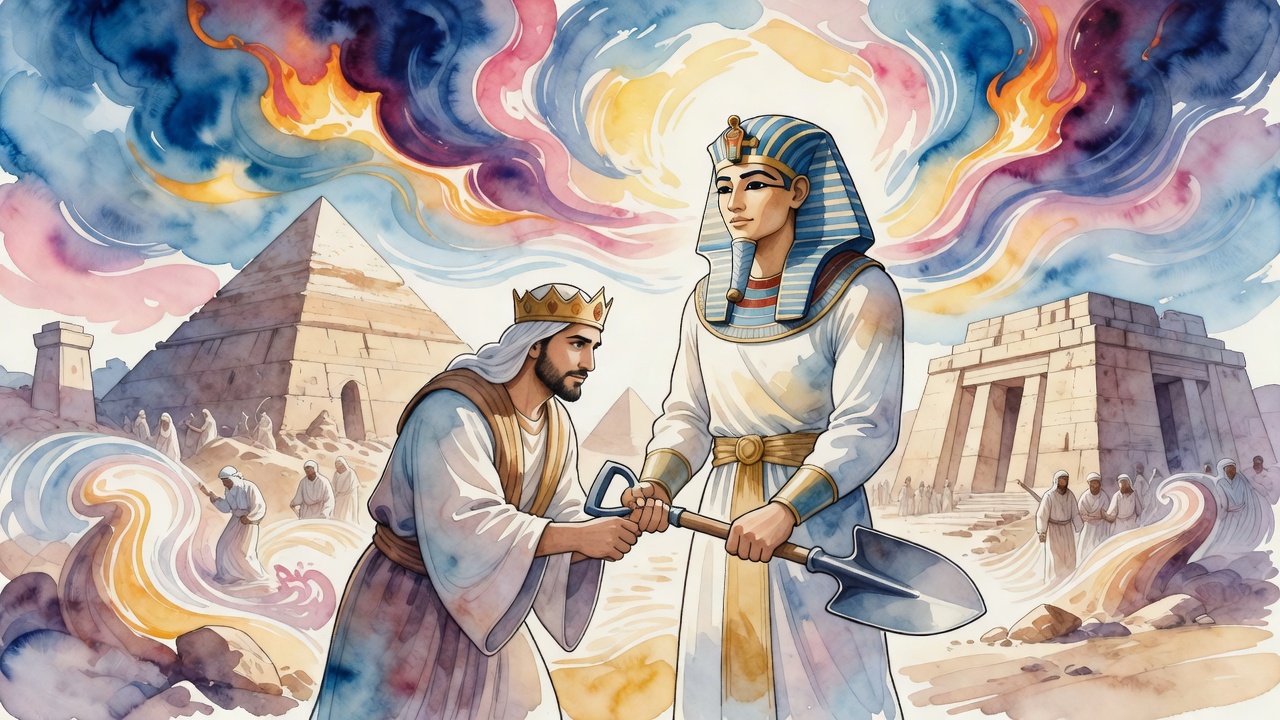
Heralds went through Egypt and through Goshen with an offer. The king was raising two cities, Pithom and Rameses, storehouses and walls, and he wanted hands. Daily wages. Egyptian and Hebrew alike, same pit, same coin.

They came. Men stripped of their fields picked up the shovel because the shovel paid, and for a month the arrangement held exactly as announced. Egyptians and Hebrews stood in the same clay and drew the same silver at dusk.

Then the Egyptians began to leave. One from this crew, two from that one, slipping off quietly week by week until the pits held Hebrews and nobody else. The men who had walked away came back with rods in their hands and stood on the rim of the pit, and the paying stopped.

A man who set down his tools and asked for his wage was knocked into the clay and told to keep working. No decree was read out in Goshen, no chain was fastened on anyone. The coin stopped and the beatings started, and by the time the word slave was spoken aloud the lower courses of Pithom already stood.

One tribe never entered the pits. The sons of Levi had turned the offer down on the first day, having read the shape of it before a single wage was paid, and the Egyptians left them where they were.

The rest made bricks, and they made one joke, the kind available to people with nothing else. The king's name was Melol. In Goshen they called him Meror (מרור), bitter, and the name held for the ninety four years he sat on the throne.

He worked them to break the birth rate. That was the design under the mortar, since a man who comes home at midnight with his back opened does not father children. The counts climbed anyway. The harder Egypt pressed, the more Hebrew children filled the lanes of Goshen, until Egyptians crossing that district went quiet with dread.

The Small King Counted the Bricks Himself

Melol died, and Egypt crowned his second son at twenty.

Adikam stood a cubit and a span tall. His beard came down to his feet and swept the floor when he walked. The wise men of Egypt, who called every king Pharaoh the way a title swallows a name, gave this one a second name behind their hands. Ahuz, short. It fit the body, and it would fit the reign.

He did not run Goshen from the hall. He came down to the brickfields with his officers, stood in the dust while the work went on, and set the daily count in his own mouth, and then set it higher. What his father had squeezed out through overseers, Adikam took in person.

The count was not a target. It was a line with a punishment underneath it.

What They Put Into the Wall

When a crew came up short at the end of a day, the taskmasters walked into the houses.

They took infants out of their mothers' arms. They carried them to the unfinished courses, set them among the bricks, and sealed the mortar over them alive to make up the missing count. Women were held back from the scaffolding while it happened. The men laid the next row on top. Two hundred and seventy children went into the walls of Egypt that way.

What came up out of Goshen afterward had no words arranged in it. It went up regardless.

God heard the voice of the children of Israel and their cry in those days, and God remembered the covenant cut with Abraham, Isaac, and Jacob.

No sea moved that night. No hail fell on Egypt.

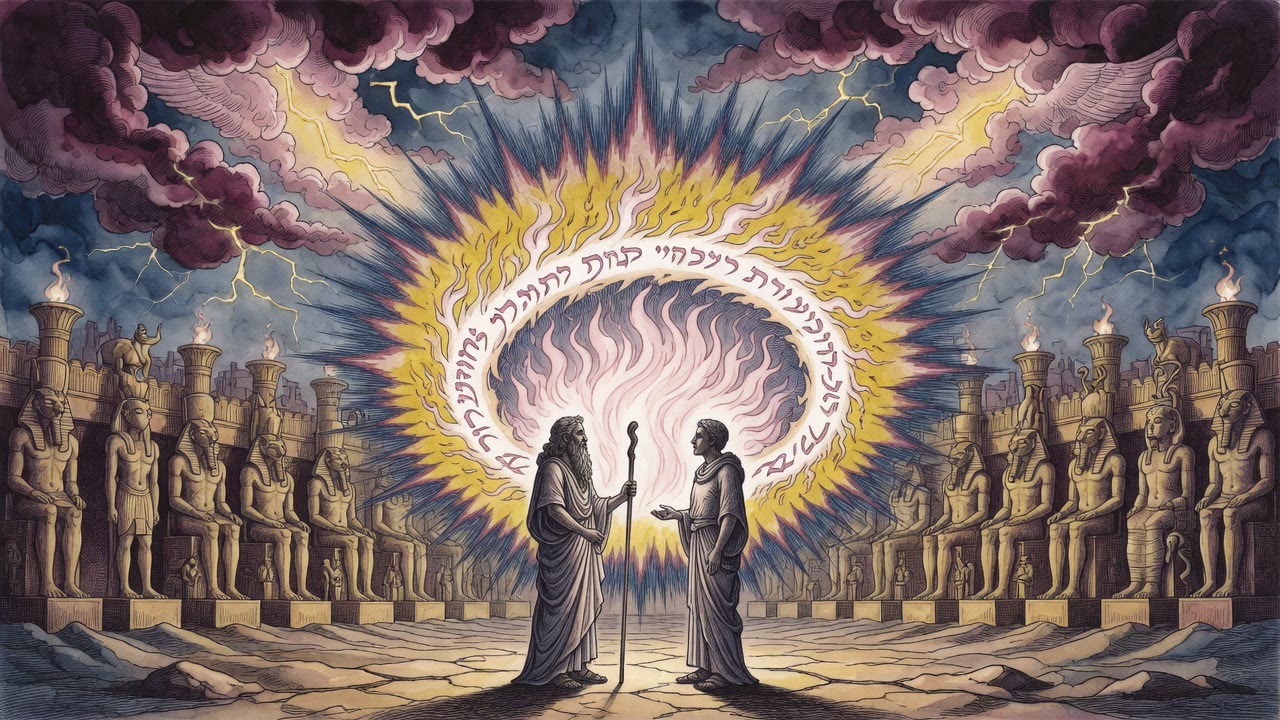
Across the border, in a garden in Midian, a staff of sapphire stood planted upright in the dirt with the Name of God cut into its length. It had been in the hand of Adam after Eden and had come down through Noah and Shem to Abraham, to Isaac, to Jacob, who took it off Esau by force, and then to Joseph, and after Joseph into the ground of Reuel the Midianite. Strong men had put both hands on it and pulled. It did not shift for any of them.

Under Reuel's house, in a pit, an Egyptian-raised man was finishing his tenth year of imprisonment on food that Reuel's daughter Zipporah carried down in secret. His name was Moses. The staff was standing there for whoever had a right to it.


← All myths
From the tradition

Sources

3 sources

The texts behind this telling. Some cards carry a translation of the source; others are our own retelling of it, and each card says which. Every card links out to the original.

Jasher 63Book of Jasher

Retold in our words. Read the original at the link below.The Book of Jasher, J. H. Parry edition (1887) · Public Domain

Out of nowhere, we get a completely separate war story! Buckle up, because

First, the tradition turns to Levi, one of Jacob's sons, passes away at the ripe old age of 137. The Book of Jasher tells us he was put in a coffin and entrusted to his children. (Jasher 63:1) A peaceful end. But his death marks a turning point. With all of Joseph's generation gone, the Egyptians start to forget the good the Israelites had done for them during the famine. (Jasher 63:2, 5)

Oppression creeps in.

The Egyptians begin to "afflict the children of Jacob, and to embitter their lives." (Jasher 63:2) They seize the land and homes that Joseph had granted them. The once-favored Israelites become the abused underclass. We're told, "the Egyptians injured the Israelites until the children of Israel were wearied of their lives." (Jasher 63:3) It's a stark and painful picture of how quickly fortunes can change.

Then Pharaoh dies! (Jasher 63:4) A new one, Melol, takes the throne. But it doesn't bring relief. This new Pharaoh, like the new generation of Egyptians, doesn't remember Joseph's contributions. They only see the Israelites as a large, potentially threatening population. So, the oppression continues.

Now, here's a fascinating theological twist. The Book of Jasher tells us "this was also from the Lord, for the children of Israel, to benefit them in their latter days, in order that all the children of Israel might know the Lord their God." (Jasher 63:7) It's a classic example of finding divine purpose in suffering. The idea is that this hardship is meant to ultimately bring the Israelites closer to God, to remind them of their ancestors' faith, and to prepare them for the "signs and mighty wonders" that are to come during the Exodus. (Jasher 63:8) It's a tough pill to swallow, but it speaks to the enduring human need to find meaning, even in the darkest of times.

Okay, deep breath. Because now, we're shifting gears completely.

Suddenly, we're whisked away to a completely unrelated war. We're introduced to Zepho, the son of Eliphaz, who is himself the son of Esau. Zepho hears that the troops of Angeas, the king of Africa, are out pillaging in the land of Chittim – usually identified with Cyprus, though sometimes used more broadly to refer to the Mediterranean isles and coastal regions. (Jasher 63:10) Zepho, ever the warrior, goes out and wipes them out! (Jasher 63:11-12)

Well, Angeas isn't too happy about that, so he gathers an enormous army, enlisting the help of his brother Lucus. (Jasher 63:13-14) Zepho and the people of Chittim are terrified, and Zepho sends a desperate plea for help to the land of Edom, to the children of Esau. "Come help us, or we're all going to die!" he basically says. (Jasher 63:16-18)

But the Edomites refuse, citing a long-standing peace treaty that goes all the way back to the time of Joseph. (Jasher 63:19) So, Zepho is on his own.

Outnumbered and outgunned, Zepho turns to prayer. He cries out to the God of Abraham and Isaac, acknowledging Him as the one true God and asking for deliverance. (Jasher 63:23-25) And here's the key: "The Lord hearkened to the voice of Zepho, and he had regard for him on account of Abraham and Isaac." (Jasher 63:26)

God answers his prayer! Zepho and the children of Chittim defeat Angeas and his massive army, slaying hundreds of thousands of them. (Jasher 63:27-28) Even after Angeas tries to replenish his forces, Zepho prevails again! (Jasher 63:29-34) Angeas and his brother flee back to Africa in terror. (Jasher 63:35)

What are we to make of this sudden shift in narrative? It’s jarring. We go from the Israelites suffering in silence to a full-blown war narrative with different characters, different geography, and seemingly different stakes. Perhaps the inclusion of this story serves as a reminder that God's providence extends beyond the Israelites. Or maybe it's simply a popular story that the author of Jasher wanted to include.

Whatever the reason, Chapter 63 of the Book of Jasher leaves us with a lot to think about. The cyclical nature of oppression, the enduring power of faith, and the unexpected ways that deliverance can arrive.

Full source
Jasher 65Book of Jasher

Retold in our words. Read the original at the link below.The Book of Jasher, J. H. Parry edition (1887) · Public Domain

Book of Jasher turns to Pharaoh's Advisors Warn That Israel Grows Too Strong.

Chapter 65 plunges us right into the heart of Pharoah's court. The scene opens with the counselors and elders of Egypt gathering before the king. They're worried, and for good reason. "Behold, the people of the children of Israel is greater and mightier than we are," they say, according to the Book of Jasher. They remember past skirmishes, where a few Israelites routed much larger Egyptian forces. They fear the Israelites will become too numerous and, in the event of war, side with Egypt’s enemies, potentially even driving the Egyptians out of their own land!

What's a Pharoah to do? Well, according to this account, he proposes a cunning plan, a strategy of slow, insidious oppression. He suggests they begin a building project, constructing and fortifying the cities of Pithom and Rameses (mentioned also in (Exodus 1:1)1). The plan? Lure the Israelites in with the promise of paid labor, then slowly, subtly, turn the tables.

The Pharoah instructs his advisors to proclaim throughout Egypt and Goshen – the region where the Israelites resided – that the king is seeking laborers for this grand construction project. Egyptians and Israelites alike are invited, with the promise of daily wages. It's a classic bait-and-switch.

At first, everyone's paid fairly. Egyptians and Israelites work side-by-side. But then, the Egyptians begin to withdraw, one by one, in secret. After a month, they start disappearing, as the Book of Jasher tells us. Then the Egyptians return not as fellow workers, but as taskmasters, as oppressors. The wages stop. The work intensifies.

If any Israelite refuses to work without pay, they are beaten and forced back into labor. This is how freedom erodes, isn't it? Not with a sudden cataclysm, but with a gradual tightening of the screws.

And what was the goal of all this deception? To weaken the Israelites, to diminish their numbers. The Pharoah believed that the back-breaking labor would take a toll, even to the point of preventing them from being with their wives and having children. A chilling strategy of demographic warfare.

The plan works, at least for a time. The Israelites build Pithom and Rameses, fortifying the land of Egypt. They make bricks, they build walls. For years, they toil under this oppressive regime, until, as the Book of Jasher poignantly states, "the time came when the Lord remembered them and brought them out of Egypt."

The Book of Jasher notes that the tribe of Levi, the priestly tribe, never participated in this forced labor. They saw through the Egyptians' deception from the beginning and refused to cooperate. As a result, the Egyptians left them alone. We can see here an early example of how maintaining one’s integrity, even in the face of immense pressure, can provide a form of protection.

The text also tells us that the Egyptians grew increasingly harsh, embittering the lives of the Israelites with hard labor in mortar, bricks, and fields. The Israelites, in a darkly humorous twist, even renamed the Egyptian king Melol to Meror, meaning "bitter," because of the bitterness they experienced during his reign.

But here's the thing: despite the Egyptians' efforts to diminish them, the Israelites continued to increase and grow stronger. As (Exodus 1:12) also tells us, "the more they afflicted them, the more they multiplied and grew. And they were in dread of the Israelites." Oppression, paradoxically, often fuels resilience.

What can we take away from this chapter of the Book of Jasher? It's a stark reminder of the insidious nature of oppression, how it can creep in disguised as opportunity. It shows us the importance of vigilance, of questioning authority, and of standing in solidarity with those who are vulnerable. And it also offers a glimmer of hope: that even in the darkest of times, resilience can flourish, and liberation, eventually, will come.

Full source
Jasher 77Book of Jasher

Retold in our words. Read the original at the link below.The Book of Jasher, J. H. Parry edition (1887) · Public Domain

There are entire books dedicated to filling in those gaps, offering tantalizing glimpses into the lives of our ancestors. One such book is the Book of Jasher, a work referenced in the Bible itself (Joshua 10:13; (2 Samuel 1:1)8), lending it an air of mystery and intrigue. Chapter 77, a passage brimming with hardship, divine remembrance, and a very special stick.

The story opens with Adikam, a young and, shall we say, aesthetically challenged Pharaoh. That Adikam was only 20 years old when he ascended the throne in Egypt, four years after the Israelites arrived. While his father, Melol, reigned for 94 years, Adikam's rule was destined to be shorter. The text in Jasher points out that the Egyptians would call each Pharaoh, well, Pharaoh. It was a custom similar to calling every Caesar by that title, so the wise men nicknamed Adikam Ahuz, meaning "short" in Egyptian, possibly referencing his brief reign or, perhaps, his diminutive stature–described as being "a cubit and a span" tall with a beard reaching his feet!

Adikam wasn't just short in stature; he was also short on compassion. He surpassed even his wicked father in cruelty, intensifying the Israelites' suffering. He personally oversaw their backbreaking labor in Goshen, demanding they meet impossible quotas and threatening dire consequences for failure.

What were these consequences? A horrifying decree: when the Israelites fell short of their daily brick quota, Pharaoh's taskmasters would seize their infants, forcibly removing them from their mothers' arms, and using them as… building materials. The text paints a grim picture of parents weeping as their children were entombed alive within the very structures they were forced to build. Two hundred and seventy children were killed in this way.

The Israelites cried out to God, and the text explicitly states: "God heard the voice of the children of Israel and their cry, in those days, and God remembered to them his covenant which he had made with Abraham, Isaac and Jacob." (Book of Jasher 77:24) This is a crucial moment. It's not just about suffering; it's about divine remembrance, a theme that resonates throughout Jewish history. God remembers the covenant.

Meanwhile, where is Moses in all of this? He’s languishing in a dungeon, imprisoned by Reuel, the Midianite. For ten long years, he’s been sustained in secret by Reuel's daughter, Zipporah, who provides him with food. After a decade, Zipporah convinces her father to check on Moses, reminding him of the power of the Hebrew God. "Surely thou hast heard that the God of the Hebrews is great and awful, and does wonders for them at all times," she says (Book of Jasher 77:32).

Reuel relents, and Moses is freed. He emerges, shaves, changes his clothes, and goes to the garden to pray. And it's here, in the garden, that things take a truly legendary turn.

Moses sees a sapphire stick planted in the ground. It’s no ordinary stick. Engraved upon it is the name of God. He reaches out, effortlessly plucks it from the earth, and suddenly possesses an object of immense power and history.

This stick, according to the Book of Jasher, is no less than the staff used by God in creation! It was held by Adam after his expulsion from Eden, passed down through generations to Noah, Shem, Abraham, Isaac, and Jacob. Jacob even took it by force from his brother Esau! It eventually came into the possession of Joseph, and then, somehow, ended up in the hands of Reuel the Midianite, who planted it in his garden.

Many tried to retrieve the staff, but none could.

The text explains that the staff remained planted in Reuel's garden until "he came who had a right to it." (Book of Jasher 77:50) When Reuel sees Moses holding the stick, he understands. He knows that Moses is destined for greatness, and he gives him his daughter Zipporah in marriage.

What are we to make of this chapter? It’s a blend of historical narrative, harrowing suffering, and fantastical elements. It emphasizes the brutality of slavery in Egypt, yet also offers a glimmer of hope through divine intervention and the enduring power of faith. The story of the sapphire stick adds a layer of mystique, connecting Moses to a lineage of patriarchs and bestowing upon him a tool of cosmic significance.

The Book of Jasher, while not part of the canonical Bible, provides a compelling narrative that enriches our understanding of the Exodus story. like a sapphire stick planted in a garden.

Full source