6 min read

Elisha the Prophet Who Multiplied Oil and Walked a Blind Army Home

Samaria starved until a donkey's head cost eighty pieces of silver. Elisha named cheap flour for tomorrow. The officer who laughed died in the gate.

Curated by Arthur · Told by Maggid ·
Table of Contents
  1. The Widow's Last Jar
  2. A Blind Army Walked to Samaria
  3. Windows in Heaven
  4. Flour in the Gate

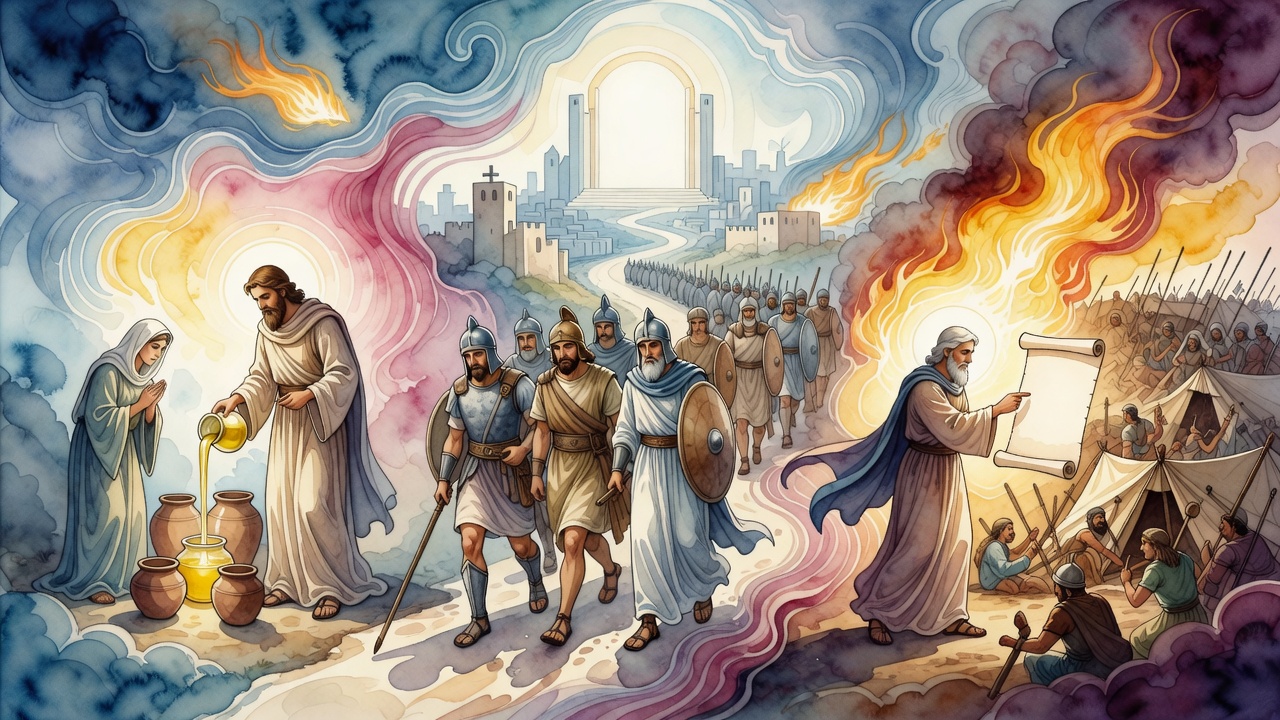
The creditors were already at the door when she found Elisha. Her husband was dead. The debt was not. They had come for her two sons, to take them as slaves until the account was clean. All she had in the house was one small jar of oil.
Elisha the Prophet Who Multiplied Oil and Walked a Blind Army Home Click for full size

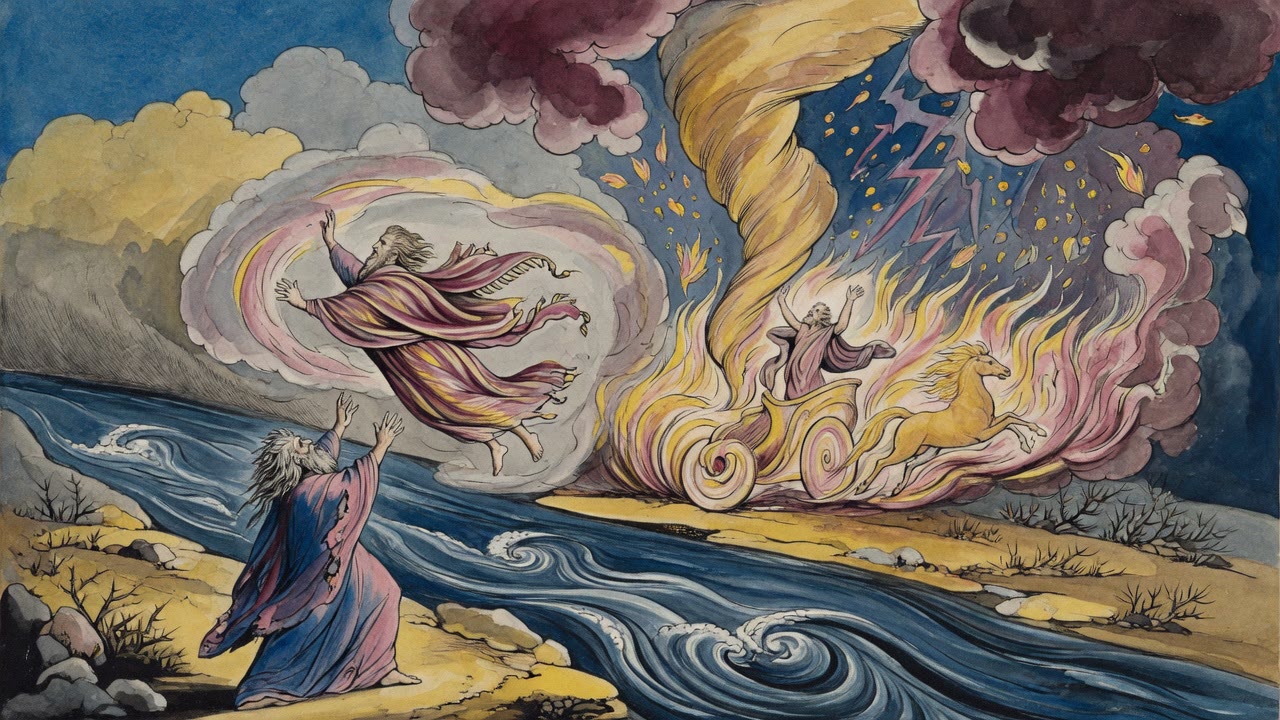
He had already crossed the Jordan alone, on a double portion of Elijah's spirit, sixteen wonders against his master's eight. The extra measure was not a title. It was work. She put the work in front of him and waited.

The Widow's Last Jar

The dead man had been Obadiah, steward of King Ahab, who had hidden a hundred prophets in caves during Jezebel's killings and fed them at his own expense. He had borrowed money to do it. Now the loan had come due on his widow's threshold. Elisha asked her what she had. One jar. He told her to borrow empty vessels from all her neighbors, as many as she could carry, then go inside, shut the door, and pour.

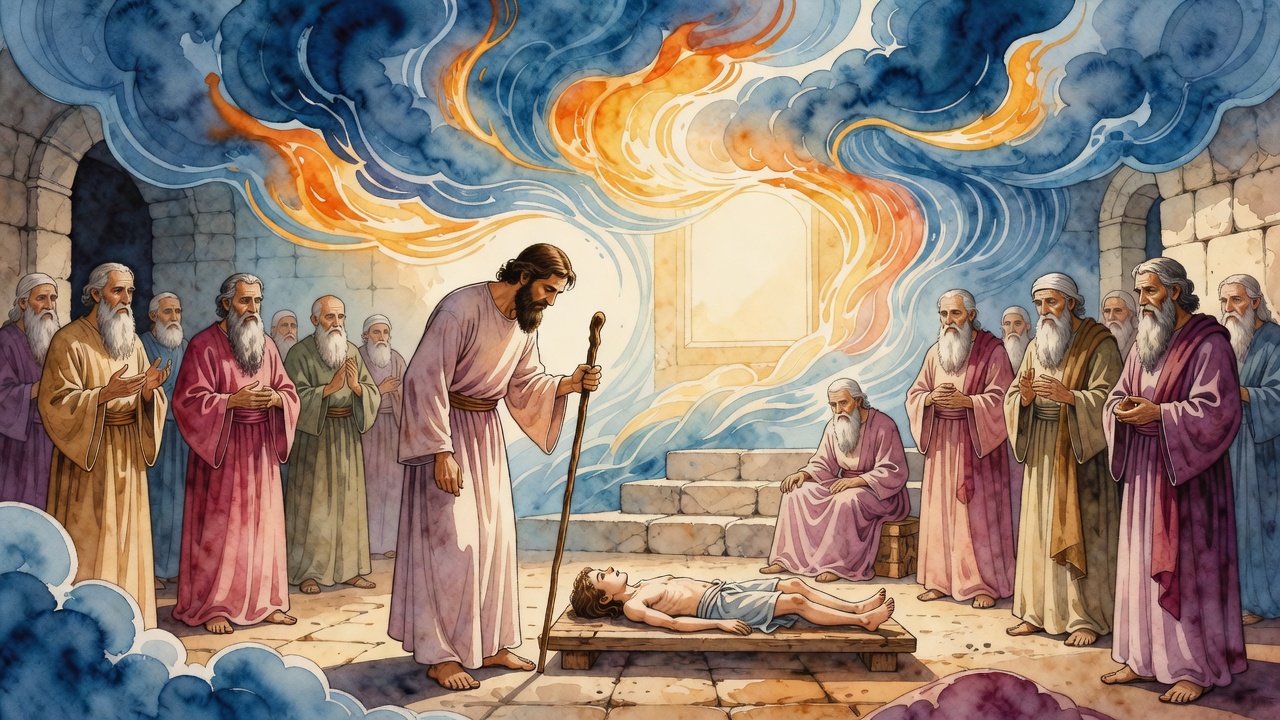
She poured. The oil kept coming. Vessel after vessel filled, and the jar in her hand did not lighten. When she had filled the last vessel she could find, the flow stopped. The moment there were no more mouths for it, the miracle closed its mouth too. She went back to Elisha. He said, "Sell the oil, pay your debt, and you and your sons will live on what is left." Empty things had filled until there was no more room. That was the pattern. It would not stay in one house.

A Blind Army Walked to Samaria

The king of Aram was at war with Israel and could not keep a secret. Every move he planned in his bedroom was known in Samaria before the army reached its place. His officers told him why. Elisha the prophet was telling the king of Israel the words spoken in that room. The Aramean king sent horses, chariots, and a large force to Dothan, where Elisha was staying. They surrounded the city by night.

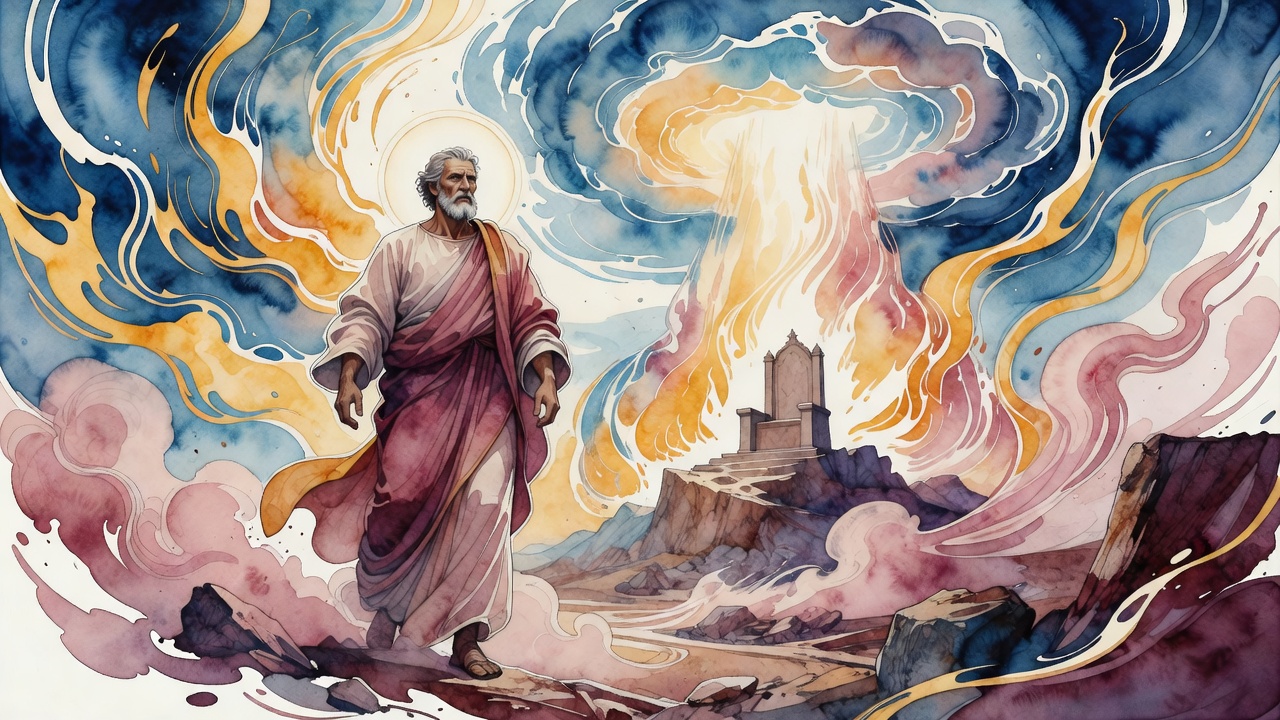
Elisha's servant woke early, went outside, and saw the army. He ran back in. "What do we do?" Elisha said, "Do not be afraid. Those who are with us are more than those who are with them." He prayed that the servant's eyes would be opened. The servant looked up and saw the mountain full of horses and chariots of fire around Elisha. Then Elisha prayed a second prayer, this one to strike the Aramean army with blindness. The blindness came. He walked up to the sightless soldiers and told them they were in the wrong place, that he would lead them to the man they were looking for. He walked the entire army to Samaria, the capital they had set out to break. Then he asked God to restore their sight. They opened their eyes inside the city they had come to attack, ringed by the Israelite host.

The king of Israel asked, "Shall I strike them down?" Elisha said no. "Feed them and send them home." The king prepared a great feast. The soldiers ate and drank and were released. The raiding parties stopped coming. Mercy, poured like the widow's oil, filled men who had arrived empty of sight. It did not fill them forever.

Windows in Heaven

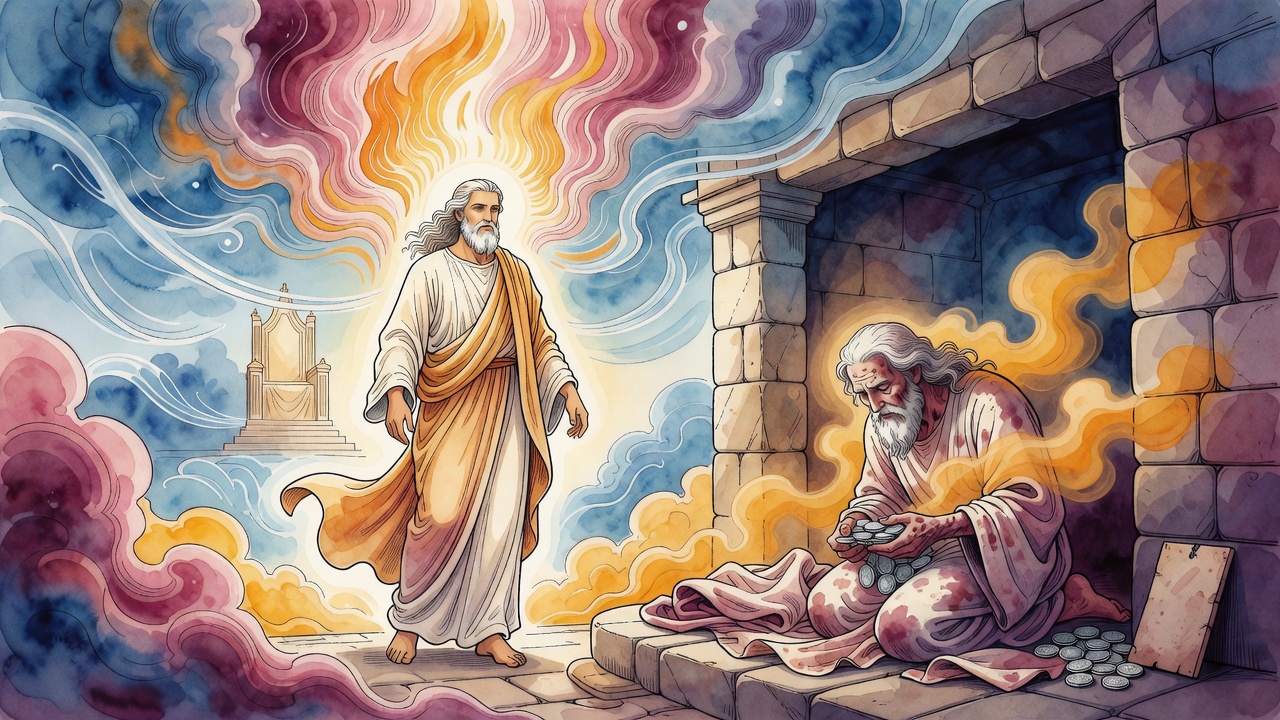
When Ben-hadad of Aram besieged Samaria later, the city starved. A donkey's head sold for eighty pieces of silver. A handful of dove's dung for five. Mothers ate their children. The king of Israel walked the walls, heard these things, and tore his clothes. Under the torn robe the people saw sackcloth against his skin. He sent a man to kill Elisha.

Elisha was sitting in his house with the elders around him when the executioner's messenger reached the door. He spoke the next day before it arrived. "Tomorrow at this time, a measure of fine flour will sell for a shekel in the gate of Samaria, and two measures of barley for a shekel." The king's officer, the captain on whose hand the king leaned, said, "If God opened windows in heaven, could this happen?" Elisha turned to him. "You will see it with your eyes, but you will not eat of it."

Flour in the Gate

That night God put a sound in the Aramean camp: horses and chariots, a force arriving from two directions in the dark. The Arameans told one another that the king of Israel had hired other kings. They fled at dusk and left their tents standing, their horses tied, their donkeys, their food still warm, their silver and gold, everything exactly where it was. They ran and did not look back.

Four lepers sitting at the city gate decided they had nothing to lose. Enter the city and die of famine. Sit still and die. They rose at twilight and walked into the Aramean camp. They found it empty. They ate and drank, hid silver and gold and clothing, then thought better of staying quiet. This is a day of good news, they said, and we are keeping silent. They went back and called to the gatekeepers.

The king suspected a trap. He sent scouts on the last of the horses. The scouts followed a trail of discarded garments all the way to the Jordan. The army was gone. The city poured out through the gate and plundered the camp, and by evening a measure of fine flour was selling for a shekel in the gate of Samaria, exactly as Elisha had said. The king's officer had been set to hold that gate during the rush. The crowd caught him. They trampled him to death in the gate. He saw the flour with his eyes. He did not eat of it. The oil had multiplied. The blind army had been walked home and fed. The man who asked if heaven had windows died under the answer.


← All myths
From the tradition

Sources

4 sources

The texts behind this telling. Some cards carry a translation of the source; others are our own retelling of it, and each card says which. Every card links out to the original.

Antiquities IX.3-4Antiquities of the Jews (Josephus)

Retold in our words. Read the original at the link below.Antiquities of the Jews, trans. William Whiston · Public Domain

Elisha inherited Elijah's mantle and immediately proved he was no lesser prophet. His miracles were stranger, more varied, and sometimes more violent than his master's.

A widow of Obadiah, King Ahab's steward, came to him in desperation. Her husband had hidden a hundred prophets from Jezebel's massacre and borrowed money to feed them. Now creditors were coming to enslave her children. All she had was a tiny cruse of oil. Elisha told her to borrow every empty vessel she could find, shut her door, and pour. The oil flowed until every vessel was full. She sold it, paid her debts, and lived on the rest.

When Benhadad, king of Syria, set ambushes for King Joram, Elisha exposed every trap. Benhadad sent a whole army to capture one prophet in the city of Dothan. Elisha's servant panicked at the sight of enemy chariots surrounding them. Elisha told him to look again. God opened the servant's eyes and he saw the hills blazing with heavenly chariots of fire. Then Elisha prayed for God to blind the Syrians. He walked among the blinded soldiers, promised to lead them to the man they sought, and marched them into the heart of Samaria. When God restored their sight, they were surrounded. Elisha forbade their slaughter. Feed them and send them home, he said.

Benhadad besieged Samaria so severely that an ass's head sold for eighty pieces of silver and women ate their own children. King Joram swore to kill Elisha for not praying the siege away. Elisha made a promise that sounded insane: by tomorrow, fine flour will sell for a shekel. A captain scoffed that not even God could pour grain from the sky. Elisha told him he would see the plenty but never taste it.

That night, God made the Syrians hear phantom armies thundering toward them. They fled in terror, abandoning tents full of gold, silver, and food. Four lepers stumbled into the empty camp and brought word to Samaria. The people stampeded out to plunder. The mocking captain was posted at the gate. The mob trampled him to death, exactly as Elisha had foretold.

Full source
Legends of the Jews 8:5Legends of the Jews

Retold in our words. Read the original at the link below.The Legends of the Jews by Louis Ginzberg (1909) · Public Domain

Legends of the Jews turns to Elisha Receives a Double Portion of Elijah's Spirit.

Elijah had promised Elisha a "double portion" of his spirit. And according to Legends of the Jews, that promise was fulfilled instantly. In fact, Elisha performed sixteen miracles during his lifetime, doubling the eight attributed to his master.

The first miracle, crossing the Jordan River, is particularly striking. Elijah had crossed it with Elisha at his side. But Elisha? He traversed the river alone. As the saying goes, two righteous ones always have more power than one.

With great power, as they say, comes great responsibility. And Elisha's next miracle, the "healing" of the waters of Jericho, proves that being a prophet isn't always easy. The story goes that the water was undrinkable, so Elisha purified it, making it safe. Sounds good. Well, not for everyone.

Imagine you're a water merchant, selling clean water for a living. Suddenly, the prophet makes the local water source drinkable, and your business dries up. According to Legends of the Jews, these tradesmen were, let’s just say, not the most virtuous bunch. Elisha, with his prophetic insight, knew that they, their ancestors, and their descendants had "not even the aroma of good about them."

So, he cursed them.

Suddenly, a forest sprang up, and bears emerged, devouring the complaining merchants. Yikes!

Now, we might think they deserved it, but even with their wickedness, Elisha’s actions had consequences. That Elisha was struck with a serious sickness as a "correction" for giving in to passion. It seems even prophets aren't immune to the pitfalls of wrath.

This reminds us of Elijah, who also struggled with letting anger and zeal take over. God, it seems, wanted both of these great prophets to be cleansed of this fault. We find this echoed later in the narrative, when Elisha rebukes King Jehoram of Israel. In that moment, the spirit of prophecy actually left him, and he had to find ways to reawaken it within himself. He had to actively work to regain that connection.

What does this tell us? Perhaps it's that even those chosen for greatness are still fundamentally human, wrestling with the same emotions and challenges as the rest of us. That even with divine power, self-control and compassion are virtues to be constantly cultivated. It's a reminder that being a force for good requires not only power, but also wisdom and a constant striving for inner balance. And that, perhaps, is the most miraculous lesson of all.

Full source
Kohelet Rabbah 8:1Kohelet Rabbah

Retold in our words. Read the original at the link below.The Sefaria Midrash Rabbah, 2022 · CC-BY

The verse in question is (Ecclesiastes 7:8): "The end of a matter is better than its beginning; one of patient spirit is better than one of proud spirit." The rabbis, as they often do, unpack this verse with stories and thought-provoking examples.

One particularly striking story involves Rabbi Meir and his former teacher, Elisha ben Avuya – a brilliant scholar who tragically fell from grace. Rabbi Meir is teaching in Tiberias when he learns that Elisha is riding through the marketplace on Shabbat – a clear violation of Jewish law. He goes to meet his former teacher, and their conversation is laced with both respect and profound sadness.

Rabbi Meir tells Elisha that he's been discussing the verse "The Lord blessed the latter days of Job more than his beginning" (Job 42:12). Elisha corrects him, saying that Rabbi Akiva, their teacher, taught that Job's later blessings were a result of his repentance and good deeds. This sets the stage for a deeper discussion about endings and beginnings.

Rabbi Meir offers several interpretations of "the end of a matter is better than its beginning." He suggests it could refer to a merchant who finds success later in life, or a person who loses children in their youth but finds solace and continuity in old age. He even suggests it could describe someone who does wicked deeds when young, but turns to good deeds later in life, or someone who forgets their Torah learning, but then rediscovers it.

But Elisha isn't convinced. He counters that the end of a matter is only good if it was good from the beginning. He then shares a painful story from his own life. His father, Avuya, celebrated his birth with a lavish feast, inviting prominent scholars like Rabbi Eliezer and Rabbi Yehoshua. The atmosphere was electric, filled with Torah study that felt as vibrant as the revelation at Sinai. Avuya, impressed by the power of Torah, declared that he would dedicate his son to its study. But, Elisha laments, because his father's intention wasn't purely for the sake of Heaven, his own Torah learning didn't endure.

The story then explores the reasons for Elisha’s tragic downfall. One account says that Elisha became disillusioned after witnessing what he perceived as injustice. He saw a man violate the commandment to send away the mother bird before taking the fledglings (Deuteronomy 22:7). The man climbed the tree and took both the mother and the fledglings, but came to no harm, and, later, another man who observed the commandment died after doing so. Elisha questioned the fairness of divine reward and punishment, forgetting Rabbi Akiva's teaching that the reward for mitzvot (commandments) is experienced in the Olam Ha'ba (the World to Come). Another version says that Elisha had a craving for idol worship instilled in him when his pregnant mother ate food from a pagan sacrifice. Still another says that he was disgusted by the sight of Rabbi Yehuda the baker's tongue in the mouth of a dog.

Whatever the reason, Elisha’s story serves as a cautionary tale. He even heard a Divine Voice proclaiming that repentance was possible for everyone "except for Elisha ben Avuya, who was aware of My might and rebelled against Me."

Despite his state, Rabbi Meir never gives up on his teacher. When Elisha falls ill, Rabbi Meir visits him and urges him to repent. Elisha wonders if repentance is even possible for him at this point. Rabbi Meir responds, quoting (Psalms 90:3), reminding him that God accepts repentance even when one's soul is crushed. At that moment, Elisha weeps and dies, leading Rabbi Meir to believe that his teacher had finally repented.

After Elisha's death, a fire engulfs his grave. Rabbi Meir, ever loyal, spreads his garment over the grave, reciting verses from Ruth, pleading for Elisha's redemption. It's a powerful scene of a student's unwavering devotion to his teacher, even after his teacher has strayed from the path.

The story doesn't end there. Later, Elisha's daughters are in need, and initially, they are denied charity. However, after it is revealed that they possess the wisdom of their father and demonstrate modest comportment, Rabbi Yehuda HaNasi recognizes the value of their lineage and orders that they be supported. This act acknowledges that even from a broken vessel, something of value can remain.

The text then moves on to another interpretation of "one of patient spirit is better than one of proud spirit," contrasting the approaches of Rav and Shmuel in teaching a Persian convert the Hebrew alphabet. Rav, impatient and demanding, quickly dismisses the Persian when he questions the letters. Shmuel, on the other hand, patiently guides him, ultimately leading him to accept the Torah.

Finally, the text relates a story about Aquila, a proselyte, who questioned Rabbi Eliezer about the love God has for converts. Rabbi Eliezer's initial response seems dismissive, focusing only on the basic necessities of "bread and a garment" (Deuteronomy 10:18). However, Rabbi Yehoshua offers a more nuanced and encouraging interpretation, equating "bread" with Torah and "garment" with glory.

These stories highlight the importance of patience, understanding, and the enduring power of Torah. They remind us that even when things start poorly, or when people stumble along the way, the possibility of a better ending always exists. And that sometimes, the most effective way to guide someone is not through harsh judgment, but through patient encouragement and a willingness to see the good that remains.

So, what do you think? Can the end truly be better than the beginning? And what role does patience play in helping ourselves and others achieve that better ending?

Full source
A Certain Woman From the Wives of the Sons of the ProphetsOtzar Midrashim (Eisenstein)

Retold in our words. Read the original at the link below.Sefaria Community Translation · CC0

"And a certain woman of the wives of the sons of the prophets": This midrash (rabbinic interpretive commentary) is based on the verse, "And a certain woman of the wives of the sons of the prophets..." (2 Kings 4:1). It praises righteous women in contrast to wicked ones, particularly lauding the woman mentioned in this verse. According to the midrash, she was the wife of Obadiah who helped her sustain the prophets. The midrash then continues to explain the entire chapter and the story in an aggadic (legendary) manner as it was passed down to the author of the midrash. In the Yalkut Shimoni, a compilation of rabbinic interpretations, only a few lines from this midrash can be found: "Rabbi Mena said: Were it not for the merit of Obadiah's wife, Israel would have long been lost, God forbid. This is based on the verse 'And a certain woman of the wives of the sons of the prophets...'. The oil she had was precious, and she came to ask Elisha if she should sell it or not. The final blessing she received was greater than the first, as it is said, 'You and your sons shall live on the rest,' until the resurrection of the dead." That's the extent of it in the Yalkut. This midrash was copied from a manuscript in Rome and was published in "Otzar Tov" by Berliner and Hapman (Vol. 1, p. 014, Berlin, 1878).

Full source