Parshat Shemini5 min read

Elisheva Lost Her Sons on the Day of Glory

Aaron chose her by looking at her brother. On the morning the sanctuary opened she counted five honors in her family, and by afternoon two sons were ash.

Curated by Arthur · Told by Maggid ·
Table of Contents
  1. Aaron Asked About Her Brother First
  2. Five Crowns in One Morning
  3. They Carried In Fire Nobody Had Asked For
  4. Justice Laughed
  5. Columns of Smoke
Elisheva Lost Her Sons on the Day of Glory Click for full size

Aaron Asked About Her Brother First

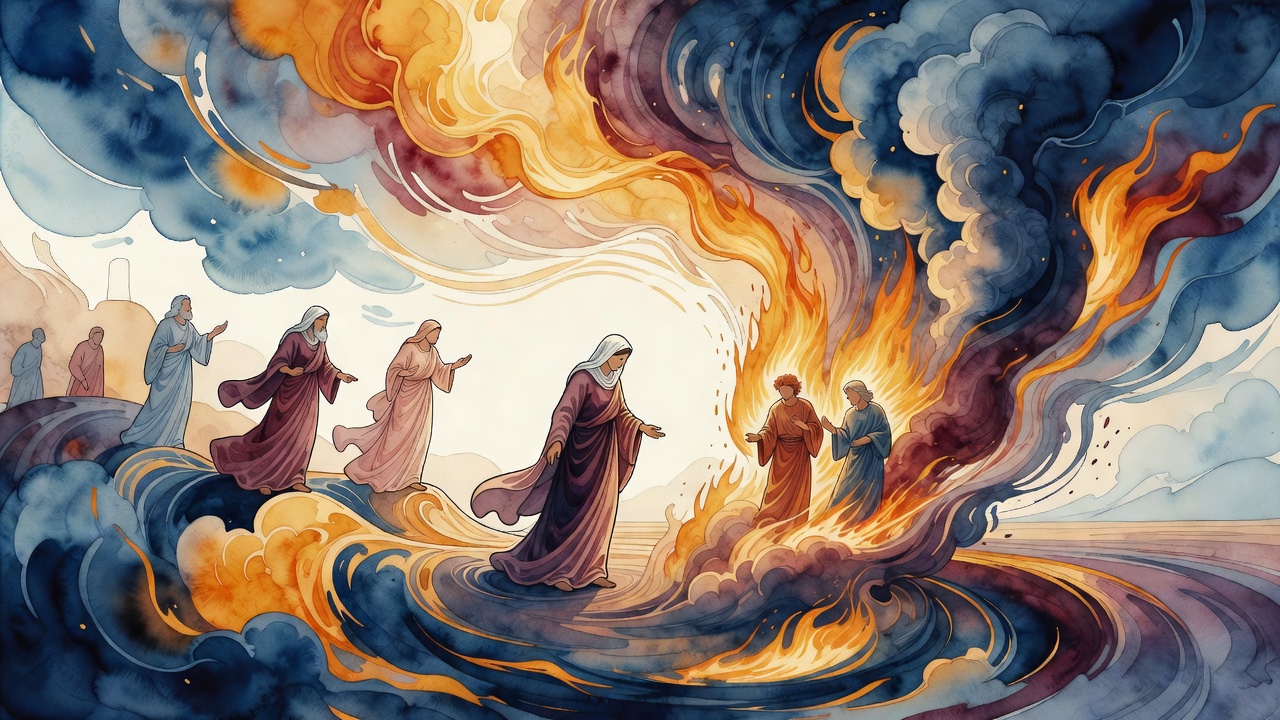
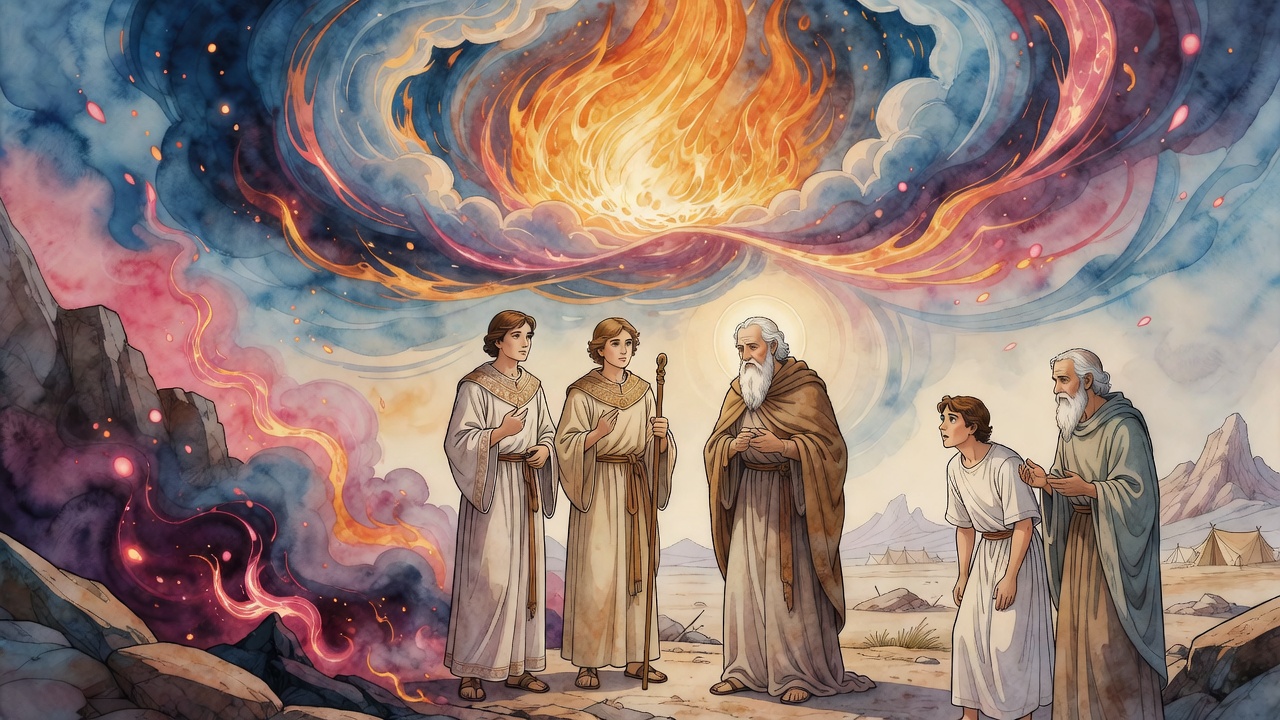
Aaron took Elisheva for a wife, and the Torah gives her two labels where one would have done. Daughter of Aminadav. Sister of Nahshon.

The second label is the one that mattered at the time. A man looking at a bride was told to look at her brothers, because sons tend to come out resembling their mother's brothers rather than their father's. So Aaron looked at Nahshon, who would stand at the head of all twelve princes, and he made his decision about the marriage from there.

She came into his tent as a woman whose family was going up. Her sons were born there: Nadav, Avihu, Elazar, Itamar. Later her son Elazar would marry into a house that ran back through two lines at once, one from Joseph who had beaten down his own inclination, and one from Yitro, who had fattened calves for idols before he ever heard of Israel's God. From that mixed household came Pinchas.

Five Crowns in One Morning

Then came the day the sanctuary opened, and every man in her family was standing somewhere near the top of it.

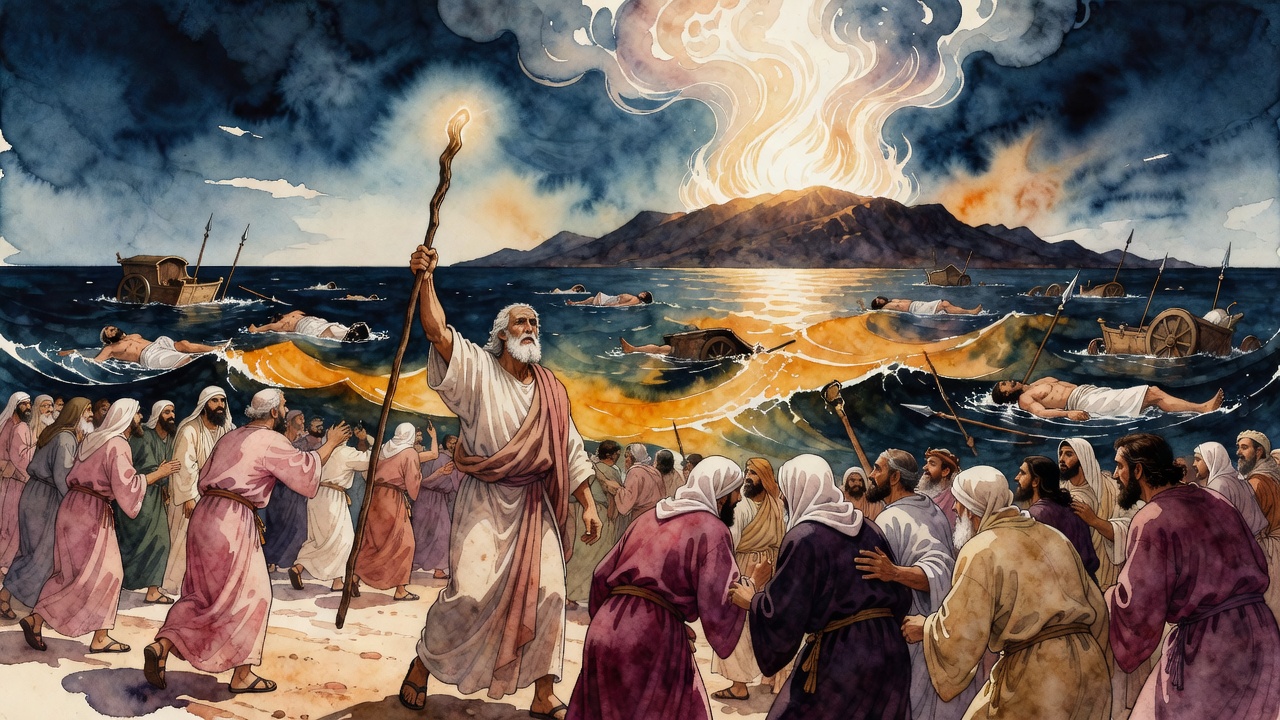
Moses, her husband's brother, ruled the people like a king. Nahshon, her own brother, had been raised prince over the princes. Aaron wore the high priest's vestments with the stones of the ephod across his chest, and the oil was still shining in his hair. Her two eldest sons served as deputies of the priesthood, standing where nobody else in Israel was allowed to stand. Her grandson Pinchas held the anointing of the priest who goes out with the army.

Five honors, one household, one morning. No woman in the camp had ever held that many at once. Elisheva walked out into a day that smelled of fresh oil and new linen and had nothing left to want.

They Carried In Fire Nobody Had Asked For

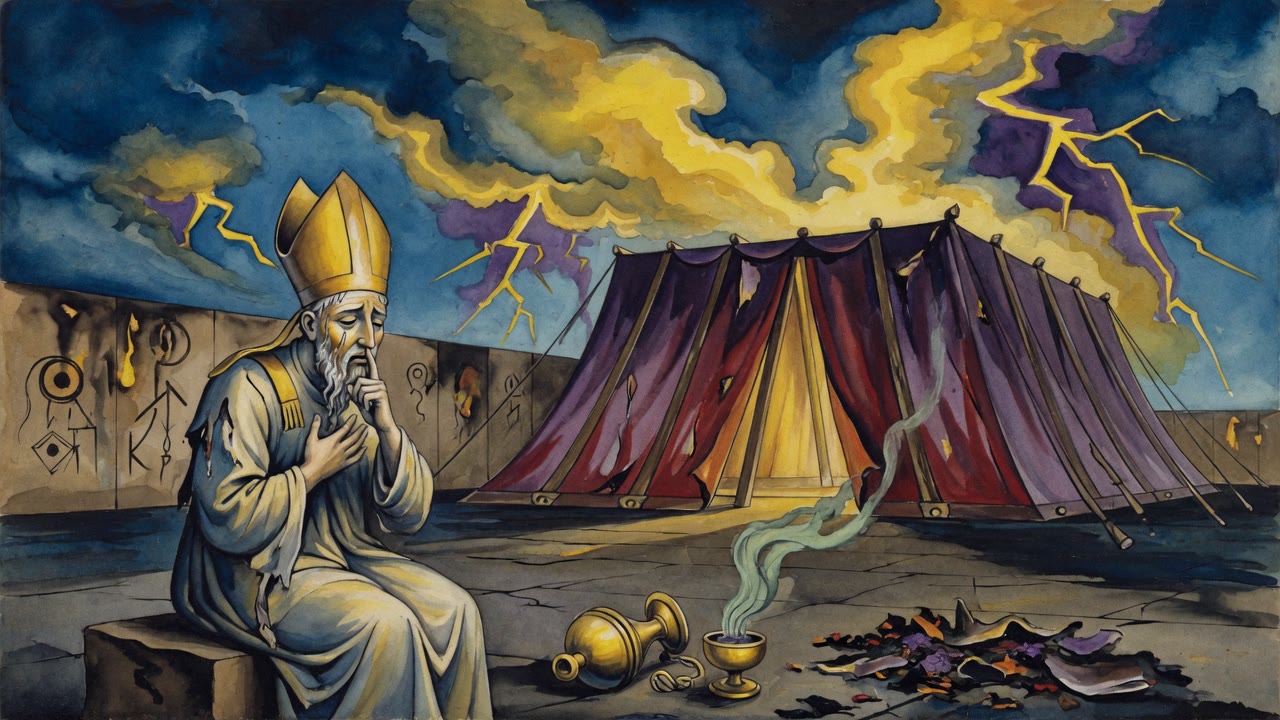
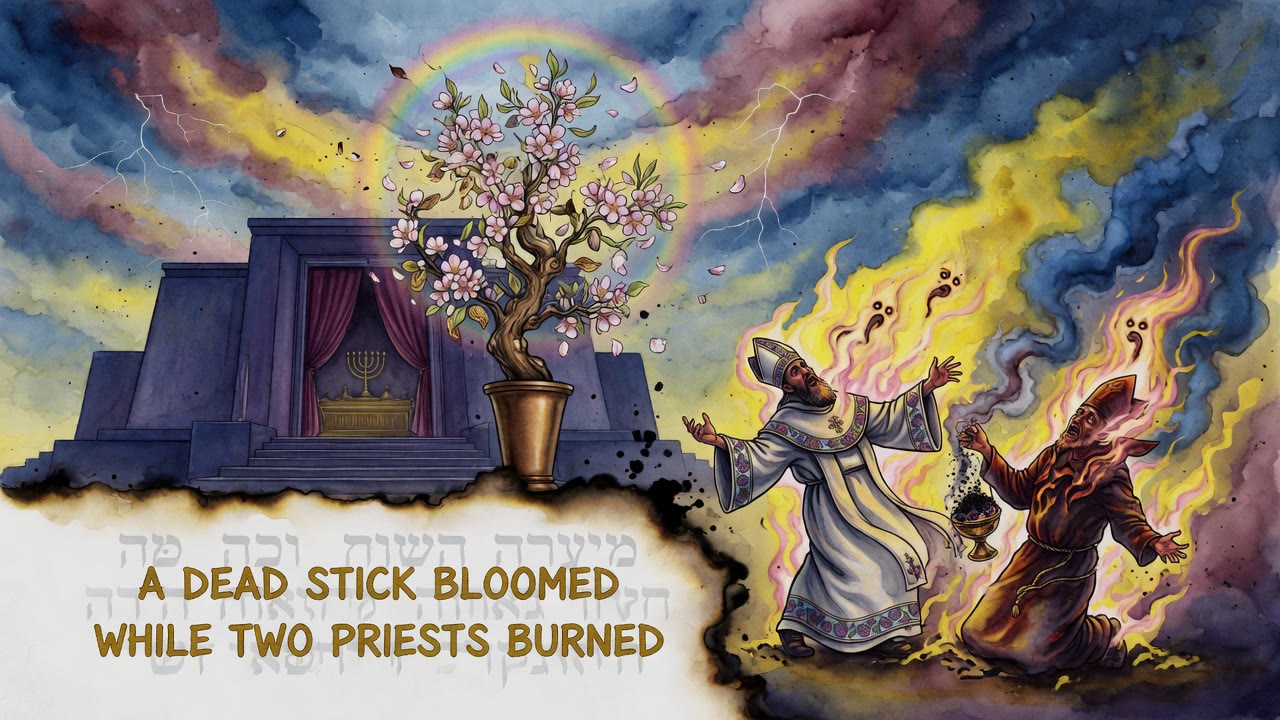
Nadav and Avihu took their pans and went in.

The incense was their own idea. Nobody had told them to bring it and nobody had told them to come in at that hour, and they were young enough and close enough to the Presence to think the difference would not matter.

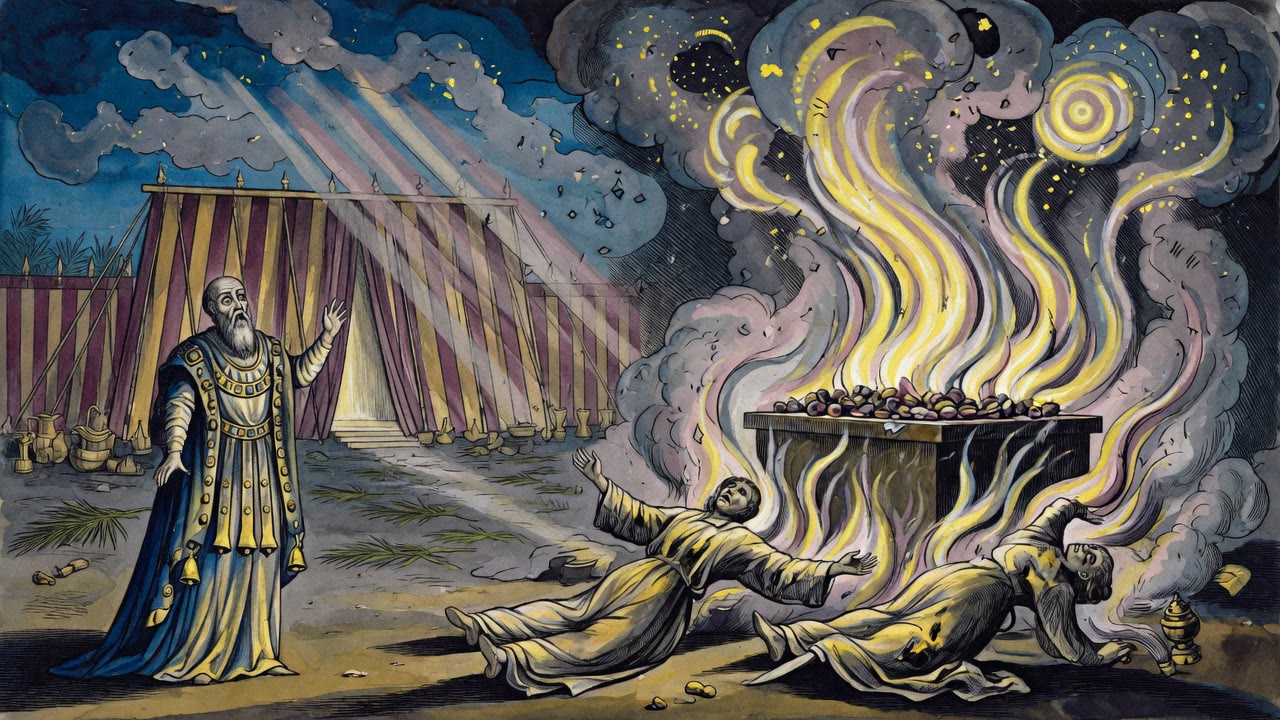
Fire came out from before the Lord. It did not touch the pans or the curtain or the floor. It took the two men who were holding the pans, and it put them down.

They had gone in on their feet. They came out carried, and they came out burnt.

Justice Laughed

Of laughter it was said, it is confounded. The line was written long before her and it landed on her that afternoon, because the attribute of Justice laughed at Elisheva bat Aminadav.

Not one of her five honors was fake. Her brother-in-law really did rule Israel. Her brother really was prince over the princes. Her husband really did wear the ephod, and he went on wearing it, standing in the doorway of the tent, saying nothing at all while men carried his sons past him by their tunics.

That is what made the hour unbearable. Nothing had to be taken away from her for the day to break. The honors all stayed exactly where they were. Two of the five simply stopped breathing inside them.

Her celebration turned into mourning between one service and the next.

Columns of Smoke

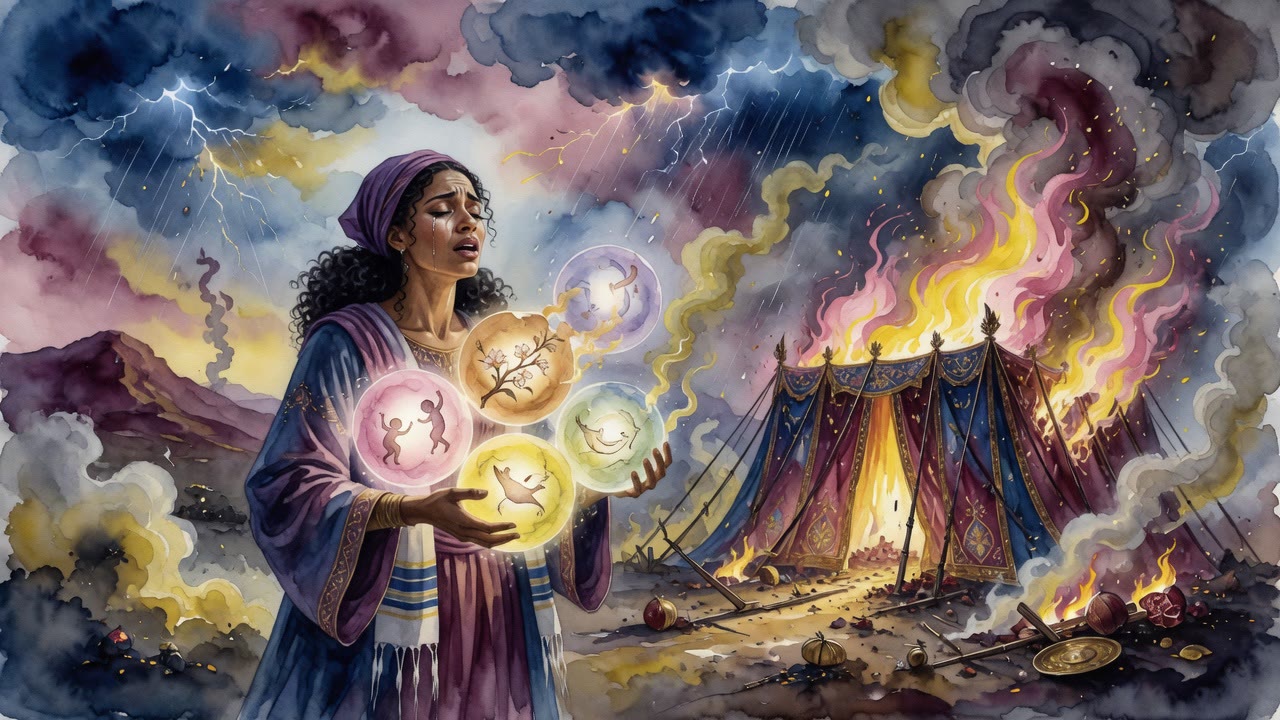
She became like columns of smoke. Blackened through, from the pain and from the grief, standing in a camp that still smelled of inauguration incense and now smelled of something else underneath it.

Elazar and Itamar were still alive. They were still in their linen. They would carry the priesthood forward, and their line would run through Pinchas and past him, and the service of that day was not even suspended.

Aaron did not speak. Moses spoke, about strange fire and about glory, and the words went over the top of a woman who had woken up that morning with five crowns in her house and would go to sleep with three.

The camp moved on within the week. The smoke went with it.


← All myths
From the tradition

Sources

3 sources

The texts behind this telling. Some cards carry a translation of the source; others are our own retelling of it, and each card says which. Every card links out to the original.

Shir HaShirim Rabbah 6:7Shir HaShirim Rabbah

Retold in our words. Read the original at the link below.The Sefaria Midrash Rabbah, 2022 · CC-BY

Shir HaShirim Rabbah turns to Elisheva's Song.

The verse "Who is this ascending…," from (Song of Songs 3:6), is interpreted as referring to Elisheva, daughter of Aminadav. But who was she, and why does the text focus on her ascent? Well, as the Rabbis tell it, Elisheva experienced five incredible celebrations all on the same day.

First, she saw her brother-in-law, Moses, become king. A leader chosen by God! Then, her brother, Nahshon, was appointed a prince. Her husband, Aaron, became the High Priest, the Kohen Gadol, the one who would serve in the holiest way before God. And, to top it all off, her two sons were appointed as deputy High Priests. As if that wasn't enough, her grandson, Pinhas, became the priest anointed for war – a crucial role for the people's safety and spiritual well-being. (Shir HaShirim Rabbah 6:1).

Elisheva was at the pinnacle of happiness.

But the story takes a devastating turn.

As her sons entered to perform their priestly duties, to offer sacrifice, tragedy struck. They emerged… burnt. Consumed. Her joy, in an instant, transformed into inconsolable mourning. Her celebration became her greatest sorrow. The text says she became like columns of smoke, blackened by pain and grief. (Shir HaShirim Rabbah 6:1).

It’s a stark reminder of how fragile life can be, how quickly fortunes can change. One moment, everything is perfect; the next, devastation. The Rabbis don't shy away from the harsh realities of life; they delve right into them, using stories like Elisheva's to explore the complexities of faith, loss, and the human condition.

The text then shifts, seemingly abruptly, to another figure: Rabbi Elazar ben Rabbi Shimon. When he died, his generation would read in his regard, “Who is this ascending from the wilderness…from all the powders of the merchant” (Song of Songs 3:6). What does this cryptic phrase, "from all the powders of the merchant," even mean?

Shir HaShirim Rabbah explains that Rabbi Elazar bar Rabbi Shimon was an expert in Bible, Mishna (the core of the Oral Torah), preaching, and composing ritual poetry. He was a master of all things Torah. So, the "powders of the merchant" are interpreted as representing the diverse and rich knowledge that Rabbi Elazar possessed.

But why connect this to Elisheva? What’s the common thread?

Perhaps it's the idea of ascent. Both Elisheva and Rabbi Elazar, in their own ways, "ascended." Elisheva experienced the highest earthly honors, even if they were tragically fleeting. Rabbi Elazar ascended through his wisdom and spiritual understanding. Both stories remind us that life, in all its complexity, is about striving, learning, and ultimately, facing our own ascents and descents with faith and resilience. The Zohar, the central text of Kabbalah, often speaks of ascent as a spiritual journey, a striving to connect with the divine.

These ancient stories offer a profound reflection on the human experience. They remind us that joy and sorrow are often intertwined, and that even in the face of immense loss, there is still the potential for growth, wisdom, and ultimately, ascent. Can we, like Elisheva and Rabbi Elazar, find meaning and purpose even when life feels like a wilderness? Maybe that's the question we're meant to confront.

Full source
Kohelet Rabbah 2:2Kohelet Rabbah

Retold in our words. Read the original at the link below.The Sefaria Midrash Rabbah, 2022 · CC-BY

Her story, found in Kohelet Rabbah, the commentary on Ecclesiastes, is a stark reminder that joy and sorrow can be two sides of the same coin.

The verse But what does that really mean? Kohelet Rabbah illustrates it with a powerful example: Elisheva.

Elisheva bat Aminadav was having the kind of day most of us only dream of. Seriously. Her brother-in-law was none other than Moses, the king! Her brother, Naḥshon, was the prince, the head honcho of all the tribal leaders! And her husband, Aaron, was the High Priest, decked out in the priestly garments and the ephod stones. To top it all off, her two sons were serving as deputy High Priests. The sheer joy? Four major celebrations all rolled into one single day!

Elisheva must have felt like she was on top of the world. This was it! The pinnacle of happiness! But here’s where the story takes a devastating turn.

Her two sons, brimming with zeal, entered the Tabernacle to offer incense. Now, offering incense was a sacred act, and it had to be done exactly right, with the proper authorization. Sadly, they acted without permission. And in that moment, everything changed.

They were consumed by fire. Gone. Just like that, Elisheva's quadruple celebration was shattered. Her joy transformed into the deepest mourning. The laughter? Confounded. Silenced.

The passage then quotes (Leviticus 16:1), "After the death of the two sons of Aaron.." It's a chilling reminder of the fragility of happiness, how quickly it can be snatched away.

So, what are we to make of Elisheva's story? It's a tough one. It shows us that even in moments of immense joy, we need to remember that life is unpredictable. That sorrow can lurk just around the corner. Does this mean we should avoid happiness? Absolutely not! But perhaps it encourages us to appreciate the good times, to hold them close, and to remember that even in the face of tragedy, there is still room for hope and resilience. Elisheva's story, as told in Kohelet Rabbah, is a powerful, albeit painful, lesson on the confounding nature of laughter and the fleeting nature of joy. It's a story that stays with you.

Full source
Shemot Rabbah 7:5Shemot Rabbah

Retold in our words. Read the original at the link below.The Sefaria Midrash Rabbah, 2022 · CC-BY

Shemot Rabbah turns to Moses and the Dreamer of Aminadav.

Take, for instance, the passage in Exodus (6:14): "These are the heads of their fathers' houses; the sons of Reuben the first-born of Israel: Ḥanokh, and Palu, Ḥetzron, and Karmi. These are the families of Reuben.” And then it says, "These are the heads of their fathers’ houses." It all seems straightforward. But the rabbis of the Midrash (rabbinic interpretive commentary), in Shir HaShirim Rabbah 4:7, saw more than just a list. They saw connections, clues, and a deeper understanding of lineage. This isn't just about who's related to whom, but why it matters.

Speaking of family, consider Aaron. (Exodus 6:23) tells us: “Aaron took for himself Elisheva, daughter of Aminadav, sister of Naḥshon, as a wife; she bore him Nadav and Avihu, Elazar and Itamar.” Now, the Midrash in Shemot Rabbah picks up on something interesting: why does it specifically mention "daughter of Aminadav" if we already know she's the sister of Naḥshon?

The rabbis suggest a profound lesson here. "…from the fact that it says “daughter of Aminadav,” do I not know that she was the sister of Naḥshon? Rather, it is to teach you that anyone who marries a woman should examine her brothers.” It's a fascinating, if somewhat old-fashioned, piece of advice! The idea is that a woman's brothers can give you insight into her character and family traits. After all, as the saying goes, "most sons resemble the brothers of the mother."

But the story doesn't end there. We also learn about Elazar, Aaron's son, who "took for himself from the daughters of Putiel as a wife; and she bore him Pinḥas" (Exodus 6:25). Notice it doesn't say "daughter of Putiel," but "daughters of Putiel." What's going on?

According to the Midrash, his wife came from two distinct lineages. One side descended from the tribe of Joseph, known for overcoming (pitpet) his evil inclination. The other side came from Yitro, who, before converting, fattened (pitem) calves for idol worship. What a mix! This detail emphasizes the idea that even within a single family, you can find a blend of influences, both positive and negative.

Finally, we arrive at (Exodus 6:26-27): “This is Aaron and Moses, to whom the Lord said: Take the children of Israel out of the land of Egypt according to their hosts. It was they who spoke to Pharaoh king of Egypt, to take the children of Israel out of Egypt. This is Moses and Aaron.” The Midrash in Shemot Rabbah seems to highlight the importance of these two figures.

Why all the details about lineage leading up to this point? Some commentaries suggest it's to provide context for Moses and Aaron, highlighting that all these genealogies are detailed to emphasize the background and importance of these two individuals, who served as messengers of God. It’s a reminder that even the most extraordinary leaders come from somewhere, and their family histories, with all their complexities, contribute to who they become.

So, what's the takeaway from all this genealogical exploration? Perhaps it’s this: our families, our lineages, are more than just names on a list. They shape us, influence us, and provide a context for understanding our own stories. They remind us that we are all part of something bigger than ourselves, a weaving with threads of the past, present, and future.

Full source