6 min read

Moses Drove Israel From the Egyptian Dead

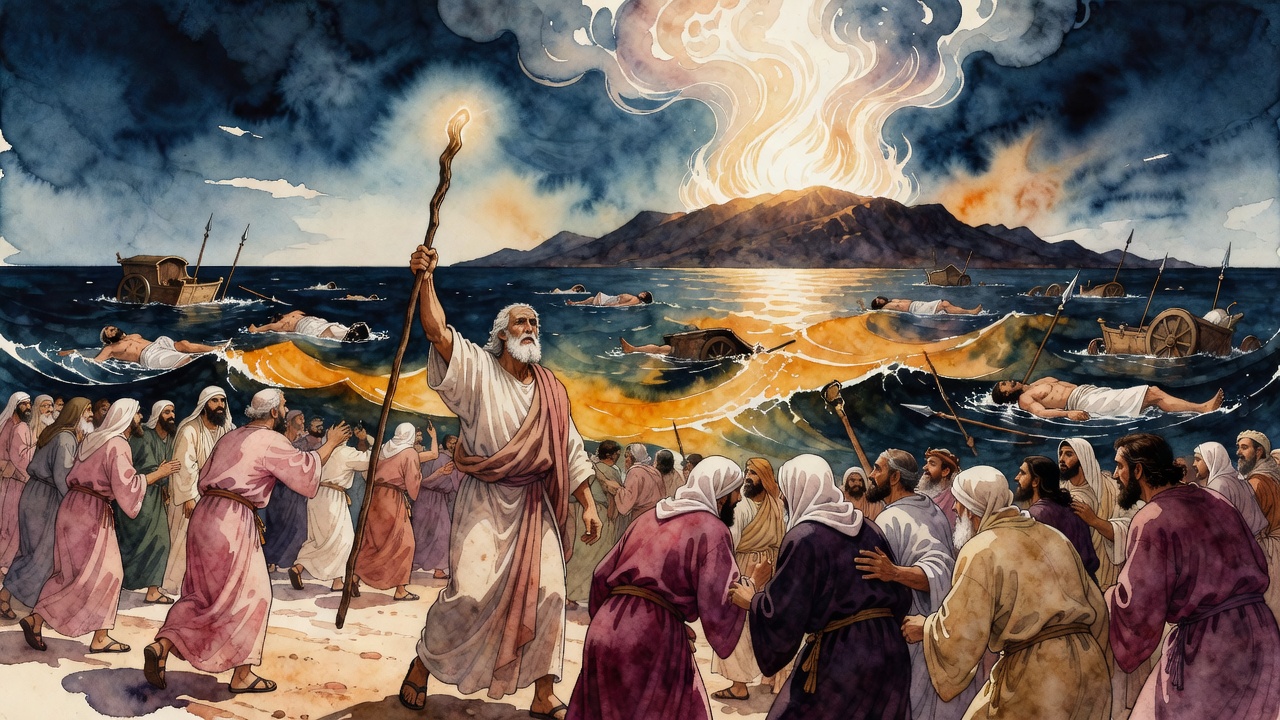
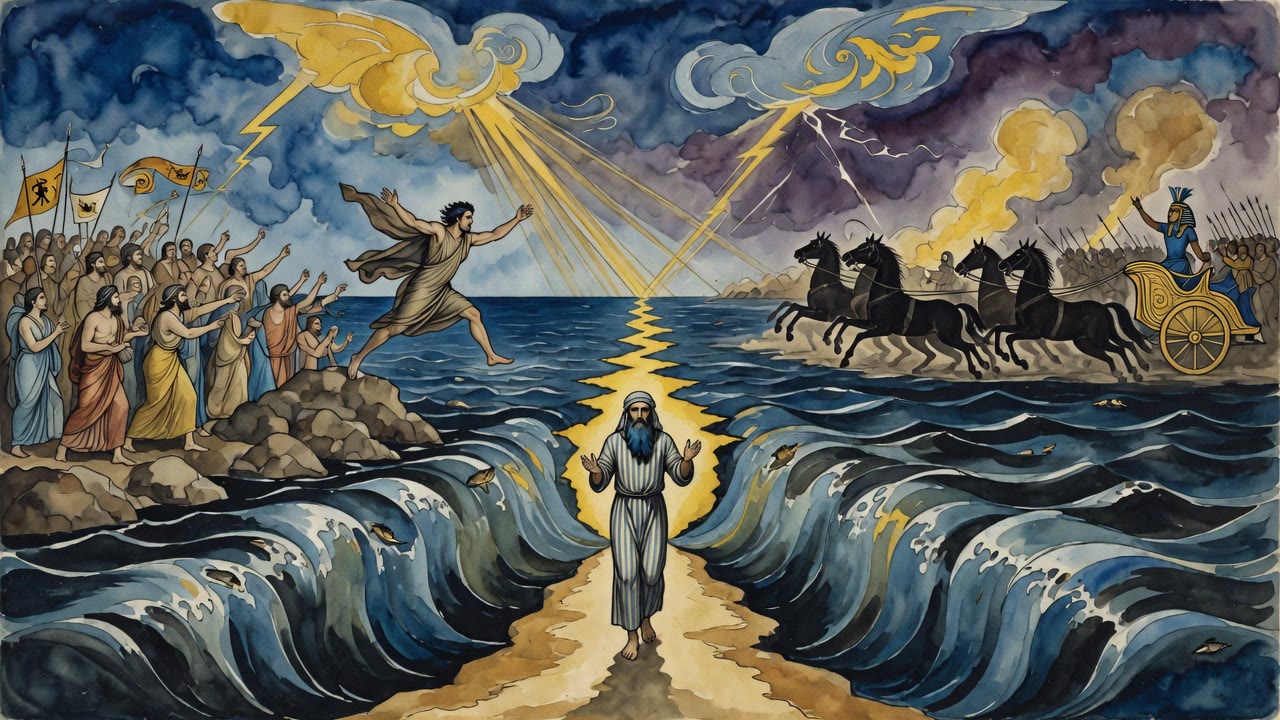
After the sea fell, Israel saw Egyptian corpses on the water and tried to turn back home, until Moses raised his staff and forced the march toward the mountain.

Curated by Arthur · Told by Maggid ·
Table of Contents
  1. The Count on the Beach
  2. What Moses Said and What They Answered
  3. The Leader They Wanted Instead
  4. The Staff Came Down on His Own People
  5. The Thing in the Pack
Moses Drove Israel From the Egyptian Dead Click for full size

The Count on the Beach

A man knelt at the waterline to look into the face of a dead Egyptian, and what he said when he stood up went along the shore faster than the news of the sea had. He knew the face. It belonged to the overseer who used to count his bricks at the end of the day and dock him for the ones that cracked in the mold. Now it was rolling in the foam with the mouth open.

By midmorning the arithmetic had gone through the whole camp. They had the plunder of Egypt in their packs, the clouds of glory over their heads, a split sea behind them, their masters face down in it, and the song already sung, and since the Holy One had taken them out for exactly those five things, the account was closed and paid. So the word started as a mutter and hardened into a plan before anyone thought to argue with it. Let us return to Egypt.

What Moses Said and What They Answered

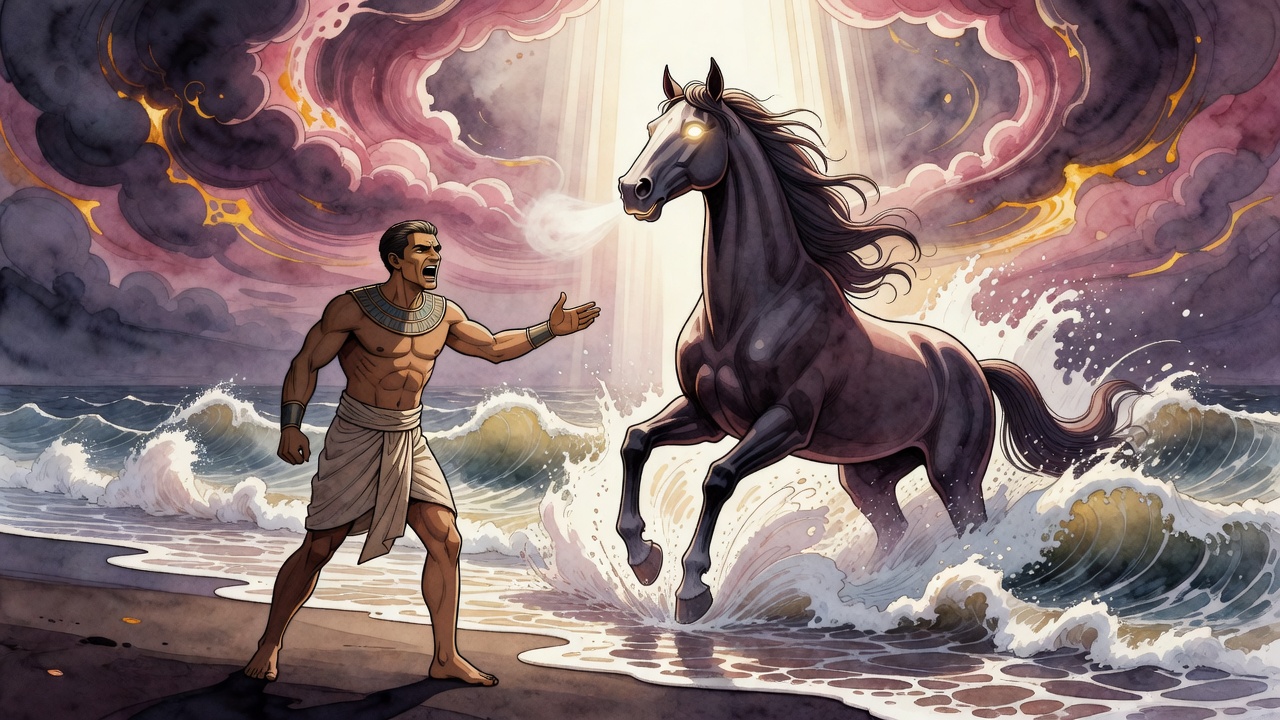
Moses came down the beach with the staff still in his hand and his arms still shaking from the night. He threw the sentence at them like a rope. "As you saw the Egyptians today, you shall not see them ever again" (Exodus 14:13).

But they pointed at the water, and the water answered him better than they could. "They have all died already." That was the whole argument, and it was a good one. Because the Egyptians were dead, Egypt was empty; because Egypt was empty, it was a house with the owner gone, full of ovens they knew how to light and streets they knew in the dark. The wilderness in front of them had none of that. It had thirst.

So Moses played the note he had been holding since the bush stopped burning. "When you take the people out of Egypt, you will worship God upon this mountain" (Exodus 3:12). A debt, then, not a gift. The mountain was still out there with no Israelite song on its stones, and the exodus was only half paid.

They did not move.

The Leader They Wanted Instead

What moved instead was a suggestion, going from one family to the next while the bodies kept coming in on the tide. Let us appoint a leader, and return to Egypt (Numbers 14:4). Not this leader. Another one, who would walk west.

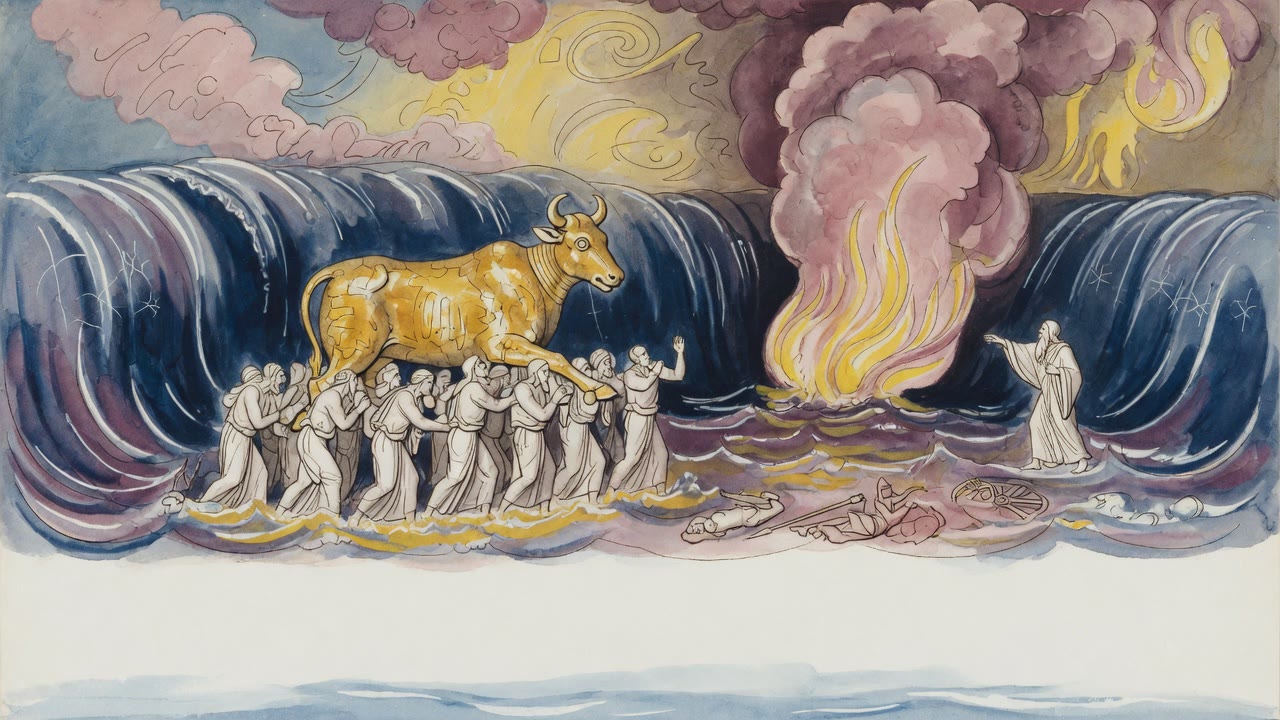
And a column heading west would want something to walk in front of it, since a people that has just watched a sea open does not follow a man with a stick out of habit. So they talked about making a thing. Small enough to carry at the head of the line, solid enough to look at, quiet enough never to ask anyone for anything.

The Staff Came Down on His Own People

Moses raised the staff.

He had lifted it over water twice in a night, and the water had gone where he pointed. Now he was lifting it over the tops of his own people's heads, close enough to see which of them flinched and which of them only stared at him, and for about five seconds his arm stayed up there while he understood what he was about to do with it. Then he brought it down. Not on a body. He swung it flat through the air in front of the nearest faces, the way a man moves cattle that will not take a gate, and again, and again, until the front of the crowd broke and stumbled east because east was the only direction with nobody hitting the air in it.

They did not travel at the command. They traveled because he forced them to travel. A child cried over a sandal left in the sand and got pulled along without it. An old man spat toward a chariot wheel turning slowly in the shallows, and then turned his back on it under the shadow of the staff.

The Thing in the Pack

Halfway down the column he found what he had been half expecting since the talk about making something to walk in front of them. A pack, opened, and inside it a little god, small enough to hide under grain, heavy enough to turn a man's neck the wrong way for the rest of his life.

He took it out with his hand. The word for leading them out that day is also the word for taking a thing away, and both happened in the same motion: he pulled the column east and he pulled the idol out of the middle of it, walking, without stopping the march to hold a trial about whose pack it was.

They refused to heed, and did not remember the wonders (Nehemiah 9:17). Their feet kept trying to point west while the sea was still wet on their legs.

Behind them the Egyptian dead stayed where they were, face down, quieter than they had ever been alive. Ahead was a mountain nobody had seen yet and a debt nobody had agreed to. Moses walked east at the head of them with the little god shut in his fist, and nobody asked him whose it was.


← All myths
From the tradition

Sources

2 sources

The texts behind this telling. Some cards carry a translation of the source; others are our own retelling of it, and each card says which. Every card links out to the original.

Shemot Rabbah 24:2Shemot Rabbah

Retold in our words. Read the original at the link below.The Sefaria Midrash Rabbah, 2022 · CC-BY

Rabbi Yehuda tells us that the Israelites reasoned, "The Holy One, blessed be He, only took us out of Egypt for five things!" What were those five things? First, to give us the plunder of Egypt; second, to bear us on the clouds of glory; third, to split the sea on our behalf; fourth, to take our vengeance from the Egyptians; and fifth, to recite song before Him. And since they’d already experienced all of that, they figured their purpose was fulfilled. “Let us return to Egypt,” they declared. Can you imagine Moses' reaction?

Moses reminds them, "The Omnipresent said to me, 'For as you saw the Egyptians today, you shall not see them ever again!'" (Exodus 14:13). But the people were unconvinced. “They have all died already,” they countered. "Let us return to Egypt."

Moses wasn’t having it. He played his trump card: “Let us repay our promissory note, for so said the Holy One, blessed be He, to me: ‘When you take the people out of Egypt, you will worship God upon this mountain’” (Exodus 3:12). In other words, "Guys, we have a promise to keep!

Rabbi Elazar adds another layer to the story. He suggests the Israelites weren’t exactly cooperating. They didn't travel at God's command, but rather, Moses had to force them to move with his staff! Why the resistance? Because they were seeing the corpses of their former enslavers, the Egyptians who had oppressed them with mortar and bricks, floating on the water. Seeing them vanquished, they thought, "Okay, everyone's dead, no one’s left in Egypt. ‘Let us appoint a leader and return to Egypt’" (Numbers 14:4). Even worse, they considered crafting an idol to lead them back!

Did they only talk about going back, or did they actually try to? The verse in (Nehemiah 9:17) tells us, "They refused to heed and did not remember Your wonders." It wasn't just idle chatter; they were actively rejecting the miracle they’d witnessed!

Finally, Rabbi Yehuda ben Rabbi Ilai offers a fascinating insight. He says there was actually an idol already in the possession of the Israelites, and Moses removed it. The Hebrew words are key here: Moses “led” Israel, which is vayasa (וַיַּסַע). Rabbi Yehuda ben Rabbi Ilai connects this to another Hebrew word, hisia (הֵסִיר), meaning "removed." So, the very act of Moses leading them was also an act of removing idolatry from their midst.

So, what does this all mean? Perhaps it's a reminder that even after experiencing incredible miracles and achieving apparent goals, the journey is far from over. There’s always a "promissory note" to repay, a purpose to fulfill, and maybe even some hidden idols we need to confront within ourselves. The Exodus wasn't just about leaving Egypt; it was about the ongoing process of leaving behind the things that hold us back from fully embracing our potential and our destiny. And sometimes, like the Israelites, we need a little… or a lot… of prodding to keep us moving forward.

Full source
Shemot Rabbah 7:5Shemot Rabbah

Retold in our words. Read the original at the link below.The Sefaria Midrash Rabbah, 2022 · CC-BY

Shemot Rabbah turns to Moses and the Dreamer of Aminadav.

Take, for instance, the passage in Exodus (6:14): "These are the heads of their fathers' houses; the sons of Reuben the first-born of Israel: Ḥanokh, and Palu, Ḥetzron, and Karmi. These are the families of Reuben.” And then it says, "These are the heads of their fathers’ houses." It all seems straightforward. But the rabbis of the Midrash (rabbinic interpretive commentary), in Shir HaShirim Rabbah 4:7, saw more than just a list. They saw connections, clues, and a deeper understanding of lineage. This isn't just about who's related to whom, but why it matters.

Speaking of family, consider Aaron. (Exodus 6:23) tells us: “Aaron took for himself Elisheva, daughter of Aminadav, sister of Naḥshon, as a wife; she bore him Nadav and Avihu, Elazar and Itamar.” Now, the Midrash in Shemot Rabbah picks up on something interesting: why does it specifically mention "daughter of Aminadav" if we already know she's the sister of Naḥshon?

The rabbis suggest a profound lesson here. "…from the fact that it says “daughter of Aminadav,” do I not know that she was the sister of Naḥshon? Rather, it is to teach you that anyone who marries a woman should examine her brothers.” It's a fascinating, if somewhat old-fashioned, piece of advice! The idea is that a woman's brothers can give you insight into her character and family traits. After all, as the saying goes, "most sons resemble the brothers of the mother."

But the story doesn't end there. We also learn about Elazar, Aaron's son, who "took for himself from the daughters of Putiel as a wife; and she bore him Pinḥas" (Exodus 6:25). Notice it doesn't say "daughter of Putiel," but "daughters of Putiel." What's going on?

According to the Midrash, his wife came from two distinct lineages. One side descended from the tribe of Joseph, known for overcoming (pitpet) his evil inclination. The other side came from Yitro, who, before converting, fattened (pitem) calves for idol worship. What a mix! This detail emphasizes the idea that even within a single family, you can find a blend of influences, both positive and negative.

Finally, we arrive at (Exodus 6:26-27): “This is Aaron and Moses, to whom the Lord said: Take the children of Israel out of the land of Egypt according to their hosts. It was they who spoke to Pharaoh king of Egypt, to take the children of Israel out of Egypt. This is Moses and Aaron.” The Midrash in Shemot Rabbah seems to highlight the importance of these two figures.

Why all the details about lineage leading up to this point? Some commentaries suggest it's to provide context for Moses and Aaron, highlighting that all these genealogies are detailed to emphasize the background and importance of these two individuals, who served as messengers of God. It’s a reminder that even the most extraordinary leaders come from somewhere, and their family histories, with all their complexities, contribute to who they become.

So, what's the takeaway from all this genealogical exploration? Perhaps it’s this: our families, our lineages, are more than just names on a list. They shape us, influence us, and provide a context for understanding our own stories. They remind us that we are all part of something bigger than ourselves, a weaving with threads of the past, present, and future.

Full source