5 min read

Nadav and Avihu Ruled While Moses Still Stood

Two sons of Aaron decided law with Moses present, and fire answered. A later student learned the same danger when a master timed his death in a week.

Curated by Arthur · Told by Maggid ·
Table of Contents
  1. A Ruling Spoken Too Soon
  2. The Student Who Would Not Finish the Week
  3. Four Joys, Two Sons Carried Out
  4. Death That Atones Like a Day
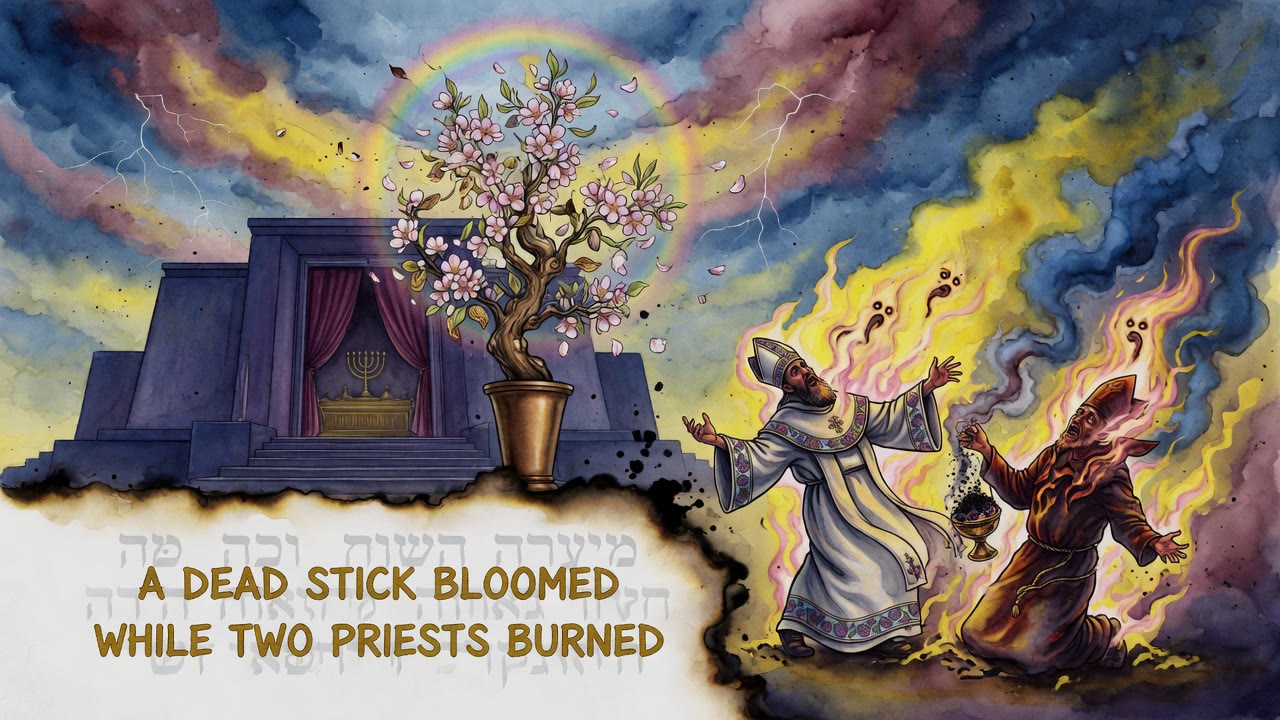
Nadav and Avihu Ruled While Moses Still Stood Click for full size

A Ruling Spoken Too Soon

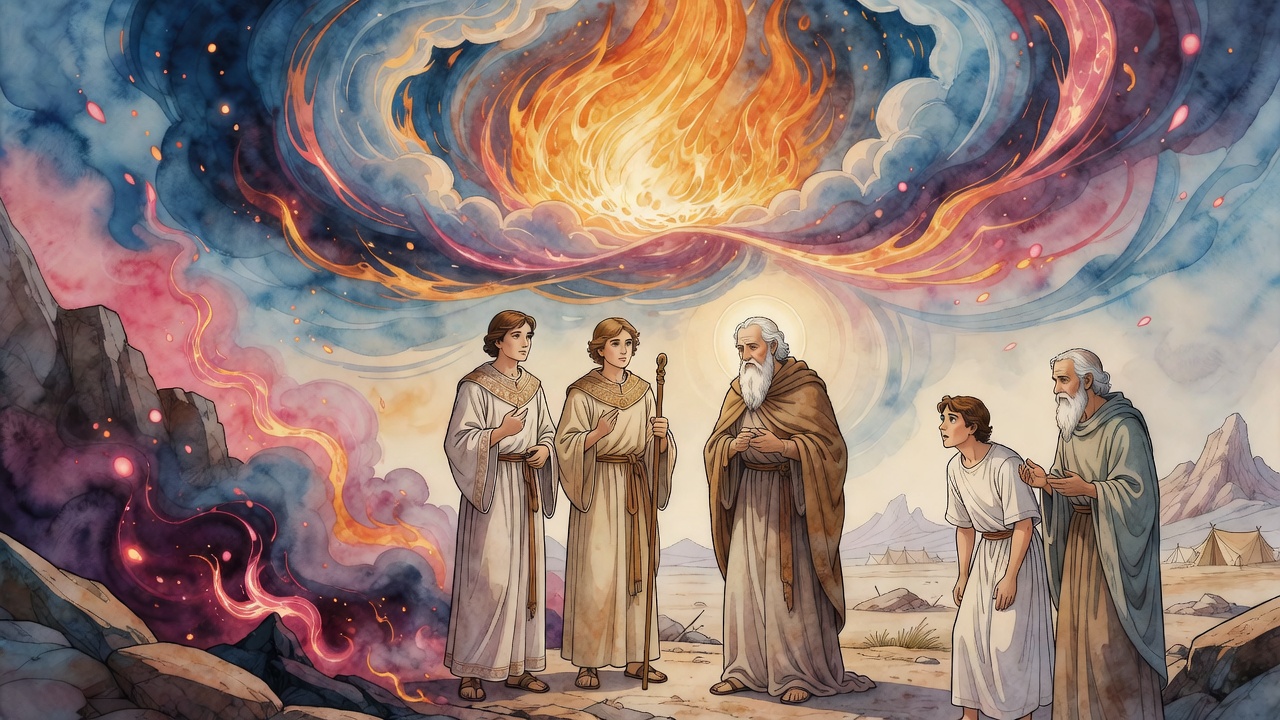
Nadav and Avihu stood near the altar with the smell of dedication still in the air. Moses their teacher was present. They ruled on a matter of law anyway, as if authority had already passed to their mouths and the camp no longer needed the old voice.

Rabbi Eliezer names that as the pointed reason they died. To decide a halakhic question while the master who taught you stands right there is to treat his authority as if it were your own. Fire does not always wait for a second warning. It answers the first overreach with heat.

Strange fire is the verse's word. In this reading the strangeness is not only the pan and the coals. It is the timing. The teacher still breathed in the camp, and the students spoke as if the camp already belonged to them. The dedication day that should have been pure joy became a lesson written in smoke that everyone could smell.

The Student Who Would Not Finish the Week

Rabbi Eliezer backed the claim with a story from his own court. A student once issued a ruling in front of him. The rabbi quietly told his wife, Imma Shalom, that this man would not finish out the week alive. He did not. The week closed without him, and the disciples had to ask what kind of power had spoken.

When they asked whether their teacher was a prophet, Eliezer refused the title. "I am neither a prophet nor the son of a prophet, but this I have received as tradition." The danger was not his prediction. The danger was the law itself, older than his court and sharper than any student's confidence at the front of the room.

How much distance makes ruling permissible? Eliezer sets it at twelve mil, the span of the Israelite camp by the Jordan, from Beth-jeshimoth to Abel-shittim. Rabbi Tanchum sat in Chafar answering legal questions freely until his students pointed out that his master Rabbi Mani lived in nearby Sepphoris, well within twelve mil. Tanchum was stunned. "May it come upon me if I realized," he said, and from that hour he never issued a ruling there again. Geography itself becomes a fence around the teacher's honor, measured in dusty miles a person can walk.

Four Joys, Two Sons Carried Out

To those who clamor for unbroken happiness, the midrash answers with a roll call of the great. Adam walked under thirteen wedding canopies in Eden, so radiant that the apple of his heel outshone the sun, then heard, dust you are, to dust you return. Abraham received a son at a hundred, then climbed three days with a knife waiting, until a cloud marked the place only he and Isaac could see. When Isaac described the altar, Sarah's soul fled, and Abraham returned from Moriah to bury her in the cave.

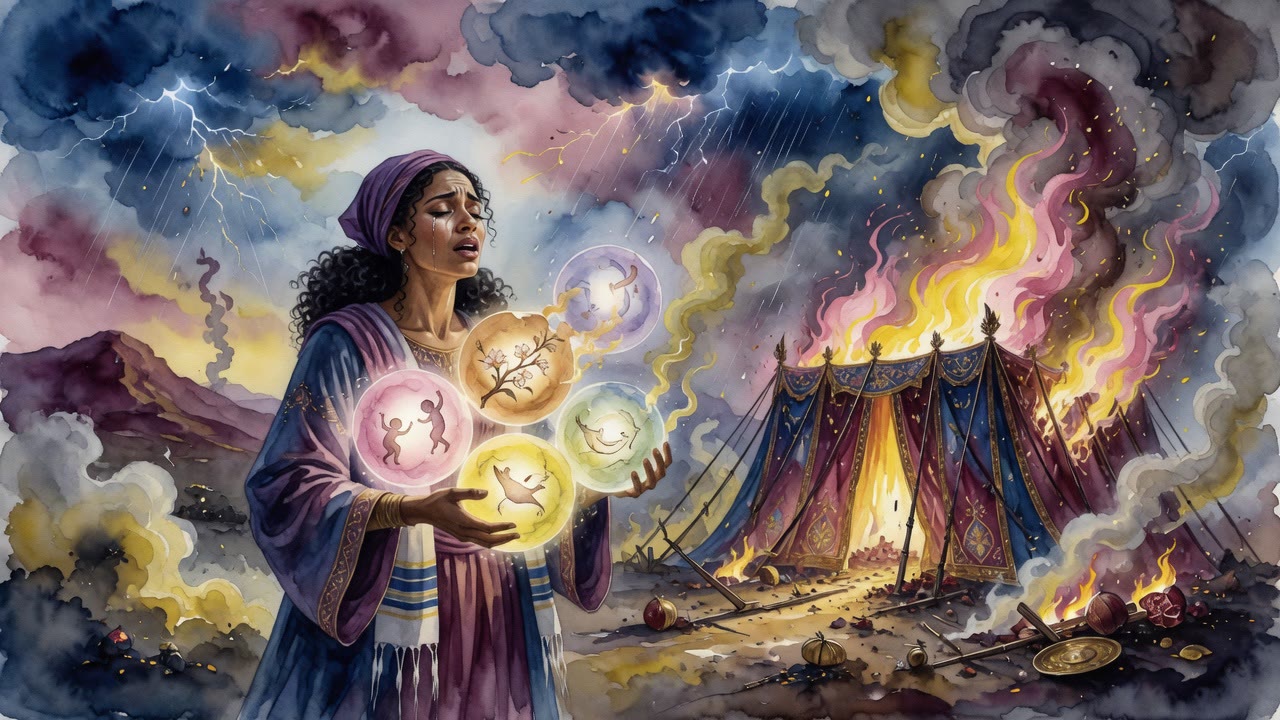
The chain closes with Elisheva. In a single day she held four joys: husband High Priest, brother a prince, brother-in-law a king, two sons deputy priests. Then she watched those sons carried out burned. Her gladness turned to mourning before the feast dishes were cold. No one in this world is promised the unbroken laughter the wicked demand. Real joy waits, and it waits beyond the smoke.

Nadav and Avihu's death is not only discipline. It is the shattering of a family's brightest hour. The camp sees silence where songs had been prepared, and Aaron is silent too, as the Torah records, holding a grief that has no public speech left in his mouth.

Death That Atones Like a Day

Why does the account of Miriam's death sit beside the law of the red heifer's purifying ashes? Because just as those ashes cleanse, the death of Miriam cleanses too. Why is Aaron's death set next to the shattered tablets? Because the loss of a righteous man weighs on Heaven as heavily as the breaking of the very words of God on the stones.

Rabbi Hiyya bar Abba pressed a stranger detail. Aaron's two sons died on the first of Nisan, in the spring. Why does the Torah recall their death in the Yom Kippur reading, months later in the autumn? Because just as the Day of Atonement brings forgiveness, so the death of the righteous brings atonement for the generation they leave behind.

After the bones of Saul and Jonathan were gathered and buried with honor in the tomb of Kish, God was entreated for a famished land. The righteous, even in death, can mend what the living could not. Nadav and Avihu's fire remains a warning about ruling before a teacher. It also becomes, in the calendar's memory, a wound heaven turns toward the people's repair, spring death read in autumn, pain folded into the day's pardon for a nation that still needs cleansing.


← All myths
From the tradition

Sources

3 sources

The texts behind this telling. Some cards carry a translation of the source; others are our own retelling of it, and each card says which. Every card links out to the original.

Pesikta DeRav Kahana 26:7Pesikta de-Rav Kahana

Translation of the source text.Pesikta de Rav Kahana according to an Oxford manuscript, Dov Mandelbaum ed., N.Y. 1987 · CC-BY

It was taught in the name of Rabbi Eliezer: Nadav and Avihu died only because they ruled on a point of law in the presence of Moses our teacher. There was once an incident concerning a certain disciple who ruled on a point of law in the presence of Rabbi Eliezer, and he said to Imma Shalom his wife: This one will not live out his week before he dies. And he did not live out his week before he died. His disciples said to him: Rabbi, are you a prophet? He said to them: I am neither a prophet nor the son of a prophet, but this is what I have received as tradition: that anyone who rules on a point of law in the presence of his teacher is liable to death.

Rabbi Eliezer taught: It is forbidden for a disciple to rule on a point of law in the presence of his teacher unless he is at a distance of twelve mil from him, like the camp of Israel, as it is written, "And they encamped by the Jordan from Beth-jeshimoth to Abel-shittim" (Numbers 33:49). Like this case of Rabbi Tanchum son of Rabbi Yirmeyah, who was in Chafar, and they would ask him questions and he would rule, ask him and he would rule. They said to him: Rabbi, did you not teach us thus, that it is forbidden for a disciple to rule on a point of law in the presence of his teacher unless he is at a distance of twelve mil from him, like the camp of Israel; and behold, Rabbi Mani sits in Sepphoris! He said to them: May it come upon me if I knew. From that hour on he did not rule.

Full source
Pesikta DeRav Kahana 26:3Pesikta de-Rav Kahana

Translation of the source text.Pesikta de Rav Kahana according to an Oxford manuscript, Dov Mandelbaum ed., N.Y. 1987 · CC-BY

Rabbi Levi opened: "I said to the boastful, Do not boast" (Psalms 75:5). "I said to the boastful [holelim], Do not boast" -- to the confused ones, those whose hearts are full of evil tremblings upon tremblings. Rabbi Levi would read them as "woe to them," those who bring woes (allei) into the world. "And to the wicked, Do not lift up the horn" (Psalms 75:5) -- the Holy One, blessed be He, said to the wicked: The righteous did not rejoice in My world, and you seek to rejoice in My world?

Adam did not rejoice in My world, and you seek to rejoice in My world? Rabbi Levi in the name of Rabbi Shimon ben Menasya said: The apple of Adam's heel dimmed the orb of the sun. And do not be astonished: it is the way of the world that a man makes himself two platters, one for himself and one for a member of his household; for whom does he make the finer one? Surely his own. So too Adam was created for the service of the Holy One, blessed be He, and the orb of the sun was created for the service of creatures; how much more so should the apple of Adam's heel have dimmed the orb of the sun, and the radiance of his face all the more so. Rabbi Levi in the name of Rabbi Chama son of Rabbi Chanina said: Thirteen canopies the Holy One, blessed be He, bound for him in the Garden of Eden. And after all this praise, "for dust you are, and to dust you shall return" (Genesis 3:19).

Abraham did not rejoice in My world, and you seek to rejoice in My world? Abraham had a son born to him at a hundred years, and in the end the Holy One, blessed be He, said to him, "Take now your son" (Genesis 22:2). And our father Abraham made a journey of three days, as it is written, "On the third day Abraham lifted up his eyes and saw the place from afar" (Genesis 22:4). What did he see? He saw a cloud bound upon the mountain. He said to his son: My son, do you see what I see? He said to him: Yes. He said to him: And what do you see? He said to him: I see a cloud bound upon the mountain. He said to his lads: Do you see what we see? They said: No. He said to them: Since you see nothing, and the donkey sees nothing, "stay here with the donkey" (Genesis 22:5) -- the people who are like a donkey. What did he do? He took his son Isaac and went up to the top of the mountain, and built the altar, and arranged the wood, and bound him upon the altar, and took the knife in his hand to slaughter him. Had the Holy One, blessed be He, not said to him, "Do not stretch out your hand against the lad" (Genesis 22:12), he would already have been slaughtered.

And when he came to his mother, she said to him: My son, what did your father do to you? He said to her: My father took me and led me up mountains and brought me down hills and led me up to the top of one mountain, and built an altar and arranged the wood and laid out the wood and bound me upon the altar and took the knife in his hand to slaughter me. Had the Holy One, blessed be He, not said to him, "Do not stretch out your hand against the lad," I would already have been slaughtered. She said to him: Woe to you, son of an afflicted woman! Had the Holy One, blessed be He, not said, "Do not stretch out your hand against the lad," you would already have been slaughtered. She had not finished the matter before her soul departed, as it is written, "And Abraham came to mourn for Sarah and to weep for her" (Genesis 23:2). From where did he come? From Mount Moriah.

As it were, the Holy One, blessed be He, did not rejoice in His world, and you seek to rejoice in His world? It is not written, "The LORD rejoiced in His works," but rather "may He rejoice" (Psalms 104:31) -- in the future the Holy One, blessed be He, is destined to rejoice in the deeds of the righteous in the time to come. Israel did not rejoice in My world, and you seek to rejoice in My world? It is not written here, "Israel rejoiced," but rather "let Israel rejoice" (Psalms 149:2) -- for Israel is destined to rejoice in the works of the Holy One, blessed be He, in the time to come.

Elisheva daughter of Amminadab did not rejoice, and you seek to rejoice in My world? Elisheva daughter of Amminadab saw four joys in one day: her husband a High Priest, her brother-in-law a king, her brother a prince, and her two sons deputy priests; and once they entered they came out burned, and her joy was turned to mourning, as it is written, "after the death of the two sons of Aaron" (Leviticus 16:1).

Full source
Pesikta DeRav Kahana 26:11Pesikta de-Rav Kahana

Translation of the source text.Pesikta de Rav Kahana according to an Oxford manuscript, Dov Mandelbaum ed., N.Y. 1987 · CC-BY

Rabbi Abba bar Zavina said: Why was the death of Miriam placed next to the passage of the ashes of the red heifer? This teaches that just as the ashes of the heifer atone, so the death of Miriam atones.

Rabbi Judan said: Why was the death of Aaron placed next to the breaking of the tablets? This teaches that it is as grievous before the Holy One, blessed be He, as the breaking of the tablets.

Rabbi Hiyya bar Abba said: The sons of Aaron died on the first of Nisan, and why does He mention their death on the Day of Atonement? This teaches that just as the Day of Atonement atones, so the death of the righteous atones. And from where do we know that the Day of Atonement atones? As it is written, "For on this day He shall make atonement for you" (Leviticus 16:30). And from where do we know that the death of the righteous atones? As it is written, "And they buried the bones of Saul and Jonathan his son in the land of Benjamin, in Zela, in the tomb of Kish his father, and they did all that the king commanded, and after that God was entreated for the land" (2 Samuel 21:14). The end.

Full source