6 min read

Gabriel Fed the Infant Abraham and Carried Him to Nimrod

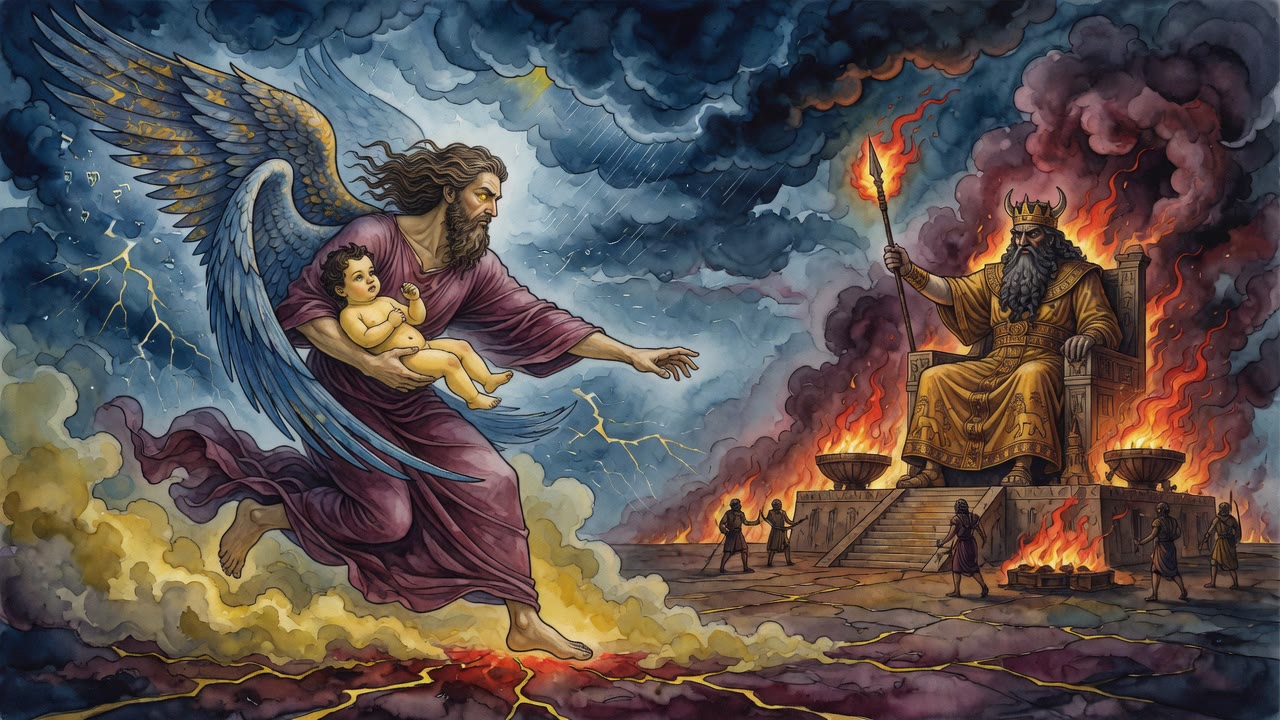
Gabriel made milk flow from his finger for the abandoned infant Abraham. Decades later he carried the same man on his shoulder into Nimrod's capital.

Curated by Arthur · Told by Maggid ·
Table of Contents
  1. Ten Days Old in a Cave
  2. The Greeting on the Road
  3. The Shoulder That Carried Him
  4. The Two Visits That Made One Story

Ten Days Old in a Cave

There was no one else in the cave. Nimrod's astrologers had read the sky on the night Abraham was born and told the king that a child had just entered the world who would one day challenge his power, and Nimrod had given the order that the child should be killed before that became a problem. Abraham's father Terah had hidden his wife and the newborn in a cave in the hills outside the city. Then he had gone back to his life, and the infant was alone.

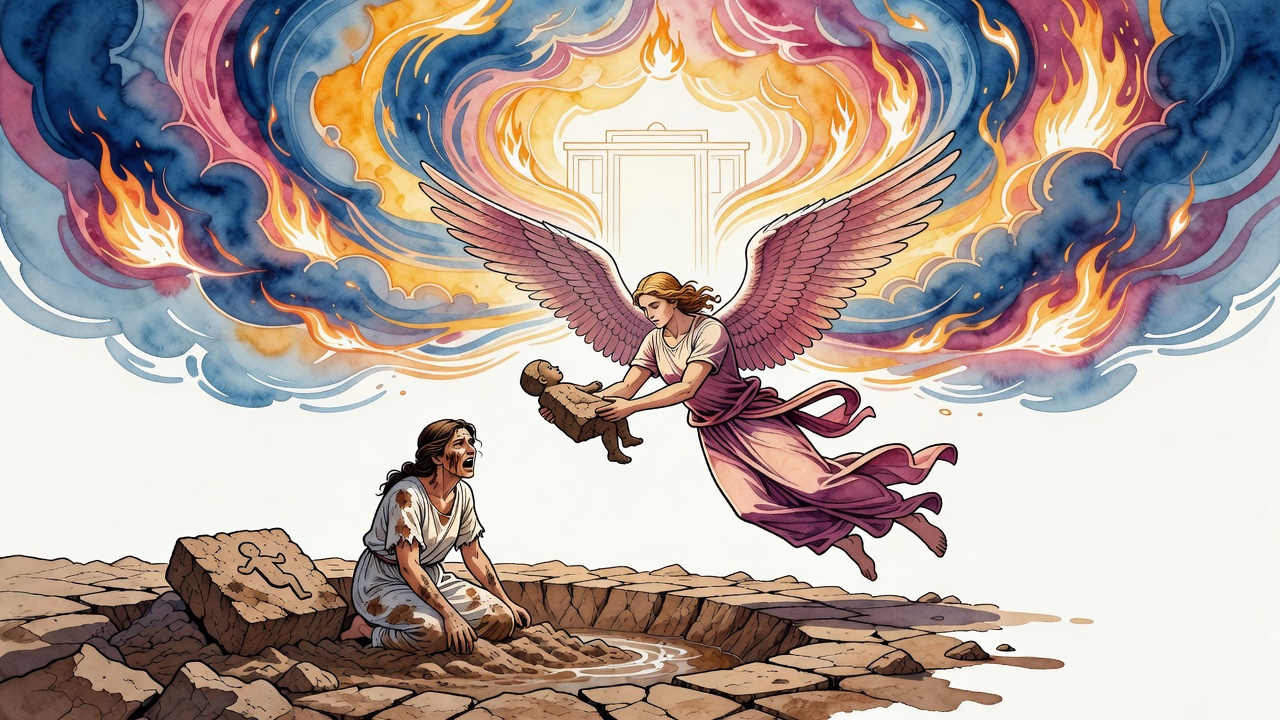
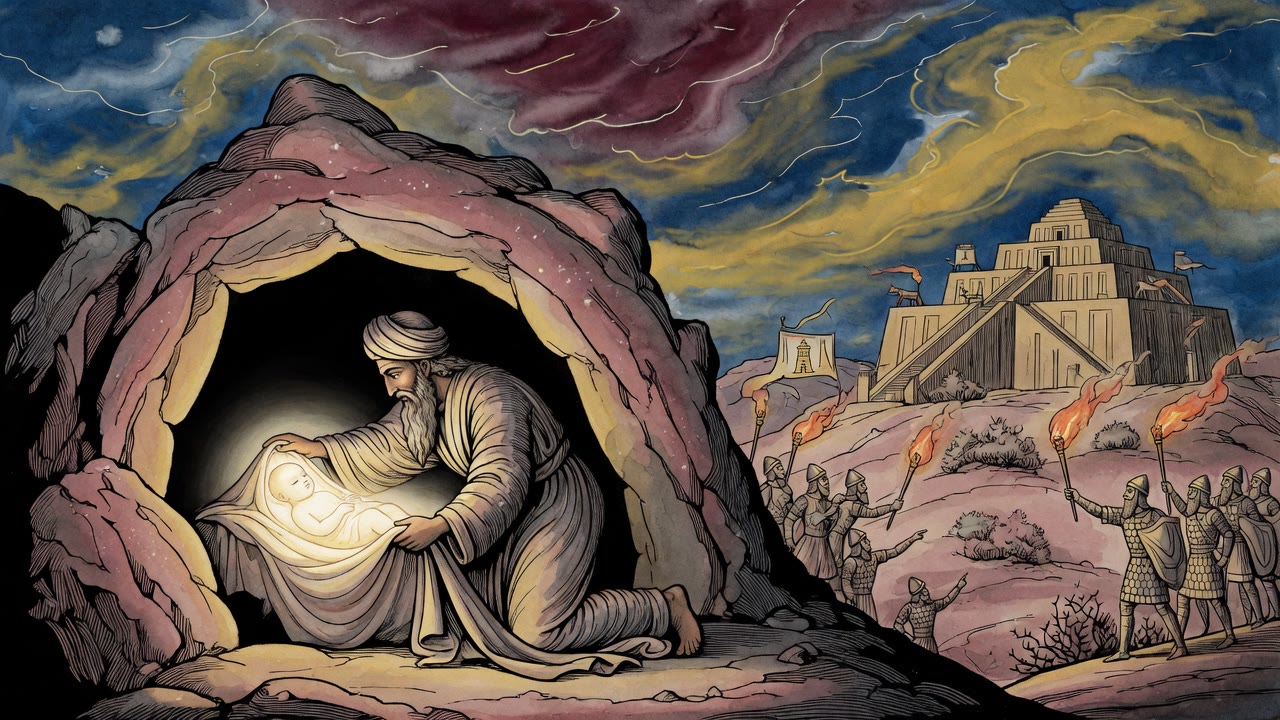
The Legends of the Jews records what God did about this. He sent Gabriel. The angel came into the cave and found the ten-day-old child crying in the dark and the cold, and he did what needed to be done. He made milk flow from the little finger of Abraham's right hand. The infant latched on and nursed from the angel's finger for ten days, growing stronger each day in the cave while Nimrod's soldiers were looking for a newborn somewhere in the city and not finding him.

At the end of the ten days Abraham got up and walked. Not toddled, not crawled. Walked, with a confidence that had no business belonging to a ten-day-old, to the edge of the valley. He went outside and looked at the sky at night for the first time, and he saw the stars and said: "these must be the gods." Then the sun rose and he looked at the sun and said: "that must be the god." Then the sun set and the stars were back and he thought about it and concluded: these things rise and set and are therefore governed by something that does not rise and set. That is the one I will serve. The first act of monotheistic reasoning in the Abrahamic tradition was performed by a child who had been kept alive on angel's milk.

The Greeting on the Road

Years later, when Abraham had grown into the man who smashed his father's idols and stood trial before Nimrod and survived the furnace, he was sitting alone somewhere when Gabriel came again. Not with milk this time but with a formal greeting: Shalom aleichem. The traditional words of peace, offered by the angel to the human being who had first known him as a finger producing nourishment in the dark.

Abraham answered correctly, gave the response back, and then asked the natural question: who are you? Gabriel identified himself. And then he led Abraham to a nearby spring, where Abraham washed and prayed and bowed himself down to the ground. The second meeting between these two was a meeting of equals, more or less, a recognized relationship being resumed after many years.

Meanwhile, according to the Legends of the Jews, something was being arranged at court. Nimrod had heard that Abraham was out there somewhere, the child who had survived the cave and grown into an adult threat to everything the king had built.

The Shoulder That Carried Him

The order came eventually: go to Babylon and confront Nimrod. Abraham's response was reasonable panic. He did not have an army. He could not ride into the capital city of the most powerful empire in the world without support and expect to walk out. Gabriel's answer was the answer of someone who had been maintaining a child in a cave on angel's milk and had a long view of what was necessary and what was possible.

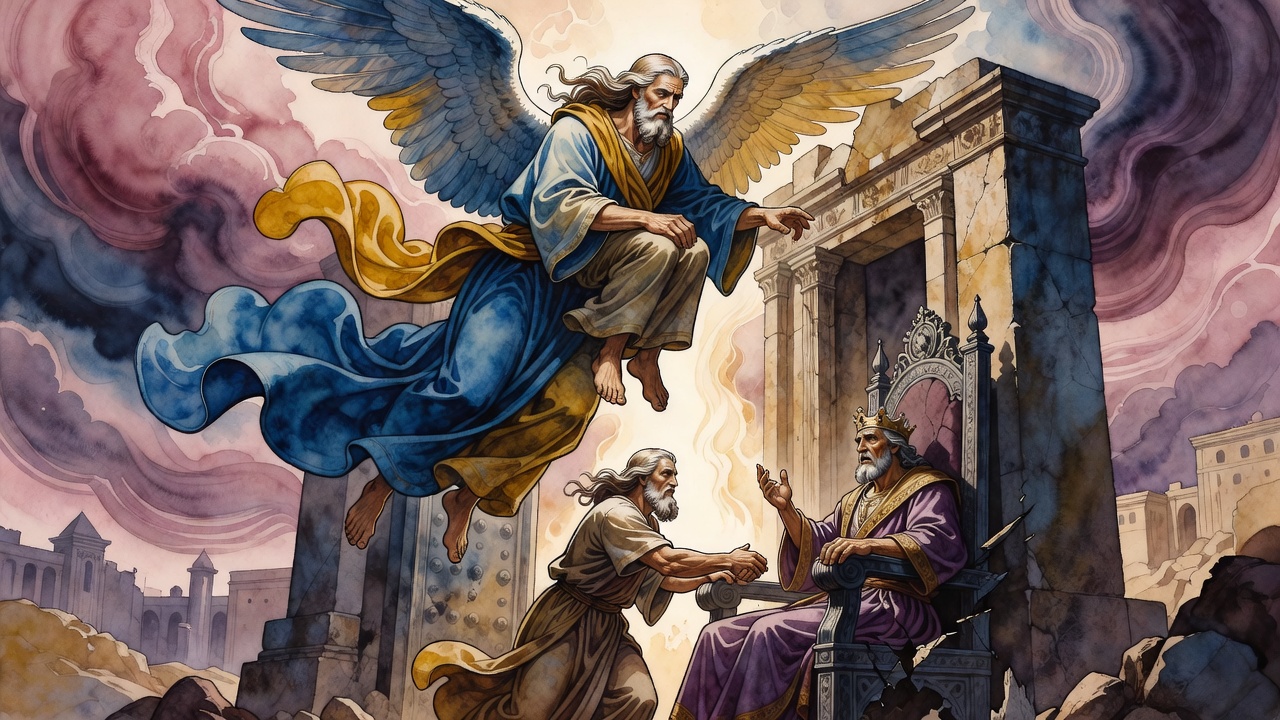
"Thou needest no provision for the way," Gabriel told him. No horse to ride. No warriors. No chariots, no riders. "Sit upon my shoulder and I shall bear thee to Babylon." The angel who had fed him on a finger now offered his shoulder, and Abraham climbed up and was carried through the air to the capital of the empire that had ordered his death on the day he was born.

He arrived without an army and confronted the king face to face and walked back out. The arc that Gabriel had started in the cave was completed not with nourishment but with transport, not with sustenance but with mission. The infant who had needed milk to survive had become the man who needed only a shoulder and a destination.

The Two Visits That Made One Story

The two appearances of Gabriel in Abraham's life are easy to read as separate stories. One is a birth narrative. One is a mission narrative. They happen at opposite ends of a life, when Abraham is ten days old and when he is a grown man challenging an empire. But the Legends of the Jews reads them as a single arc, and the reading is correct.

Gabriel who fed the infant knew what the infant would become. The milk was in service of the mission. The ten days in the cave were preparation for the years of confrontation that followed. God had decided that this particular child would live and do particular things, and the angel assigned to maintain the child was the same angel assigned to deliver him to the place where the things would be done. First on a finger. Then on a shoulder. Both times the destination was the same world, the world that needed Abraham to be in it.


← All myths
From the tradition

Sources

4 sources

The texts this telling draws on, in full. Open a card to read inline, or expand it for a wider, quieter read.

Legends of the Jews 5:11Legends of the Jews

Picture a cave deep in the earth, hidden from the eyes of a murderous king. No parents, no comfort, just the cold, hard stone and the echoing silence. Abraham, newly born, was left to fend for himself. According to Legends of the Jews, he began to wail, as any infant would.

God, in his infinite compassion, sent the angel Gabriel down to sustain him. And how did Gabriel do that? He made milk flow from the little finger of Abraham's right hand! For ten days, little Abraham suckled at his own hand, growing stronger each day.

Then, something remarkable happened. He got up and walked. Not just a few wobbly steps, but a confident stride to the edge of the valley. He ventures out of the cave. As night fell, and the stars blazed into life, Abraham, in his innocence, exclaimed, "These are the gods!" The vastness of the night sky, the twinkling lights – it must have been an awesome sight.

Dawn broke, and the stars faded. "I will not pay worship to these," he declared, "for they are no gods." He realized that their power was fleeting, dependent on the sun.

Then the sun rose, a glorious spectacle of light and warmth. "This is my god," Abraham proclaimed, "him will I extol!" It's easy to see why he thought so. The sun gives life, sustains the world, and banishes the darkness.

But as the day waned, the sun set, and Abraham, once again, was left in twilight. "He is no god," he said, his search continuing.

Then he saw the moon, serene and beautiful in the night sky. He called her his god, the one to whom he would pay divine homage. But then, the moon, too, was obscured, perhaps by clouds, perhaps by the natural cycle of its phases.

And Abraham cried out, his voice echoing in the darkness, "This, too, is no god! There is One who sets them all in motion."

This is such a powerful moment. Abraham's journey wasn't about finding the right celestial body to worship. It was about understanding that everything he saw, everything that seemed powerful and divine, was ultimately just a creation. It pointed to something beyond itself, something greater, a single, unifying force behind all of existence. Abraham recognized that there has to be One who sets them all in motion.

What a journey. From a lonely baby in a cave to a seeker of truth, Abraham teaches us that the search for meaning is a lifelong quest. And maybe, just maybe, the answer isn't in the stars, the sun, or the moon, but in recognizing the One who created them all.

Full source
Legends of the Jews 5:13Legends of the Jews

He wasn't just sitting idle. He was in deep conversation – but with whom? Himself? With the Divine?

Then, tradition tells us, an angel appeared. Gabriel, no less! He approached Abraham with the traditional greeting, "Shalom aleichem," "Peace be with thee." And Abraham, ever the gracious host even in isolation, returned the greeting, "Aleichem shalom," "With thee be peace." Then, naturally, he asked, "Who are you?"

Gabriel identified himself as God's messenger. According to Ginzberg’s retelling in Legends of the Jews, Gabriel then led Abraham to a nearby spring. Imagine the relief – the chance to wash, to purify himself after all that time alone. And what did Abraham do? He prayed. He bowed down. He prostrated himself before God. A powerful moment of reconnection and devotion.

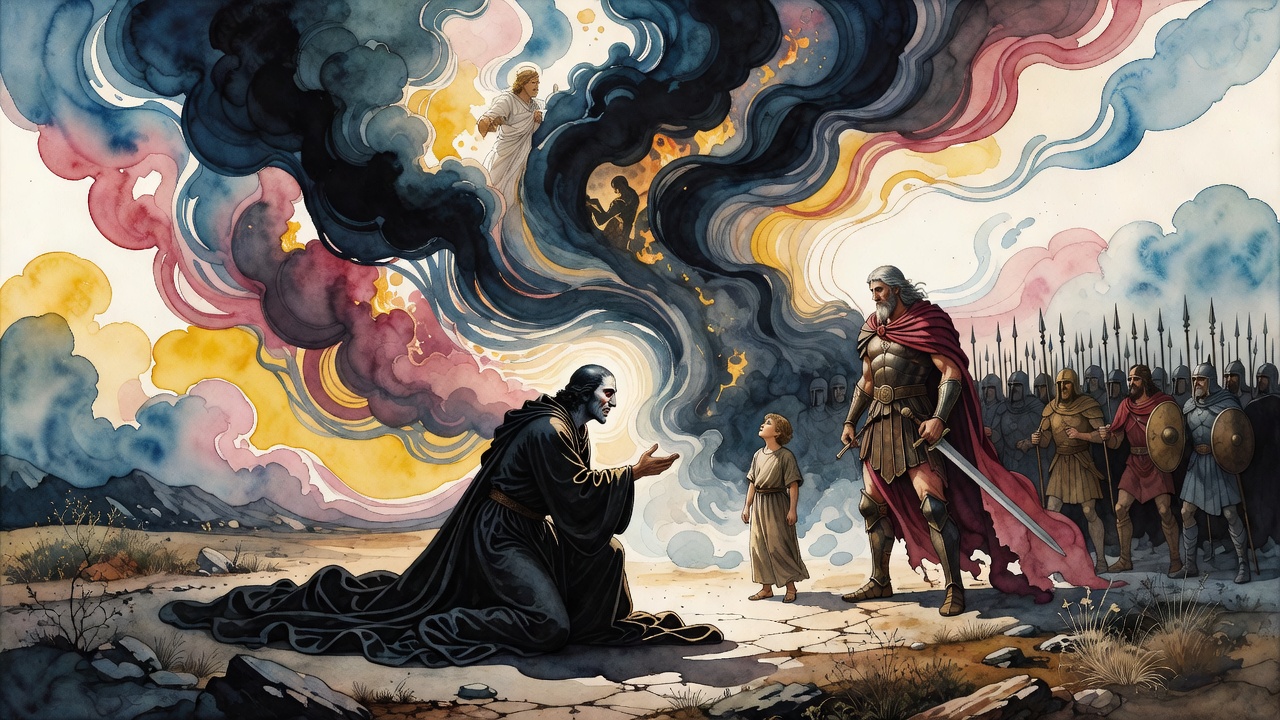
Meanwhile, what about his mother? She hadn't forgotten him. As we find in Legends of the Jews, her heart ached. Driven by sorrow and tears, she ventured out from the city, desperately searching for him in that very cave where she'd left him. Can you feel her anguish?

She didn't find him there, and her despair intensified. "Woe is me!" she cried, imagining the worst. "That I bore thee only to become a prey for wild beasts – the bears, the lions, the wolves!" She went to the edge of the valley, and there, she saw a young man.

But here’s the twist: she didn’t recognize him. He had grown so much! She approached him, offering the same greeting: "Peace be with thee!" And, just like with Gabriel, he responded, "With thee be peace!" Then he asked, "Why have you come to the desert?"

She explained her heartbreaking mission: "I came from the city, searching for my son." Abraham pressed her: "Who brought your son here?"

And then she poured out the whole story. "I conceived him with my husband Terah. But I feared for his life! The king of Canaan had already slaughtered seventy thousand male children. So, when my labor pains began near this very cave, I gave birth and left him there. Now," she finished, her voice thick with emotion, "I've come back to find him, but he's gone."

Imagine that moment. The son listening to his mother recount the agonizing decision she made to save his life, neither of them knowing who the other truly was. What a powerful, bittersweet encounter. It makes you wonder about all the unseen connections and hidden identities that shape our own lives, doesn't it? How often do we unknowingly cross paths with those who are deeply connected to our own stories?

Full source
Legends of the Jews 5:28Legends of the Jews

The story of Abraham and Nimrod is a perfect example, and it's wild. We pick up the tale after Abraham has already begun to challenge Nimrod's authority, but now things are about to get really interesting.

So, Abraham, following God's command, receives an order from the angel Gabriel himself: go to Babylon and confront Nimrod. Can you imagine? He balks, naturally. He protests that he's not equipped for a showdown with the king. "I don't have an army!" he probably exclaimed. "I can't just walk into Babylon!"

Gabriel, ever the reassuring messenger, calms him down. "Thou needest no provision for the way, no horse to ride upon, no warriors.. no chariots, nor riders." According to Legends of the Jews, Gabriel tells Abraham, "Just sit upon my shoulder, and I shall bear thee to Babylon." The sheer audacity of it!

Abraham, trusting in God's plan, actually does it! He climbs onto Gabriel's shoulder. And in the blink of an eye – bam! – he’s standing before the gates of Babylon. Can you imagine the look on his face?

Now, here's where it gets even more dramatic. At the angel's urging, Abraham enters the city. And what does he do? He doesn't whisper, he doesn't hide. He calls out with a loud voice, proclaiming: "The Eternal, He is the One Only God, and there is none beside. He is the God of the heavens, and the God of the gods, and the God of Nimrod."

Talk about a mic drop moment!

He continues, demanding they acknowledge this as truth – men, women, and children alike! And, he declares himself Abraham, God's servant, the trusted steward of His house. He doesn't just challenge Nimrod, he publicly announces his allegiance to something much greater.

What courage! What conviction! It's a scene that resonates even today. It makes you wonder, doesn't it? What would we do if faced with such a daunting task? Would we have the faith to climb onto the angel's shoulder and proclaim our truth in the face of power? The story of Abraham and Nimrod reminds us that sometimes, the smallest voice, backed by unwavering belief, can shake the foundations of an empire.

Full source
Gaster, Exempla no. 2bThe Exempla of the Rabbis (1924)

Abraham stepped out of the cave where he had been hidden as an infant, and for the first time saw the world above ground. He looked up and saw the sun climbing, enormous and warm, and he thought: surely this is God. He worshipped it. Then the sun set, and the moon rose, silver and calm, and he thought: the sun has a ruler too, and it is this. He worshipped the moon. Then the moon set, and the stars wheeled, and at last the true God spoke in the silence behind all of them: I am the Lord, and I made each of those lights. Abraham worshipped Him.

He returned to his father Terah's house, where the shelves were crowded with idols his father sold for profit. When Terah sent him to carry a sacrifice to the statues, Abraham watched the gods of wood and stone sit motionless before their portion. They could not so much as lift a crumb. Abraham set the whole house on fire and watched his father's merchandise burn.

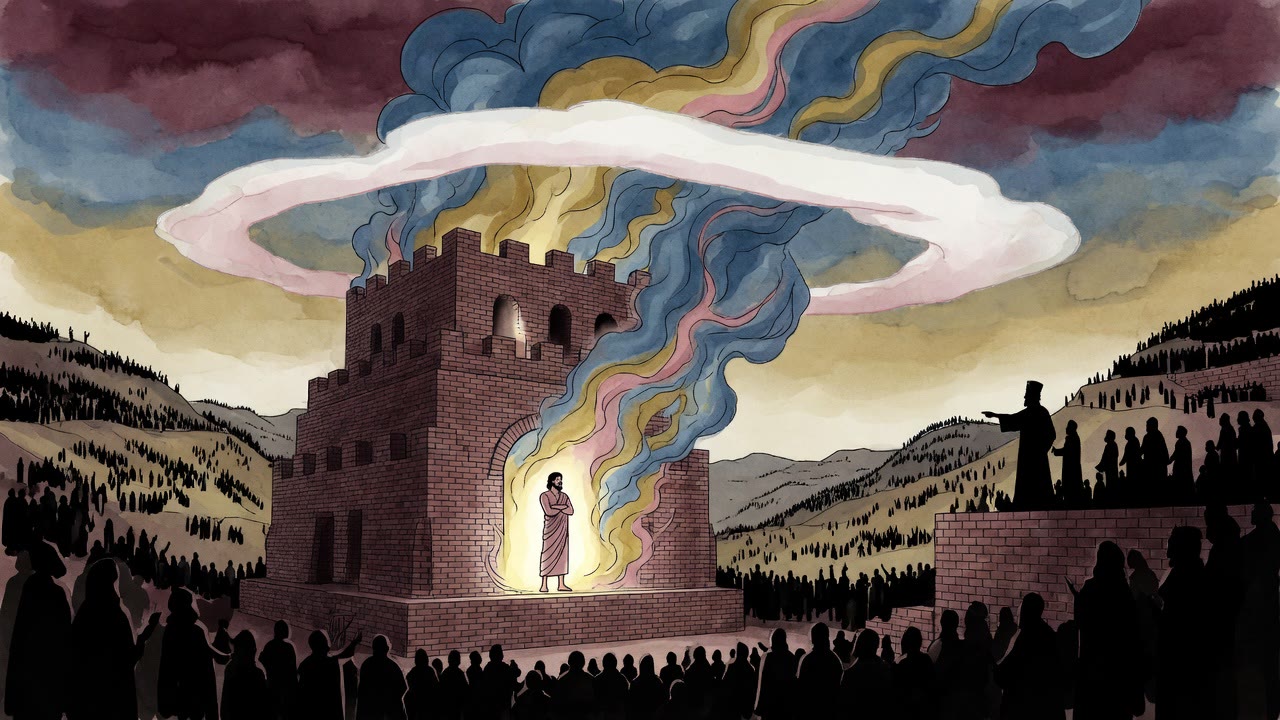
Word traveled fast. Abraham was brought before Nimrod, the king who had declared himself a god. "If you are God," Abraham said evenly, "then make the sun rise in the west tomorrow and set in the east." Nimrod could not. In answer, he ordered a furnace heated and commanded that Abraham be thrown into it.

The king's magicians whispered that the fire would not hurt him because his brother Haran was an astrologer and a fire-worshipper, and that this family practiced spells. They were wrong. Abraham walked through the flames unburned because the God who made the sun held him in His hand. A single spark leapt out and struck Haran, who had not committed to any side with full heart. And burned him to death.

All the nations watching that day, the midrash says, recognized the superiority of the God of Abraham. The furnace that was meant to silence him became the first altar of his public witness.

(From The Exempla of the Rabbis, Moses Gaster, 1924, no. 2b, drawing on the Ma'aseh Book / Codex Gaster.)

Full source