6 min read

God Brought Israel Into Sinai's Wine House Under a Banner of Torah

Sinai becomes a wine house of love. Israel stands between the yetzer hara, the evil inclination, and Torah while heaven argues life against death.

Curated by Arthur · Told by Maggid ·
Table of Contents
  1. The Mountain as a Wine House
  2. Hosts on the Right and on the Left
  3. Enough of the Dark Reading
  4. Under the Banner After the First Word

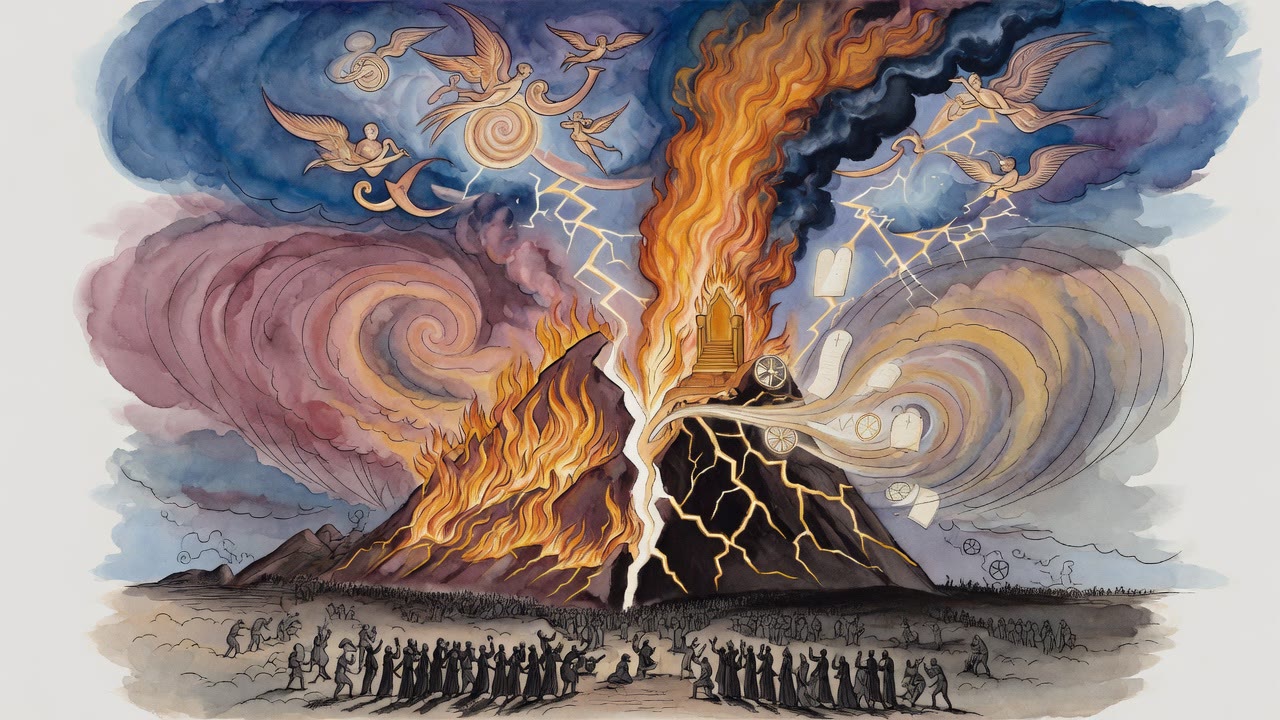
Israel stood at the foot of the mountain with dust on their ankles and the smell of Egypt still in their clothes. Thunder sat on the rock. A cloud pressed low enough to taste. God had not yet spoken the first word of the Decalogue, and already the people swayed as if wine had reached their blood, not from a cup but from the fear and heat of a covenant about to land on their heads.
God Brought Israel Into Sinai's Wine House Under a Banner of Torah Click for full size

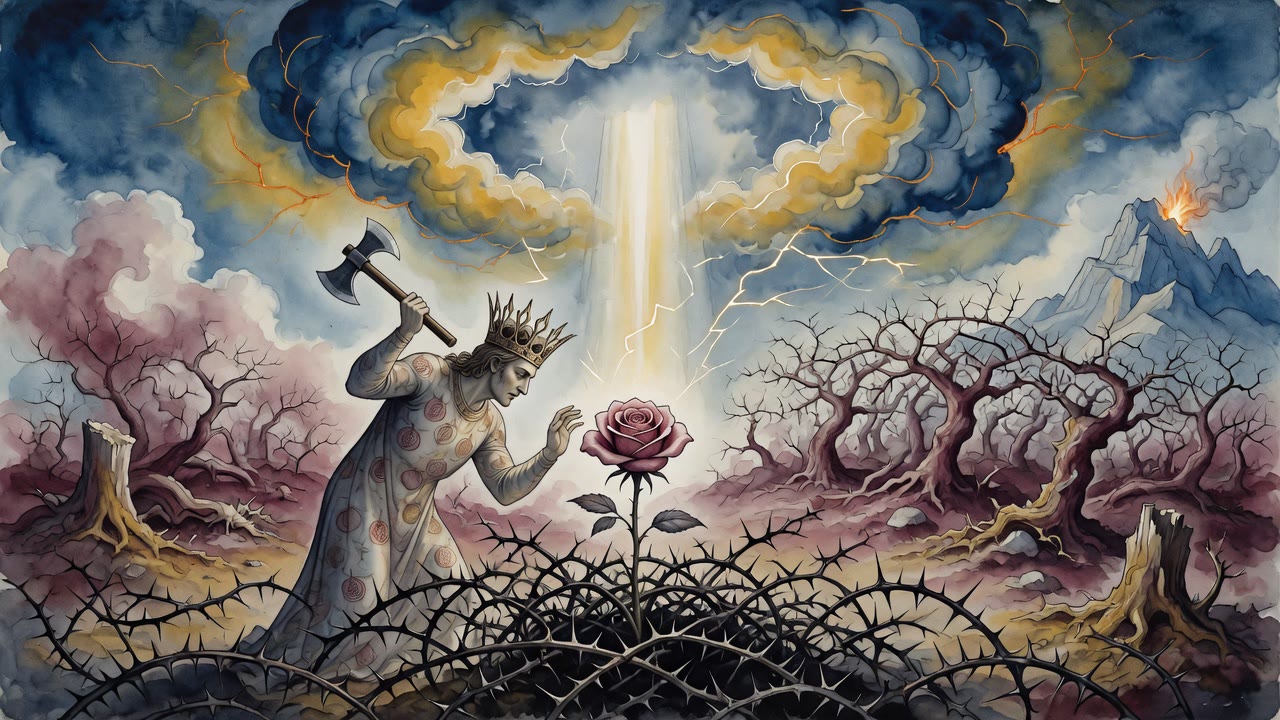
Some among them still carried the thirst that would one day shape a calf of gold. That thirst had a name later ages would call the yetzer hara, the evil inclination, and it worked like strong drink: it blurred the next step, made a false god look solid, made a true God look far. The mountain waited. The people waited. Between them lay a choice no sermon could soften.

The Mountain as a Wine House

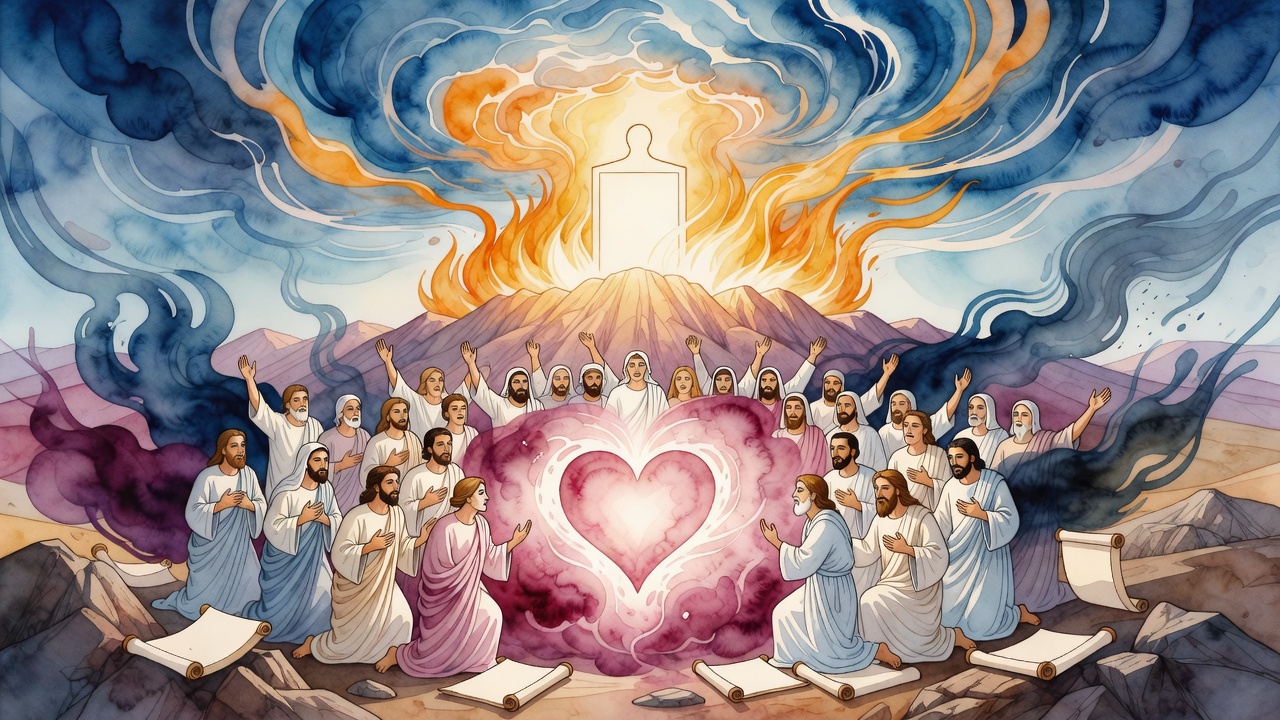
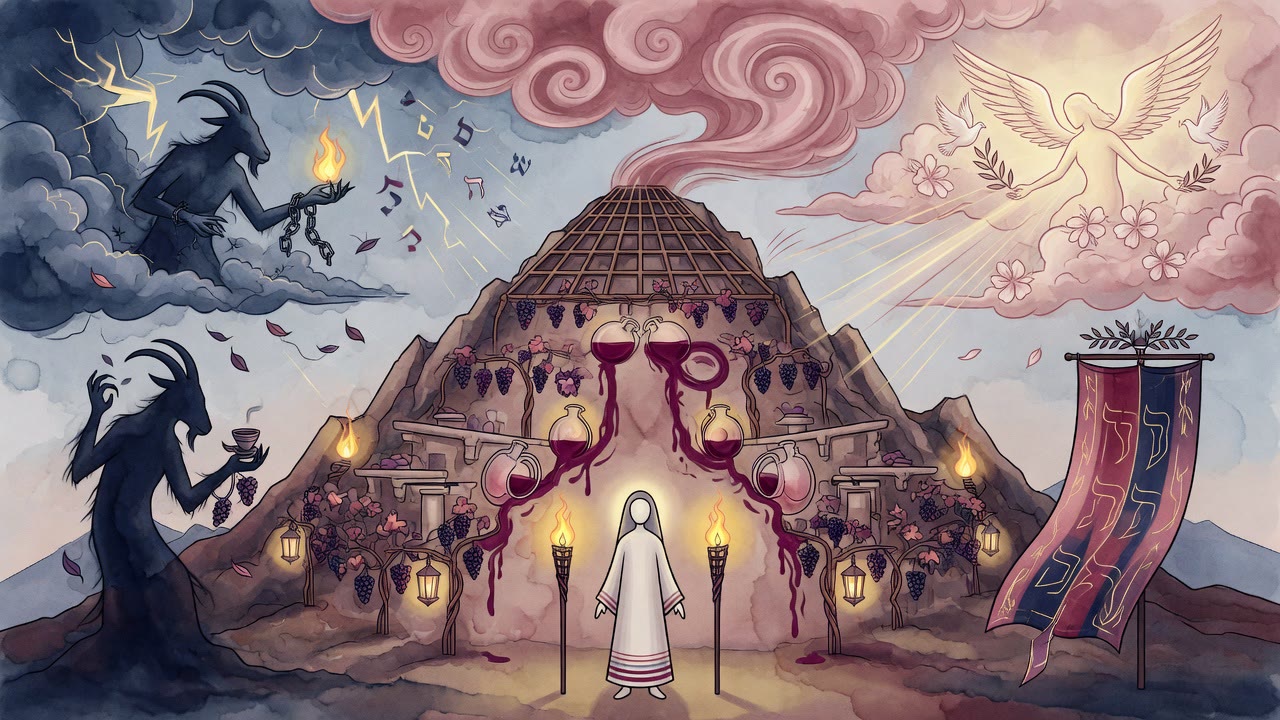
Song of Songs sings, "He brought me to the house of wine, and his banner over me is love" (Song of Songs 2:4). On this ridge the house of wine was not a tavern. It was Sinai itself. God did not drag Israel into a cellar of forgetfulness. He brought them into a place where the heart could be flooded with something stronger than fear.

One reading of that verse treats the wine house as the yetzer hara (the evil inclination) alone, the intoxication that ends at a calf and a shattered tablet. Another reading refuses that path. The mountain is the wine house. The banner is Torah. The love is the commandments and the good deeds Israel would take on with open hands. Forty-nine approaches toward purity and forty-nine toward impurity open under that banner, and the Hebrew for "his banner," vediglo, carries the same count of forty-nine. Love and argument share one flag.

Israel lifted its eyes. Fire walked the rock. No cup was poured, yet every throat burned. The people who would later fail still stood under a banner that named them beloved before the first sin of the golden calf had a chance to form in their mouths.

Hosts on the Right and on the Left

Above the mountain, another court was already in session. Isaiah saw the Lord on a high and exalted throne (Isaiah 6:1). Micaiah saw the same throne and a host of heaven standing to the right and to the left (1 Kings 22:19). They were not furniture. Some pressed for exoneration. Some pressed for condemnation. A case could live or die in the space between those ranks.

Truth did not sit quiet while mercy spoke, and mercy did not bow out when truth raised its voice. "The Lord God is truth," Jeremiah says (Jeremiah 10:10), and truth here is not a plaque on a wall. It is what emerges when a multitude of voices finishes arguing and a verdict still has to fall. Daniel hears of truth and a great host in the same breath (Daniel 10:21). Heaven runs on contention that ends in judgment, not on soft agreement.

Israel on the plain did not see the advocates. They felt the weight. Every commandment that would soon leave God's mouth would pass through a court that knew how to kill and how to spare. Rabbi Simon names the throne as one that distinguishes between death and life. At Sinai that distinction hovered over a nation that had already known brick and whip and would soon know both glory and collapse.

Enough of the Dark Reading

In the study halls later ages would stage a quarrel over the same wine house. Rabbi Meir heard only the yetzer hara in the cup, Israel drunk and stumbling toward the calf. Rabbi Yehuda cut him off. "Enough, Meir." The Song of Songs, he insisted, praises Israel. It does not serve as a catalog of their worst hour alone.

The quarrel was not academic for the people who had stood under the cloud. If the wine house is only ruin, the mountain becomes a trap. If the wine house is Sinai and the banner is love, then even a people who will fail still entered under a flag that claimed them first. God brought them in. The banner went up before the first golden ear was cast.

When two colleagues later argue a point of law and one cannot find the source, heaven still looks on their effort with love. A mispronounced word in the Shema (Hear O Israel) does not erase the attempt. The court that knows death and life also knows how to count unfinished labor as beloved work. That is the other face of the wine house: not only the rush of revelation, but the long heat of study that never quite finishes the glass.

Under the Banner After the First Word

Then the mountain spoke. Smoke rose. The people stepped back until their heels found the camp's edge. Some covered their ears and still heard. The banner did not come down when the first fear hit. Love in this telling is not a soft mood. It is a standard planted in rock while a court above weighs life against death and a people below shakes.

Israel would still make the calf. Tablets would still break. The yetzer hara would still pour its own wine in the valley. None of that rewrote the first arrival. God had brought them to the wine house of Sinai, set Torah over them as a banner of love, and let the heavenly host keep arguing cases while the nation learned what it meant to stand under a flag that does not leave when the drink turns bitter.

At dusk the thunder eased. Ash of cloud still clung to the upper rock. The banner was still there, invisible and heavy, and the court above had not adjourned.


← All myths
From the tradition

Sources

2 sources

The texts behind this telling. Some cards carry a translation of the source; others are our own retelling of it, and each card says which. Every card links out to the original.

Shir HaShirim Rabbah 1:9Shir HaShirim Rabbah

Retold in our words. Read the original at the link below.The Sefaria Midrash Rabbah, 2022 · CC-BY

The book of Shir HaShirim Rabbah, a collection of rabbinic interpretations of the Song of Songs, explores this very question. It uses vivid imagery and insightful debates to paint a picture of a heavenly court, a place where justice, mercy, and, above all, truth reign supreme.

It starts with a verse from (Song of Songs 1:9), "To a mare in Pharaoh's chariots I have likened you, my love." It seems like a strange jumping-off point. But Rabbi Papis connects this to (Job 23:13), "He is of one mind, and who can respond to Him?" The idea being, God is the ultimate authority, and no one can challenge His judgments.

Rabbi Akiva isn't so sure. He pushes back, saying, "Enough, Papis, one may not challenge the words of the One who spoke and the world came into being, because everything is true and everything is just." He points to (Isaiah 6:1), "I saw the Lord sitting on a high and exalted throne." This isn't just about power, it's about a system of justice.

Rabbi Simon adds another layer. He describes this throne as one that "distinguishes between death and life," and pictures God surrounded by a heavenly host, as in I (Kings 22:19). But then comes the kicker: are these hosts on God's right and left just… there? No! Some advocate for exoneration, others for condemnation. We find a similar sentiment in (Daniel 10:20), "The truth of the matter and a great host." Rabbi Yoḥanan, citing Rabbi Aḥa, explains that truth emerges from this multitude of voices, this grand debate. It echoes (Jeremiah 10:10), "The Lord God is truth."

So, what is truth, in this context? Rabbi Aivun says it's that God is the living God and King of the universe. Rabbi Elazar takes it a step further, stating that whenever we see "And the Lord," it implies God and His court. He uses the example of I (Kings 22:23), where the prophet Micaiah says, "And the Lord has spoken evil in your regard." This verse is the climax of a story where Micaiah sees God on His throne, surrounded by the heavenly host, as described in I (Kings 22:19). It's not just God acting alone; it's a process, a deliberation.

But if God is "of one mind," as Rabbi Papis initially suggested, how does this court fit in? Rabbi Elazar clarifies that God alone seals the final verdict. No one else has that power. But what is God's seal? Rabbi Beivai, quoting Rabbi Reuven, says it's emet (אמת), truth itself! He refers to (Daniel 10:21), "However, I will tell you what is inscribed in the writ of truth."

Here's where it gets really interesting. Why both "truth" and "inscribed"? It seems redundant. The answer is subtle but profound: until the ruling is signed, it's "inscribed," meaning it can still be changed. But once it's signed, it becomes emet, immutable truth.

Reish Lakish offers a beautiful, almost poetic interpretation of emet. He points out that alef (א) is the first letter of the Hebrew alphabet, mem (מ) is in the middle, and tav (ת) is at the end. This, he says, echoes (Isaiah 44:6): "I am first and I am last and aside from Me there is no God." "I am first," meaning God didn't receive His kingdom from anyone. "And I am last," meaning He won't transfer it to anyone else. "And aside from Me there is no God," meaning there's no equal to Him. Emet, therefore, encapsulates God's eternal and absolute nature.

So, what does this all mean for us? It suggests that even the Divine operates with a system of justice, deliberation, and ultimately, truth. That even in the face of seemingly arbitrary events, there's a process, a reason, and a commitment to emet guiding the universe.

Full source
Shir HaShirim Rabbah 4:1Shir HaShirim Rabbah

Retold in our words. Read the original at the link below.The Sefaria Midrash Rabbah, 2022 · CC-BY

Shir HaShirim Rabbah turns to He Brought Me to the Wine House and His Banner Is Love.

The first reading, this sounds pretty romantic. But the Rabbis, as they often do, find layers and layers of meaning beneath the surface. Rabbi Meir takes a rather… pessimistic approach. He suggests that the "wine house" represents the intoxicating power of the yetzer hara, the evil inclination. He argues that Israel, drunk on this inclination, stumbled and proclaimed the Golden Calf as their god. Wine, after all, can confuse us, make us do things we regret.

Rabbi Yehuda isn't having it. "Enough, Meir!" he exclaims, basically saying you can't interpret the Song of Songs in a negative light. This book, he insists, is all about praising Israel. So, what's the real meaning of "He brought me to the wine house"?

In Rabbi Yehuda, the "wine house" is Sinai. It's the place where God brought the Israelites to receive the Torah. And that "banner of love"? That's the Torah, the mitzvot (commandments), and the good deeds that Israel accepted with open hearts.

Rabbi Abba, quoting Rabbi Yitzchak, elaborates on this idea. He says that at Sinai, God gave Israel the Torah, which can be analyzed with "forty-nine approaches for purity and with forty-nine approaches for impurity.” And get this, the numerical value of the Hebrew phrase "vediglo" – "his banner" – is also 49! (Vav is 6, dalet is 4, gimmel is 3, lamed is 30, and vav is 6). It’s a beautiful connection, showing how deeply the Torah and God's love are intertwined.

But here’s where it gets really interesting. The text goes on to explore the idea that even our mistakes, our imperfections, can be seen with love. Rabbi Yona says that when two colleagues are debating a point of halakha (Jewish law), and one can’t quite remember the source… God still sees their efforts with love. Even an incomplete attempt at understanding Torah is cherished.

Rabbi Acha takes it further. What about someone who makes a mistake in pronunciation, confusing "love" (ve'ahavta) with "hate" (ve'ayavta)? God sees even that mistake with love!

And it continues! Rabbi Yisakhar talks about a child mispronouncing names like Moshe (Moses) or Aharon (Aaron). Rabbi Hunia describes someone accidentally touching God’s name in a text. The Rabbis even suggest a child skipping over God’s name while reading. In all these instances, God's response is… love.

Rabbi Berekhya even brings up Jacob's deception of his father, Isaac, when he wore goatskins to trick Isaac into giving him Esau's blessing (Genesis 27:16). Even that act of "subterfuge" (digulin), Rabbi Berekhya says, is met with God’s Divine Presence.

What are we to make of all this? Are we being given a license to mess up? Absolutely not. But I think there's something profoundly comforting in the idea that God’s love isn’t conditional on perfect performance. It embraces our efforts, our struggles, even our stumbles. It’s a love that sees the intention, the yearning, behind the imperfection.

Rabbi Yehoshua of Sikhnin, quoting Rabbi Levi, brings us back to Sinai. He envisions the Israelites seeing the angels, Michael and Gabriel, with their banners. Inspired by these heavenly rites, they yearned for banners of their own. And God granted their wish, instructing Moses that each tribe should encamp with its own banner (Numbers 2:2).

So, what’s the takeaway? Maybe it’s this: God isn't looking for perfection. God is looking for connection. God is looking for us to show up, to try, to engage, even when we fall short. And in those moments of imperfection, we might just find that God's banner over us is, love.

Full source