Parshat Bereshit6 min read

God Forged the Heavens from Fire and Water

A philosopher told Rabbi Gamaliel that God was an artist who found good materials ready to hand. The sage answered that even chaos was made, clay and all.

Curated by Arthur · Told by Maggid ·
Table of Contents
  1. Balls of Fire and Snow
  2. Everything Paired, God Alone
  3. Mind Before Matter
  4. The First Day Already Late

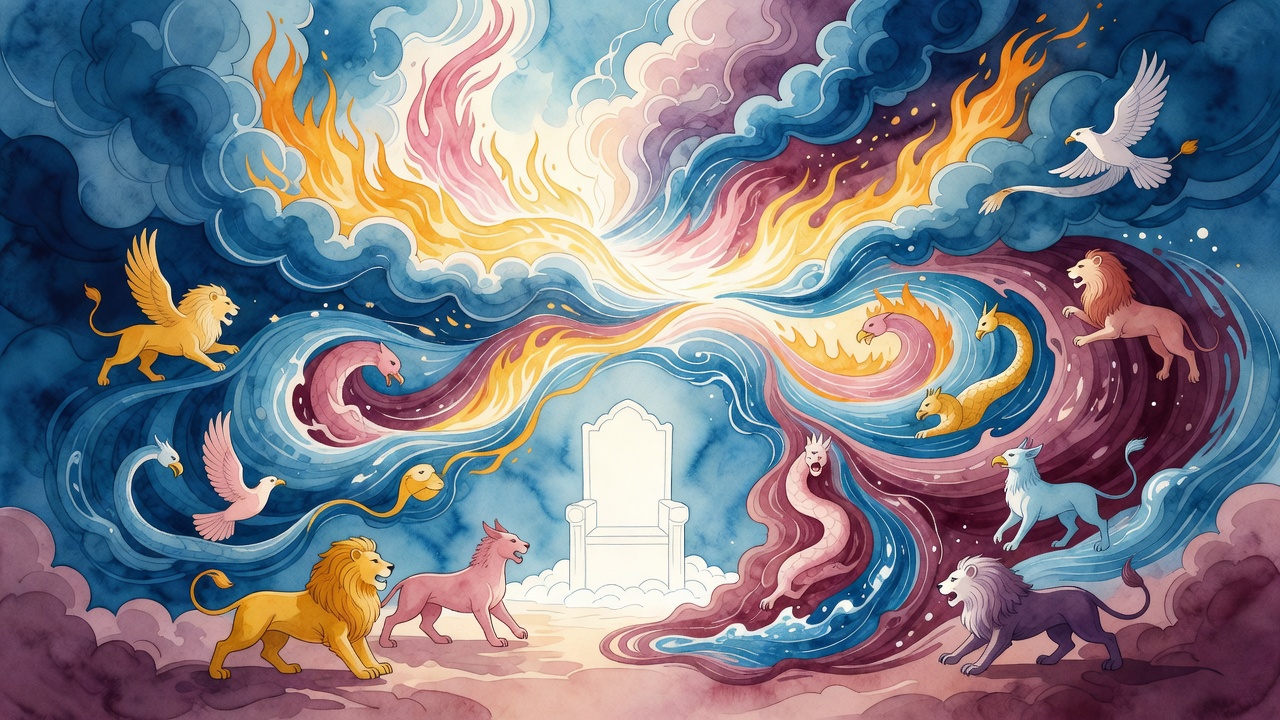
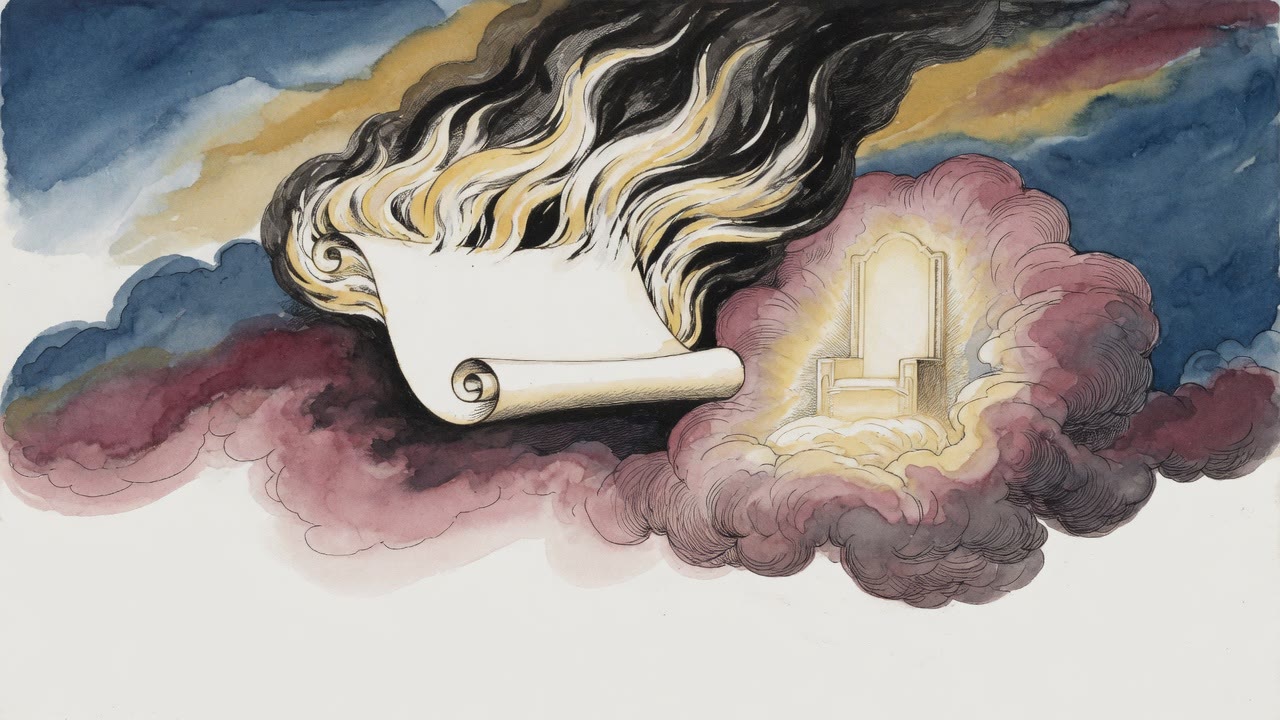
Before a single "let there be," the dark and the void, the raw and the finished, already lived in the mind of God. Nothing surprised the Planner. Colors waited before rain. Leaf-green and sunset-fire waited before leaf or sun. The blueprints, the materials, and the completed world swirled together in divine consciousness. Creation was not improvisation. It was a release of what had already been held.

God Forged the Heavens from Fire and Water Click for full size

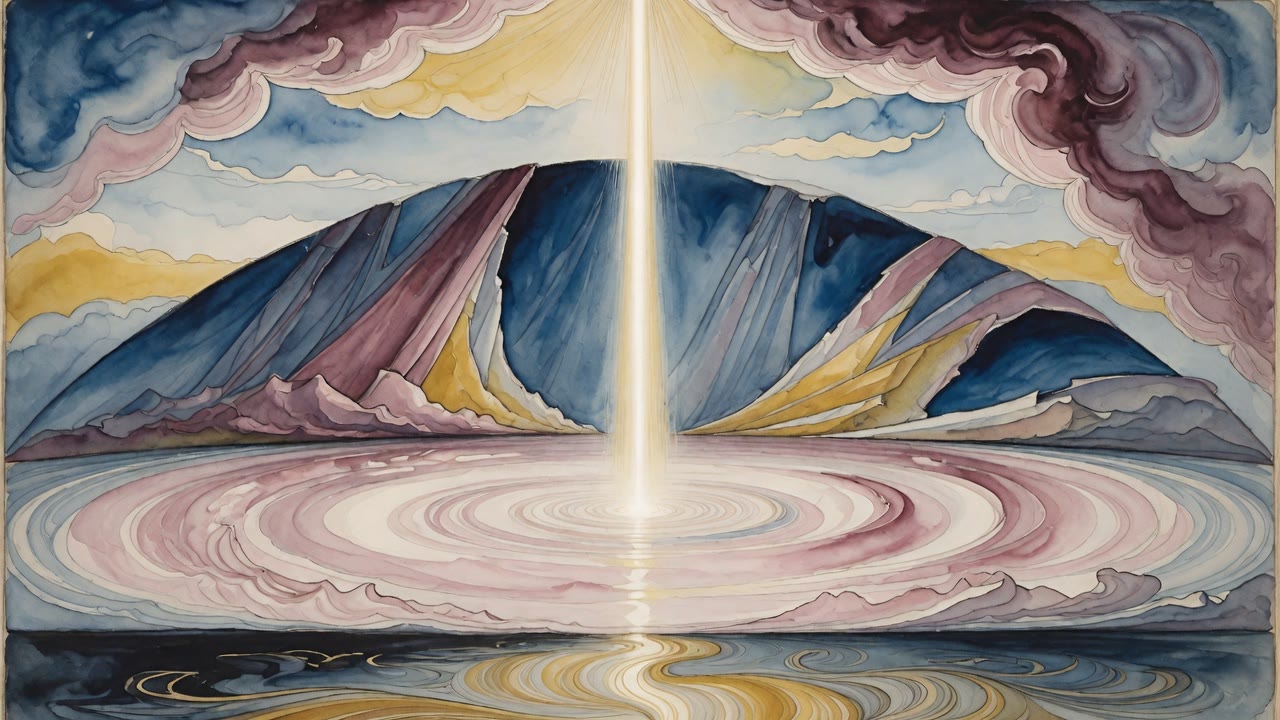
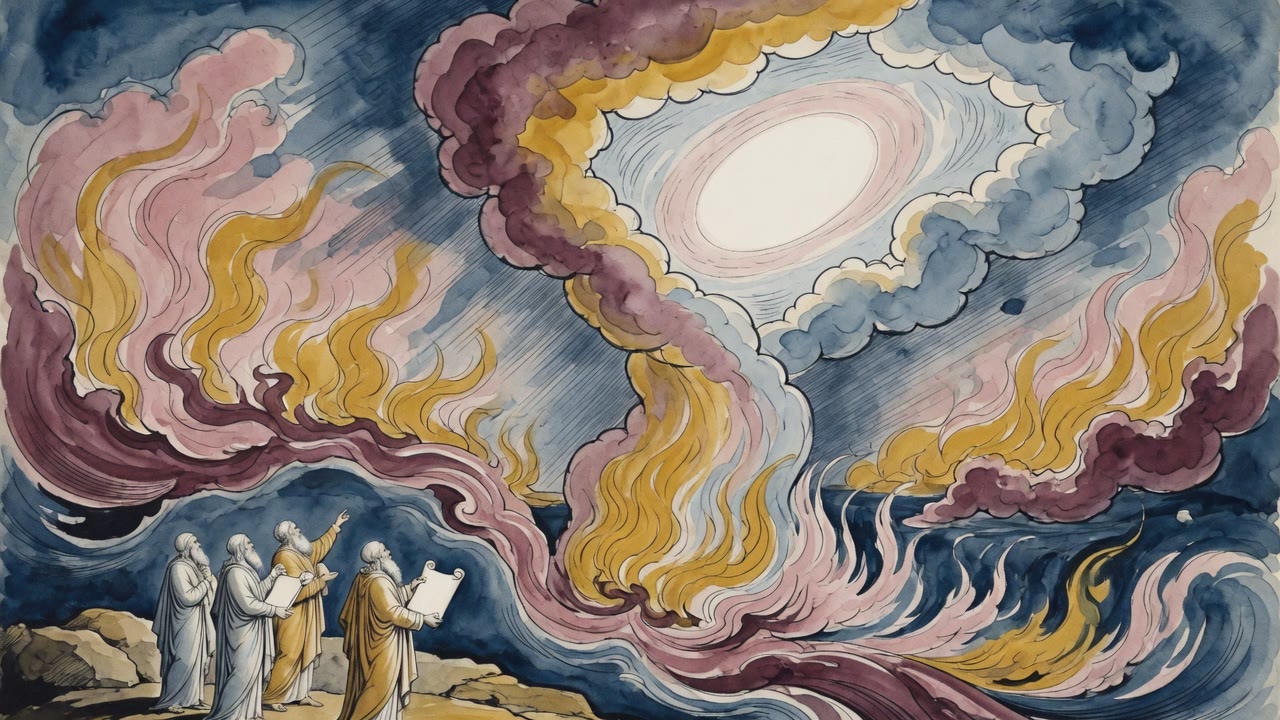
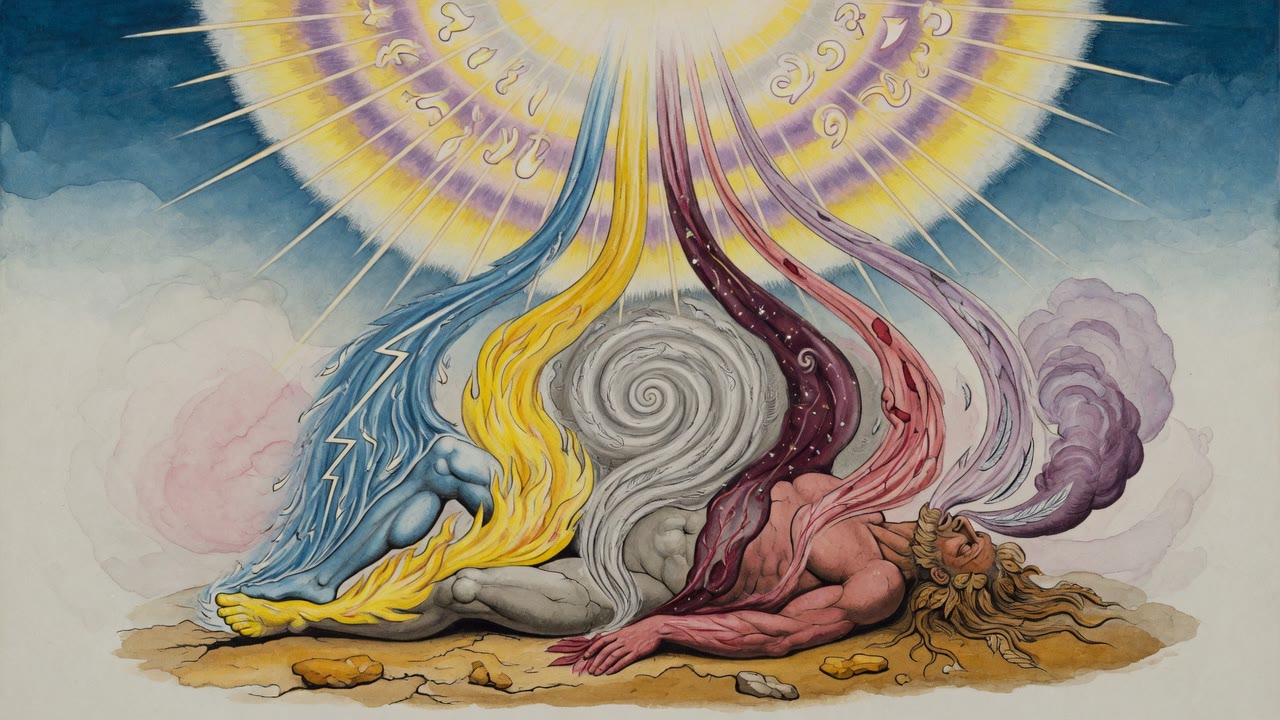
Then the work began in a blacksmith's grammar. One tradition says God created the heavens by taking fire and water, opposites, and beating them together until sky stood. Another says He brought a single spark from primal darkness, blew until it kindled, drew a single drop from the deep, and joined drop to spark. With those two elements the world was made.

Balls of Fire and Snow

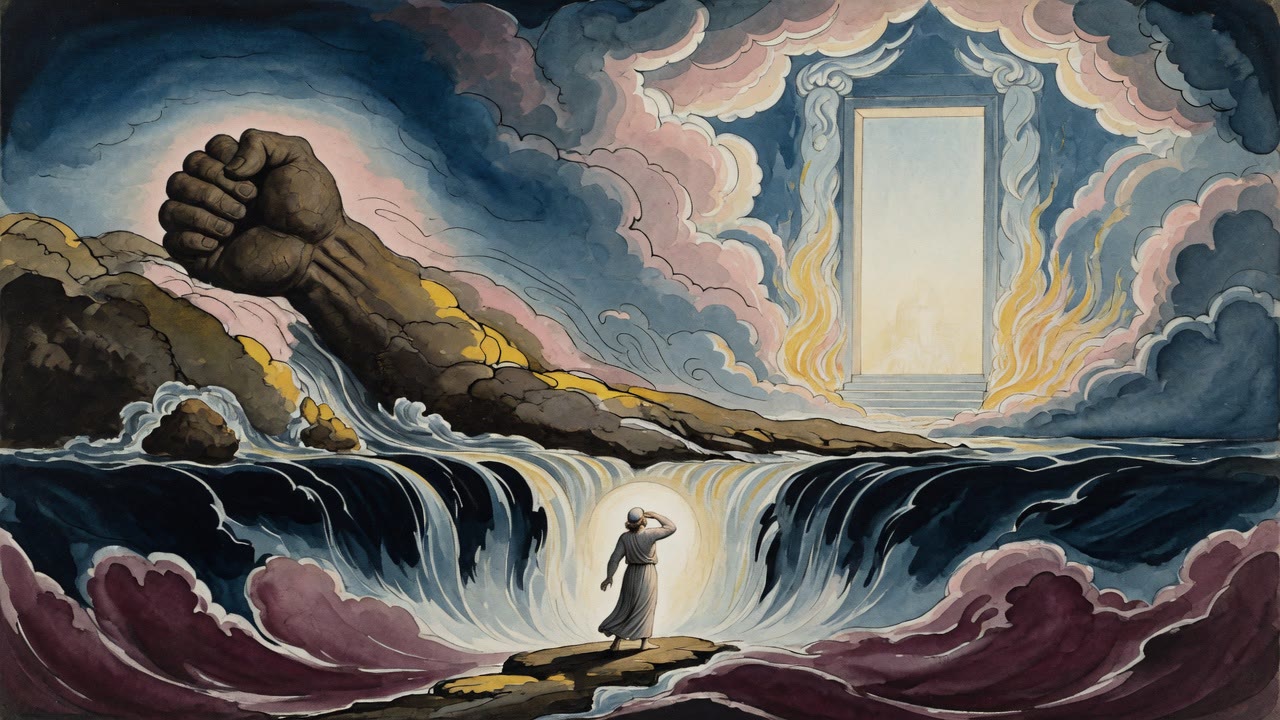
For the earth the stories branch. Some say God took two balls, one of fire and one of snow, and kneaded them like a baker. Others speak of four balls for the corners of the world, or six, corners plus above and below. Tohu and vohu, chaos and void, were themselves building blocks of darkness and water, and from darkness and water the world emerged. Formlessness was not a rival power. It was raw stuff waiting for command.

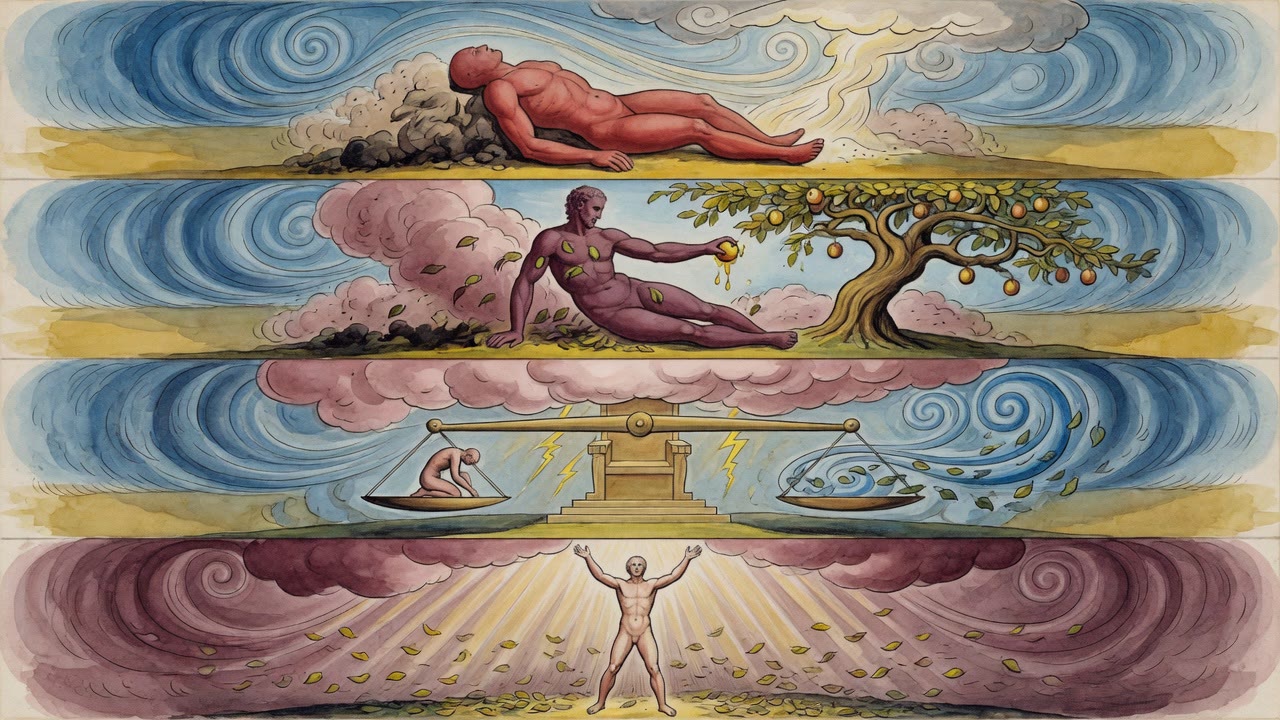
Three creations, says one strand, preceded this world: water, wind, and fire. Water bore thick darkness. Fire bore light. Wind bore wisdom. The world is maintained by six: wind and darkness, fire and light, water and wisdom. Pair after pair holds the house up. Still the pairs do not stand as eternal matter God merely found. When a philosopher told Rabbi Gamaliel that God was a great artist who found good materials ready to hand, the sage answered that even tohu was created. There is no unowned chaos. The Artist made the clay before He shaped it.

Everything Paired, God Alone

Everything God created, He created as a pair. Heaven and earth. Sun and moon. This world and the Olam Ha-Ba, the World to Come. Duality is sewn through the fabric. Then there is God. The Shema (Hear O Israel) proclaims the Lord is one. God is not half of a couple. God stands alone. He was in Egypt, at the splitting of the Sea, in the desert, in this world, and in the World to Come. Presence without a twin.

Heavenly beings with the right hand, earthly beings with the left, says one image, yet the same One works both sides. At times the whole world cannot contain His glory. At times He speaks from within the Ark, a small space that holds a voice larger than mountains. Immensity and nearness are not two gods. They are one will wearing two distances.

Mind Before Matter

The mind that held all futures did not outsource the first materials to chance. Fire and water in the sky, fire and snow in the earth, water wind and fire before the week began, all of it answers to a single consciousness that already knew the finished product. When opposites are beaten into heaven, the beating is not a war of equal powers. It is craft. The blacksmith is never the iron's peer.

Israel would later say Hear, O Israel, and mean this: the pairs are real, the One is more real. Creation's dualities do not threaten monotheism. They display it. Only a God who is not a pair can invent pairs without becoming one of them.

The First Day Already Late

By the time light is spoken, the story has already run a secret prologue in the divine mind and in the forging of elements. The first day is late news to Heaven and first news to creatures. Rainbows exist as possibility before rain. Wisdom is born of wind before any human sage opens a mouth. The world that feels solid underfoot is a late stage of a plan that never blank-slated itself.

Stand under a sky that was once fire joined to water, on an earth kneaded from heat and snow, and the Shema sharpens. All this is paired. The Maker is not. All this was thought before it was struck into being. The first command Israel ever learned to hear as a people would one day be calendar and freedom. The first command the cosmos ever obeyed was the release of a mind that had already contained it whole.

Opposites did not negotiate a truce on their own. They met under a will that could hold both without splitting. Fire did not conquer water; water did not quench the plan. The sky that results is a permanent sign that conflicted elements can serve one purpose when the One who is not paired commands them into service.

Rabbi Gamaliel's answer to the philosopher still stings any theology that smuggles eternal matter past the Creator. If tohu (formless void) helped, tohu was first made. If water, wind, and fire preceded the week of days, they still answered to a voice that invented them. Ex nihilo is not a cold slogan here. It is the refusal to share God's throne with raw stuff that "always was."

The mind of God that held rainbows before rain also held exile and return, altar and ruined altar, pairs and the unpaired Name. Nothing in later history falls outside that prior holding. When Israel says the Shema against a world full of twins and polarities, it is not denying the pairs. It is naming their source. The blacksmith of heaven remains one, even when the iron and the water hiss.


← All myths

From the tradition

Sources

3 sources

The texts behind this telling. Some cards carry a translation of the source; others are our own retelling of it, and each card says which. Every card links out to the original.

Bereshit Rabbah 4:2Bereshit Rabbah

Translation of the source text.Midrash Rabbah -- TE · Public Domain

"And God said: Let there be a firmament in the midst of the waters" (Genesis 1:6). The Rabbis said it in the name of Rabbi Chanina, and Rabbi Pinchas and Rabbi Yaakov son of Rabbi Avin in the name of Rabbi Shmuel bar Nachman: At the moment the Holy One, blessed be He, said "Let there be a firmament in the midst of the waters," the middle drop congealed, and the lower heavens and the heaven of heavens above were made.

Rav said: On the first day their substance was moist, and on the second day it congealed. "Let there be a firmament" let the firmament grow firm. Rabbi Yehuda son of Rabbi Simon said: Let a patch be made for the firmament, just as you say, "And they beat the gold into thin plates" (Exodus 39:3). Rabbi Chanina said: Fire went forth from above and licked the surface of the firmament.

Rabbi Yochanan, when he would reach this verse, "By His breath the heavens were made fair" (Job 26:13), would say: Rabbi Chanina taught me this well. Rabbi Yudan son of Rabbi Shimon said: Fire went forth from above and scorched the surface of the firmament. Rabbi Berekhya in the name of Rabbi Abba bar Kahana said: The work of creation came to teach about the giving of the Torah, and ended up learning from it,

"As when the melting fire burns" (Isaiah 64:1). When did the fire divide between the upper and the lower waters? Was it not at the giving of the Torah? I wonder. Yet so it was at the creation of the world.

Full source
Shemot Rabbah 3:5Shemot Rabbah

Retold in our words. Read the original at the link below.The Sefaria Midrash Rabbah, 2022 · CC-BY

Shemot Rabbah turns to God's Existence.

It gets even more interesting when we consider the world around us. According to tradition, everything God created, He created as a pair. Heaven and earth, sun and moon, this world and the Olam Ha-Ba – the World to Come. Duality is woven into the very fabric of creation. As we find in Genesis Rabbah (4:4), everything has its counterpart.

Then there's God. The Shema, that central prayer of Judaism – "Hear, O Israel! The Lord is our God, the Lord is one" (Deut. 6:4) – proclaims God's unique singularity. God is not part of a pair. God stands alone. One. As Deuteronomy Rabbah (2:41) puts it, God was there in Egypt, at the splitting of the Sea, in the desert, in this world, and in the World to Come.

The Mekhilta de-Rabbi Ishmael, Shirata (4:27-31) and Exodus Rabbah (3:5) emphasize this point: God’s presence is constant throughout all of history and all of existence.

It’s like, God created the heavenly beings with His right hand and the earthly beings with His left, as we see in Exodus Rabbah 3. What does that imagery convey about the scope and nature of divine creation?

And there’s this almost paradoxical element, too. There are times, the midrash (rabbinic interpretive commentary) suggests, when the entire world, with all its vastness, cannot contain God's glory. Yet, at other times, God speaks to humankind from inside the Ark of the Tabernacle, a relatively small space. (B. Menahot 36b). How can something be so immense and yet so intimately present?

This tension between the duality of creation and the singularity of God The world is filled with pairs, contrasts, balances. But God transcends that. God is the ultimate unity, the ultimate source. The contrast only highlights the uniqueness of God’s being.

The Sifre on Deuteronomy 35, along with other sources, reaffirms both God’s existence and God's role as creator. So, what does it all mean? Perhaps it's a reminder that while we can observe the world in its complexities and dualities, we must also recognize the singular source from which it all originates. A source that exists beyond our comprehension, beyond our categories, beyond even time itself.

Maybe the real question isn’t whether God exists – but how we choose to relate to that existence. How do we find the One in a world of twos? How do we connect with the infinite in our finite lives?

Full source
Mekhilta de-Rabbi Ishmael be-Shalah 133Mekhilta DeRabbi Yishmael

Retold in our words. Read the original at the link below.Mechilta, translated by Rabbi Shraga Silverstein · CC-BY

I mean, everything!

In some of our ancient sources, God's mind held within it all that ever was, is, or will be. It wasn't just a blank slate waiting to be filled. It already held the darkness and the void, the potential for light and for a solid earth. It held the blueprints, the raw materials, and the finished products, all swirling together in the divine consciousness.

All the colors of a rainbow, shimmering and vibrant, even before a single raindrop had fallen and refracted the light. Picture the lush green of leaves, the fiery hues of sunset, and the blinding brightness of a light that hadn’t even been switched on yet. It was all there, pre-loaded, in the Mind of God.

This idea resonates with something we find in Plato – the concept of archetypes, these perfect, ideal forms that exist in a higher realm. But the Jewish tradition takes it a step further. Instead of abstract, philosophical ideals, here, those archetypes – those potentialities – all find their origin in God’s own mind. It's a profoundly personal and intimate view of creation.

Why this image? Well, it springs from a very human way of understanding the divine. We often talk about God in human terms – eyes, a voice, hands, feet. It’s called anthropomorphism. So, it makes sense that if God has all these other attributes, God must also have a mind, filled with thoughts and ideas.

And, crucially, a plan.

Think of God as the ultimate architect, meticulously drafting every detail of the universe long before the first day of creation. The Mekhilta de-Rabbi Ishmael (a collection of legal and narrative teachings) tells us this idea has deep roots. And the Sefer ha-Zikhronot ("Book of Remembrances") echoes this sentiment, emphasizing the pre-ordained nature of existence.

It all points to a God who wasn't just reacting to circumstances but actively, consciously, and intelligently bringing the universe into being. If all of existence existed in God's mind before creation, what does that say about our own potential? What seeds of greatness, what sparks of creativity, lie dormant within us, waiting to be called into being? Perhaps, in our own small way, we too are reflections of that original, all-encompassing Mind of God.

Full source