Retold in our words. Read the original at the link below.Townsend 1989 translation of Midrash Tanhuma, S. Buber Recension · CC-BY
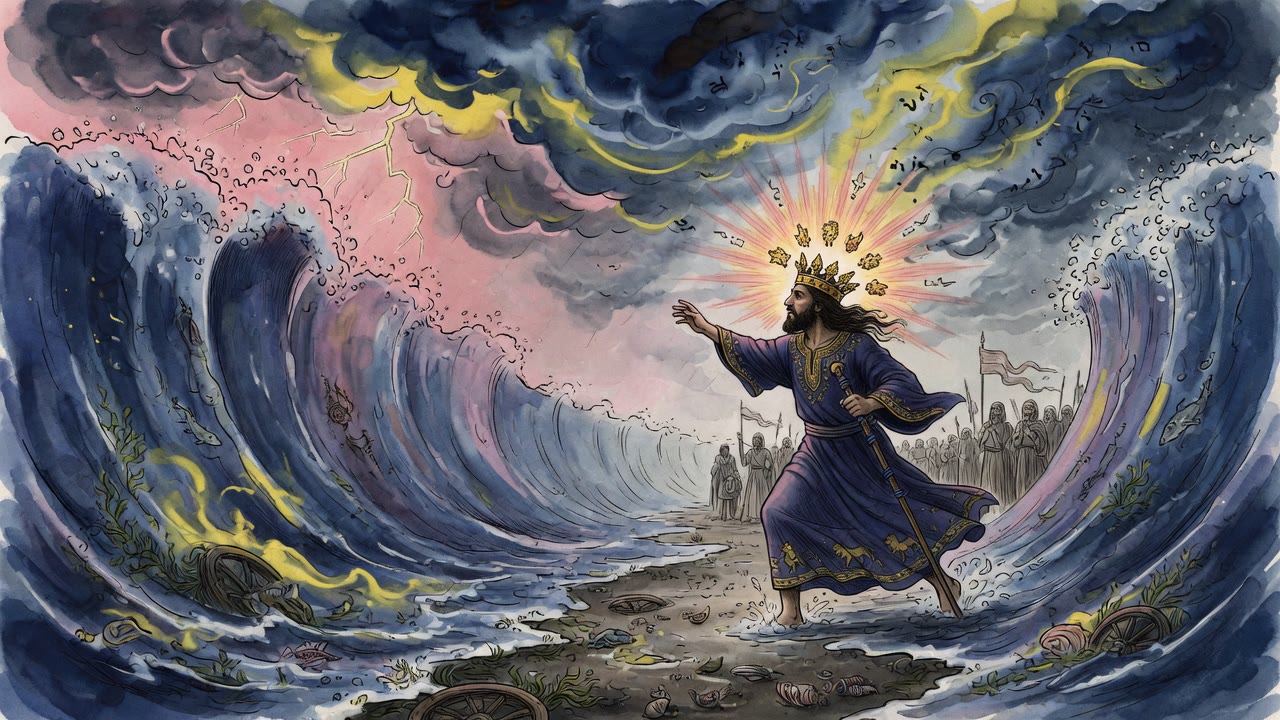
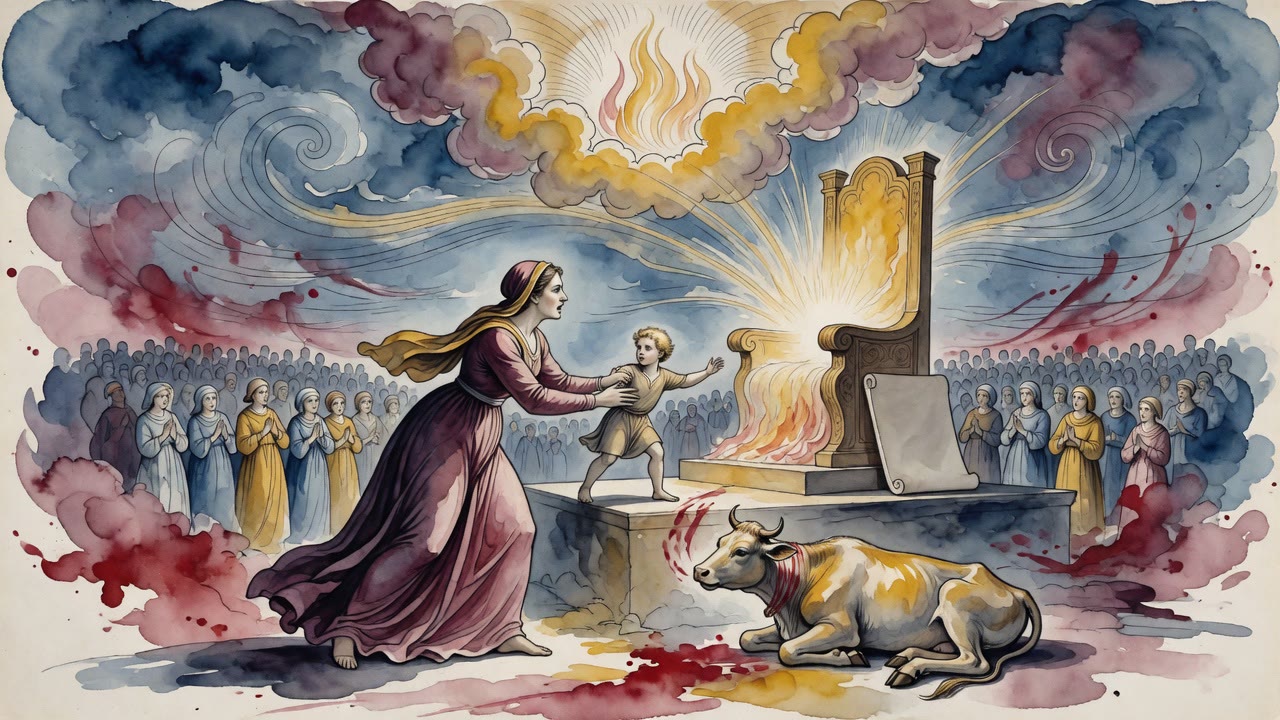
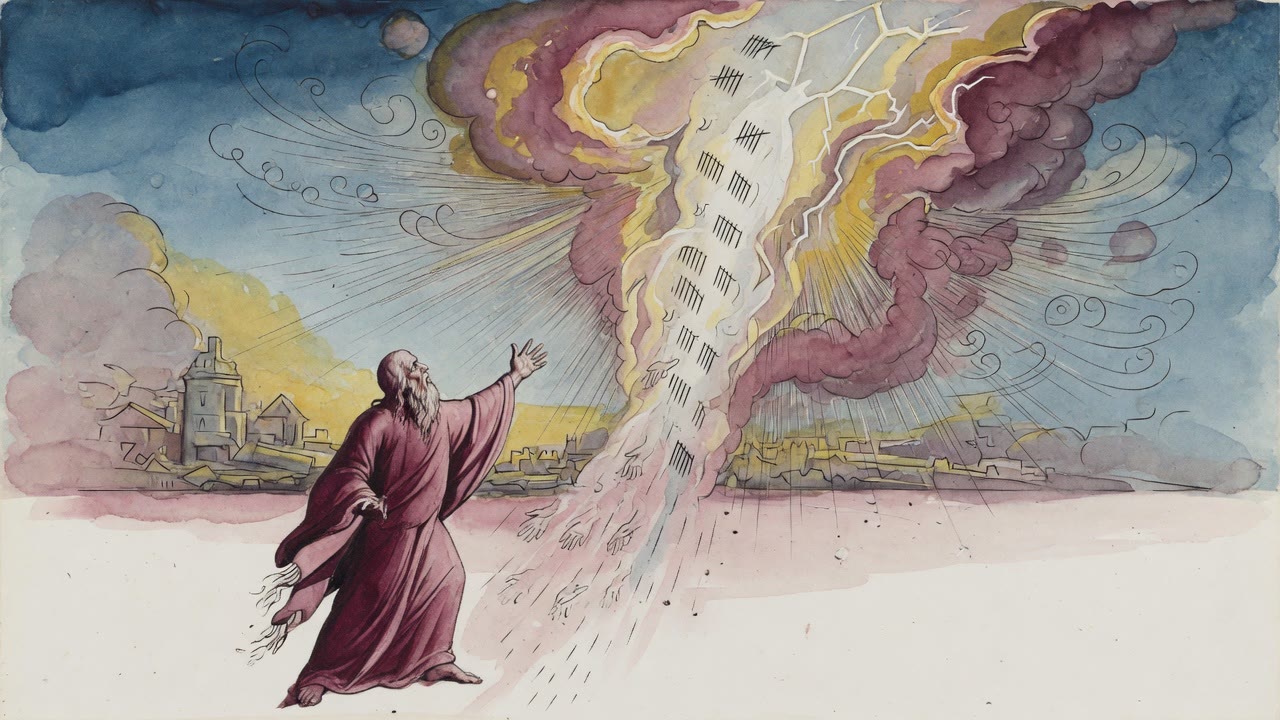
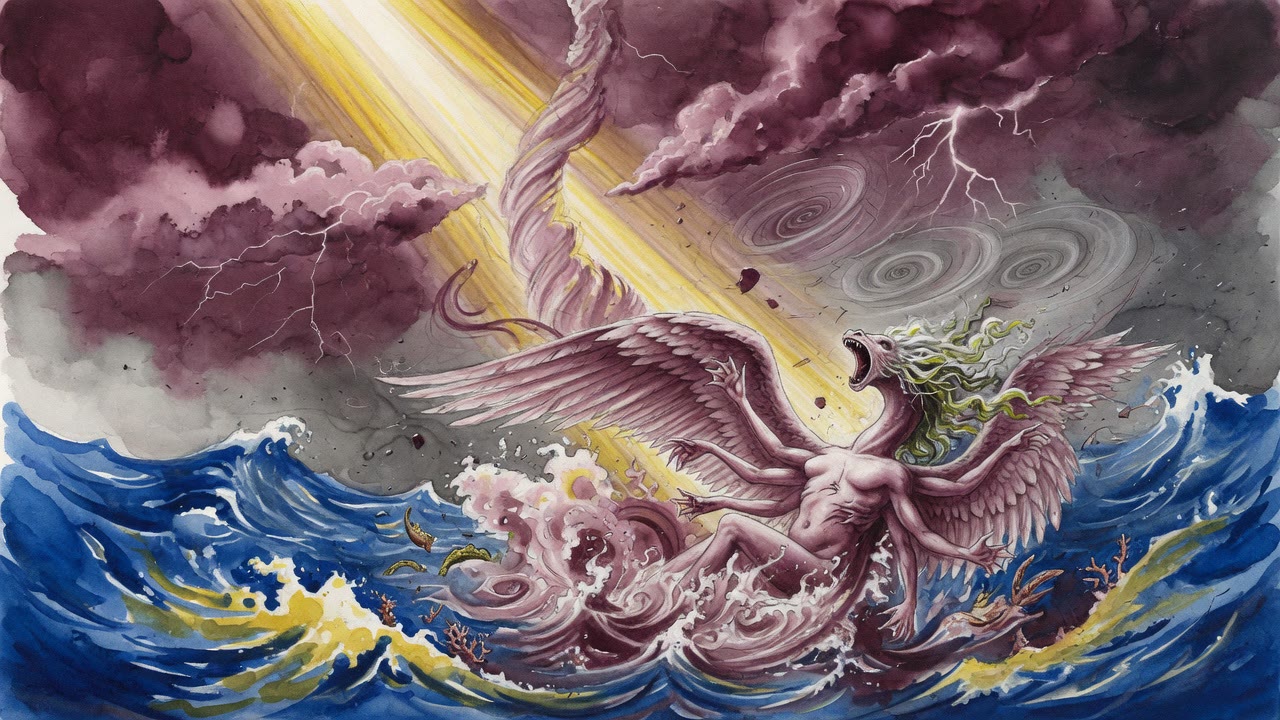
(Numb. 19:2:) Blessed be the name of the supreme King of kings, the Holy One, blessed be He, who created the world in wisdom and understanding; for His wonders have no limit and His greatness is beyond reckoning. (Ps. 33:7:) “He has gathered the waters of the sea like a mound, and He has put the deeps in storehouses.” Now what is the meaning of “He gathers the waters of the sea like a mound?” When the Holy One, blessed be He, created the world, He said to the ministering angel of the sea, “Open your mouth and swallow all the waters of creation,” he said [back] to Him, “Master of the world, it is enough for me to continue with what is [already] mine.” Then he began to weep. [So God] kicked him to death, as stated (in (Job 26:1)2), “In His power He stilled the sea, and in His understanding He struck down Rahab.” You find that the ministering angel of the sea was named Rahab. What did the Holy One, blessed be He, do? He subdued [the waters] and trampled them down; and so it was that the sea accepted them, as stated (in (Amos 4:1)3), “He tramples on the heights of the earth; the Lord God of hosts is His name.” So for [the waters] He set sand in place as bar and gates, according to what is stated (in (Job 38:8), 10), “And [who] blocked off the sea with doors…. and I set bar and gates in place.” Moreover, it says (in Jer. 5:22), “’Do you not fear Me,’ says the Lord; ‘Will you not tremble because of Me, when I have placed sand as a boundary for the sea?’” And it says (in (Job 38:1)1), “And I said, ‘You may come this far and no farther [..].’” Then the sea said to Him, “Master of the world, in that case my sweet waters will be mingled with the salt [waters]!” He said to it, “No! Each and every one will have a storehouse for itself, as stated (in Ps. 33:7), “and he has put the deeps in storehouses.” If you should say that this is a great wonder for their waters not to mingle, then consider the face, which the Holy One, blessed be He, created in people. [Although only] the [size of] a full sit, it has so many springs (from 'yn); yet they do not mingle with one another. The waters of the eyes ('yn) are salty; the waters of the ears are oily; the waters of the nose are putrid; the waters of the mouth are sweet. For what reason are the waters of the eyes salty? Because when someone weeps for the dead, [doing so] all the time, he would immediately become blind; however, because [tears] are salty, he stops and does not weep. For what reason are the waters of the ears oily? Because when a person hears bad news, if he held it in his ears, it would collect in his heart, and he would die. Because they are oily, [the news] goes in one ear and out the other. For what reason are the waters of the nose putrid? Because when a person smells a bad odor, if the waters of the nose were not putrid [enough] to stop it, he would soon die. And for what reason are the waters of the mouth sweet? It sometimes happens that someone eats food that does not agree with him, and he vomits. Now if the waters of the mouth were not sweet, he would not recover. Since he reads the Torah, of which it is written (in Ps. 19:11), “sweeter also than honey and the drippings of the comb,” the waters of the mouth are therefore sweet. Now here are the grounds for arguing a fortiori (qal wehomer), that if [something the size of] a full sit has so many springs [without them mingling with one another], how much the more so in the case of the Great Sea, of which it is stated (in Ps. 104:25), “There the sea is great and wide […].” [This is] to teach that in everything, the Holy One, blessed be He, accomplishes His mission and that He has not created one thing in vain. Sometimes the Holy One, blessed be He, has accomplished His mission by means of a frog, by means of a gnat, by means of a wasp, or by means of a scorpion. R. Hanan of Sepphoris said, “There is a story about a certain scorpion that went to carry out the Holy One, blessed be He's mission (to sting a certain person) beyond the Jordan; so the Holy One, blessed be He, summoned a certain frog for him, and he crossed over upon it. Then that scorpion went and stung [the] person so that he died. [There is] also a story about a certain reaper who stood and reaped in the valley of Beth-Kuzevah. When burning heat came, he took grass and tied it on his head. [When] a certain mighty serpent came at him, he killed it. A certain [snake] charmer passed by him. He saw the slain serpent. He said to him, ‘Who killed that serpent?’ [So the reaper] said to him ‘I [did].’ He looked at the grass on his head. He [then] said to him, ‘Remove the grass from your head and [then you can brag (if you still have that power)].’ When he did so, [the charmer] drew near. He had not succeeded in touching him, before [the reaper’s] body parts [all] shed.” R. Jannay was sitting as a judge at the gate of his city, [when] he saw a serpent hissing and coming toward the city. When they would secure against it in one place, it would go to another. He said, “It seems to me that this [serpent] is on its way to carry out its mission.” When it entered the city, a rumor spread in the city, “So-and-so ben so-and-so was bitten by a serpent and he is dead.” R. Elazar was strolling by the seashore of Caesarea. He found a femur bone strewn on the path. [So] he removed it from there, but he found it there again; he removed it from there [a second time] and found it there again. He said, “It seems to me that this [bone] is arranged to carry out its mission.” After [some] days, a minister came and fell over it and died. They looked into him and found evil documents against the Jews in his hand. There is a story about two people who were walking on the way. One who could see, and one was blind. They sat down to eat. They reached out their hands for the herbs of the field and ate. The one who could see became blind, and the one who had been blind became sighted. They did not move from there until the former was being supported by the latter whom he had been supporting. There is a story about a certain person who was going from the land of Israel to Babylon. While he was eating, he saw two birds fighting with each other. One of them killed its companion. Then going to get an herb, [it placed it on its mouth,] and made it live again. That person (the one who saw what had happened) went and took the very herb that had fallen from the bird. Then he went to make the dead live with it. When he arrived at the Ladder of Tyre, he found a dead lion lying in the open. He touched the herb to its mouth and made it live. The lion got up and ate him. The proverb says, “Do not do good to the evil, and evil will not happen to you.” There is a story of Shihin (a town near Sepphoris) about a certain blind person who went down to bathe in the waters in a cave. He happened upon the well of Miriam, immersed [himself in it], and was healed. Titus the wicked entered the interior of the holy of holies. When he had cursed and blasphemed, he stood up and slashed the veil. Then he took a Torah scroll and brought it out. Next he unrolled it; and bringing two whores, he transgressed upon them. Then he drew his sword to cut up the book. A miracle took place in that blood began to spew forth from it. He began to boast, saying that he had killed himself (i.e. God). He began to become bolder and bolder. When he reached the sea, the sea began to grow stormier and stormier. He said, “The God of these people only has power in the sea. When Pharaoh arose, He drowned him in the sea, and Sisera as well. Now if He would, let there be dry land between Him and I. Then let us see who overcomes.” The Holy One, blessed be He, said, “O you wicked one, son of a wicked one, I am sending against you a tiny creature, the least of My creatures, to eradicate you from the world.” A gnat entered his nostril, and stayed in his nostril for three years. When he passed by a place where blacksmiths were working [and the gnat] heard the sound of iron, it was still. Whenever a gentile [blacksmith] would pass him, [Titus] would hire him for four dinars and say to him, “Bang your hammer in front of me the whole day.” And when he would do this the whole day, [Titus] would give him his four dinars. But when a Jewish [blacksmith] passed him, he would say to him, “Take [your hammer] and bang it [here] and I will give you your wage.” And he would bang the whole day. [But] when he was about to leave him and the Jew would say to [Titus], “Give me my wage,” he would answer and say to him, “It is enough for you that you see your enemy like this.” So would he do every day for three years. When he died they split open his head and found that [the gnat had grown] to be like a partridge and a sparrow and its claws were as hard as copper. And he died an unnatural death. Why is it named a base creature? Because it takes in but does not excrete. Sometimes it is by means of a hornet [that God's will is carried out]. Thus it is written (in Exod. 23:28), “I will send the hornet before you [to drive out the Hivites, the Canaanites, and the Hittites from before you].” Our masters have said, “When the Holy One, blessed be He, sent the hornet before Israel to kill the Amorites, see what was written about them (in Amos 2:9), “Yet I destroyed the Amorites [before them, whose stature was like the cedars in height and who were as strong as the oaks].” It entered one's right eye and poured out its poison in it. Then [that person] burst open and dropped dead. This indeed is the way of the Holy One, blessed be He, to carry out His missions by means of small things against all who vaunt themselves against Him. He sends them a small creature to exact punishment from them, in order to inform them that there is no substance to their might. Also in the world to come the Holy One, blessed be He, is going to exact punishment from the [idol-worshiping] peoples of the world by means of small things. It is so stated (in Is. 7:18–19), “And it shall come to pass on that day that the Lord shall whistle for the fly. They all shall come […].”

 Click for full size