5 min read

God Raises Every Head of Israel in the Desert

In the Sinai wilderness God tells Moses to lift Israels heads in a census, counting a people like a shepherd after the wolf.

Curated by Arthur · Told by Maggid ·
Table of Contents
  1. A Contract, Not a Count
  2. Heads in a Country With No Walls
  3. The Wolf Got Into the Flock
  4. Returning the Flock Counted

On the first day of the second month of the second year out of Egypt, in the Tent of Meeting, Moses was handed an order with a date on it.
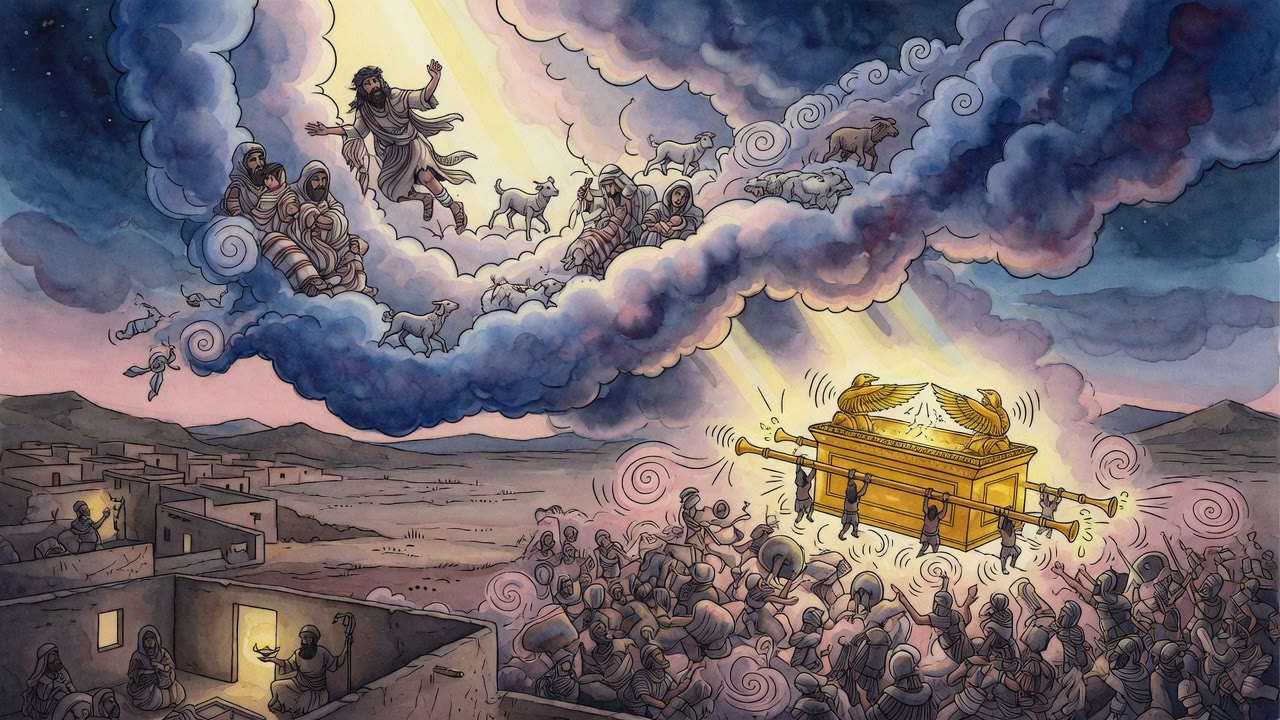
God Raises Every Head of Israel in the Desert Click for full size

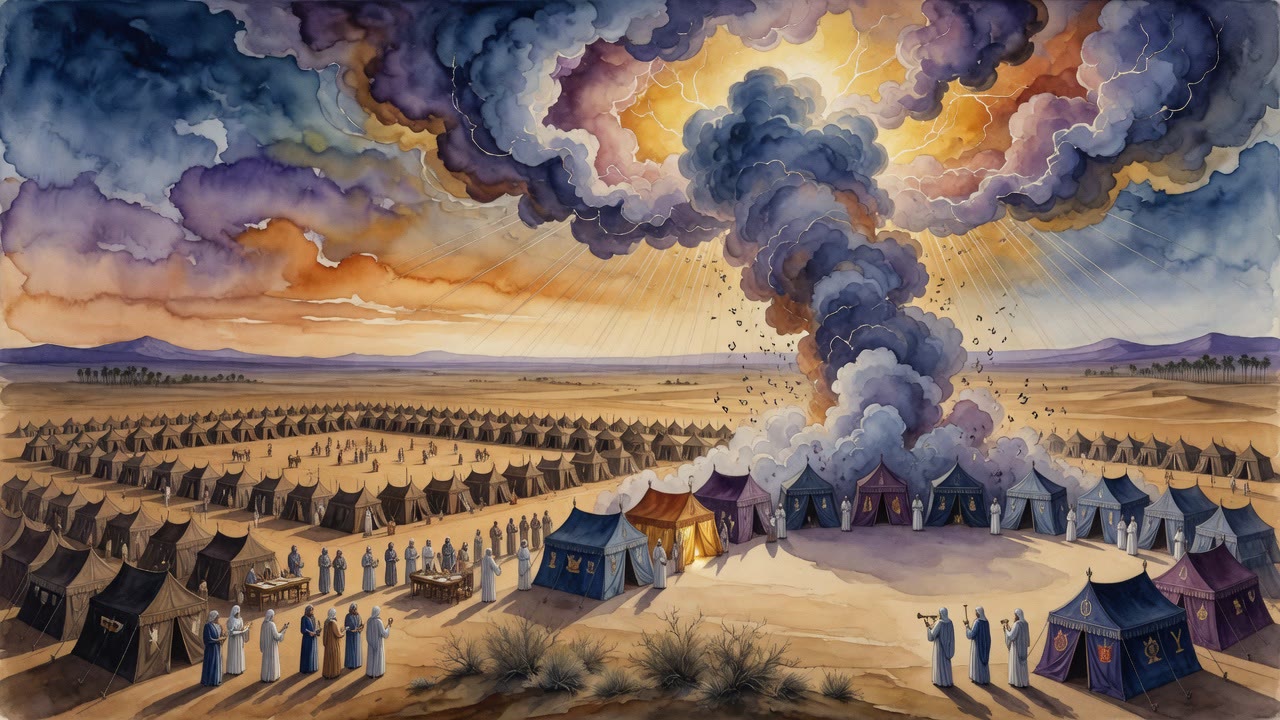
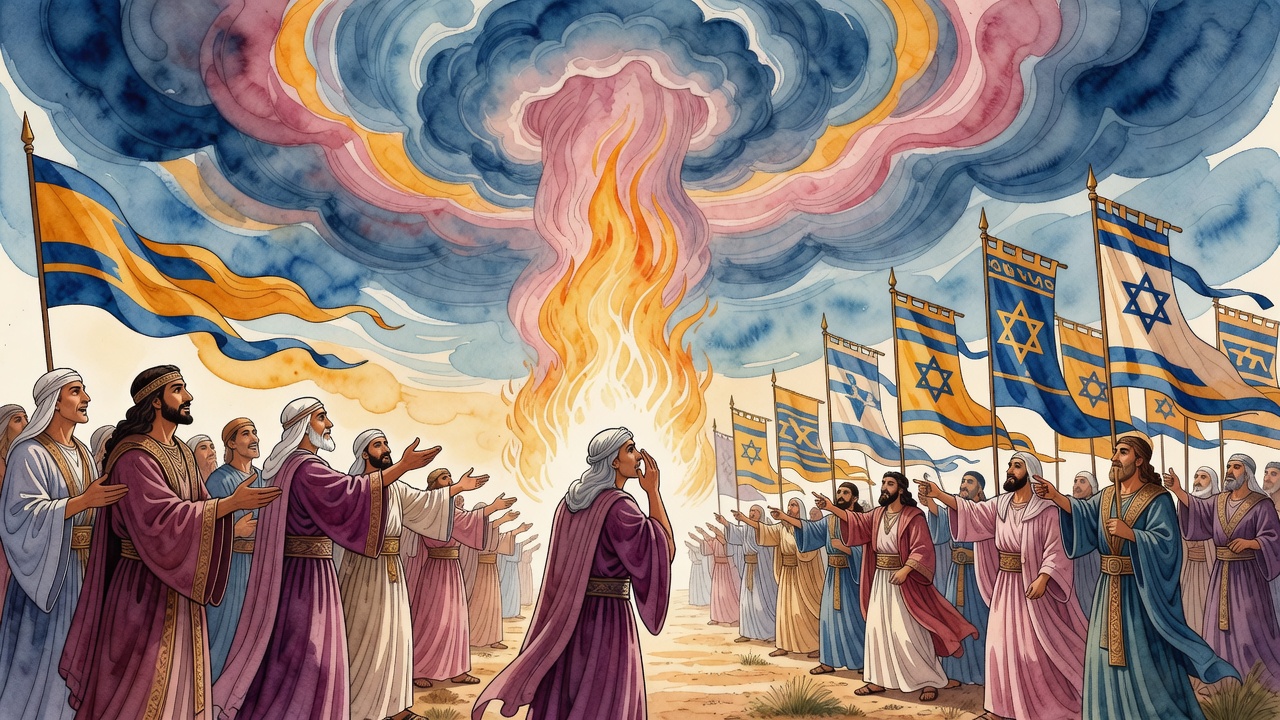
The order was to take a census, and the words the order used were se'u et rosh, raise the head of the whole congregation of the Children of Israel (Numbers 1:1-2). Scribes came with their lists. The tribal standards went up in the wind, and out past the last row of tents there was nothing to look at in any direction.

A Contract, Not a Count

A king had married before, more than once, and had never bothered to write any of those wives a marriage contract, and when he sent them off he did not write a bill of divorce either. Then he saw an orphan girl who was well born and modest and upright, and he went to his groomsman about her. "Do not do with her what was done with the first ones," he said. "Write her a contract. Put down which seven-year period, which year, which month, which district."

The generation of the flood got no such paperwork. Heaven made them and did not write down when, and wiped them out and did not write down when, and all the record says is that on that day the wellsprings of the great deep were breached (Genesis 7:11). The tower generation went the same way, and so did Egypt. But this order in Moses' hands carried the district, which was the Tent of Meeting, and the year, which was the second, and the month, which was the second, and the day, which was the first, and the era, which was of their exodus from the land of Egypt. Nobody dates an errand like that. So what Moses had been handed was not a tally. It was a signature going onto a bond, and he was the one holding the pen.

Heads in a Country With No Walls

"I have not cherished any creation more than you," the Holy One said to Israel, "and so I have given you a head held high and likened you to Me. Just as I am exalted as head over all that comes into the world, I have done the same for you."

The clans came up in order, and the scribes wrote, and somewhere in that line stood a man who had spent his working life carrying wet brick for a foreman who never asked his name. He heard his father's house called out. He gave his name and it went down on the list, and he stepped away with nothing on his head and nothing in his hand.

There was no city out there to lend anybody standing. No gate, no throne room, no fields, nothing but tents and manna and a sanctuary that folded up for travel. The head-lifting happened in that country because it had to come from somewhere else, since the country had nothing to give.

The Wolf Got Into the Flock

Thirty-eight years later the same order came again, and this time it came right after a plague (Numbers 26:1-2). Every time they fell they were counted. A wolf gets in among the sheep and goes back out through the same gap, and then the owner walks in among the animals and counts them, because counting is how a man learns what is missing.

Moses stood in the plains of Moab while the totals came in clan by clan. He had been given about six hundred thousand men on foot at the going out from Egypt, and he had been given them by name and by number. He knew what he was holding now, and he knew it because he had just counted it.

The second count is not a gentler thing than the first. It assumes the wolf, and the blood on the grass, and the fathers and sons who were on the first list and are not on this one. The order was still the same order. Raise the head.

Returning the Flock Counted

A householder hands a shepherd a flock after counting it out in front of him, and when the watch is over the shepherd does not simply walk off and leave the animals in the field. He stands there while they are counted back, one by one, into the hands that gave them. That is what the second census was.

Moses had received them numbered in the wilderness of Sinai and he was about to die. So he returned them numbered, on the near side of a river he had been told he would not cross, and the last thing he did with the people he had carried for forty years was hold them still long enough for somebody to write down how many of them were left.


← All myths
From the tradition

Sources

4 sources

The texts behind this telling. Some cards carry a translation of the source; others are our own retelling of it, and each card says which. Every card links out to the original.

Bamidbar Rabbah 1:9Bamidbar Rabbah

Retold in our words. Read the original at the link below.The Sefaria Midrash Rabbah, 2022 · CC-BY

That feeling, that inherent worth… it's something the ancient rabbis grappled with too. And they found a powerful message about it in the very first verses of the Book of Numbers, Bamidbar in Hebrew.

The Torah portion opens with God speaking to Moses "in the wilderness of Sinai" (Numbers 1:1). God commands him to "take a census" of the people, using the Hebrew phrase se’u et rosh. Now, se’u et rosh literally means "lift up the head." But the Rabbis, in Bamidbar Rabbah, that treasure trove of Midrashic (rabbinic interpretive commentary) interpretations, see so much more in those words.

God, according to this interpretation, is saying to Israel, “I was not fond of any creature more than you.” In all of creation, God has a special fondness for the Jewish people. But why? What makes them so special?

The answer, according to Bamidbar Rabbah, lies in the idea of telui rosh – according preeminence or literally "hanging the head," giving prominence. God says, "I accorded you preeminence… and likened you to Me." Just as God has preeminence over all mankind, as it says in I (Chronicles 29:11), "Yours, Lord, is the greatness… and the preeminence over every head [vehamitnaseh lekhol lerosh]," so too, God gives preeminence to Israel.

It's a powerful metaphor. God isn't just counting heads; God is recognizing, elevating, and celebrating the inherent worth of each individual within the community. It’s about lifting them up.

That's why it says se’u et rosh – "lift up the head." The Midrash connects this to the verse "He raised a horn for His people" (Psalms 148:14). A horn, in biblical imagery, is a symbol of strength, dignity, and pride. God is raising up the people, giving them strength and dignity. Similarly, (Deuteronomy 28:1) tells us, "The Lord your God will place you uppermost over all the nations of the earth."

What does this all mean for us today? It's not about superiority or arrogance. It’s about recognizing the unique potential within each person, the spark of the divine that connects us all. It’s about understanding that we are part of something bigger than ourselves, a people with a shared history and a shared destiny. It is a reminder that we each have intrinsic value.

So, the next time you feel lost or insignificant, remember the words of Bamidbar Rabbah. Remember that God has a special fondness for you. Remember that you have preeminence. Lift up your head. You are part of something truly extraordinary.

Full source
Midrash Tanchuma, Bamidbar 8Midrash Tanchuma

Retold in our words. Read the original at the link below.Townsend 1989 translation of Midrash Tanhuma, S. Buber Recension · CC-BY

(Numb. 1:1) “Then the Lord spoke unto Moses in the Sinai desert.” What did He say to him (in vs. 2)? “Take a census (literally: raise [rt. ns'] the head) of the whole congregation of the Children of Israel….” The Holy One, blessed be He, said to Israel, ‘I have not cherished [any] creation more than you; therefore I have given you a head held high and have likened you to Me. Thus just as I have a head held higher than all that come into the world, as stated (in I Chron. 29:11), ‘To you, O Lord, belong the greatness, the might, the splendor, the triumph, and the majesty; for all that is in the heavens and in the earth is Yours; [Yours] is the kingdom, O Lord, and [You] are exalted (rt. ns') as head over all’; so I have also done for you, for you to have a head held high.” It was therefore stated (in Numb. 1:1), “Raise (rt. ns') the head.” [This exaltation was] to fulfill what is stated (in Ps. 148:14), “He has raised up a horn for His people, praise for all His righteous ones, even the Children of Israel, a people near to Him. Hallelujah.” And so it says (in Deut. 28:1), “and the Lord your God will set you high over all the nations of the earth.”

Full source
Midrash Tanchuma, Pinchas 4Midrash Tanchuma

Retold in our words. Read the original at the link below.Townsend 1989 translation of Midrash Tanhuma, S. Buber Recension · CC-BY

(Numb. 26:1-2:) “And it came to pass after the plague [that the Lord said unto Moses and unto Elazar ben Aaron the priest, saying,] ‘Take a census.’” Every time that they fell, they were required to be numbered. The matter is comparable to the wolf who went into the midst of the flock. The owner of the flock was obliged to count them to know how many were missing. Another interpretation (of Numb. 26:2): Why did he count them here? The matter is comparable to a shepherd to whom the householder has delivered a flock after numbering them. [After] he has fulfilled his guardianship, when he returns them, it is necessary for them to be numbered. Thus when Israel went out from Egypt the Holy One, blessed be He, delivered them to Moses after numbering [them], as stated (in Numb. 1:1-2), “Then the Lord spoke unto Moses in the Sinai desert …, ‘Take a census….’” So also, when they went out, it is written (in Exod. 12:37), “Then the Children of Israel traveled [from Ramases to Succoth, about six hundred thousand men on foot].” Ergo, he received them with a numbering. [So when] he was about to pass away in the Plains of Moab (after completing his guardianship), he returned them with a numbering. It is therefore stated (Numb. 26:2), “Take a census.”

Full source
Bamidbar Rabbah 1:5Bamidbar Rabbah

Retold in our words. Read the original at the link below.The Sefaria Midrash Rabbah, 2022 · CC-BY

The ancient sages pondered similar questions when interpreting the very first verse of the Book of Numbers, Bamidbar, which begins: “The Lord spoke to Moses in the wilderness of Sinai…”

What, they asked, was so special about this moment? Why was this encounter, this census, so meticulously recorded? Bamidbar Rabbah, a collection of rabbinic interpretations on the Book of Numbers, offers a powerful analogy.

A king who marries several times. Each time, he neglects to draw up a proper marriage contract, a ketubah (a marriage contract). He divorces them just as casually, without even a formal bill of divorce, a get. He treats these unions as fleeting, insignificant.

Then, he meets a woman who is different. An orphan, yes, but of noble birth, refined, and virtuous. He realizes he must treat her with respect and honor. He tells his groomsman, "Don't treat her like the others! She deserves more." So he instructs him to write a proper marriage contract, detailing everything: the seven-year cycle, the specific year, the month, even the district.

This, Bamidbar Rabbah suggests, is how God related to the nations before Israel. He created the generation of the Flood, but didn't record the details of their creation or destruction. We only get vague pronouncements like "On that day all the wellsprings of the great depth were breached" (Genesis 7:11). The same went for the generation of the Tower of Babel and the Egyptians. No specifics, no commitment. They came and went, almost as experiments.

But with Israel, it was different. God declared, "I will not act with these like those first ones. These are the descendants of the patriarchs, the descendants of Abraham, Isaac, and Jacob."

And so, He commanded a detailed record. "Go, write for them which month, how many days in the month, which year, which district, and in which city I raised their horn." We find this precision in (Numbers 1:1): "In the Tent of Meeting" – that’s the district; "in the second year" – that’s the year; "of the second month" – that's the month; "on the first of the month" – that's the day. The era was also written: "of their exodus from the land of Egypt." Even Esther's story reflects this attention to detail: "Esther was taken to King Aḥashverosh, to his royal palace, in the tenth month, which is the month of Tevet, in the seventh year of his reign" (Esther 2:16).

Why this meticulous record-keeping? Why “take a census of the entire congregation of the children of Israel” (Numbers 1:2)? To realize what is stated in Psalms: “He did not do so for every nation” (Psalms 147:20). What did He do? “He raised a horn for His people” (Psalms 148:14).

The census, the detailed accounting, wasn't just about numbers. It was about commitment, about a covenant meticulously recorded, a promise etched in time. It was a sign that this relationship, this covenant with Israel, was different. It was special. It was meant to last.

So, what can we learn from this ancient interpretation? Perhaps that true connection requires attention, intention, and a willingness to commit to the details. Maybe it’s a reminder that the most meaningful relationships are the ones we cherish and record, not just in our memories, but in the very fabric of our lives.

Full source