Parshat Beshalach5 min read

God Rode Mare and Stallion Against Pharaoh

Pappus taught that God matched Pharaoh horse for horse at the sea. When Moses ordered a turn back toward Egypt, Israel obeyed without panic.

Curated by Arthur · Told by Maggid ·
Table of Contents
  1. Horse Against Horse on the Seabed
  2. Turn Back Toward the Enemy
  3. Who Enters First When the Floor Is Still Wet
  4. Joy That Almost Swallowed Both Sides
  5. The Shore After the Race
God Rode Mare and Stallion Against Pharaoh Click for full size

Horse Against Horse on the Seabed

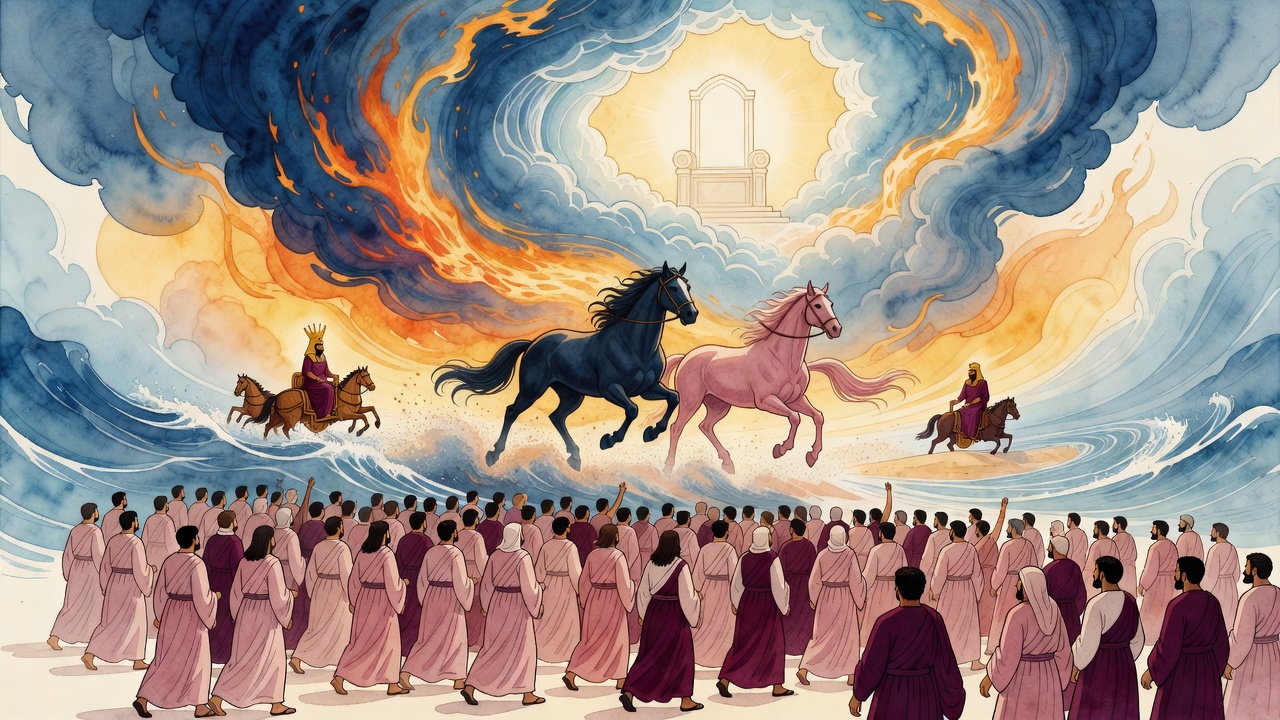
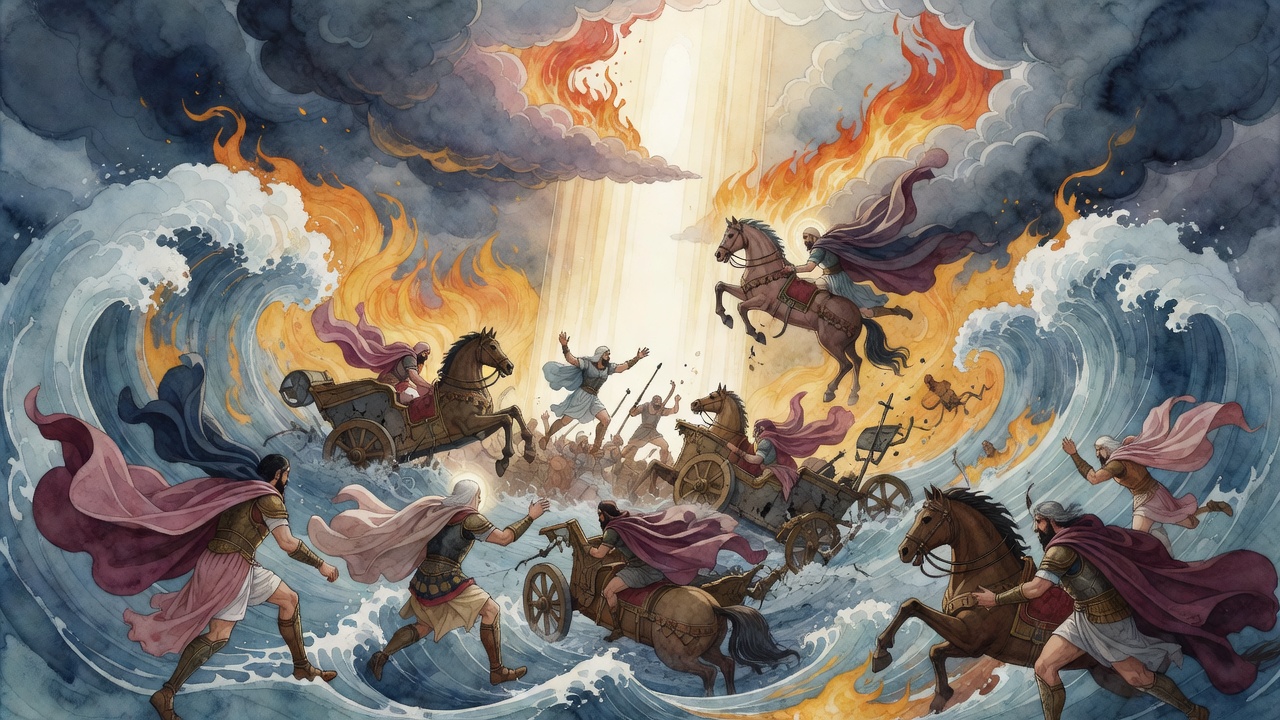
Pharaoh rode into the chase on a stallion. The Mekhilta hears Pappus expound the Song of Songs: "to a mare in the chariots of Pharaoh" (Song of Songs 1:9). Pharaoh on a stallion; the Holy One, as it were, on a stallion, for Habakkuk says, "You made Your stallion tread the sea" (Habakkuk 3:15). Pharaoh also rode a mare, which endures a long stretch better than a stallion; the Holy One revealed Himself on a mare as well. The pursuit was matched beast for beast, endurance for endurance, until the sea became a racecourse with only one finish that favored Israel.

Rabbi Akiva cut in. "Enough, Pappus!" The image of God on horseflesh pressed too hard for him. Pappus asked how then to read lesusati, "to a mare." Akiva heard lesasti, "to My joy." The Holy One said: just as I rejoiced in destroying Egypt, so I would have rejoiced in destroying Israel for their idolatry. What prevented Me? The merit of those who stood on their right and on their left, the faithful structure of a people heaven still chose to spare.

Two readings share one shore. One stages a duel of mounts. The other stages a duel of joys restrained by covenant. Both refuse to let Pharaoh own the last metaphor of power.

Turn Back Toward the Enemy

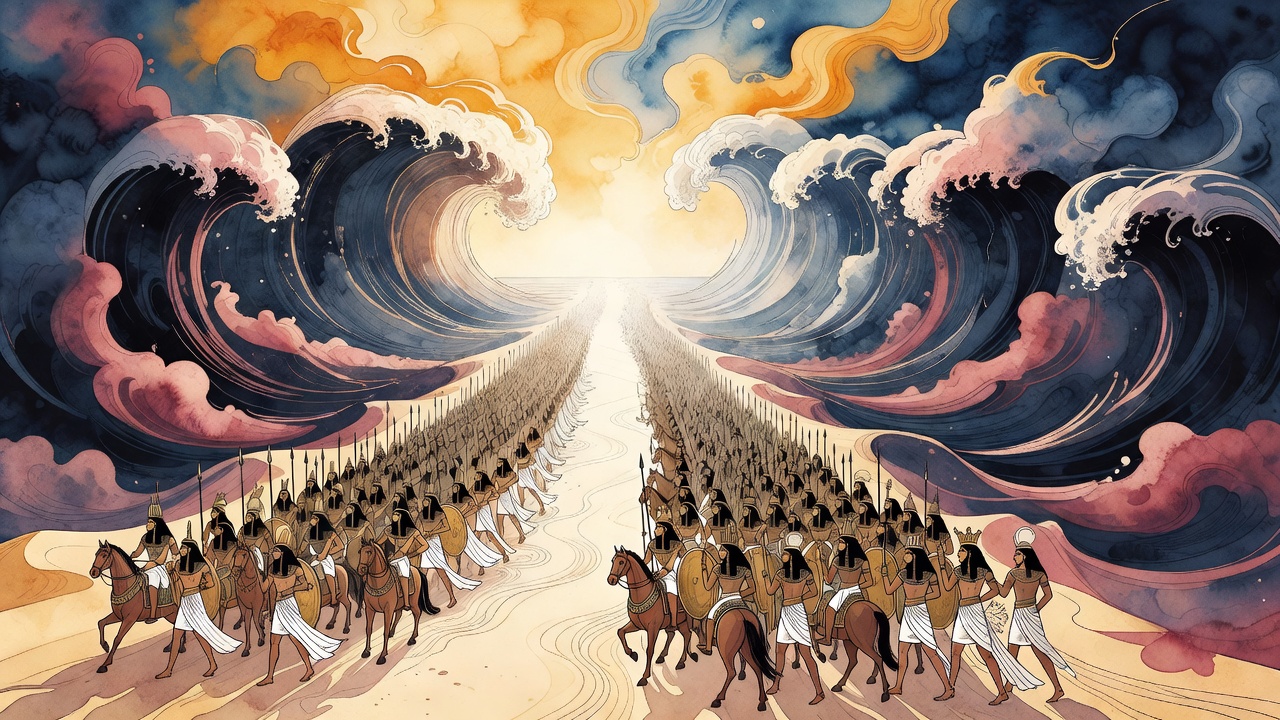
Before the walls of water, Moses gave an order that sounded like suicide. Turn back toward Egypt. March as if into the mouth of the chase. The Mekhilta records the people's response in three words of Scripture: "And they did so." No panic speech. No open questioning that would demoralize women and children. Broadcasting fear, they understood, could kill faster than chariots.

A second interpretation says they told themselves, whether we like it or not, we must do only as the son of Amram says. The son of Amram is Moses. In crisis they chose unity over private strategy committees. The man who had already brought them out of slavery remained the only rational center. The Mekhilta calls that discipline wisdom.

Pharaoh saw a people wandering into his trap. Heaven saw a people practicing the obedience that would soon walk between walls of sea.

Who Enters First When the Floor Is Still Wet

The legends add another quarrel at the edge of the miracle. The sea was not yet fully dry. The tribes argued over who would enter first and magnify the Name. Before the wordy strife finished, the tribe of Benjamin leapt. Judah, robbed of the first step, pelted the Benjamites with stones. Sibling rivalry in the middle of salvation, faith wearing the face of a fight.

God saw praiseworthy purpose in both. Benjamin's leap earned the dwelling of the Shekhinah (God's indwelling presence) in its territory. Judah's passion for honor earned royalty, the line of kings. The sea that matched Pharaoh's horses also measured Israel's hearts and refused to crown only one kind of courage.

Wet sand took the first footprints of a nation that could argue and still be saved, obey and still need restraint from heaven's own joy in judgment.

Joy That Almost Swallowed Both Sides

Akiva's reading is the darker blade. God rejoiced to destroy Egypt and could have rejoiced to destroy Israel when idolatry later stained them. The difference was not that Israel never failed. The difference was a fence of merit, ancestors and faithful ones standing right and left, blocking a joy that would have been just and unbearable.

Pappus's horses make the battle visible. Akiva's joy makes the mercy visible. Between them the people who turned back on command and the tribe that jumped too soon share one night's work: they moved when told, or moved when love of God outran the argument, and the sea answered both motions.

Egypt's stallions drowned. Israel's arguments became institutions: sanctuary in Benjamin, crown in Judah. The Mekhilta and the legends refuse a simple cartoon of passive refugees. They show a people learning how to be led, how to leap, and how to be spared by a God who can match a tyrant's horse and still rein in His own wrath.

The Shore After the Race

When the water returned, Pharaoh's endurance mare and proud stallion were equal at last under the wave. Israel stood on the far side with a song and a memory of three hard lessons. Obey when the order looks insane. Do not let fear become a public sermon. Know that the God who treads the sea as a mounted warrior is also the God whose joy in justice requires covenant brakes.

Later generations who read Song of Songs at the sea are not doing literary sport. They are checking the harness. Who rides? Who endures? Who almost becomes the object of the same joy that broke Egypt? The answers keep a people alive between arrogance and despair, between Benjamin's leap and Judah's stones, between Moses' turn-back and the open path that followed.


← All myths
From the tradition

Sources

3 sources

The texts behind this telling. Some cards carry a translation of the source; others are our own retelling of it, and each card says which. Every card links out to the original.

Mekhilta Tractate Vayehi Beshalach 7:8Mekhilta DeRabbi Yishmael

Retold in our words. Read the original at the link below.Mechilta, translated by Rabbi Shraga Silverstein · CC-BY

Pappus expounded (Song of Songs 1:9) "to a mare in the chariots of Pharaoh, etc.": Pharaoh rode on a stallion, the Holy One Blessed be He revealed Himself, as it were, on a stallion, viz. (Habakkuk 3:15) "You made Your stallion tread the sea." Pharaoh (also) rode on a mare, which can endure a long stretch better than a stallion, the Holy One Blessed be He revealed Himself on a mare, viz. "To a mare in the chariots of Pharaoh, etc." R. Akiva: "Enough, Pappus!" Pappus: How, then, do you understand "to a mare" ("lesusati")? R. Akiva: Understand it as "lesasti" ("to My joy"), the Holy One Blessed be He saying: "Just as I rejoiced in destroying Egypt, so I would have rejoiced in destroying Israel (for their idolatry). What prevented Me from doing so? "on their right and on their left" (see above).

Full source
Mekhilta Tractate Vayehi Beshalach 2:11Mekhilta DeRabbi Yishmael

Retold in our words. Read the original at the link below.Mechilta, translated by Rabbi Shraga Silverstein · CC-BY

When Moses gave the order to turn back toward Egypt, seemingly marching straight into danger, the people obeyed without argument. The Mekhilta says: "And they did so." Three words that reveal the extraordinary wisdom of Israel.

The people could have panicked. They could have said: "How can we turn back toward our pursuers?" They could have openly questioned the strategy, demoralizing the women and children among them. But they did not. They understood that broadcasting fear would be more destructive than any external enemy.

The Mekhilta offers a second interpretation that captures a different kind of wisdom. The people said among themselves: "Whether we like it or not, we must do only as the son of Amram says." The "son of Amram" is Moses. They recognized that in a moment of crisis, unity matters more than individual judgment. Even if the order seemed counterintuitive, following Moses, the man who had already brought them out of slavery, was the only rational course of action.

This passage paints a portrait of a people who understood leadership and trust at a critical moment. They did not demand explanations. They did not form committees. They looked at the man God had appointed and they followed. That discipline, that willingness to act on faith in a proven leader, is what the Mekhilta calls wisdom.

Full source
Legends of the Jews 1:34Legends of the Jews

Retold in our words. Read the original at the link below.The Legends of the Jews by Louis Ginzberg (1909) · Public Domain

The Israelites, after witnessing incredible plagues and finally being released from Pharaoh's grip, found themselves trapped between the sea and the pursuing Egyptian army. But they had faith. And as The familiar version gives us, the sea split. But what happened next is a story of faith, rivalry, and divine reward.

In Legends of the Jews, that incredible collection of rabbinic stories compiled by Louis Ginzberg, the sea wasn't quite dry land yet on that fateful morning. Still a bit… soggy. But the Israelites, brimming with trust in God, were ready to plunge in.

The tribes, those ancient families that made up the nation of Israel, started arguing. Who would get the honor of being first to enter the sea? It wasn't just about bragging rights, it was about showing their devotion, their courage, their unwavering belief.

Before the argument could be settled, before the "wordy strife" as Ginzberg puts it, could reach a conclusion, the tribe of Benjamin took the initiative. They just… jumped. The sheer, unadulterated faith?

But the tribe of Judah wasn't happy. Not one bit. They felt cheated, robbed of their chance to demonstrate their own devotion. They were so incensed, the story goes, that they actually pelted the Benjamites with stones! Now, that’s some serious sibling rivalry!

But here's the beautiful part. God, in his infinite wisdom, saw the hearts of both tribes. He knew that both Judah and Benjamin were motivated by the same "praiseworthy purpose": to magnify His Name. They both wanted to honor God, even if their methods were… a little different.

So, God rewarded them both. Benjamin, for their audacious leap of faith, was given the honor of having the Shekhinah, the divine presence, dwell within their territory. Think of it as God saying, "I see your faith, and I'm right here with you."

And Judah, for their passionate desire to honor God, was granted the royalty of Israel. From Judah would come the kings, the leaders, the line of David, who would establish the eternal dynasty.

What does this story tell us? Perhaps it's that God values intention as much as action. He sees our hearts, our motivations, even when we stumble or get caught up in rivalry. It also shows that faith isn't always quiet and reserved. Sometimes, it's a bold leap, a passionate argument, a willingness to be first, even if it means getting a few stones thrown your way. And sometimes, it's just trusting that even when the sea isn't quite dry, it's safe to take that first step.

Full source