God Showed Samael the Exile and Samael Chose Mockery
Before the exile, God revealed to Samael exactly what would happen and offered a reward for treating Israel with dignity. Samael chose mockery instead.
Table of Contents
 Click for full size
The Disclosure Before the Exile
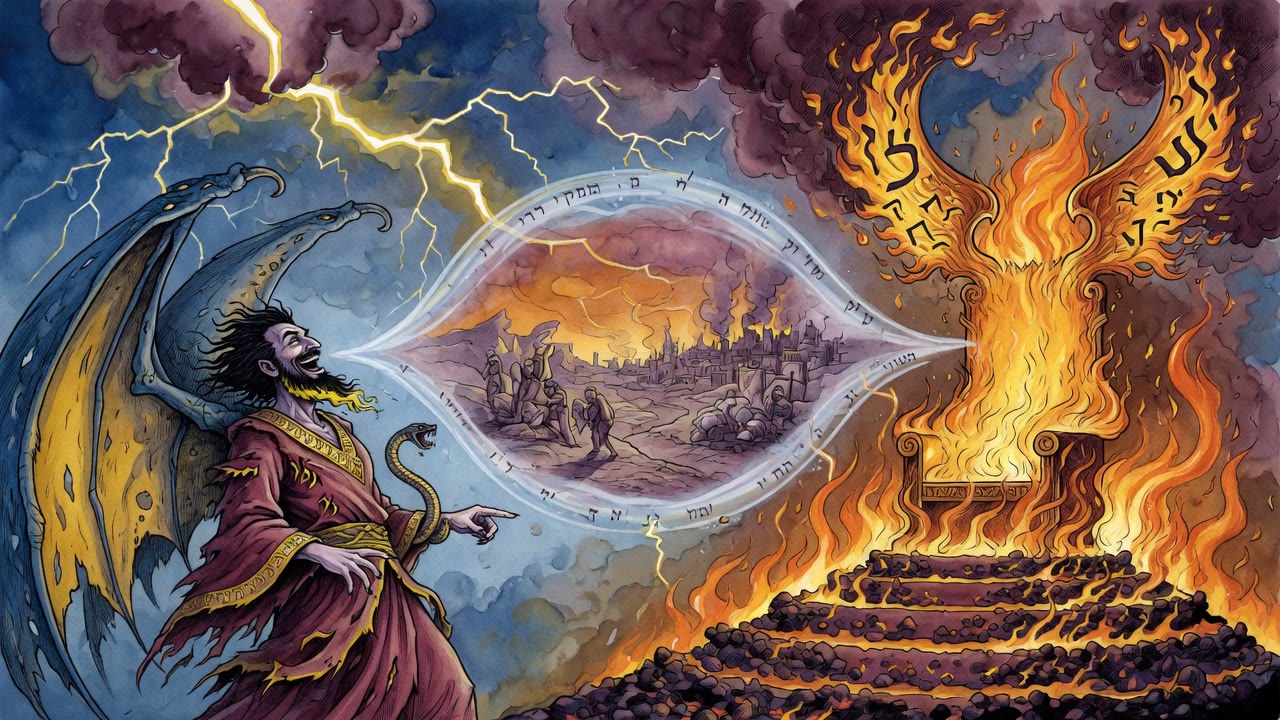
Before Israel went into exile, before the first Temple burned and the people scattered, God called Samael and told him what was coming. Not as a warning to Samael. As an offer.
This is the account preserved in the Tikkunei Zohar, Tikkun (a repair) 47, placed in the mouth of Elijah: that the Blessed Holy One disclosed the future to the accuser, showed him the exile in its full scope, Israel dispersed under the nations, living under the dominion of powers that did not love them. And then God made it conditional. If you treat my children with dignity in their exile, you will receive a reward. The exile was going to happen regardless. The question was how Samael would conduct himself during it.
What Samael Did Instead
Samael and his forces, according to the Tikkunei Zohar, did not fear God, and they destroyed His house. Both Temples. The first and the second. The very dwelling places of the divine presence, reduced to rubble. The text calls this a devastating reality: the house where the Shekhinah (that indwelling presence) had rested, gone.
More than the physical destruction, what the text emphasizes is the attitude. Samael was not a passive tool of historical forces. He was given foreknowledge and a choice, shown exactly what role he would play, offered the alternative of exercising that role with some measure of restraint and respect. He chose contempt instead. He did not merely allow the exile to happen. He took pleasure in it.
The Pattern with Joseph
The Tikkunei Zohar found the same dynamic playing out on a smaller scale in the story of Joseph. Joseph in Egypt was Israel in miniature, a single representative of the people in a foreign land under foreign power. The cosmic battle between the forces aligned with Joseph and the forces aligned against him mirrored the larger conflict between Samael's domain and the divine protection over Israel in exile.
The Tikkunei Zohar read Joseph's survival and eventual triumph as evidence that the protective force over Israel was not absent during the exile, only constrained. Samael was given dominion. But dominion and annihilation are different things. God had not handed Israel over to destruction. He had placed them under a sovereignty that would face a reckoning.
The End of the Sabbath as Cosmic Signal
Elijah's teaching in this tikkun used the moment when Shabbat ends as a lens for understanding exile. When the Sabbath closes and the sacred time retreats, Israel is left in the ordinary week under the pressure of the seventy appointed nations and their angelic representatives. Samael and the appointed seventy are the powers that press on Israel in the days between holy times.
But the Sabbath returns. It always returns. And when it returns, those pressures must yield. The exile has a structure: it is bounded by sacred time above and below it, and the very forces that were given dominion during the exile are the forces whose claim collapses when the Shabbat comes back. Samael was shown this too, in the original disclosure. He was shown not just the exile but its limits. He chose to act as though there were none.
← All myths