God Told David to Open the Torah Scroll First
David wanted a blade from heaven. The lamp smoked. Letters held still while his pulse ran ahead of them, and the street outside stayed armed.
Table of Contents
 Click for full size
A King Asks for War
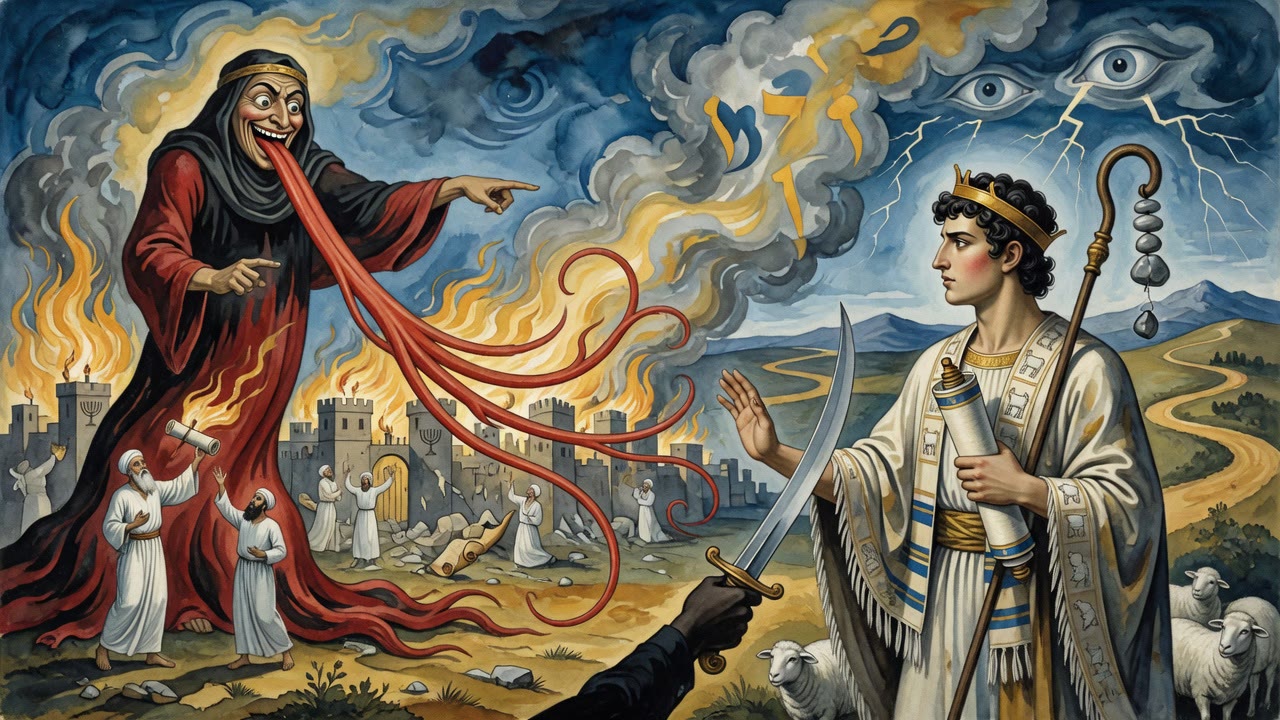
David did not ask for a gentle night. He asked for a fight. "May the Lord contend with my enemies," he cried, voice scraped raw, while the room still held the smell of sweat and old iron (Psalm 35). Trouble had made him drunk without wine. From what am I made drunk? From troubles. Enemies filled the doorway of his mind until every shadow looked armed.
He wanted heaven to step into the street with a blade. He wanted the avenger of bloodshed to remember and move (Psalm 9:13). If You do not stand for me, who will stand for me? Look at what they are doing. Lamentations had already logged the reproach and the schemes spoken where the hurt could hear them (Lamentations 3:59-60).
David waited for war to drop from the ceiling. His hand found the hilt of a sword and then left it, as if even metal knew it was the wrong instrument for the hour.
The Scroll Instead of a Sword
God did not load a quiver for him on demand. The Holy One answered with a condition that felt, at first, like a refusal. Engage in Torah study, and I will fight your battle. Not later, after you finish the scroll. As the way the battle is fought. The king who wanted angels in the alley was sent back to words.
David's jaw set. A scroll does not stop a spear in the first second a man imagines. Then the pressure shifted. Study was not exile from the war. Study was the gate through which the war would be taken out of his hands and into God's. He opened the text. Lamp oil smoked. Letters held still while his pulse tried to run ahead of them. He sat. He read. He refused the easy theater of a public vow of vengeance.
Outside, men who wanted him small still talked. Inside, the only motion that counted was a finger finding the next line. He turned the page and the room grew quieter than the street deserved.
Silence Under Insult
On another night the plea changed shape. Incline Your ear, O Lord, and answer me, for I am poor and needy. Preserve my soul, for I am godly (Psalm 86:1-2). Godly. The word should have stuck in a sinner's throat. Rabbi Levi ties the psalm to Moses blessing Judah at the edge of death: and this for Judah he said (Deuteronomy 33:7). Attention begged for a tribe and a king the same way, ear first.
The Holy One is also called godly, as Jeremiah hears: I am godly, says the Lord (Jeremiah 3:12). Whoever hears his disgrace and remains silent, and has the power to protest, becomes a partner with the Holy One. God hears the blasphemies of nations and could end them in a breath. He waits. That restraint is not weakness. It is the strength that lets a human share the Name's posture for a span of hours.
David heard his own disgrace and kept his mouth shut when shutting it cost him. A courtier mocked. David turned his face to the wall and did not answer. He could have ordered the man dragged out. He did not. The silence did not erase his failures. It marked the hours when he mirrored the patience he had begged heaven to abandon on his behalf.
Preserve my soul, for I am godly. Not perfect. Partnered, for a stretch, with the God who absorbs insult without immediate fire. David released the insult the way a man releases a live coal he finally understands will burn the hand that throws it wrong.
Moses Learned the Clock First
Long before David's lamp, Moses had already stumbled on the same hard kindness of timing. God told him to speak to Aaron that he should not come at all times into the Holy Place (Leviticus 16:2). Moses took the cut into himself. If my brother may not enter freely, what am I? The thought landed without polish. I am like nothing.
Then the teaching of hours closed around the wound. There is a time for an hour, a time for a day, a time for a year, a time Joseph waited twelve years until the word came to pass (Psalm 105:19). Desire of the humble, You have heard, O Lord (Psalm 10:17). Humility here was not self-hatred. It was refusing to force the curtain on a schedule the sanctuary did not keep.
Moses stepped back from the fantasy of permanent access. He walked the camp until the heat left his neck. Aaron would enter when the day and the blood and the name lined up. David, centuries later in the same stream of reading, stepped back from the fantasy of permanent war-on-call. Torah first. Ear first. Silence when silence is the stronger hand.
A priest's foot still waited outside the veil. A king's hand still waited on a scroll. Both men learned that heaven keeps a clock that does not flatter urgency.
Empty Hands
David did not stop having enemies. He stopped demanding that God fight them as a hired blade while he sat idle. The scroll took hours. The silence took more. When he rose from the lamp, the street outside had not emptied of danger. Something in him had emptied of the right to command heaven's temper.
He walked the stone corridor with the psalm still unfinished in his mouth. Poor and needy. Godly only in the thin sense of shared restraint. The Lord would contend in a way the king could not stage-manage. Study had become the field. Silence had become the armor that did not shine.
Somewhere a dog barked at a night watch and went quiet. David set the scroll down as if it were a weapon that had finally agreed to fit his hand. He blew out the lamp. Smoke climbed. In the dark he did not reach for the sword again. He left both hands empty and open, ready for words that fight when steel cannot.
← All myths