5 min read

God Was Honored Through Pharaoh at the Sea

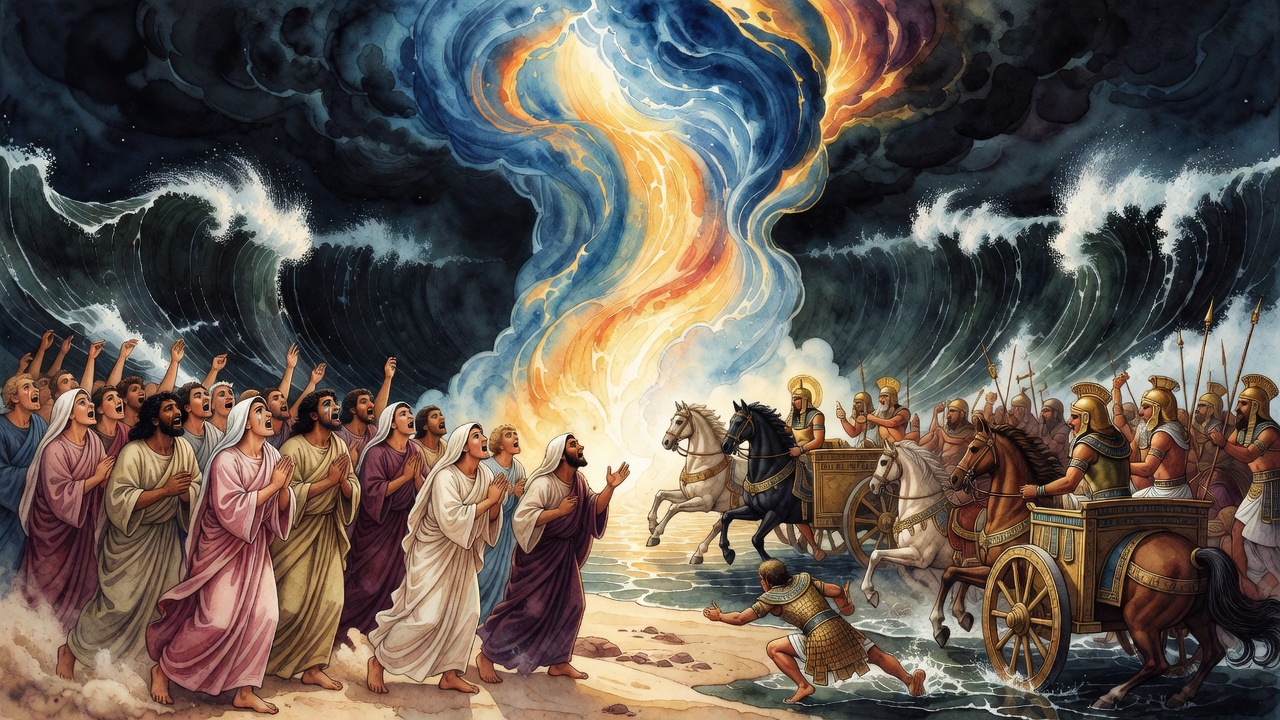
Egypt froze in thick dark between camps. Shalishim filled the chariots, Israel cried, and God took honor from Pharaoh's fall before the waters closed.

Curated by Arthur · Told by Maggid ·
Table of Contents
  1. The Night Neither Camp Moved
  2. Shalishim on Every Chariot
  3. Honor Taken from a Falling King
  4. Morning and the Split
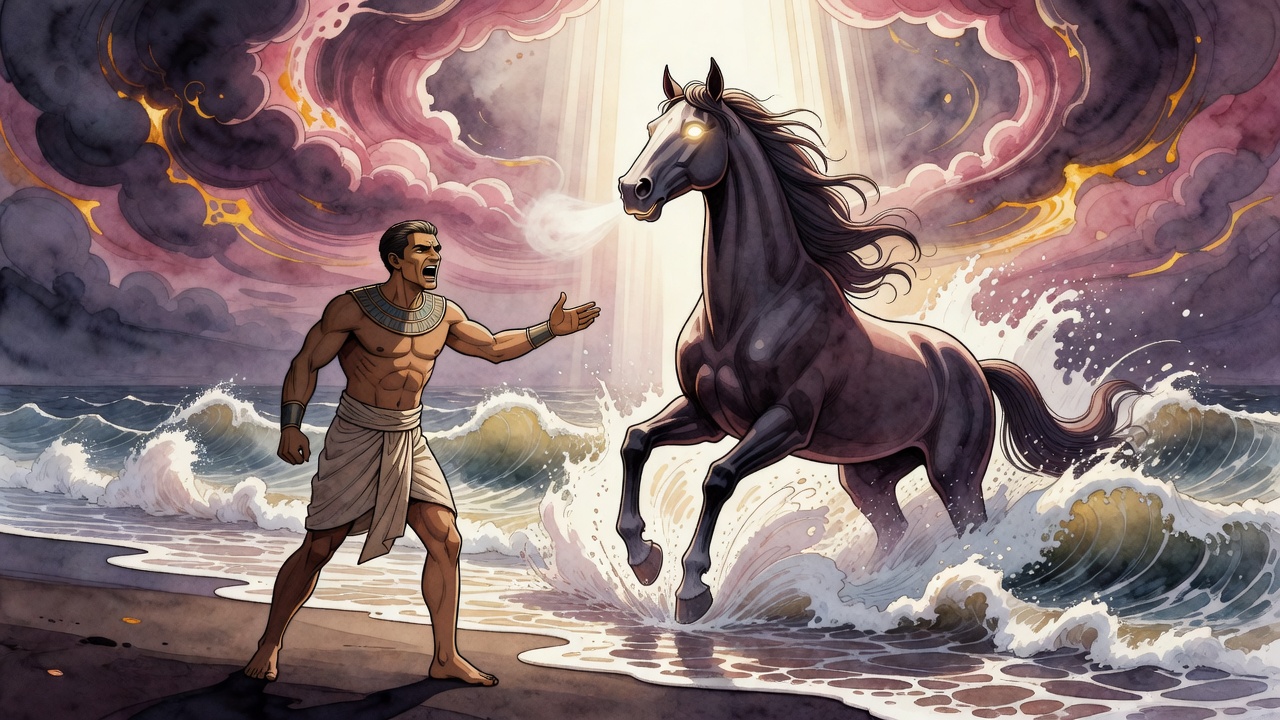
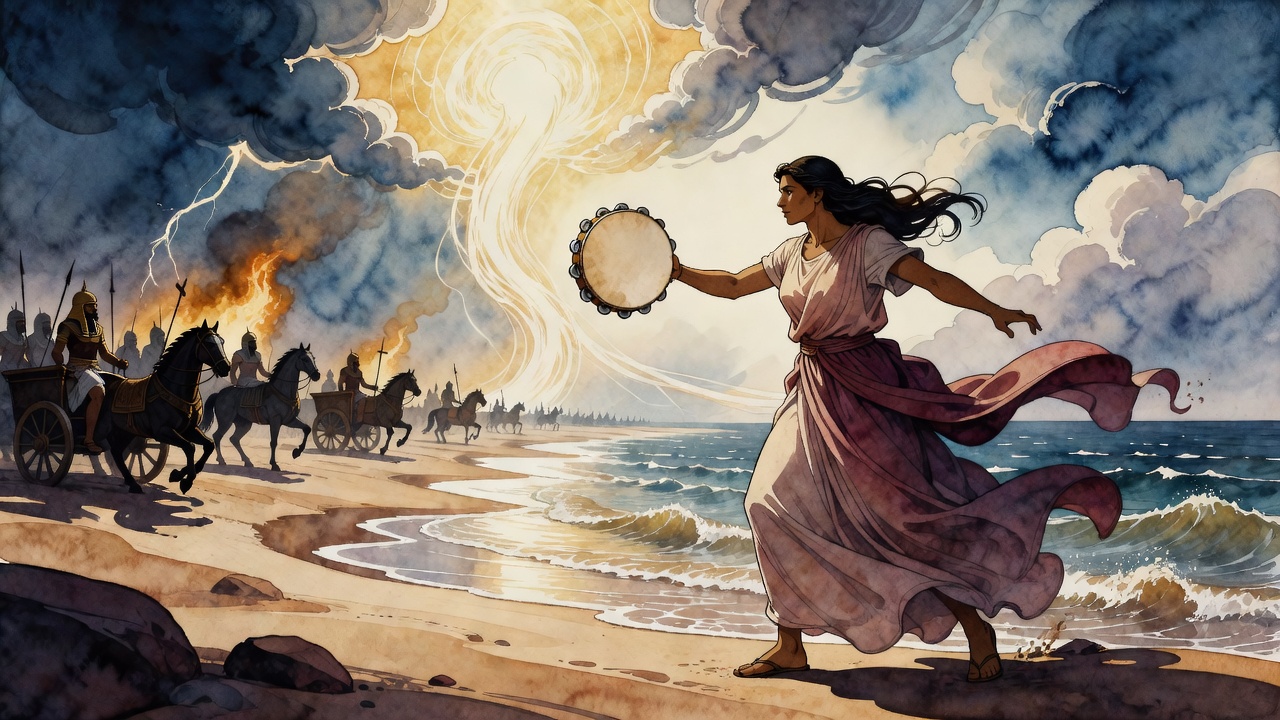
God Was Honored Through Pharaoh at the Sea Click for full size

The Night Neither Camp Moved

"And one did not come near another the entire night" (Exodus 14:20). The Mekhilta hears two silences in one line. First, the darkness that pinned Egypt. A standing man could not sit. A sitting man could not stand. One who had unloaded could not load again. The gloom of the old plague returned as a fist, holding bodies where the night found them.

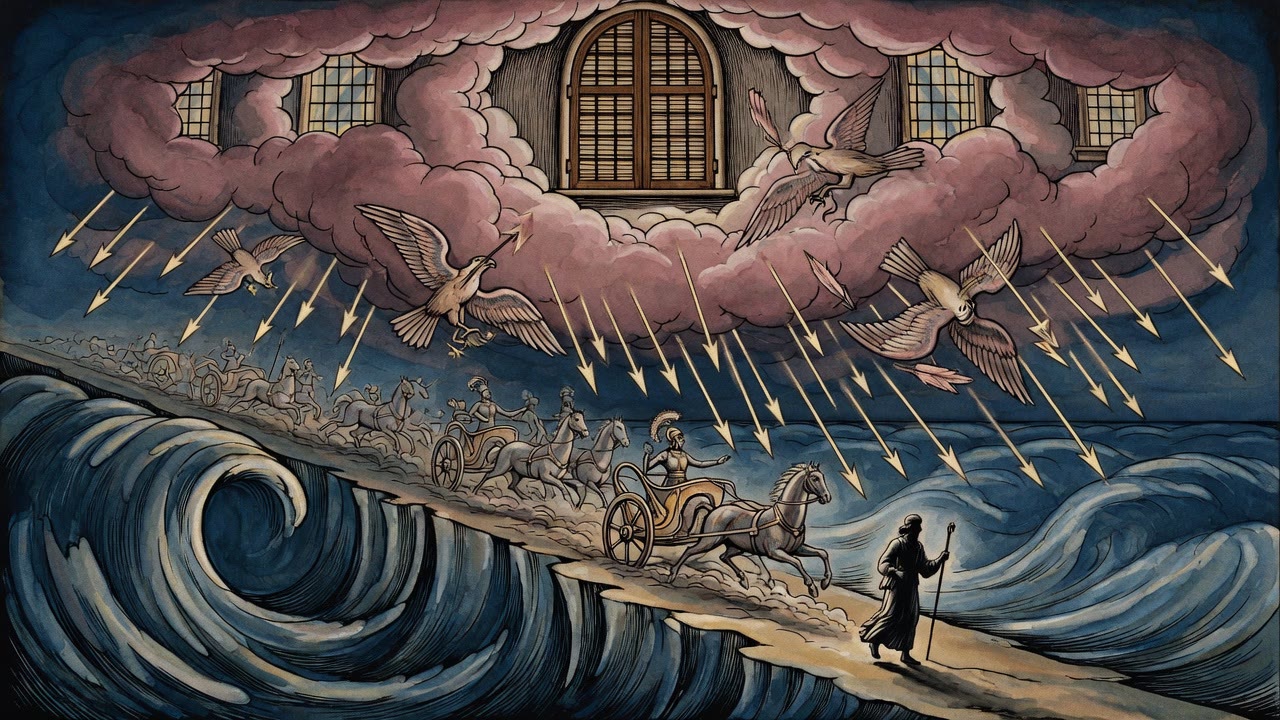
Second, the camps themselves. Egyptian host and Israelite host did not close the gap. Cloud and darkness stood as a wall so Pharaoh's army could not fall on the people before morning. The night was not empty. It was a held breath between slavery's last lunge and the water's verdict.

Children in Israel heard horses and did not see them. Soldiers in Egypt cursed a dark that had weight. Between them God kept a corridor of separation until the hour appointed for honor. Panic had to wait its turn behind divine scheduling. Freedom slept a few hours longer under a sky that refused to let murder arrive early.

Shalishim on Every Chariot

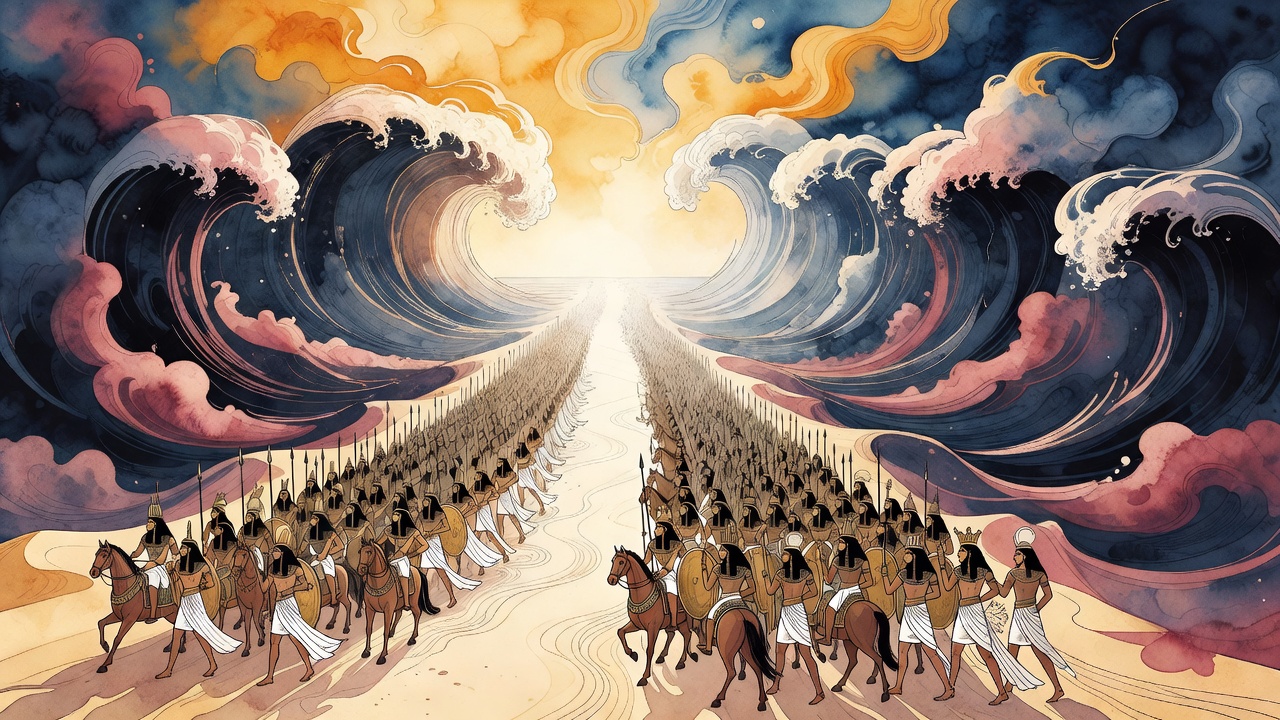
Pharaoh did not come light. "Shalishim upon all of them" (Exodus 14:7) fills the charge with officers and thirds, a density of command meant to make the sea's edge a slaughter yard. The midrash lingers on the word because the threat must be felt as complete. This is not a scouting party. This is the machine that built store-cities, now turned to erase the slaves who walked out under a strange god's name.

Israel sees the dust and panics in the classic way. Better Egypt than bones in the wilderness. Fear rewrites the Exodus as a mistake. Moses has only a staff and a promise, and a people who can smell chariot leather on the wind. The shalishim are the argument of empire in human form: we outnumber your hope.

Heaven's answer is not a smaller army. It is a larger claim. The denser the shalishim, the louder the honor when they sink. God does not need Pharaoh weak to win. God needs Pharaoh fully armed so the nations later tell the story without footnotes and without pity for the pursuer.

Honor Taken from a Falling King

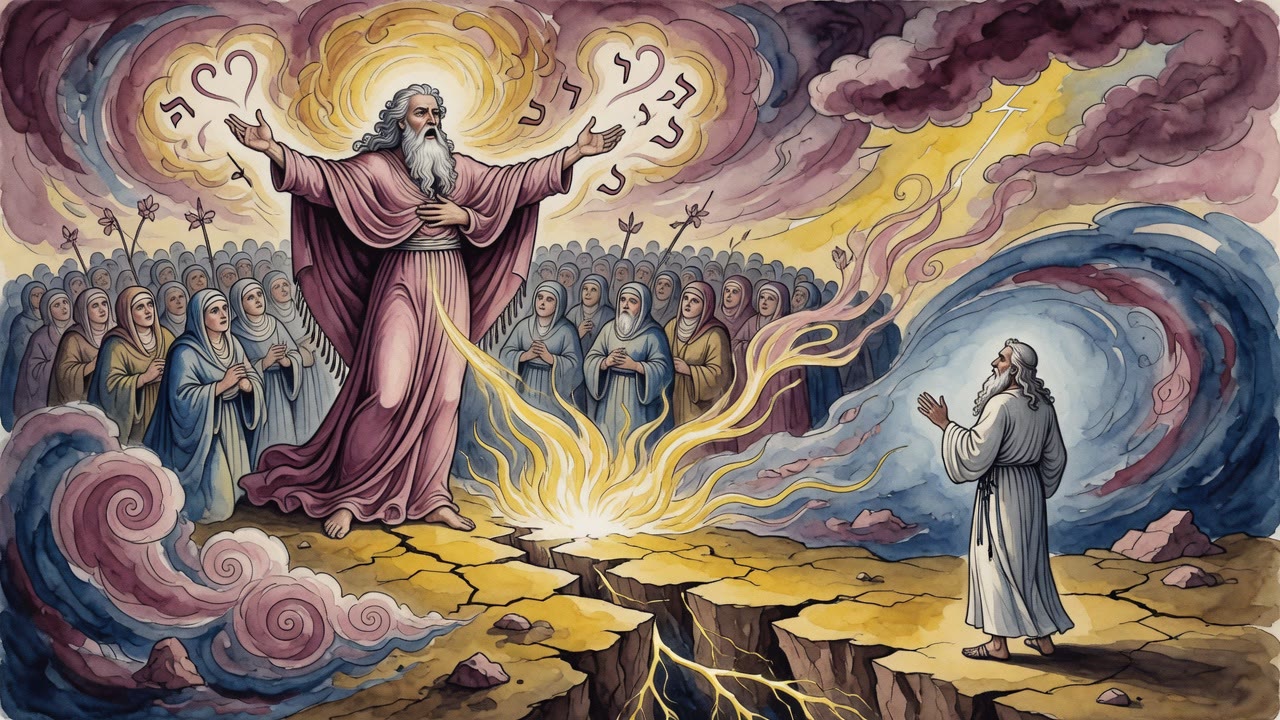
"And I will be honored through Pharaoh." The Mekhilta reads a law of history. When the Lord punishes the nations, the Name grows great in the world. Survivors go out and declare glory among peoples who never stood at the Nile. Chains and prostration follow in prophetic imagination. Gog is struck with pestilence and hail so that many nations know the Lord. Bows break in Zion's memory. God is known in Judah.

Tanchuma sets the same drum to another rhythm. When the wicked spring up like grass, it is that they may be destroyed forever, and when retribution falls, the Name is glorified. Judgments against Egypt's gods, Rahab's melting heart at the report of the sea, idols passing away, the Lord alone exalted, saviors on Esau's mount, the kingdom becoming the Lord's. Verse after verse, the pattern holds. The fall of the oppressor is a loudspeaker for heaven.

Pharaoh began the sin of crushing Israel. From him the punishment begins. Measure is not vague weather over a region. It is a spear aimed at the first hand that rose. The king who claimed the river as his invention learns the sea does not take orders from thrones.

Morning and the Split

When morning comes the wall of dark has done its work. Israel is still a people. Egypt is still an army. The sea becomes a road and then a grave. Honor is not a hymn invented after safety. It is the public meaning of a king's corpse and a shore of empty chariots.

The night of no approach is the hinge. Without it the story is only flight and luck. With it the story is timed judgment. God holds the killers back until the stage is set, then takes payment in full view of history. Shalishim who could not sit in the dark will not stand in the morning tide.

Later generations who light candles for the Exodus are not only celebrating escape. They are repeating the Mekhilta's claim. The Name grows when tyranny drowns. Fear of Israel in distant cities begins with a report of water that stood and fell on cue, and of a night when two camps breathed the same wind and could not touch.

Wind moves over a closed sea. Somewhere a shalish's armor settles into sand. Somewhere a child who could not sleep through the dark night learns the first verse of a song about a horse and a rider thrown into the sea.


← All myths
From the tradition

Sources

4 sources

The texts behind this telling. Some cards carry a translation of the source; others are our own retelling of it, and each card says which. Every card links out to the original.

Mekhilta Tractate Vayehi Beshalach 2:9Mekhilta DeRabbi Yishmael

Retold in our words. Read the original at the link below.Mechilta, translated by Rabbi Shraga Silverstein · CC-BY

"and I will be honored through Pharaoh": Scripture here apprises us that when the L–rd exacts punishment of the nations, His name is aggrandized in the world, as it is written (Isaiah 66:19) "And I will put a sign upon them (the nations), and I will send some of them as survivors to the nations. Tarshish, Pul, Lud, the Archers, Toval and Yavan … and they will declare My glory among the nations," and (Ibid. 45:14-15) "Thus said the L–rd: The toil of Egypt and the men of Cush and the Sabeans, men of stature, will pass to you and will become yours. They will follow after you and pass in chains. They will prostrate themselves before you. They will pray before you. Only with you is G–d, and there is none other except for G–d." What follows? "You are a G–d who conceals Himself. The G–d of Israel is the Savior." And it is written (Ezekiel 38:22) "And I will punish him (Gog) with pestilence and with blood, torrential rain and hailstones, fire and sulphur, etc.", followed by (23) "And I will be exalted and I will be sanctified, and I will make Myself known before the eyes of many nations, and they will know that I am the L–rd." And it is written (Psalms 76:3) "And His tabernacle will be in Jerusalem, and His dwelling in Zion, etc." And (Ibid. 4) "There He broke the flying bows, shield, sword, and battle, Selah." (Ibid. 2) "G–d is known in Judah. His name is great in Israel."

Full source
Mekhilta Tractate Vayehi Beshalach 5:6Mekhilta DeRabbi Yishmael

Retold in our words. Read the original at the link below.Mechilta, translated by Rabbi Shraga Silverstein · CC-BY

The verse (Exodus 14:20) says of the night before the sea split, "And one did not come near another the entire night." The Mekhilta offers two readings of this strange stillness. In the first, Scripture is teaching the severity of the darkness that gripped the Egyptians. A standing Egyptian could not sit down, and a sitting one could not stand up; one who had unloaded his burden could not load it again, and one who had loaded could not unload, because he was held fast in a thick darkness. This recalls the plague described in (Exodus 10:21), "and darkness will be darkened," a gloom so dense it pinned bodies in place wherever the night found them.

The second reading takes the verse about the two camps rather than about individuals. "And one did not come near another the entire night" means that the Egyptian camp could not approach the Israelite camp, and the Israelite camp likewise did not approach the Egyptian camp. Through the long night the pillar of cloud and the darkness stood between the two hosts, keeping them apart so that Pharaoh's army could not fall upon Israel before the morning.

Both readings draw the same lesson from one verse: the night was a time of divine separation, whether felt as paralysis upon the pursuers or as a barrier holding the two camps from contact until the deliverance at the sea.

Full source
Mekhilta Tractate Vayehi Beshalach 2:30Mekhilta DeRabbi Yishmael

Retold in our words. Read the original at the link below.Mechilta, translated by Rabbi Shraga Silverstein · CC-BY

The Torah describes Pharaoh's pursuit force with the word "shalishim", a term the Mekhilta unpacks through three different interpretations, each revealing a different dimension of Egypt's military preparation (Exodus 14:7).

The first reading identifies "shalishim" as elite warriors. The proof comes from (Ezekiel 23:23), where the prophet lists "shalishim and notables, all riders of horses" among the military ranks. These were not ordinary soldiers. They were the finest fighters Egypt could field, handpicked for the pursuit of Israel.

The second reading takes "shalishim" from the root meaning "three" and interprets it as "triple-armed." Each warrior carried three weapons, a complete arsenal that made them formidable in close combat, at range, and in chariot warfare. Pharaoh equipped his men for every possible scenario, leaving nothing to chance.

Rabbi Shimon ben Gamliel offered a third interpretation that focused not on weapons but on chariot design. In standard Egyptian warfare, two men rode in each chariot, a driver and a fighter. Pharaoh added a third man to every chariot, creating "shalishim", triplets. The extra crew member meant the chariots could pursue at greater speed and with more endurance, since the men could rotate duties.

Rebbi, Rabbi Yehuda HaNasi, pushed the innovation even further into history, noting that while Pharaoh introduced three-man chariots, Solomon later added a fourth. Military technology evolved, each generation building on the last. But Pharaoh's triple-crewed chariots, for all their innovation, raced straight into the closing waters of the Red Sea.

Full source
Midrash Tanchuma, Tetzaveh 10Midrash Tanchuma

Translation of the source text.Midrash Tanchuma -- Torat Emet · Public Domain

"And this is the thing that you shall do to them" (Exodus 29:1). This is what Scripture says: "But You, O LORD, are on high forevermore" (Psalms 92:9). What is written above this verse? "When the wicked spring up like grass, and when all the workers of iniquity flourish, it is that they may be destroyed forever" (Psalms 92:8). What is written after it? "But You, O LORD, are on high forevermore." For whenever the Holy One, blessed be He, exacts punishment from the wicked, His name is magnified in the world, as it is said: "And against all the gods of Egypt I will execute judgments" (Exodus 12:12). At that moment, "I am the LORD" (Exodus 12:12).

And likewise Rahab says: "For we have heard how the LORD dried up the waters of the Red Sea before you when you came out of Egypt," and so forth, "And when we heard, our hearts melted, and there remained no more spirit in any man because of you; for the LORD your God, He is God in the heavens above and on the earth beneath" (Joshua 2:10-11). And likewise it is written: "And the idols shall utterly pass away" (Isaiah 2:18). At that moment, "And the LORD alone shall be exalted in that day" (Isaiah 2:17). And likewise: "And saviors shall come up on Mount Zion to judge the mountain of Esau" (Obadiah 1:21). And at that moment: "and the kingdom shall be the LORD's" (Obadiah 1:21). And it is written: "And the LORD shall be king," and so forth (Zechariah 14:9).

And likewise: "Thus shall you say to them: The gods that have not made the heavens and the earth, these shall perish from the earth and from under these heavens. He has made the earth by His power, He has established the world by His wisdom" (Jeremiah 10:11-12). And likewise: "Let sinners be consumed out of the earth, and let the wicked be no more" (Psalms 104:35). At that moment, "Bless the LORD, O my soul, Hallelujah" (Psalms 104:35). And you may interpret them all according to this view, heaps upon heaps of verses. "In Salem also is His tabernacle," and so forth, "There He broke the flashing arrows, the shield and the sword and the battle, Selah" (Psalms 76:3-4), "In Judah God is known" (Psalms 76:2). This is to say: whenever He exacts punishment from the wicked, His name is magnified in the world.

"But You, O LORD, are on high forevermore" (Psalms 92:9). A king of flesh and blood, when he judges and acquits, they praise him; but when he condemns, they do not praise him. But the Holy One, blessed be He -- for the good, His praise ascends, "Blessed is the Good and Doer of good," and for the evil, His praise ascends, "Blessed is the true Judge" (Tractate Berakhot 54). This is to say, "But You are on high." And so David says: "I will lift up the cup of salvation, and call upon the name of the LORD" (Psalms 116:13). "I found trouble and sorrow, and I called upon the name of the LORD" (Psalms 116:3-4). And likewise: "In God I will praise His word, in the LORD I will praise His word" (Psalms 56:11). And likewise Job says: "The LORD gave and the LORD has taken away; blessed be the name of the LORD" (Job 1:21).

Another interpretation: "But You, O LORD, are on high forevermore." David said: Master of the universe, once You grant exaltation to a man, it never departs from him forever. You gave kingship to the house of David -- it never departs from him forever, as it is said: "And David My servant shall be prince over them forever" (Ezekiel 37:25). You gave the priesthood to Aaron -- it never departs from him forever, as it is said: "And it shall be to him and to his seed after him a covenant of everlasting priesthood" (Numbers 25:13). Therefore the Holy One, blessed be He, commands to grant Aaron exaltation in the high priesthood. This is to say, "But You, O LORD, are on high forevermore."

And what did He see, to magnify Aaron and his sons by sanctifying them? Rabbi Mani of Sheab and Rabbi Yehoshua of Sikhnin said in the name of Rabbi Levi: At the time when Israel sought to commit that deed, they said to Aaron, "Arise, make us gods" (Exodus 32:1). Hur the son of Caleb arose and rebuked them; immediately they rose against him and killed him. Aaron saw and feared for himself, as it is said: "And Aaron saw, and built an altar before it" (Exodus 32:5). This is to say, read it: "And Aaron feared (vayyira), and built an altar before it." Know that they killed Hur, for when Moses went up to the mountain, what did he say to them? "Behold, Aaron and Hur are with you; whoever has a dispute, let him approach them" (Exodus 24:14). When he came down, you do not find that he mentioned Hur, neither among the living nor among the dead. And what does it say? "And Moses said to Aaron, What did this people do to you, that you have brought," and so forth (Exodus 32:21). This is to say, they killed Hur.

"And Aaron saw, and built an altar" (Exodus 32:5). Immediately he took there a plate of a gold earring and cast it into the fire, as it is said: "And I cast it into the fire, and there came out this calf" (Exodus 32:24). And Aaron was afraid that perhaps there was something in the heart of the Holy One, blessed be He, against him. Therefore the Holy One, blessed be He, said to Moses: "And this is the thing that you shall do to them to sanctify them, to serve Me as priests" -- to exalt and magnify Aaron and his sons in the high priesthood, since it was revealed and known before Him that Aaron acted only out of fear; and therefore He made known to them that there was nothing in the heart of the Holy One, blessed be He, against him.

"Take one bull" (Exodus 29:1). A bull, to atone for the calf, which was a bull. "Two rams," corresponding to his two sons who were destined to die. For all his sons deserved to die, as it is said: "And the LORD was very angry with Aaron, to destroy him" (Deuteronomy 9:20). "To destroy him" means nothing other than the destruction of children, as it is said: "And I destroyed his fruit from above and his roots from beneath" (Amos 2:9). Once Moses prayed for him, as it is written, "And I prayed for Aaron also" (Deuteronomy 9:20), two died and two remained.

Full source