Parshat Tzav5 min read

God Wrapped Himself in Light Before Creation

Before the sun existed, God wrapped Himself in light and the radiance filled creation. Adam saw from one end of the world to the other with it.

Curated by Arthur · Told by Maggid ·
Table of Contents
  1. The Garment Before the World
  2. Adoil and the Moment Before the World
  3. The Light Adam Could See By
  4. Where the Light Was Stored

The Garment Before the World

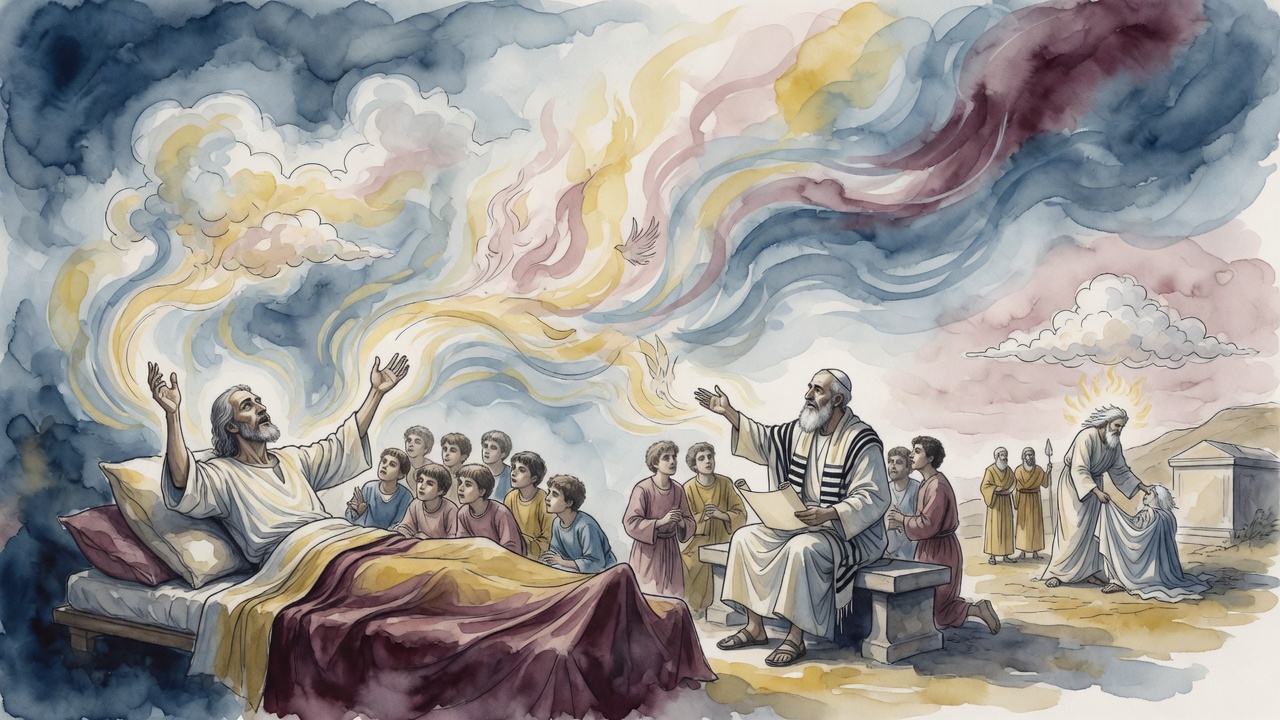
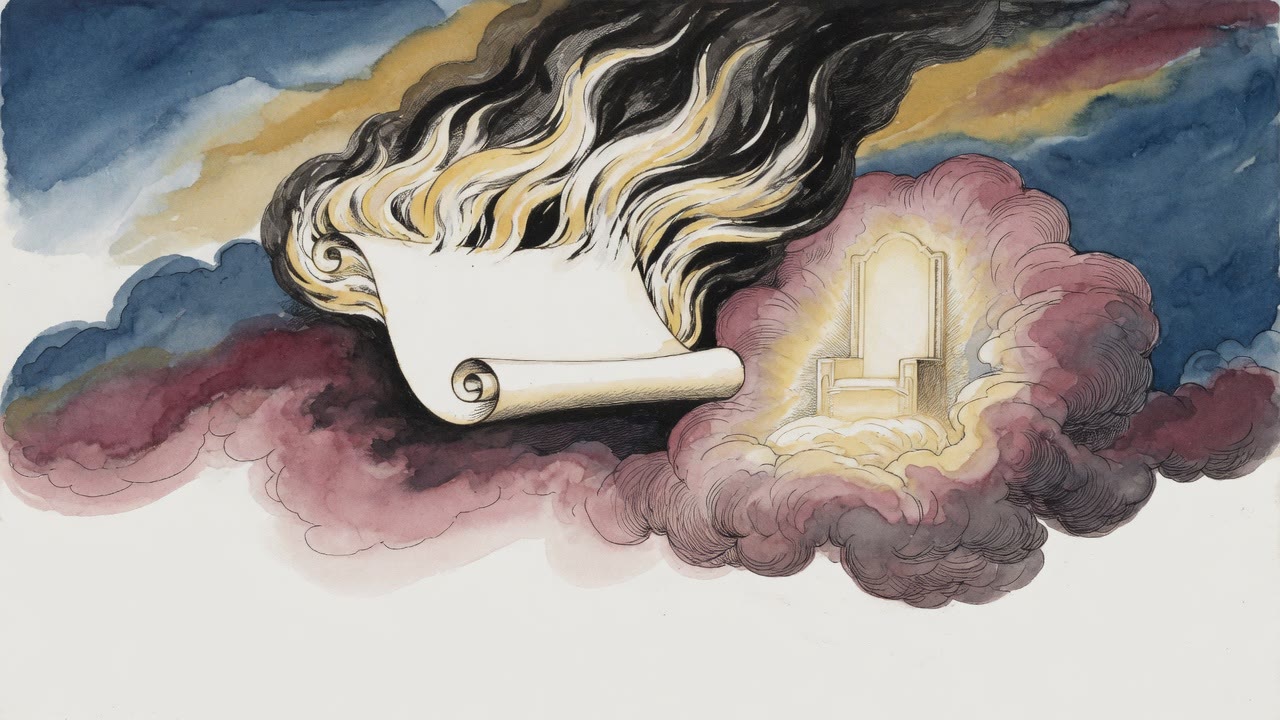
Before the sun was made, before the moon, before a single star hung in any sky, God wrapped Himself in light. Some traditions describe it as a prayer shawl, a tallit woven not from wool or linen but from pure radiance, covering every direction simultaneously. The letters of the Hebrew alphabet were etched across the garment, black fire on white fire, and the light cast from that robe suffused the entire world at the very instant it spread outward. Other traditions see it differently: God stretched the light like a canopy over the void, and as He stretched it the heavens themselves continued expanding outward, growing without boundary in every direction.

This light was not the light of the sun. The sun did not yet exist. Whatever burned in those first moments of creation was something distinct and primordial, older than any physical source of illumination, older than the bodies that would eventually generate their own fire. The creatures of later days would not be able to look at it directly. It was the first fact of the universe, and it came from what God was wearing.

Adoil and the Moment Before the World

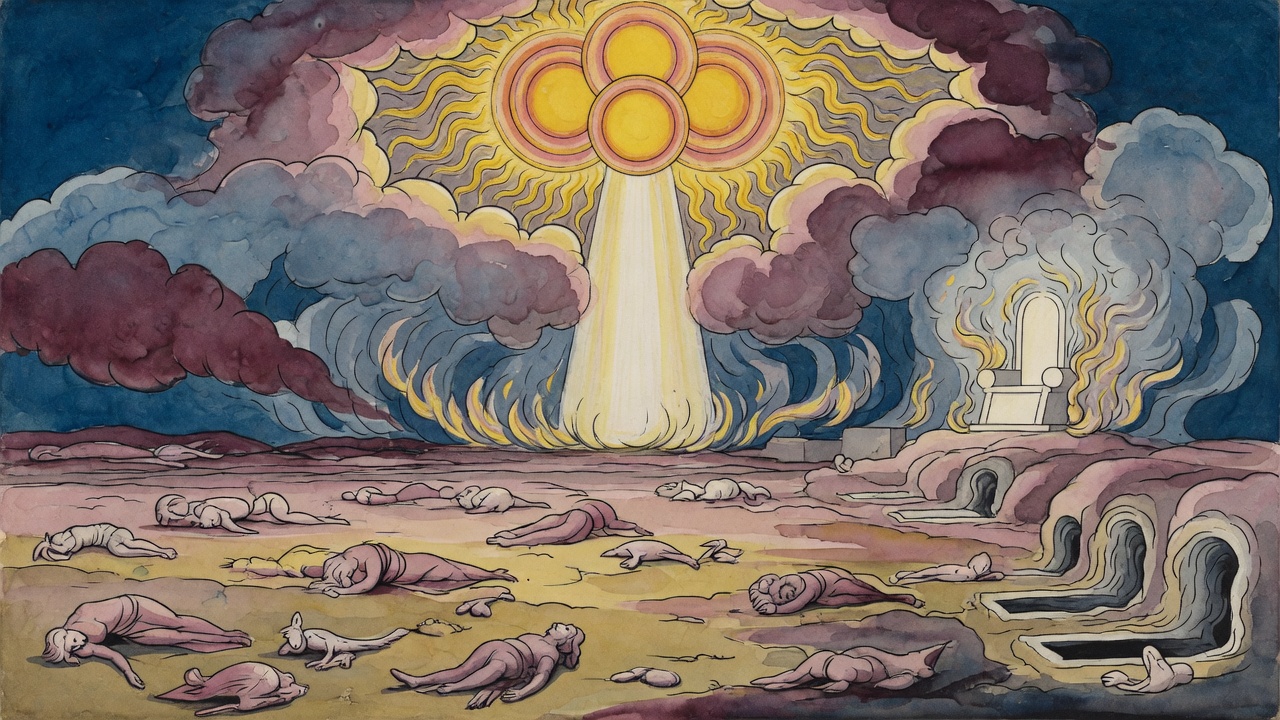
One account of creation's opening reaches further back than Genesis. Before anything visible existed, there were only invisible things. God spoke into that invisibility: let one of the invisible things descend and become visible. Adoil descended. He was enormous, and he contained within himself a great light. God commanded Adoil to disintegrate, and Adoil obeyed, and from his dissolution came the foundations of the world. The great light that had been inside him poured outward and became what is above, and from the remnant, the solid remainder of what he had been, God fashioned the earth below.

This is creation as sacrifice. The primordial being dissolves itself at God's command and from its dissolution the framework of existence emerges. Light is not invented in this telling. It is released from a container that was willing to break.

The Light Adam Could See By

When Adam stood in the Garden, he could see from one end of the world to the other by the light of that first day. Not because his eyes were stronger than any human eye that came after him, but because the primordial light made everything visible simultaneously, collapsing the distance between any two points in creation. It was a different kind of seeing, one that did not require proximity or the movement of photons from source to eye across intervening space.

That light did not last. When God saw what would be done by the wicked generations, the generation of the Flood and the generation of the Tower, He hid the light away before they could use it. He concealed it, the sources say, for the righteous who would come at the end of time. The world that remained after the hiding was navigable by the lesser luminaries, the sun and moon created on the fourth day, but those were pale replacements, functional rather than revelatory. What had once allowed a man to stand still and perceive the full width of creation was gone, stored somewhere in divine custody until the time it was needed again.

Where the Light Was Stored

Some sages said the hidden light was stored in the Temple. Not in any cabinet or chamber, but in the Kodesh HaKodashim, the Holy of Holies, where the Ark of the Covenant resided. From that inner sanctum the concealed radiance continued to leak outward through the Temple structure and into the surrounding world, dim enough not to blind, present enough to sanctify. When the Temple was built, the ancient light returned slightly to human experience, and when the Temple was destroyed the loss of that ambient holiness was part of what made the catastrophe total rather than merely political.

The mystics found the light in a different location. Every year, just before Kol Nidrei opens the Yom Kippur service, they described a tremendous illumination descending through all the worlds, washing over the angels and filling human souls to overflowing. Where did this light come from? From tears shed before God's Name. The Zohar says light is sown for the righteous as a farmer sows seed in dark soil. The crying of the contrite plants something in the ground of divine reality, and at the appointed hour, the sown light breaks open the darkness and rises. The original garment God wore before creation has not been destroyed. It is waiting for the tears that will call it back.


← All myths

From the tradition

Sources

5 sources

The texts this telling draws on, in full. Open a card to read inline, or expand it for a wider, quieter read.

Pirkei DeRabbi Eliezer 3Pirkei DeRabbi Eliezer

From what place were the heavens created? From the light of the garment of the Holy One, blessed be He, with which He is clothed. He took from it and spread it out like a cloak, and it kept stretching and going until He said to it: Enough. For this reason His name is called Shaddai, for He said to the heavens "Enough" (dai) and they stood firm. And from where do we know that they were created from the light of His garment? As it is said (Psalms 104:2): "He wraps Himself in light like a garment, He stretches out the heavens like a curtain."

Full source
Hagigah 12aTalmud Bavli, Hagigah

And Rav Yehudah said in the name of Rav: Ten things were created on the first day, and these are they: the heavens and the earth, formlessness and void, light and darkness, wind and water, the measure of day and the measure of night.

The heavens and the earth, as it is written: "In the beginning God created the heavens and the earth" (Genesis 1:1). Formlessness and void, as it is written: "And the earth was formless and void" (Genesis 1:2). Light and darkness; darkness, as it is written: "And darkness was upon the face of the deep" (Genesis 1:2); light, as it is written: "And God said, Let there be light" (Genesis 1:3). Wind and water, as it is written: "And the spirit of God hovered over the face of the waters" (Genesis 1:2). The measure of day and the measure of night, as it is written: "And there was evening and there was morning, one day" (Genesis 1:5).

And was the light created on the first day? But it is written: "And God set them in the firmament of the heavens" (Genesis 1:17), and it is written: "And there was evening and there was morning, the fourth day" (Genesis 1:19)! This is in accordance with Rabbi Elazar. For Rabbi Elazar said: The light that the Holy One, blessed be He, created on the first day, a person could see by it from one end of the world to the other. When the Holy One, blessed be He, looked upon the generation of the Flood and the generation of the Dispersion and saw that their deeds were corrupt, He arose and hid it from them, as it is said: "And from the wicked their light is withheld" (Job 38:15).

And for whom did He hide it? For the righteous in the time to come, as it is said: "And God saw the light, that it was good" (Genesis 1:4), and "good" means nothing other than the righteous, as it is said: "Say of the righteous that it shall be good with him" (Isaiah 3:10). When He saw the light that He had hidden for the righteous, He rejoiced, as it is said: "The light of the righteous rejoices" (Proverbs 13:9).

Full source
2 Enoch 25-262 Enoch

2 Enoch turns to How Light And Darkness Were Created.

Before anything we can see existed, there were only invisible things. Then God, in His infinite wisdom, decided to make the invisible visible. And so, God spoke: "Let one of the invisible things descend and become visible."

Adoil descended.

Who was Adoil? Well, this astonishing creation myth comes from 2 Enoch, a text dating back to around the second century BCE to the first century CE. It paints a picture radically different from Genesis. Adoil wasn't an angel, not a god, just a primordial being, an invisible force entirely under God's command. He was enormous, and within him, he held a great light.

God commanded Adoil: "Disintegrate yourself, Adoil, and let what is born from you become visible." Disintegration as an act of creation. It echoes the Kabbalistic concept of Shevirat haKelim, the shattering of the vessels, a concept we find in the teachings of the Ari, Rabbi Isaac Luria (1534-1572). It's like both stories suggest that breaking apart is necessary before something new can be formed.

And Adoil disintegrated.

From him emerged a very great light. And God was in the midst of the light. Another light came forth out of that light, revealing all of creation that God had thought to create. And God saw that it was good. God placed a throne for Himself and sat down. Then God spoke to the light, saying, "You rise up and become the foundation for the highest things. For there is nothing higher than light, except for nothingness itself."

But what about darkness?

God summoned the very lowest beings a second time, commanding, "Let one of the invisible beings descend and become visible."

And Arkhas came out, solid, heavy, and very red. Like Adoil, Arkhas was a primordial being, not an angel, not a god. God commanded Arkhas: "Open yourself up, Arkhas, and let what is born from you become visible."

And Arkhas disintegrated.

From him emerged a great darkness, very large, bearing the creation of all lower things. And God saw how good it was. God said to the darkness, "Descend and become the foundation of all lower things. For there is nothing lower than the darkness, except nothing itself."

So, we have light and darkness, each with its own origin, its own purpose. But God's work wasn't done.

God took some light and some darkness and mixed them together, commanding them to thicken. And when they did, He wrapped them with light and spread it out, and it became water. God spread it out above the darkness and below the light, dividing the world above from the world below. And God made a foundation of light around the waters, with seven circles inside it, with the appearance of crystal. He pointed out the route of each one of the seven stars to its own heaven.

And finally, God made a division between the light and the darkness, saying to the light that it should be day, and to the darkness that it should be night. And there was evening and there was morning, a first day (Genesis 1:5).

What a powerful image: light and darkness, not as opposing forces, but as essential ingredients, mixed together to create the very fabric of our world. The light of Adoil, the darkness of Arkhas, both born from disintegration, both necessary for creation. Food for thought, isn't it? Perhaps the things we need to "disintegrate" in our own lives are the very things that hold the potential for the greatest light.

Full source
Zohar II:217bZohar

There's a beautiful idea that just before the solemnity of Kol Nidrei, the service that begins Yom Kippur, a tremendous light descends from the heavens. Imagine it: a cascade of pure, divine radiance flooding all the worlds, washing over the angels, and filling our very souls to overflowing. That's the image the mystics paint for us.

Where does this light come from? What sparks such a powerful illumination?

(Psalm 97:11) gives us a clue: "Light is sown for the righteous." But what does it mean for light to be "sown"? It suggests an act of planting, of cultivation. Like a farmer carefully placing seeds in the earth, something is done to bring this light into being.

What is that "something"?

The answer, poignantly, is tears. Specifically, the tears shed before God's Name. The Zohar, that foundational text of Jewish mysticism, hints at this connection. Think about the emotional intensity of the Days of Awe, the soul-searching, the repentance. All that raw vulnerability, all that yearning for connection and forgiveness… It's a potent force. It's a form of spiritual labor.

These aren't just any tears, though. They're tears offered in sincerity, in a genuine attempt to turn back to God. They represent a breaking down of the barriers we've built between ourselves and the Divine. They are, in a sense, the seeds that sprout into this extraordinary light.

So, as you stand in the synagogue, or wherever you find yourself as Kol Nidrei approaches, remember this image. Remember the light pouring down. Remember that even in our moments of deepest remorse and vulnerability, we have the power to cultivate something beautiful, something transformative. Remember that our tears, offered with a sincere heart, can actually help to illuminate the world.

What a powerful and comforting thought as we begin this holiest of days.

Full source
Ta'anit 10aTalmud Bavli, Ta'anit

verse deals with the creation of the world, when all the water was contained in the deep.

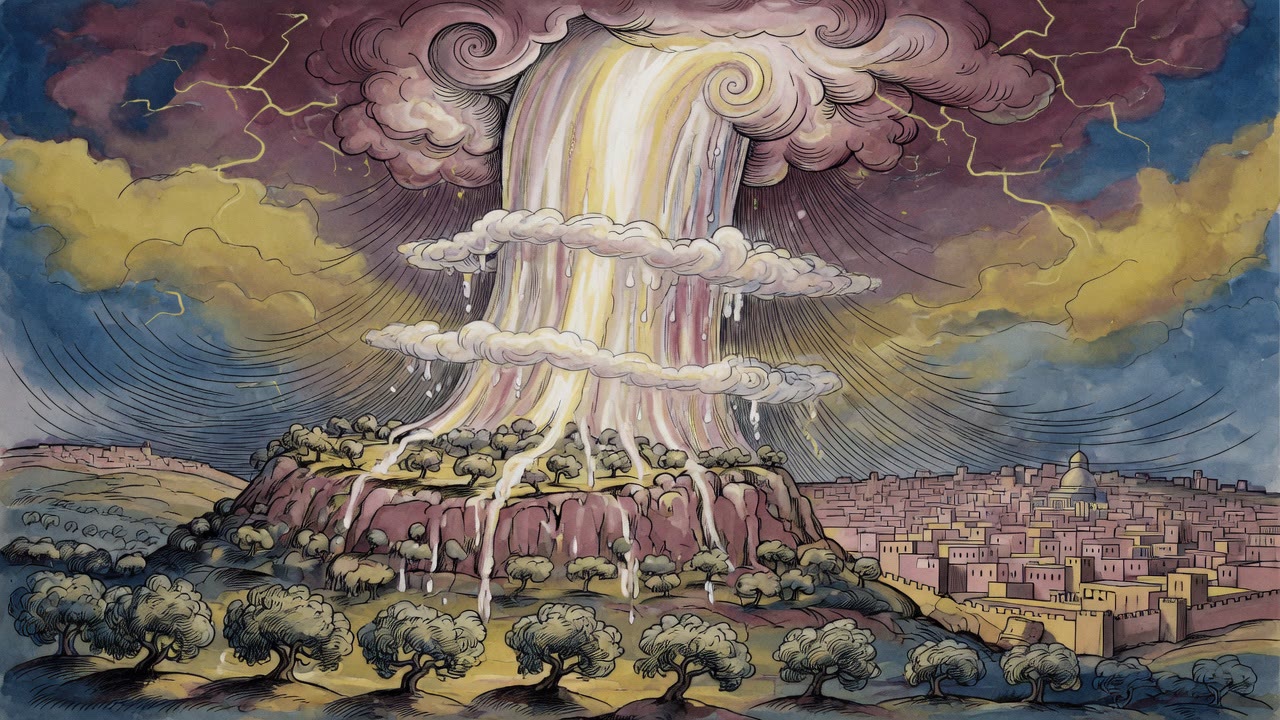
The Sages taught in a baraita: Eretz Yisrael was created first and the rest of the entire world was created afterward, as it is stated: “While as yet He had not made the land, nor the fields” (Proverbs 8:26). Here, and in the following statements, the term “land” is understood as a reference to the Land of Israel, while “the fields” means all the fields in other lands. Furthermore, Eretz Yisrael is watered by the Holy One, Blessed be He, Himself, and the rest of the entire world is watered through an intermediary, as it is stated: “Who gives rain upon the land, and sends water upon the fields” (Job 5:10).

Additionally, Eretz Yisrael drinks rainwater and the rest of the entire world drinks from the remaining residue of rainwater left in the clouds, as it is stated that God is He “who gives rain upon the land” and only afterward takes what is left “and sends water upon the fields.” Eretz Yisrael drinks first, and the rest of the entire world afterward, as it is stated: “Who gives rain upon the land and sends water upon the fields.” There is a parable that illustrates this: A person who kneads his cheese after it has curdled takes the food and leaves the refuse.

The Master said above: The ocean waters are sweetened in the clouds. The Gemara asks: From where does Rabbi Eliezer derive this? The Gemara answers that Rav Yitzḥak bar Yosef said that Rabbi Yoḥanan said that it is written: “Darkness [ḥeshkhat] of waters, thick clouds of the skies” (Psalms 18:12). And it is written, in a similar verse: “Gathering of [ḥashrat] waters, thick clouds of the skies” (II Samuel 22:12).

The Gemara explains the significance of this minor variation. These two phrases vary in only one word, which themselves differ by only one letter, a kaf for a reish. If you join the two versions together, and take the letter kaf from the first version and place it with the second version of the word, which has a reish, you can read into the verse a new word meaning rendering fit [ḥakhsharat]. Accordingly, the verse can be interpreted as: The rendering fit of water is performed in the clouds of the sky.

The Gemara asks: And Rabbi Yehoshua, with regard to these verses, what does he learn from them? The Gemara answers that Rabbi Yehoshua holds in accordance with the opinion of this Sage, Rav Dimi. As when Rav Dimi came from Eretz Yisrael to Babylonia, he said that they say in the West, Eretz Yisrael: When clouds are bright, they have little water; when clouds are dark, they have much water. Accordingly, Rabbi Yehoshua explains that when there is “a darkness of waters” in the clouds, there is also “a gathering of waters,” as rain will fall from them.

The Gemara asks: In accordance with whose opinion is that which is taught in a baraita: The upper waters do not stand in any defined place; rather, they are suspended by the word of God, and their fruit is rainwater, as it is stated: “Who waters the mountains from His upper chambers; the earth is full of the fruit of Your works” (Psalms 104:13). In accordance with whose opinion is this statement? It is in accordance with the opinion of Rabbi Yehoshua. And Rabbi Eliezer, how does he explain this verse? Rabbi Eliezer could say: That verse from Psalms is written with regard to the handiwork of the Holy One, Blessed be He, not the upper waters.

Rabbi Yehoshua ben Levi said: The entire world drinks from the runoff of the Garden of Eden, as it is stated: “And a river went out of Eden to water the garden” (Genesis 2:10). It was taught in a baraita: From the runoff of a beit kor, a field in which a kor of seed can be planted, which is approximately seventy-five thousand square cubits, a field in which a half-se’a [tarkav], of seed can be sown, i.e. one-sixtieth the size of a beit kor, can be watered. If the runoff from a beit kor is sufficient for a field one-sixtieth its size, it can be inferred that the rest of the world is one-sixtieth the size of the Garden of Eden.

The Sages taught in a baraita: The area of the land of Egypt is four hundred parasangs [parsa] by four hundred parasangs. And this is one sixtieth the size of Cush, and Cush itself is one sixtieth the size of the rest of the world. And the world is one sixtieth of the Garden of Eden, and the Garden of Eden is one sixtieth of Eden itself, and Eden is one sixtieth of Gehenna. You find that the entire world is like a pot cover for Gehenna, as Eden, which is far larger than the rest of the world, is only one sixtieth the size of Gehenna. And some say: Gehenna has no measure. And some say that Eden has no measure.

Rabbi Oshaya said: What is the meaning of that which is written about Babylonia: “You who dwells on many waters, abundant in storehouses” (Jeremiah 51:13)? What caused Babylonia to have storehouses full of grain? You must say that it is due to the fact that it resides on many waters, the Tigris and the Euphrates Rivers, which render its land easy to irrigate. Similarly, Rav said: Babylonia is wealthy since it can grow crops for harvest even without rain. Abaye said: We hold that it is better for a land to be swampy like Babylonia, and not dry, as crops in Babylonia grow all year.

MISHNA: On the third of the month of Marḥeshvan one starts to request rain by inserting the phrase: And give dew and rain, in the blessing of the years, the ninth blessing of the Amida. Rabban Gamliel says: One starts to request rain on the seventh of Marḥeshvan, which is fifteen days after the festival of Sukkot. Rabban Gamliel explains that one waits these extra four days so that the last pilgrim of the Jewish people, who traveled to Jerusalem on foot for the Festival, can reach the Euphrates River without being inconvenienced by rain on his journey home.

GEMARA: Rabbi Elazar said: The halakha is in accordance with the opinion of Rabban Gamliel, that one does not begin to request rain until the seventh of Marḥeshvan. It is taught in a baraita that Ḥananya says: And in the Diaspora one does not begin to request rain until sixty days into the season, i.e., sixty days after the autumnal equinox. Rav Huna bar Ḥiyya said that Shmuel said: The halakha is in accordance with the opinion of Ḥananya.

The Gemara asks: Is that so? But they raised a dilemma before Shmuel: From when does one mention: And give dew and rain? He said to them: From when they bring wood into the house of Tavut the bird hunter [rishba]. This is apparently a different date than that mentioned by Ḥananya. The Gemara suggests: Perhaps this and that are one measure of time, i.e., Shmuel merely provided a sign of sixty days after the autumnal equinox.

A dilemma was raised before the Sages: Is the sixtieth day itself treated as part of the period before the sixtieth day or is it included in the period after the sixtieth day? The Gemara answers. Come and hear that there is a dispute in this regard. Rav said: The sixtieth day is part of the period after the sixtieth day, and Shmuel said: The sixtieth day is part of the period before the sixtieth.

Rav Naḥman bar Yitzḥak said: And your mnemonic to remember the divergent opinions is: Those above require water; those below do not require water. Since water flows downward, those who live in low places receive their water from above and are generally in less need of additional water. Accordingly, Shmuel, who lived in the lowlands of Babylonia, ruled that one begins to request for rain later, whereas Rav, who studied in Eretz Yisrael, which is higher in elevation and has a greater need for rain, stated an earlier date. Rav Pappa said: The halakha is that the sixtieth day is part of the period after the sixtieth day, as stated by Rav, and therefore one begins to mention the request for rain on the sixtieth day after the autumnal equinox.

MISHNA: If the seventeenth of Marḥeshvan arrived and rain has not fallen, individuals, but not the entire community, begin to fast three fasts for rain. How are these fasts conducted? As the fast begins in the morning, one may eat and drink after dark, and one is permitted during the days of the fasts themselves to engage in the performance of work, in bathing, in smearing oil on one’s body, in wearing shoes, and in conjugal relations. If the New Moon of Kislev arrived and rain has still not fallen, the court decrees three fasts on the entire community. Similar to the individual fasts, everyone may eat and drink after dark, and they are permitted to engage in the performance of work, in bathing, in smearing one’s body with oil, in wearing shoes, and in conjugal relations.

GEMARA: The Gemara asks: Who are these individuals mentioned in the mishna? Rav Huna said: This is referring to the Sages, who are held to a higher standard and are expected to undertake fasts even when ordinary people do not. And Rav Huna further said: The individuals who fast the three fasts do so on a Monday, and on the next Thursday, and again on the following Monday.

The Gemara asks: What is Rav Huna teaching us? We already learned this (15b): The court may not decree a fast on the community starting from a Thursday, so as not to cause an increase in prices. Rather, the first three fasts are established on Monday, and Thursday, and Monday. What does Rav Huna’s statement add to this ruling?

The Gemara answers: Rav Huna’s comment is necessary, lest you say that this applies only to a community, but that in the case of an individual, no, the series of three fasts does not have to start on a Monday. This opinion is also taught in a baraita with regard to those mentioned in the mishna: When the individuals begin to fast, they fast on a Monday, a Thursday, and a Monday. And if one of the fast days occurs on a day with special observances, they interrupt the sequence for New Moons,

Full source