6 min read

Haman Read the Stars and Missed the Conductor

Haman charted the constellations to pick the safest day for slaughter, never hearing the Conductor who bends the sky toward his own gallows.

Curated by Arthur · Told by Maggid ·
Table of Contents
  1. The Astrologer Fixed the Day by the Lion
  2. The Court Above Weighed Why the Crown Sat on a Weathervane
  3. The Conductor Leaped Like a Deer Toward the Darkest Hour
  4. Mordecai Counted the Same Stars and Read Them for Life
  5. Haman Walked Home Glad and Did Not Look Up
Haman Read the Stars and Missed the Conductor Click for full size

The Astrologer Fixed the Day by the Lion

On the flat roof of his house in Shushan, Haman waited for the sky to turn. He was no ordinary courtier drunk on a king's favor. He read the heavens like a ledger. Night after night he charted the wheeling constellations, hunting the one configuration that would hand him the safest day to erase a people from the earth.
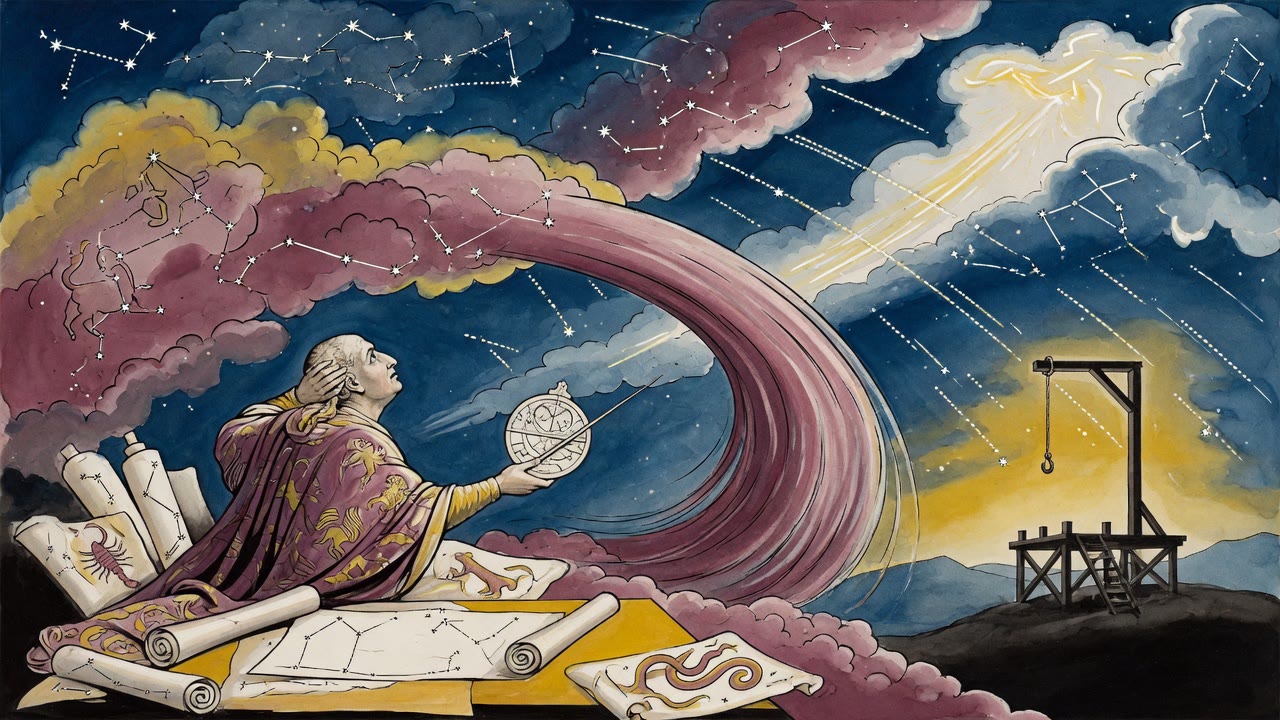
He cast the lot called Pur, throwing it against the turning of the zodiac. Month by month the signs answered, and month by month he read them for blood. When the wheel carried the Lion to the top of the sky, Leo riding high and unafraid, Haman stopped. The thirteenth of Adar. A lion, he reasoned, does not fall. He would gather every Jew under that one constellation and finish them in a single day.

He folded the calculation away like a man who has balanced his accounts. Every star counted. Every angle measured. He did not think to ask who had hung the stars.

The Court Above Weighed Why the Crown Sat on a Weathervane

Far over the roof, a different reckoning was under way. The question there was not which day, but why the crown sat on the head of Ahasuerus at all.

There is a rule for how a hollow man comes to rule. When lying judges multiply, lying witnesses multiply behind them. When informers multiply, the wealth of the people is carried off. When the brazen multiply, honor and majesty are stripped from a nation. When the young turn to the old and say, "I am better than you," the years of a people are cut short. And when beloved children grieve their Father in heaven, He raises over them a hollow king who collects the debt.

Ahasuerus was that king, raised for the snares of his own people. Why was he named a hypocrite? Because he killed his wife Vashti to please his friend Memukhan, and he would kill his friend Haman to please his wife Esther. He was a weathervane in a crown, turning to whichever voice spoke last. The man Haman flattered at every banquet was already marked in that court as the blade that would swing back on him.

The Conductor Leaped Like a Deer Toward the Darkest Hour

Beneath the whole plot ran a music Haman never heard. There is a title over the songs of Israel, "For the Conductor," and the sages read it as a name for God, who leaps like a deer to bring light to the world in its dark hour.

When is the hour truly dark? Not at midnight. At midnight the moon still hangs, the stars still burn, the constellations still turn, the very lamps Haman trusted with his verdict. The darkest moment comes at daybreak, when the moon has set, the stars have thinned, and the constellations begin to vanish from the sky. There is no darkness deeper than that seam between night and morning. Into that exact seam the Conductor raises the dawn.

This was the dread that once fell on Abraham in a deep sleep, the great darkness the sages named as Media in the days of Esther. The Lion that Haman pinned his hope on was a creature of the night. It would ride highest in the black hour before dawn, and then, at the Conductor's leap, it would pale and go out with every other star.

Mordecai Counted the Same Stars and Read Them for Life

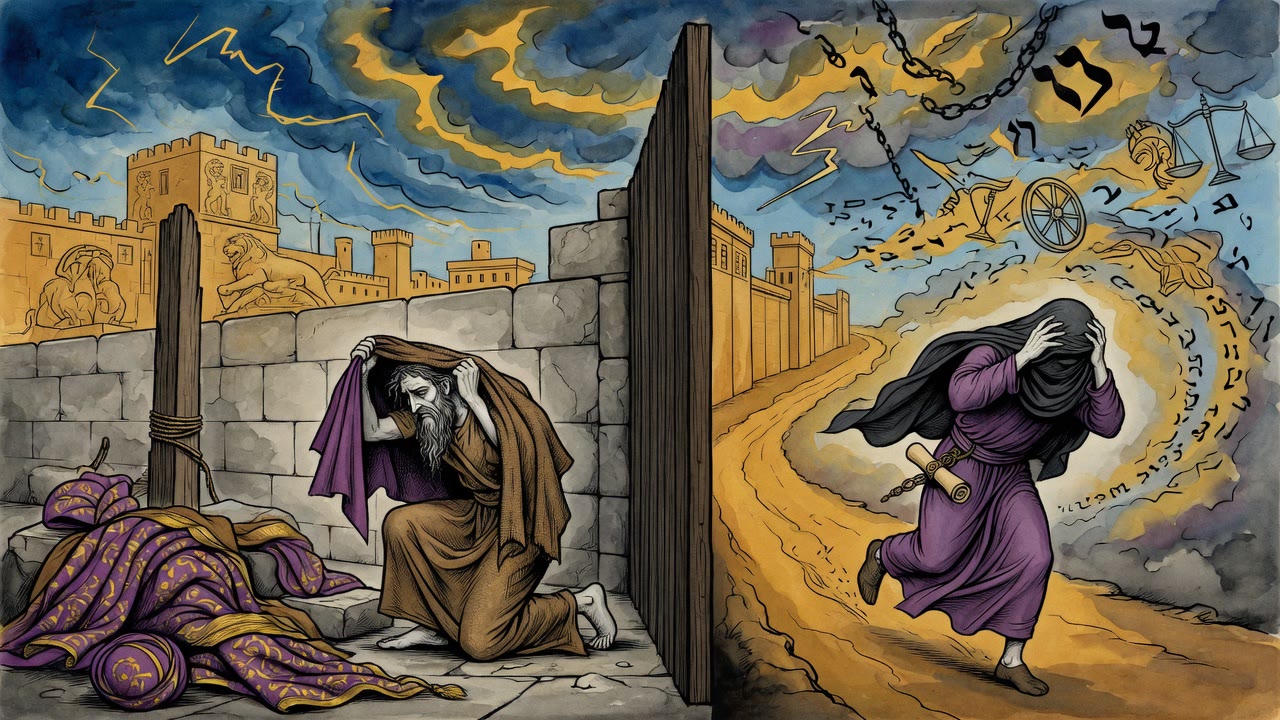
Down in the streets, Mordecai learned what had been sealed against his people, and he tore his clothes and cried out. He reminded God of an older count of stars, the promise sworn to Abraham that his children would be numbered like the host of heaven, too many to blot away. Haman had counted stars for a day of death. The covenant had counted the same stars for life.

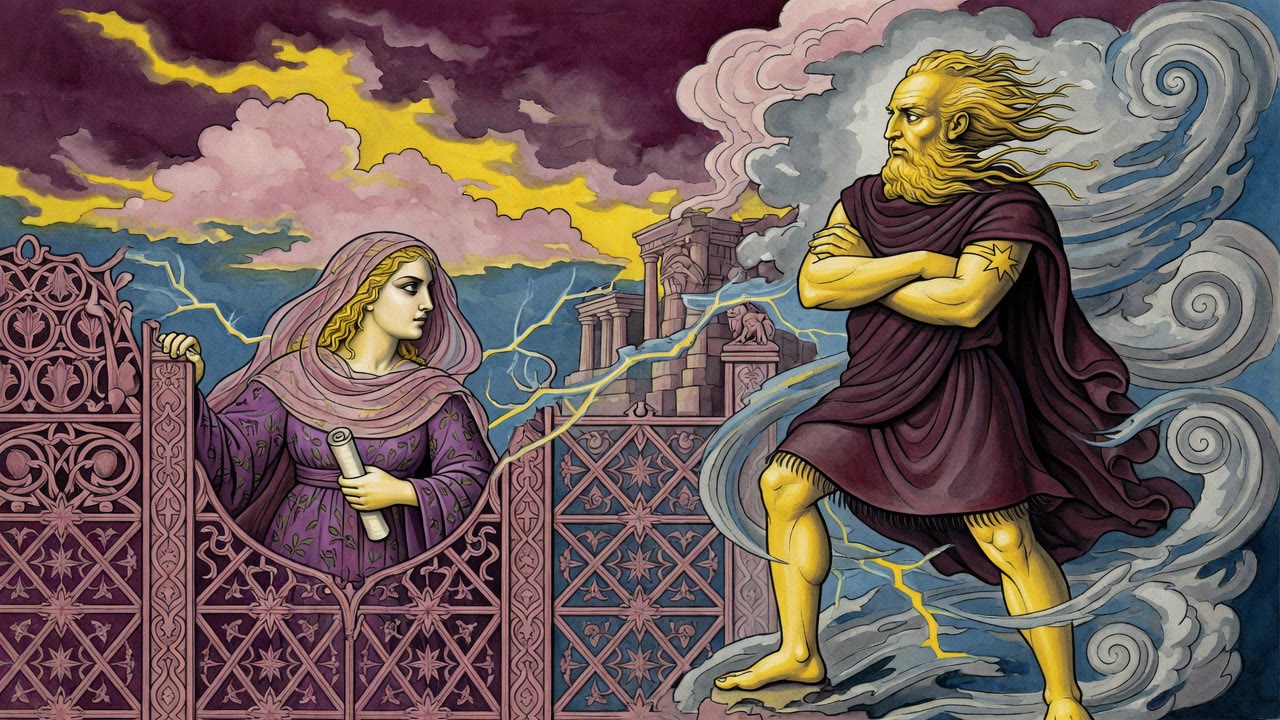
The word reached Esther, and it left her sick with fear. She sent her servant Hathach back and forth to Mordecai until Haman, watching the man cross the court once too often, had him killed. Stripped of her messenger, Esther chose the harder road. "Gather every Jew in Shushan," she said, "and fast for me three days, and neither eat nor drink."

The three days fell across Passover. Mordecai balked. "Is the third day of the fast not the night of Passover?" Esther answered him without a tremor. "If there is no Israel, for whom is there a Passover?" So Mordecai went and did it, and he broke the festival to keep the people breathing. The nation went down into the darkest seam of its night, fasting while the Lion still rode high.

Haman Walked Home Glad and Did Not Look Up

On the third day, Esther put on her royal robes and sent for the king, and for Haman, to a banquet she had spread with her own hands. Haman came. He left the first feast joyful and glad of heart, certain the queen had singled him out for honor above every man in the empire.

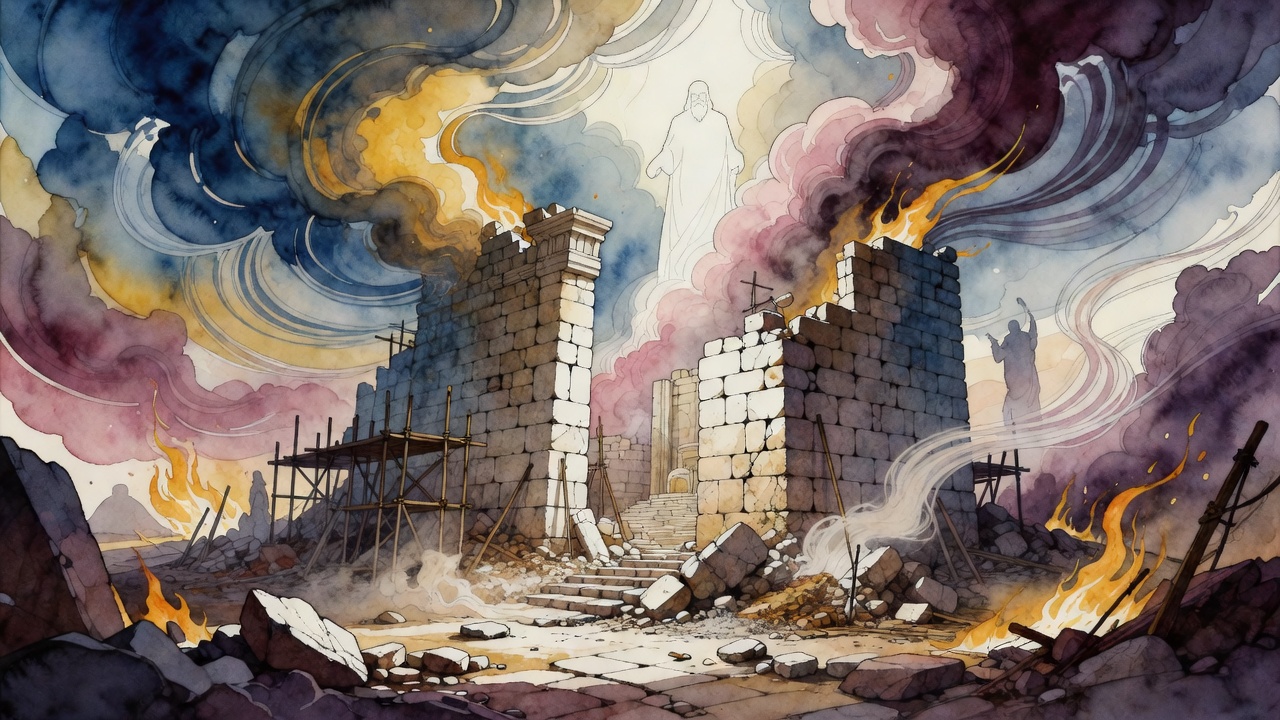
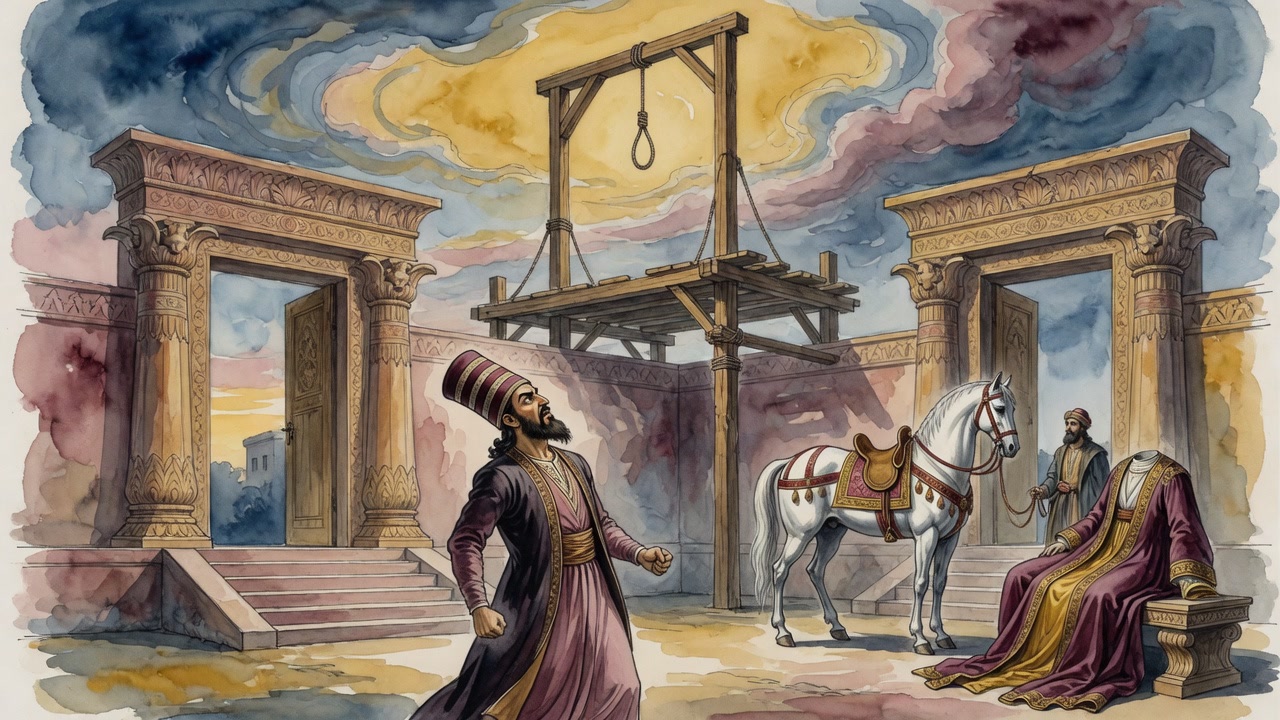
He had read every star. He had measured the ascendant Lion and set his day. He had never read the one thing above the stars, the Conductor who leaps like a deer and raises light in the blackest hour. The constellation he trusted was already sliding toward its setting. The dawn being raised over Haman would not break as a sunrise. In his own courtyard a gallows already stood, cut for another man, and it would take him instead.

He walked home under a sky he thought he owned, and the stars he had charted were going thin toward the hour when there is no darkness greater, and no darkness that holds.


← All myths
From the tradition

Sources

3 sources

The texts behind this telling. Some cards carry a translation of the source; others are our own retelling of it, and each card says which. Every card links out to the original.

Pirkei DeRabbi Eliezer 50:6Pirkei DeRabbi Eliezer

Retold in our words. Read the original at the link below.Pirke de Rabbi Eliezer, trans. Rabbi Gerald Friedlander, London (1916) · CC-BY

HAMAN wasn’t just a power-hungry villain; he was an astrologer! He meticulously cast lots – Pur, as the verse says – using the constellations to determine the most auspicious (or in this case, inauspicious) day to carry out his wicked decree (Esther 3:7). He wanted to annihilate all the Jews on the 13th of Adar, choosing that date because the constellation Leo was ascendant.

When MORDECAI learned of this, his reaction was one of profound grief and righteous anger. As the verse states, "And Mordecai knew all that was done" (Esther 4:1), and he cried out to God. He reminds God of the promise made to Abraham, Isaac, and Israel: to multiply their descendants like the stars (Exodus 32:13). He pleaded, how could God now deliver them like sheep to the slaughter?

ESTHER? The news hit her hard. "And the queen was exceedingly enfeebled" (Esther 4:4), the verse says. She sends HATHACH, her trusted servant, to find out what's happening with Mordecai. Now, this part takes a dark turn. Haman, ever the paranoid tyrant, sees Hathach going back and forth and, suspecting something, has him killed. Esther is left without a reliable messenger.

Desperate, Esther realizes she has to take action. She sends word to Mordecai: "Go, gather together all the Jews that are present in Shushan, and fast ye for me, and neither eat nor drink three days" (Esther 4:16). Now, here's where it gets really interesting. These days of fasting were the 13th, 14th, and 15th of Nisan – right during Passover!

Mordecai questions this: "Is not the third day (of the fast) the day of Passover?" Esther's response is striking: "If there be no Israel, wherefore is the Passover?" Her logic is brutal but clear. Survival takes precedence. According to Pirkei DeRabbi Eliezer, Mordecai agrees, even though it meant "he transgressed" (Esther 4:17), meaning he violated the laws of the festivals and Sabbaths. It's a stark illustration of pikuach nefesh, the principle that saving a life overrides almost all other religious considerations.

Finally, on the third day, Esther puts on her royal robes and invites the king and Haman to a banquet. And as they feast, Haman’s arrogance swells. As the text says, "Then went Haman forth that day, joyful and glad of heart" (Esther 5:9). He basks in the king's favor and Esther's attention, completely oblivious to the trap being set for him. He thinks he’s on top of the world. Little does he know…

What I find so compelling about this passage is the way it highlights the human drama within the larger narrative of the Purim story. We see Haman's meticulous plotting, Mordecai's fervent prayer, and Esther's courageous leadership, all interwoven with questions of Jewish law and destiny.

Full source
Yalkut Shimoni on Nach 685:2Yalkut Shimoni on Nach

Retold in our words. Read the original at the link below.Sefaria Community Translation · CC-BY

The Yalkut Shimoni, a fascinating collection of rabbinic commentary on the entire Hebrew Bible, touches on this very moment in section 685 on Nach (the books of Prophets and Writings).

It begins with an intriguing interpretation of "For the Conductor…". The Yalkut Shimoni suggests this refers to God, envisioning Him as leaping "like a deer." Why a deer? Because He "gives light to the world in [its] dark hour. God, full of energy and grace, bringing light precisely when it's needed most.

Wait a minute. Light in the dark? Isn't there already light at night? We have the moon, the stars, the constellations… So when is it truly dark?

The answer, according to the Yalkut Shimoni, is at daybreak. That precise instant, that cusp between night and day, when the moon has set, the stars have faded, and the constellations are beginning to disappear. "There is no darkness greater than at that hour," it declares. And it's in that very moment, that deepest, most profound darkness, that God raises the dawn and brings light to the world. It's not just about physical light, is it? This image speaks to something much deeper. It's about hope, resilience, and the unwavering promise that even in our darkest moments, light will eventually break through.

The passage then connects this idea to a verse from (Genesis 15:12): "And behold a great dark dread was falling upon him." The commentary interprets "dark" as referring to Medea (Media) "in the days of Esther." This is a fascinating connection, linking the primordial darkness before dawn with a specific historical period of Jewish vulnerability and fear, recalling the story of Esther where the Jewish people faced annihilation under the rule of Ahasuerus and the machinations of Haman.

The darkness before dawn, the dread felt by Abraham, the peril faced by Esther and her people – they’re all connected. They all speak to the same fundamental truth: that darkness, no matter how overwhelming, is never the final word.

What I find so powerful about this passage is its reminder that even when we feel most lost, most afraid, most alone in the dark, there is a force, a presence, that is working to bring light into our lives. It’s a message of hope that resonates across time, across cultures, and across personal experiences. So, next time you find yourself in a dark place, remember the leaping deer, remember the dawn, and remember that light is always on its way.

Full source
Yalkut Shimoni on Nach 920:10Yalkut Shimoni on Nach

Retold in our words. Read the original at the link below.Sefaria Community Translation · CC-BY

Jewish tradition certainly has words for those times. In fact, the Yalkut Shimoni, a vast and fascinating collection of rabbinic teachings and interpretations, points directly to some of the root causes. Specifically, the Yalkut Shimoni on Nach 920 gives us some sobering insights.

It all starts with a verse from the Book of Job (34:30): "From the kingship of the hypocritical man from the snares of the people." But what does it mean?

Abba Gurion, a sage from Sidon, sheds some light on this, quoting Rabban Gamliel. He outlines five things that go wrong, leading to the rise of, shall we say, "problematic" leadership.

First, “When lying judges multiply, lying witnesses multiply. Dishonesty at the top breeds dishonesty below. The legal system, meant to be a pillar of society, crumbles.

Next, “When informants multiply, the people's money is taken.” This one hits hard. When people are incentivized to snitch, to betray each other for personal gain, the community’s wealth is plundered. Trust erodes, and fear takes its place.

Then comes, “When brazenness multiplies, glory, majesty, and honor are taken from the people.”: When arrogance and audacity become the norm, respect for elders, for tradition, for what is truly noble, vanishes.

And here's a particularly poignant one: “When a younger says to an elder, 'I am better than you,' the years of people are shortened.” This isn't just about disrespect. It’s about a rejection of wisdom, of accumulated experience. It’s a societal short-circuit that ultimately diminishes us all.

Finally, and perhaps most importantly, “When the beloved children act in a way that angers their Father in Heaven, He raises above them a hypocritical king who exacts retribution from them.” Ouch. When we, as a people, stray from our values, from our ethical obligations, we open the door to rulers who reflect back our own failings.

The Yalkut Shimoni identifies King Ahashverosh as a prime example of this “hypocritical king.” He’s the one mentioned in the Book of Esther, the ruler whose story we celebrate every Purim.

But why Ahashverosh? Why single him out?

The text explains: “And why did the Holy Blessed One make a hypocritical man king? For the sake of the snares of the people.” It's a harsh but crucial point. Sometimes, we get the leaders we deserve – leaders who expose our own weaknesses and force us to confront them.

And why was Ahashverosh called hypocritical? Here's where the story gets even more interesting. “Because he killed his wife Vashti because of his friend Memukhan, and he killed his friend Haman because of his wife Esther. There is great hypocrisy there.” He's easily swayed, manipulated by those around him. He lacks a moral compass.

The Yalkut Shimoni concludes with a poignant observation. When people saw all this, the injustice, the instability, “they began to cry out, 'Woe!' (vay) – 'and so it was' (vay'hi) in the days of Ahasuerosh" (Esther 1:1). The very beginning of the Book of Esther, which launches a tale of redemption, is framed by this sense of collective grief and recognition of a broken world.

So, what's the takeaway? Perhaps it's this: that the quality of our leadership is inextricably linked to the quality of our own actions. That hypocrisy at the top is often a reflection of hypocrisy within ourselves. And that true change begins not with finding a better king, but with becoming better people. It's a sobering thought, but one worth pondering, especially in times when the world feels a little… tilted.

Full source