Hannah Demands a Child from the God of Hosts
Eli watched her lips move with no sound behind them and told her to sleep off the wine. She was not drunk. She was building a case out of her own body.
Table of Contents
 Click for full size
The Lips That Made No Sound
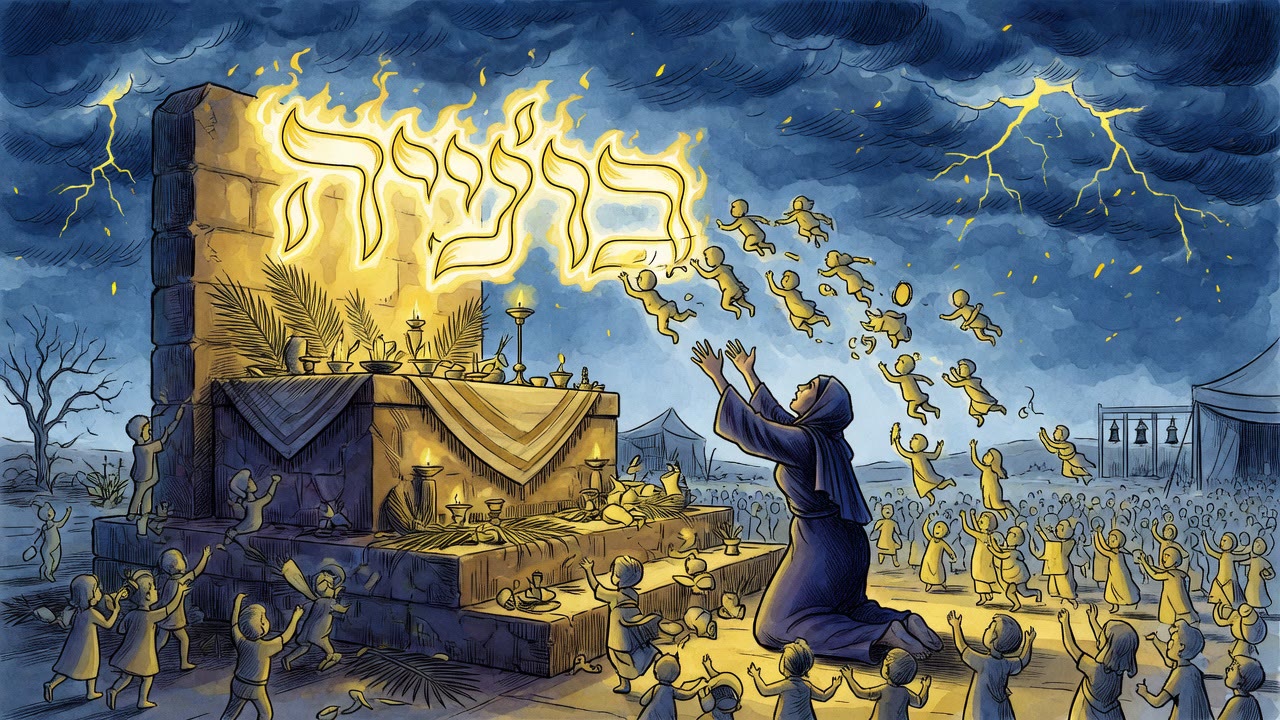
Hannah stood inside the shrine at Shiloh with her mouth working and nothing coming out of it. Eli sat by the doorpost and watched her from his seat. A woman rocking on her feet, lips moving, no voice. He had seen men come up to the festival and drink through the afternoon, and he told her what he told them. Put away your wine.
"I have drunk nothing," she said. "I am a woman of a hard spirit. I have been pouring out my soul in front of the Lord."
She had not come up to Shiloh to weep at the door. She had come to make an argument, and she did not want the priest handling it before God had heard it.
The Argument From the Body
"Master of the world," she said. "You have never made one thing for nothing."
She went through the body part by part, the way a woman goes through an inventory. Eyes, and You gave them seeing. Ears, and You gave them hearing. A mouth, and You gave it speech. A nose, and You gave it the smell of bread and smoke. Hands, and You gave them work to do. Not one organ hung on a person as decoration. Every one of them had a use, and the use had been handed down with the organ.
Then she came to herself.
"These breasts You set over my heart," she said. "What did You put them there for, if not to nurse with? Give me a child, and let them do the work You built them for."
It was not a plea. It was a claim pressed against the craftsman by the thing he had made. She stood in the sanctuary holding up the body she had been given and asked why one part of it had been left with nothing to do.
She Counted the Armies of Heaven
Then she called Him by a name no mouth had used. From the making of the world, no one had stood in front of the Holy One and said Lord of Hosts. Hannah said it, and then she made the name carry weight.
"All those armies," she said. "The ones that burn and the ones that sing and the ones that stand at the edge of the world holding it steady. You made every one of them and You command every one of them. Out of all those hosts, is one son so hard?"
The Poor Man at the Banquet Door
There was a king who made a feast for his servants. The hall filled. Every man at the tables had a portion in front of him, and the smell went out into the street.
A poor man came and stood in the doorway and asked the servants for one slice of bread. They looked past him. He asked again and they went on carrying dishes as if the doorway were empty.
So he shoved through them, into the hall, up to the table where the king sat, and stood there in his rags in front of the whole seated household.
"Out of all this," he said, "is one slice hard for you?"
That was Hannah at Shiloh. The feast was laid, the hall was full, every woman in Israel had her portion, and she pushed past the servants to say it to the King's face.
The Name Came Back Through Her Son
The Holy One came near her.
"Hannah. From the day I made the world, no one has praised Me with that name but you. By your life, your own son will stand up and open his mouth with it."
She went out and ate, and her face was not sad anymore. She bore Samuel and nursed him and weaned him and walked him back up to Shiloh and left him there with the old priest who had once taken her for a drunk.
Years later Samuel stood in front of Saul and began, "Thus says the Lord of Hosts. I have remembered what Amalek did to Israel." He was using his mother's word.
"You added to My armies by naming them," the Holy One had told her. "I will add to yours." Down her line came Heman the seer, and the record of his household says God gave him fourteen sons and three daughters, all of them raised up to lift the horn and sing.
← All myths