Translation of the source text.Pesikta Rabbati, ed. Meir Friedmann (Ish-Shalom), Vienna 1880 · Public Domain
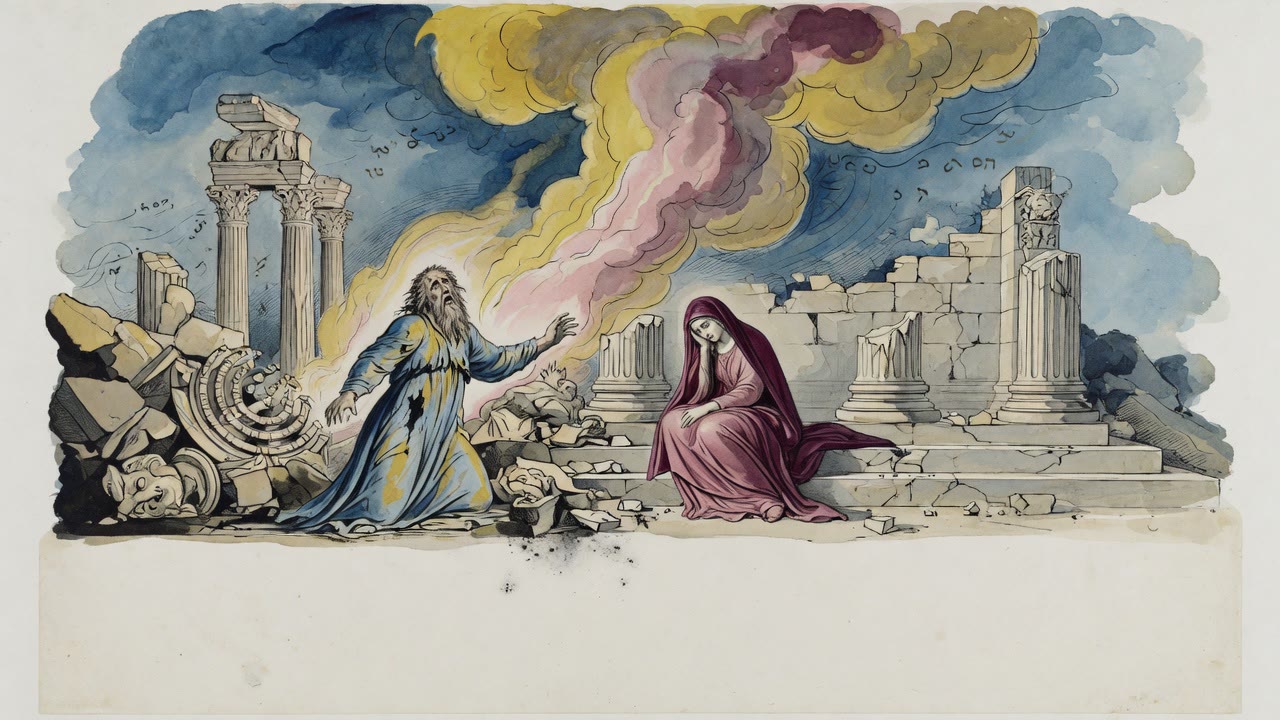
"She weeps sorely in the night" (Lamentations 1:2). Let our master teach us: may the priests immerse themselves for their terumah on the Ninth of Av? Rabbi Hanina, deputy of the priests, said: the house of our God is worthy that one immersion be lost over it (baraita, Taanit 13a). Needless to say, we must keep the destruction of the Temple in memory. The Holy One, blessed be He, said, "If I forget you, O Jerusalem, let My right hand forget" (Psalms 137:5). So too Jeremiah says, "My soul surely remembers and bows down within me" (Lamentations 3:20). As it were, see what is written about the honor of the Holy One, blessed be He: "The Lord, the LORD of hosts, called on that day to weeping and mourning" (Isaiah 22:12). And it says, "Therefore I said, Look away from me; I will weep bitterly" (Isaiah 22:4). As it were, the Holy One, blessed be He, said: just as there is weeping below, so before Me there is weeping above over what has happened. As it were, there is weeping before Me because I left My Shekhinah, as it is said, "This is My resting place forever" (Psalms 132:14). She weeps because I left the glory of My resting place from within her and abandoned her. From where do they read this matter? "She weeps sorely in the night."
"She weeps sorely in the night." Thus Rabbi Tanhuma son of Rabbi opened: this is what Scripture says, "Thus says the LORD: Let My eyes run down with tears night and day, and let them not cease" (Jeremiah 14:17). The Holy One, blessed be He, said to them: "She weeps sorely in the night. You weep in the night, and I weep day and night." Why? Because there is no sleep before Me, as it is said, "Behold, He who keeps Israel neither slumbers nor sleeps" (Psalms 121:4). "And you shall say this word: Thus says the LORD, Let My eyes run down with tears night and day." Scripture did not reveal whether the prophet said, "Let My eyes run down with tears," or not. But since it says "day and night," and it is impossible for flesh and blood to weep day and night, and since it says, "Who would make my head waters and my eyes a fountain of tears, that I might weep day and night over the slain of the daughter of my people" (Jeremiah 8:23), learn from this that it speaks of the Holy One, blessed be He, before whom there is no sleep, as it is said, "Behold, He who keeps Israel neither slumbers nor sleeps" (Psalms 121:4).
"She weeps sorely." Why two weepings? One weeping over her slain, and one weeping also over the famine that was there, when they ate the flesh of sons and daughters, as it is said, "The hands of compassionate women boiled their own children; they became their food" (Lamentations 4:10). Rabbi Yohanan said: just as the children of Zion ate the flesh of sons and daughters, so the women of Samaria ate the flesh of sons and daughters, as it is said, "There was a great famine in Samaria, and behold, they besieged it" (II Kings 6:25). "The king was passing over the wall, and a woman cried to him, saying, Help, my lord king. He said, If the LORD does not help you, from where shall I help you? From the threshing floor or from the winepress?" (II Kings 6:26-27). He said to her, "Am I God?" Even so, he turned back and received her words. He said to her, "What is with you?" as it is said, "The king said to her, What is with you? And she said, This woman said to me, Give your son, and let us eat him. So we boiled my son and ate him. Then I said to her... and she hid her son" (II Kings 6:28-29).
One who hears this might think she hid him alive. Rabbi Yohanan said: he had already been slaughtered and cooked, so she could eat him by herself. From where is this known? For it says, "I said to her, Give your son, and let us eat him." It does not write, "and let us slaughter him." This proves he had already been slaughtered and cooked. "The king said, So may God do to me, and more also, if the head of Elisha son of Shaphat remains on him today" (II Kings 6:31). Rabbi Yohanan said: in the first destruction and in the second destruction, fathers ate the flesh of sons and daughters. That is what Jeremiah laments over them: "Therefore fathers shall eat sons in your midst, and sons shall eat their fathers" (Ezekiel 5:10).
Another interpretation: why two weepings in "she weeps sorely"? One weeping over Jerusalem, and one weeping by the rivers of Babylon, as it is said, "By the rivers of Babylon, there we sat; we also wept" (Psalms 137:1). "She weeps sorely": she weeps over herself, and she weeps because Jeremiah separated from them. Why? Because he lightened the yoke from upon them. What would he do? He would put the iron collar on his own neck, and Nebuzaradan would remove it. Nebuzaradan would say to him, "You are injuring my life. The king may hear and say to me, Did I not command you concerning him?" as it is said, "Take him, and set your eyes on him, and do him no harm" (Jeremiah 39:12). He said to Jeremiah, "I see three things in you: a false prophet, a murderer, and one who kicks against suffering." Jeremiah answered in a compressed line preserved by the edition: the Holy One had said that the place needed to be destroyed, and if not by these hands, then by others. So he put himself into the collar.
The captors would drive the exiles. When they saw Jeremiah with them, they would walk more slowly. How did they drive them? They would take one of the captives, kill him, cut him limb from limb, and throw the pieces before the rest. The exiles would see and keep walking against their will, just as bandits do when they capture a flock, as it is said, "Upon our necks we are pursued" (Lamentations 5:5). Therefore they wept. This is "she weeps sorely in the night."
"How does she sit alone" (Lamentations 1:1). It is written, "You have not called upon Me, O Jacob, for you have grown weary of Me, O Israel" (Isaiah 43:22). When the idolatrous priest would come to one of them, he would say, "The idol told me that you do not want to sacrifice any of your children to it." That man would answer him, "They are under my authority, but each one of them is busy and occupied with his work. Wait for me. I have a small son, and he is in school, and I have no benefit from him. I will sacrifice him." Immediately he would take him, with one obscure word in the edition left uncertain. This is what is written, "You took your sons... whom you bore to Me" (Ezekiel 16:20). The Holy One, blessed be He, said: "To idols you sacrifice children and do not grow weary, but with Me you grow weary," as it is written, "for you have grown weary of Me, O Israel."
"You have not honored Me with your sacrifices" (Isaiah 43:23). The Holy One, blessed be He, said to them: "Did I burden you by requiring that you bring Me peace offerings? No, as it is written, 'If his offering is a sacrifice of peace offerings' (Leviticus 3:1). If one seeks to bring peace offerings, he brings them. 'I did not make you serve with a meal offering' (Isaiah 43:23). I did not burden you to bring Me a meal offering, as it is written, 'When a soul brings a meal offering to the LORD, his offering shall be fine flour' (Leviticus 2:1). 'I did not weary you with frankincense' (Isaiah 43:23). I did not tell you to bring pounds of frankincense, but only a handful, as it is written, 'He shall take from it his handful' (Leviticus 2:2). 'You have bought Me no sweet cane with money' (Isaiah 43:24). I did not tell you to bring pounds of incense, but only half a maneh in the morning and half a maneh in the evening."
Come and see. The idol of Micah stood in the west, and the Temple stood in Shiloh. Before Micah's image they would offer incense in thick clouds, as it is said, "A thick cloud of incense went up" (Ezekiel 8:11). In Shiloh they offered half a maneh in the morning and half a maneh in the evening. The two smokes would billow up and rise to heaven, as it is said, "They roll upward, proud columns of smoke" (Isaiah 9:17). The Holy One, blessed be He, would say, "Which shall We receive, this one or that one?" "But you have made Me serve with your sins" (Isaiah 43:24). The Holy One, blessed be He, said: "I used to call, 'Not so, My servant Moses' (Numbers 12:7), and 'He chose David His servant' (Psalms 78:70), and 'Fear not, My servant Jacob' (Isaiah 44:2). Through your sins you made Me call a wicked man My servant, as it is written, 'I will take Nebuchadnezzar king of Babylon, My servant' (Jeremiah 43:10)."
Another interpretation of "But you have made Me serve": the Holy One, blessed be He, said to them, "Through your sins you made Me go into exile to Babylon," as it is written, "For your sake I sent to Babylon" (Isaiah 43:14). "You have wearied Me with your iniquities" (Isaiah 43:24). The Holy One, blessed be He, said to them, "Your sins made Me occupy Myself and sit in weeping and lamentations," as it is written, "How does she sit alone" (Lamentations 1:1). Another interpretation: "How does she sit alone." Alone, all the world wonders over her, saying, "Why has the land perished and been scorched like a wilderness, without inhabitant?" "And the LORD said: because they forsook My Torah" (Jeremiah 9:11-12).
A parable: a king loved his son. He made him a golden necklace and hung it on his neck. The son did nothing but anger him. His father took the necklace from him, made shackles from it, and put them on his son's feet. So the Holy One, blessed be He, made the letters of Torah like a necklace and placed them on the necks of Israel, as it is said, "For they are a wreath of grace for your head and necklaces for your throat" (Proverbs 1:9), and "She will give your head a wreath of grace; she will shield you with a crown of glory" (Proverbs 4:9). They did nothing but forsake the Torah, as it is said, "They forsook My Torah and rejected it" (Jeremiah 6:19). So He wrote their letters as calamities and brought against them, "How does she sit alone."
Another interpretation: "How does she sit alone." What did the scroll see that caused it to be written in Jeremiah's name? There are four sons. One demanded the honor of the father but did not demand the honor of the son. One demanded the honor of the son but did not demand the honor of the father. Two demanded both the honor of the son and the honor of the father. Elijah demanded the honor of the Holy One, blessed be He, when he stood as accuser. The preserved passage breaks off here and turns to the consolation: "Comfort, comfort My people, says your God" (Isaiah 40:1).
This is what Scripture says: "Who would make you like a brother to me?" (Song of Songs 8:1). Like which brother? Not like Cain to Abel, for Cain killed Abel. Not like Ishmael to Isaac, for Ishmael hated Isaac. Not like Esau to Jacob, for Esau hated Jacob. Not like Joseph's brothers to Joseph, for Joseph's brothers hated Joseph. Rather, like Joseph to his brothers. After all the evils they had done to him, what is written? "Now do not fear. I will sustain you and your little ones" (Genesis 50:21). He comforted them and spoke words that were accepted by the heart. He said: if ten candles could not extinguish one candle, how could one candle extinguish ten? "He comforted them and spoke to their heart" (Genesis 50:21).
Israel said to Him, "Master of the Universe, come and see Joseph. After all the evils his brothers did to him, he stood and comforted them and spoke to their heart. We too know that through our sins we destroyed Your house, killed Your prophets, and transgressed all the commandments in the Torah. Still, 'Who would make you like a brother to me?'" Asaph the prophet also said, "Give ear, Shepherd of Israel, who leads Joseph like a flock" (Psalms 80:2). The Holy One, blessed be He, said to them, "You seek Me through Joseph? I will become for you like Joseph. What did Joseph do for his brothers? He comforted them and spoke to their heart. So you too: 'Comfort, comfort My people, says your God. Speak to the heart of Jerusalem'" (Isaiah 40:1-2).
Another interpretation of "Comfort, comfort": this is what Scripture says, "How then do you comfort me with vanity, when your answers remain false?" (Job 21:34). Rav Abba bar Kahana and our rabbis in the south differed. Rav Abba bar Kahana said: lies remained in them, as in "committing a trespass against the LORD" (Leviticus 5:21). Our rabbis in the south said: their answers do not cleanse. The first ones do not resemble the last ones, and the last ones do not resemble the first ones. What is the matter? The Holy One, blessed be He, sent the prophets to go and comfort Zion.
Hosea came and said to her, "Stand and receive the cup of consolations. The Holy One, blessed be He, sent me to you to comfort you." She said to him, "What is in your hand?" He said to her, "Thus the Holy One, blessed be He, said to me: that anger is canceled. From now on, 'I will be like dew to Israel'" (Hosea 14:6). She said to him, "Hosea, your consolations are given back to you. Yesterday you said, 'I became to them like a lion; like a leopard... I will meet them like a bear bereaved of her cubs' (Hosea 13:7-8), and now you say, 'I will be like dew to Israel.' Which shall we believe, the first words or the last words? They are consolations of vanity. 'How do you comfort me with vanity?' Because 'your answers remain false.'"
Joel came and said to her, "Stand. Receive the cup of consolations." She said to him, "What is in your hand and what is in your cup?" He said to her, "The Holy One, blessed be He, told me that when He redeems you, the mountains are destined to drip sweet wine for you: 'It shall be on that day, the mountains shall drip sweet wine'" (Joel 4:18). She said to him, "Your consolations are given back to you. Yesterday you said to me, 'Wail, all drinkers of wine, over the sweet wine' (Joel 1:5), and now you say, 'The mountains shall drip sweet wine.' Which shall we believe, the first words or the last words? How do you comfort me with vanity, and why? Because your answers remain false. 'I have heard many such things. Miserable comforters are you all'" (Job 16:2).
Amos came and said to her, "Stand and receive the cup of consolations." She said to him, "What is in your hand and what is in your cup?" He said to her, "The Holy One, blessed be He, told me that He is restoring your captivity and building the Temple: 'On that day I will raise up the fallen booth of David'" (Amos 9:11). She said to him, "Your consolations are given back to you. Yesterday you said, 'Fallen, she shall not rise again' (Amos 5:2), and now you say this. Which shall we believe?" Thus far, "miserable comforters are you all." Obadiah prophesied to Edom, and Jonah to Nineveh.
Nahum came, and she said to him, "What is in your hand?" He said to her, "The Holy One, blessed be He, told me: say to her, Your salvation is near, and behold, your herald comes leaping on the mountains: 'Behold upon the mountains the feet of one who announces, who proclaims peace. Celebrate your festivals, O Judah; fulfill your vows; for the wicked one shall no more pass through you. He is entirely cut off'" (Nahum 2:1). She said to him, "Nahum, your consolations are given back to you. Yesterday you said, 'From you came one who plots evil against the LORD, a counselor of Belial' (Nahum 1:11), and now you say, 'The wicked one shall no more pass through you.' Which shall we believe?"
Zephaniah came. He too said to her, "Stand and receive the cup of your consolations." She said to him, "What is in your cup?" He said to her, "Sing, daughter of Zion," the whole matter through "At that time I will bring you in, and at the time when I gather you" (Zephaniah 3:14-20). She said to him, "Yesterday you said to me, 'I will utterly sweep away everything from the face of the earth' (Zephaniah 1:2), and now you gather the exiles, 'At that time I will bring you in, and at the time when I gather you.'" Haggai came and said to her, "Stand and receive the cup of consolations." She said to him, "What is in your cup?" He said to her, "Is the seed still in the barn? The vine, the fig tree, the pomegranate, and the olive tree have not yet borne; from this day I will bless" (Haggai 2:19). She said to him, "Haggai, yesterday you said to me, 'I called for a drought upon the land, upon the grain, upon the new wine, and upon the oil' (Haggai 1:11), and now you say, 'Is the seed still in the barn?' Which shall we believe?"
Zechariah came and said to her, "Stand and receive the cup of your consolations." She said to him, "What is in your hand? What is in your cup?" He said to her, "The Holy One, blessed be He, told me: 'I am very greatly angry with the nations that are at ease'" (Zechariah 1:15). She said to him, "Yesterday you said to me, 'The LORD was greatly angry with your fathers' (Zechariah 1:2), and now you say this." Malachi came to comfort her and said, "All nations will call you happy, for you shall be a land of delight, says the LORD of hosts" (Malachi 3:12). She said, "Yesterday you said, 'I have no pleasure in you, says the LORD of hosts' (Malachi 1:10), and now you say, 'You shall be a land of delight.' Which shall we believe?" They all came before the Holy One, blessed be He, and said to Him, "Master of the Universe, we sought to comfort her, but she did not accept." The Holy One, blessed be He, said to them, "Come with Me. I and you will go to her and comfort her: 'Comfort, comfort My people, says your God'" (Isaiah 40:1).
Another interpretation of "Comfort, comfort My people." Rabbi Berekhiah the priest said: "Comfort Me, comfort Me, My people." In the practice of the world, if a person has a vineyard and bandits come and cut it down, whom do they comfort, the vineyard or the owner of the vineyard? Likewise, if a person has a house and bandits come and burn it, whom do they comfort, the house or the owner of the house? You are My vineyard, "For the vineyard of the LORD of hosts is the house of Israel" (Isaiah 5:7). Nebuchadnezzar came, destroyed it, exiled you, and burned My house. I am the one who needs to be comforted. "Comfort Me, comfort Me, My people."
Another interpretation of "Comfort, comfort My people": everything Jeremiah struck and broke, Isaiah came and healed. Jeremiah broke and said, "How does she sit alone... she has become like a widow" (Lamentations 1:1). Isaiah came and said, "As a young man marries a virgin" (Isaiah 62:5). Jeremiah struck and said, "She weeps sorely" (Lamentations 1:2). Isaiah came and healed: "You shall weep no more" (Isaiah 30:19). Jeremiah struck and said, "Judah has gone into exile" (Lamentations 1:3). Isaiah came and healed: "He will gather the dispersed of Judah" (Isaiah 11:12). Jeremiah struck and said, "The roads of Zion mourn" (Lamentations 1:4). Isaiah came and healed: "A voice calls in the wilderness: prepare the way of the LORD" (Isaiah 40:3). Jeremiah struck and said, "Her adversaries have become the head" (Lamentations 1:5). Isaiah came and healed: "The sons of those who afflicted you shall come bending low to you, and all who despised you shall bow down" (Isaiah 60:14).
Jeremiah struck and said, "From the daughter of Zion all her splendor has departed" (Lamentations 1:6). Who is her splendor? The Holy One, blessed be He, of whom it is written, "You are clothed with glory and splendor" (Psalms 104:1). Isaiah came and healed: "I saw Him coming: Who is this coming from Edom... this One splendid in His apparel?" (Isaiah 63:1). Jeremiah struck and said, "Jerusalem remembered" (Lamentations 1:7). Isaiah came and healed: "The former things shall not be remembered" (Isaiah 65:17). Jeremiah struck and said, "Jerusalem sinned a sin" (Lamentations 1:8). Isaiah came and healed: "I have blotted out your transgressions like a cloud" (Isaiah 44:22). Jeremiah struck and said, "Her impurity is in her skirts" (Lamentations 1:9). Rabbi Joshua ben Haninah said: Isaiah spoke a hard word, "When the Lord has washed away the filth of the daughters of Zion" (Isaiah 4:4).
Jeremiah struck and said, "The adversary has spread his hand over all her precious things, for she saw nations enter her sanctuary, concerning whom You commanded that they should not enter Your congregation" (Lamentations 1:10). A royal palace was given over to plunder. One plundered silver, another plundered gold, and the slave came back looking for his deed. So when the Temple was destroyed, one plundered silver and another plundered gold, while Ammon and Moab came back seeking the Torah in order to erase from it, "An Ammonite or Moabite shall not enter the congregation of the LORD" (Deuteronomy 23:4). That is why Jeremiah said, "they should not enter Your congregation." Isaiah said, "The uncircumcised and the unclean shall no more enter you" (Isaiah 52:1).
Jeremiah struck: "All her people sigh; they seek bread" (Lamentations 1:11). An example is Avika ben Gavti. When the enemies came to surround Jerusalem, Avika went up to the top of the wall. There is no end to telling their might. Do you want to know the might of Avika ben Gavti? When the enemies came to surround Jerusalem, Avika went up to the top of the wall. When they sent a stone from the ballista, as soon as Avika saw it coming toward the wall, he would brace himself, kick it with his foot, and send it back against them. What did the enemies do? They sent it short, so it would not strike the wall but would arrive before the wall. Avika thought it was coming with force. He braced himself to go out and push it back against them with his foot, and he fell between the walls, for Jerusalem had two walls, one inside the other. When the people of Jerusalem saw that Avika had fallen, they were afraid. Avika said to them, "Do not fear. It is only a blow. I was not harmed at all." They slaughtered an ox for him, roasted it, and he ate it. Then he went up to the top of the wall and fought with them as he had fought at first.
There was an incident with Miriam daughter of Nakdimon. She was awaiting levirate marriage, and she came before Rabbi Zadok. He assigned her twenty-five litras of silver for baskets of spices for her food and two seahs of wine for her cooking each and every Sabbath. She said to him, "May you assign the same to your daughters." When the famine came, her hair fell out from hunger. Rabbi Zadok saw her going around with her father in the marketplace. He said, "Is this the same Miriam for whom you assigned such and such each Sabbath and who cursed you?" Rabbi Zadok said, "May this come upon me if I did not see her gathering barley bran from animal dung, and I recited over her this verse: 'If you do not know, O fairest among women, go out by the footsteps of the flock'" (Song of Songs 1:8). The Holy One, blessed be He, said: "In this world you were transformed by famine. In the future you will be transformed by plenty. One who sees you today says, 'Are these they?' One who sees you tomorrow will say, 'Are these they?'" From where? For Isaiah said, "You shall eat the wealth of nations, and in their glory titayyamaru" (Isaiah 61:6). What is titayyamaru? Exchange, as in "if he will indeed exchange it" (Leviticus 27:10).
Jeremiah struck and said, "Is it nothing to you, all who pass by?... Is there any pain like my pain?" (Lamentations 1:12). Isaiah came and healed: "The redeemed of the LORD shall return and come to Zion with singing" (Isaiah 35:10). Jeremiah said, "From on high He sent fire into my bones" (Lamentations 1:13). Isaiah came and healed: "Until a spirit is poured upon us from on high" (Isaiah 32:15). Jeremiah struck and said, "The yoke of my transgressions is bound... He has made my strength fail" (Lamentations 1:14). Isaiah came and healed: "Those who hope in the LORD shall renew their strength" (Isaiah 40:31). Jeremiah said, "The Lord has rejected all my mighty ones" (Lamentations 1:15). Isaiah came and healed: "I will bring healing up for you, and from your wounds I will heal you, says the LORD" (Jeremiah 30:17). Jeremiah said, "For these things I weep; my eye, my eye runs down with water" (Lamentations 1:16). Isaiah said, "For eye to eye they shall see" (Isaiah 52:8). Jeremiah struck and said, "Zion spreads out her hands; there is no comforter for her" (Lamentations 1:17). Isaiah said, "Comfort, comfort My people, says your God" (Isaiah 40:1).

 Click for full size