5 min read

Jerusalem Sat Alone in the Ruins Like a Widow

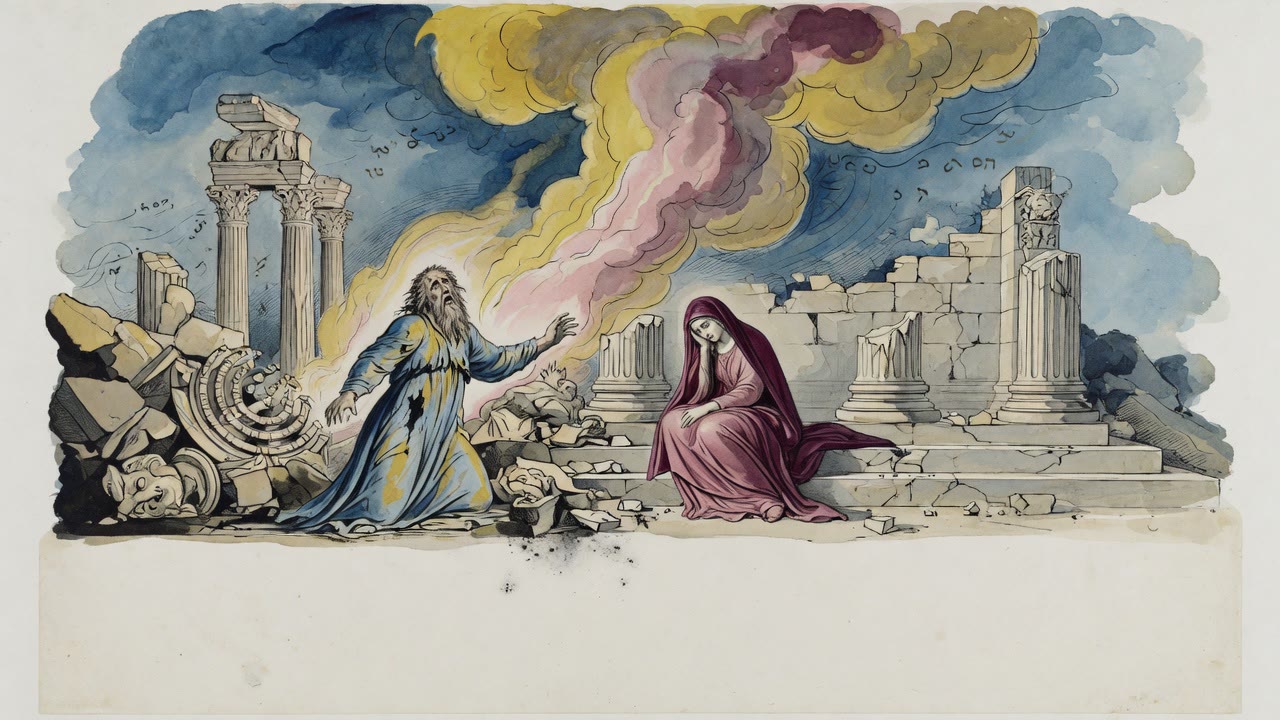
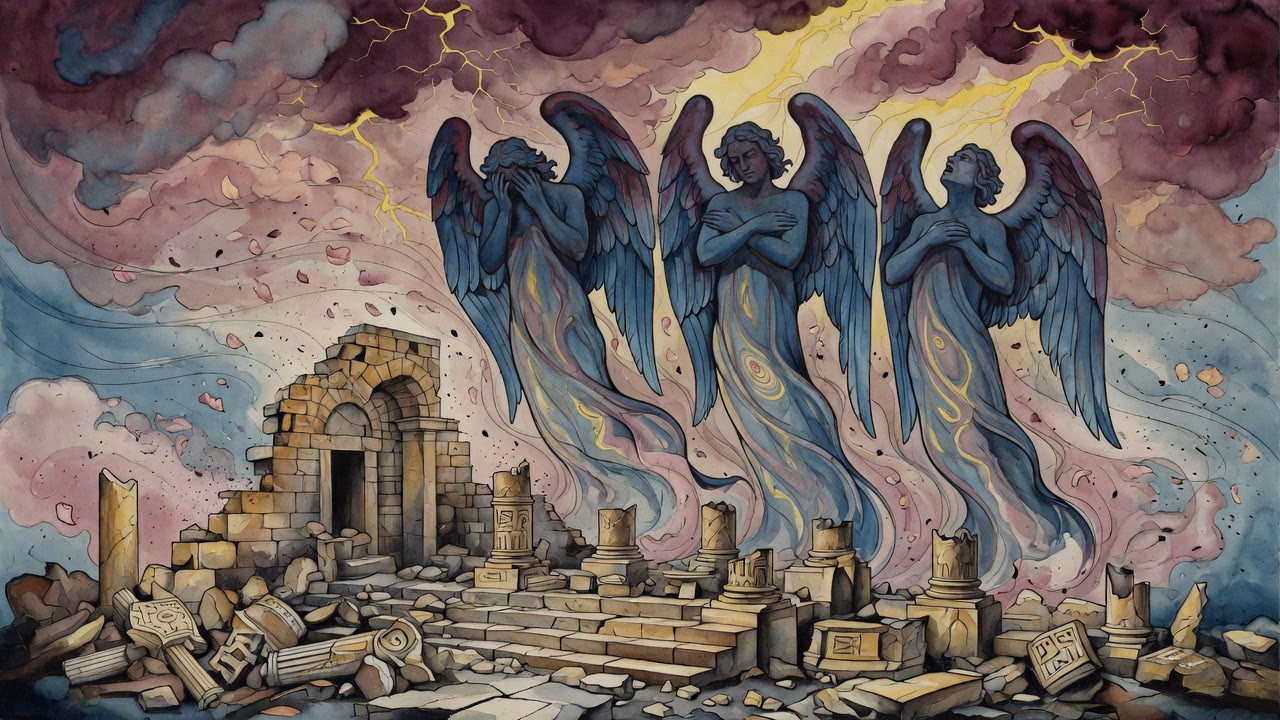
The Book of Lamentations gave Jerusalem a voice and called her a widow. Jeremiah wept beside her in the rubble while God refused to look away.

Curated by Arthur · Told by Maggid ·
Table of Contents
  1. The One Hebrew Word
  2. What He Found in the Streets
  3. Jerusalem Speaks
  4. God in the Ruins
  5. The Structure of Grief

The One Hebrew Word

The book opens with a single Hebrew word: Eichah. How. Not why. Not when will it end. Not who is responsible. Just: how has it come to this. How is it that she who was great among the nations sits alone.

The rabbis attributed these poems to Jeremiah, the prophet who had spent decades watching the catastrophe approach and being ignored. He had warned the kings. He had gone to the Temple courts and spoken. He had been thrown in a cistern, accused of treason, mocked by the priests and the prophets who kept telling the city what it wanted to hear. Now the city had fallen and the people who mocked him were dead or in chains, and Jeremiah sat in the rubble and wrote the most grief-saturated text in the Hebrew Bible.

What He Found in the Streets

When the Babylonians marched the captives north, Jeremiah went among them looking for anyone he knew. He found women he recognized from the Temple courts, daughters of prominent families who had been part of the ceremonies and celebrations of Jerusalem's public life. They were in chains. They were being marched. The dignity with which they had moved through the city was gone and could not be recalled.

The Legends of the Jews records that Jeremiah wept for these women specifically. They represented something about what the city had been that could not be recovered through theology or explanation. The city had had a way of life that was beautiful, and the beauty was now specifically and permanently absent. The weeping was not abstract. It was for faces he had known.

Jerusalem Speaks

The Book of Lamentations does something unusual: it gives Jerusalem a voice. The city personified as a woman speaks in the first person. She says: Is it nothing to you, all you who pass by? Look and see if there is any pain like my pain. She speaks as someone who has been abandoned by everyone who should have helped: her lovers have all betrayed her, her allies have turned against her, her priests are groaning, her virgins are grieving.

The midrash on Lamentations, Eikhah Rabbah, reads the phrase she has become like a widow with careful attention. The Hebrew is ke-almanah, like a widow, not almanah, a widow. The distinction matters. A widow is a woman whose husband is dead. But God is not dead. This is a woman whose husband has, for now, turned his face away. The absence is real. But it is not permanent. She is like a widow, in the condition of widowhood, not in the finality of it.

That single letter kaf, like, is where the hope lives, buried under everything.

God in the Ruins

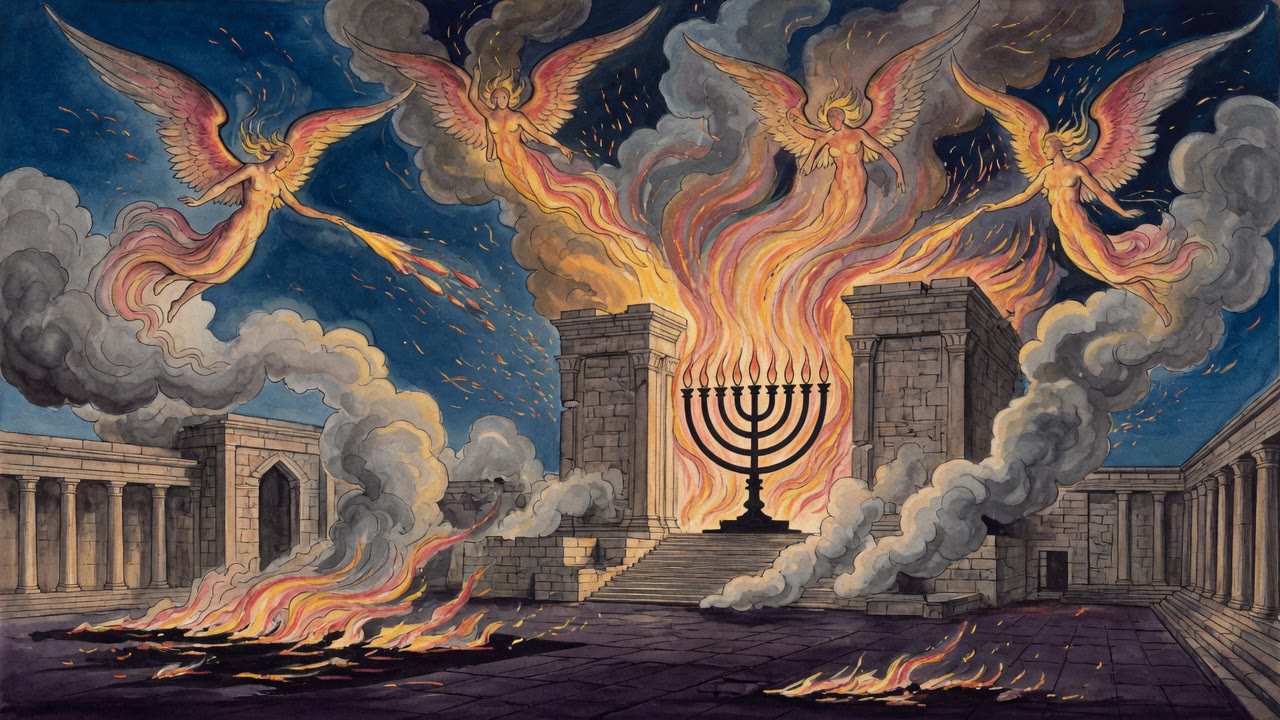
Where was God while this was happening? The rabbinic texts do not permit a clean answer. They say God called the angels to come and see what had been done to the house. They say God wept. They say the divine presence did not leave the Western Wall. They say God told Abraham and the patriarchs and Moses what had happened to their descendants, and the grief in heaven was as real as the grief on the ground.

Eikhah Rabbah records a moment when God is imagined finding the destroyed Temple and speaking to it directly: Where are the priests? Where is David? The Temple responds with silence. The silence is the answer. They are gone. Everything that gave this place its function is gone.

The tradition is not interested in a God who watches destruction serenely. It insists on a God who suffers the destruction, who permitted it for reasons the texts will not fully resolve, who weeps over the permission even as it stands.

The Structure of Grief

The five poems of Lamentations follow the Hebrew alphabet as their organizing principle. Most of the chapters have twenty-two verses, one for each letter, moving from aleph to tav without omitting anything. This is how you grieve without losing your mind: you use the structure already present in the language itself. You let the alphabet hold what your heart cannot. You move from aleph to tav, beginning to end, because grief that has no structure collapses, and grief that has too much structure becomes performance, and the alphabet is exactly the right amount of shape for something this large.

The rabbis said the three uses of Eichah in the Hebrew Bible, in Isaiah, in Jeremiah, and here, were all addressed to Jerusalem. The same word for the same grief in three registers: prophetic warning, prophetic elegy, and raw lament. The city's destruction was not a surprise to anyone paying attention. That is part of what makes the weeping so devastating. It was preventable. The prophets had said so, repeatedly, for a century. And here is the aftermath anyway.


← All myths

From the tradition

Sources

4 sources

The texts this telling draws on, in full. Open a card to read inline, or expand it for a wider, quieter read.

Eikhah Rabbah 1:1Eikhah Rabbah

“How does the greatly crowded city sit alone? She has become like a widow. Great among the nations, a princess among the states: She has become a vassal” (Lamentations 1:1).“How [eikha] does…sit [alone].” Three prophesied with the term eikha: Moses, Isaiah, and Jeremiah. Moses said: “How [eikha] can I bear alone…” (Deuteronomy 1:12). Isaiah said: “How [eikha] did [the faithful city] become a harlot?” (Isaiah 1:21). Jeremiah said: “How [eikha] does [the greatly crowded city] sit alone?” Rabbi Levi said: This is analogous to a noblewoman who had three friends. One saw her in her tranquility, one saw her in her debauchery, and one saw her in her disgrace. So, Moses saw them in their glory and their tranquility and said: “How [eikha] can I bear alone your troubles?” Isaiah saw them in their debauchery and said: “How [eikha] did [the faithful city] become a harlot?” Jeremiah saw them in their disgrace and said: “How [eikha] does [the greatly crowded city] sit [alone]?”They asked ben Azai, saying to him: ‘Our teacher, expound for us one matter from the scroll of Lamentations.’ He said to them: ‘Israel was exiled only after they denied the Unique One of the world, circumcision that was given after twenty generations, the Ten Commandments, the five books of the Torah; the numerical value of eikha.’1Alef, the Unique One of the world; yod, the Ten Commandments; kaf, twenty generations; heh, five books of Moses.Rabbi Levi said: Israel was exiled only after they denied the thirty-six instances of karet in the Torah and the Ten Commandments, the numerical value of “how does…sit solitary [eikha yasheva badad]?”2Eikha: Alef -1, yod – 10, kaf – 20, heh – 5 = 36. Badad: Beit – 2, dalet – 4, dalet – 4 = 10.Rabbi Berekhya [said] in the name of Rabbi Avdimai of Haifa: [This is analogous] to a king who had a son. When he would perform his father’s will, [the king] would clothe him in fine silk, and when he would not perform his will, he would clothe him in the garments of an olive-press worker [badad]. So too Israel, as long as they would perform the will of the Holy One blessed be He, it is written: “I clothed you in embroidery” (Ezekiel 16:10). Rabbi Sima said: Purple garments. Onkelos translated: Embroidered garments. But when they do not perform the will of the Holy One blessed be He, He clothes them in the garments of olive-press workers. That is what is written: “How does…sit solitary [badad]?”Rav Naḥman said that Shmuel said in the name of Rabbi Yehoshua ben Levi: The Holy One blessed be He summoned the ministering angels and said to them: ‘A flesh and blood king, when a relative of his dies and he mourns, what does he typically do?’ They said to Him: ‘He hangs sackcloth on his entrance.’ He said to them: ‘I, too, will do so.’ That is what is written: “I clothe the heavens in blackness and I place sackcloth as their garment” (Isaiah 50:3). ‘A flesh and blood king, what [else] does he typically do?’ They said to Him: ‘He extinguishes the lamps.’ He said to them: ‘That is what I will do,’ as it is stated: “The sun and the moon darkened and the stars withdrew their shining” (Joel 4:15). ‘A flesh and blood king, what does he typically do?’ ‘He overturns the beds.’ ‘That is what I will do,’ as it is stated: “Until thrones were set in place and the Ancient One sat” (Daniel 7:9), [implying,] as it were, that they had been overturned.3Beds were a general term for anything one would sit on. The fact that the thrones, in this verse, were set in place, implies that previously they had been overturned as a sign of mourning. ‘A flesh and blood king, what does he typically do?’ ‘He walks barefoot.’ ‘That is what I will do,’ as it is stated: “His path is in tempest and in storm, and clouds are the dust of His feet” (Nahum 1:3). ‘A flesh and blood king, what does he typically do?’ ‘He rends his purple garments.’ ‘That is what I will do,’ as it is stated: “The Lord accomplished what He devised; He implemented [bitza] His statement [emrato]” (Lamentations 2:17). Rabbi Yaakov of Kefar Ḥanan explained it: What is bitza emrato? It is that He rent His purple garments.4The word rent, or tear, in Aramaic, biza, is similar to bitza. The word emrato is spelled the same as imrato, which in rabbinic parlance means the edge of one’s garment (Matnot Kehuna). ‘A flesh and blood king, what does he typically do?’ ‘He sits in silence.’ ‘That is what I will do,’ as it is stated: “Let him sit alone and be silent” (Lamentations 3:28). ‘A flesh and blood king, what does he typically do?’ ‘He sits and weeps.’ ‘That is what I will do,’ as it is stated: “The Lord, God of hosts, called on that day for weeping and for lamentation and for baldness” (Isaiah 22:12).Another matter: Eikha, Jeremiah said to them: ‘What did you see in idol worship that you are so enthusiastic to follow it? If it had a mouth to engage in debate, we would have said this.5We would have proven the falseness of idolatry and the idols themselves would have had to concur. The word eikha is being interpreted as two words: Ei, ka, “if…this” (Etz Yosef). Instead, we will speak of it and we will speak of Him.’ We will speak of it, “So said the Lord: Do not learn the way of the nations, and from the signs of the heavens do not be frightened, though the nations are frightened by them” (Jeremiah 10:2). We will speak of Him: “Tell them this: The gods who did not make the heavens and the earth shall vanish from the earth and from under these heavens. [He makes the earth with His might]” (Jeremiah 10:11–12). “The Portion of Jacob is not like these, for He is the one who forms everything, and Israel is the tribe of His inheritance, the Lord of hosts is His name” (Jeremiah 10:16).Rabbi Yehuda and Rabbi Neḥemya, Rabbi Yehuda says: The term eikha is nothing other than an expression of reproof. That is what is written: “How [eikha] can you say: We are wise, and the law of the Lord is with us...”? (Jeremiah 8:8). Rabbi Neḥemya says: The term eikha is nothing other than an expression of lamentation. That is what is written: “The Lord God called to the man, and said to him: Where are you [ayeka]?” (Genesis 3:9), woe are you [oy lekha]. When was the scroll of Lamentations composed? Rabbi Yehuda says: It was composed in the days of Yehoyakim.6This was before the destruction of Jerusalem and the Temple. This is consistent with Rabbi Yehuda’s view that the term eikha is a term of reproof. In his view, Lamentations, or Eikha, was composed as a warning before the destruction. Rabbi Neḥemya said to him: ‘Does one weep over the dead before he dies? Rather, when was it composed? After the destruction of the Temple. This is its solution: “How [eikha] does…sit solitary?”’7This phrase implies that Jerusalem was already desolate.

Full source
Eikhah Rabbah 1:3Eikhah Rabbah

“She has become like a widow.” Rabbi Abba bar Kahana said: They did not go to extremes vis-à-vis the attribute of justice, and the attribute of justice did not go to extremes in their regard.11They did not sin in an extreme fashion and they were not punished in an extreme fashion (see Matnot Kehuna; Maharzu). They did not go to extremes vis-à-vis the attribute of justice, as it is stated: “The people were like complainers” (Numbers 11:1). “Complainers” is not written here, but rather, “like complainers.” “The princes of Judah were like those who move boundaries” (Hosea 5:10). “Those who move boundaries” is not written here, but rather, “like those who move boundaries.” “For like a wayward cow [Israel has strayed]” (Hosea 4:16), “For a [wayward] cow” is not written here, but rather, “like a wayward cow.” The attribute of justice, too, did not go to extremes in their regard. “She has become like a widow”, “A widow” is not written here, but rather, “like a widow”, like a woman whose husband went to a country overseas and plans to return to her. “He drew His bow like an enemy” (Lamentations 2:4), “enemy” is not written here, but rather, “like an enemy.” “The Lord was like an enemy” (Lamentations 2:5), “enemy” is not written here, but rather, “like an enemy.”Another matter, “she has become like a widow.” Rabbi Ḥama bar Ukeva and the Rabbis, Rabbi Ḥama bar Ukeva said: [This is analogous] to a widow who was demanding her sustenance but was not demanding her marriage contract.12After a man’s death, his widow may choose to continue to live in his home and to be supported by his estate. She may also leave and demand payment of the sum specified in her marriage contract. Israel is compared here to a widow who chooses to be supported by her late husband’s estate rather than leaving and cutting all ties to her husband. The Rabbis said: [This is analogous] to a king who grew angry at the queen and wrote her a bill of divorce and then snatched it from her. Any time that she sought to marry another, he would say to her: ‘Where is your bill of divorce?’ Any time she would demand her sustenance, he would say to her: ‘Have I not already divorced you?’ So too, any time Israel would seek to engage in idol worship, the Holy One blessed be He would say to them: “Where is your mother’s bill of divorce?” (Isaiah 50:1). Any time they request that He perform miracles on their behalf, the Holy One blessed be He says to them: ‘I have already divorced you.’ That is what is written: “I sent her away and gave her bill of divorce to her” (Jeremiah 3:8).Another matter, “she has become like a widow.” Rabbi Akiva and the Rabbis, Rabbi Akiva says: “Widow,” and you say “like a widow”? Rather, a widow from the Ten Tribes, but not a widow from the tribes of Judah and Benjamin.13Rabbi Akiva is asserting that Jerusalem is described as a widow from the Ten Tribes but not from Judah and Benjamin, because he holds that Lamentations was composed before Judah and Benjamin were exiled (Matnot Kehuna). Alternatively, because he holds that the Ten Tribes are not destined to return, but Judah and Benjamin will eventually return (Maharzu). The Rabbis say: A widow from these and from those, but not from the Holy One blessed be He, as it is stated: “For neither Israel nor Judah is widowed from its God” (Jeremiah 51:5).

Full source
Legends of the Jews 10:43Legends of the Jews

It's a heartbreaking scene, filled with a profound sense of loss and the bitter sting of "I told you so."

Jeremiah's grief wasn't just for the fallen city of Jerusalem, but also for its people, especially the young women. He’d seen them chasing fleeting pleasures, ignoring his pleas for repentance and a life devoted to God. He’d urged them to embrace teshuvah (repentance), to turn back to the right path. But, alas, they wouldn't listen.

In Legends of the Jews, when Jeremiah warned them of Jerusalem's impending doom, their response was shockingly nonchalant. "Why should we worry?" they’d say, each confident in her own worldly prospects. "A prince will marry me!" one declared. "A prefect will take me as his wife!" boasted another.

For a brief, tantalizing moment, it seemed their dreams might actually come true. The victorious Chaldeans, the very conquerors of Jerusalem, were captivated by the beauty of these women. They offered them marriage, a life of privilege and status. Can you imagine the whirlwind of emotions? Hope flickering amidst the devastation?

But this is where the story takes a truly tragic turn. God, seeing this fleeting hope, intervened. He sent diseases upon these women, disfiguring them, stripping away the beauty that had attracted their captors. The Chaldeans, once smitten, now recoiled in disgust. They cast the women out, throwing them from their chariots and driving mercilessly over their bodies. It's a brutal, horrifying image, reflecting the utter devastation and despair of the time.

This passage from Legends of the Jews paints a vivid picture of the consequences of ignoring prophetic warnings and chasing superficial dreams. It’s a stark reminder that beauty fades, worldly power is fleeting, and true value lies in a life of meaning and connection to something greater than ourselves. What does this story teach us about the choices we make? About the values we prioritize? And about the importance of listening, even when the message is difficult to hear?

Full source
Legends of the Jews 10:29Legends of the Jews

Yet, the Jewish mystical tradition doesn't shy away from portraying God as deeply affected by the events of human history, especially the tragedies. And perhaps nowhere is this more poignant than in the legends surrounding the destruction of the Temple in Jerusalem.

In Ginzberg's retelling in, Legends of the Jews, God Himself was profoundly moved by the Temple's destruction. Imagine, if you will, God abandoning His own house, His Beit Hamikdash (the Holy Temple in Jerusalem), so that the enemy could enter and destroy it. A heartbreaking image, isn’t it? After the devastation, accompanied by His angels, God visits the ruins, and gives vent to His sorrow.

"Woe is Me on account of My house," He cries. "Where are My children, where My priests, where My beloved? But what could I do for you? Did I not warn you? But you would not mend your ways."

There’s a deep sense of anguish and almost paternal disappointment in those words. God, in this moment, is not a distant, unfeeling deity, but a parent grieving for lost children.

And the grief doesn't end there. God then turns to the prophet Jeremiah. "To-day," God says, "I am like a man who has an only son. He prepares the marriage canopy for him, and his only beloved dies under it." The imagery is devastating. A chuppah, a symbol of hope and new beginnings, transformed into a site of unimaginable loss.

God continues, feeling Jeremiah's grief is not enough. "Thou doest seem to feel but little sympathy with Me and with My children. Go, summon Abraham, Isaac, Jacob, and Moses from their graves. They know how to mourn."

Imagine being tasked with summoning the Patriarchs and Moses from their eternal rest! Jeremiah, understandably, is hesitant. "Lord of the world," he replies, "I know not where Moses is buried."

God then instructs him: "Stand on the banks of the Jordan, and cry: 'Thou son of Amram, son of Amram, arise, see how wolves have devoured thy sheep.'"

That image – the wolves devouring the sheep – is a stark and brutal depiction of the destruction and scattering of the Jewish people. And the call to Moses, specifically by his lineage, "son of Amram," emphasizes his role as the leader and protector of the people. It’s a call to witness the consequences of their actions, a call to mourn.

What does it mean that the tradition portrays God as capable of such deep sorrow? Perhaps it's a way of understanding the magnitude of the loss, the profound impact of the Temple's destruction on both the divine and the human. It reminds us that our actions have consequences, not just for ourselves, but for the entire cosmos. And perhaps, most importantly, it assures us that even in our darkest moments, we are not alone in our grief. God weeps with us.

Full source