5 min read

God's Angels Set the First Temple on Fire

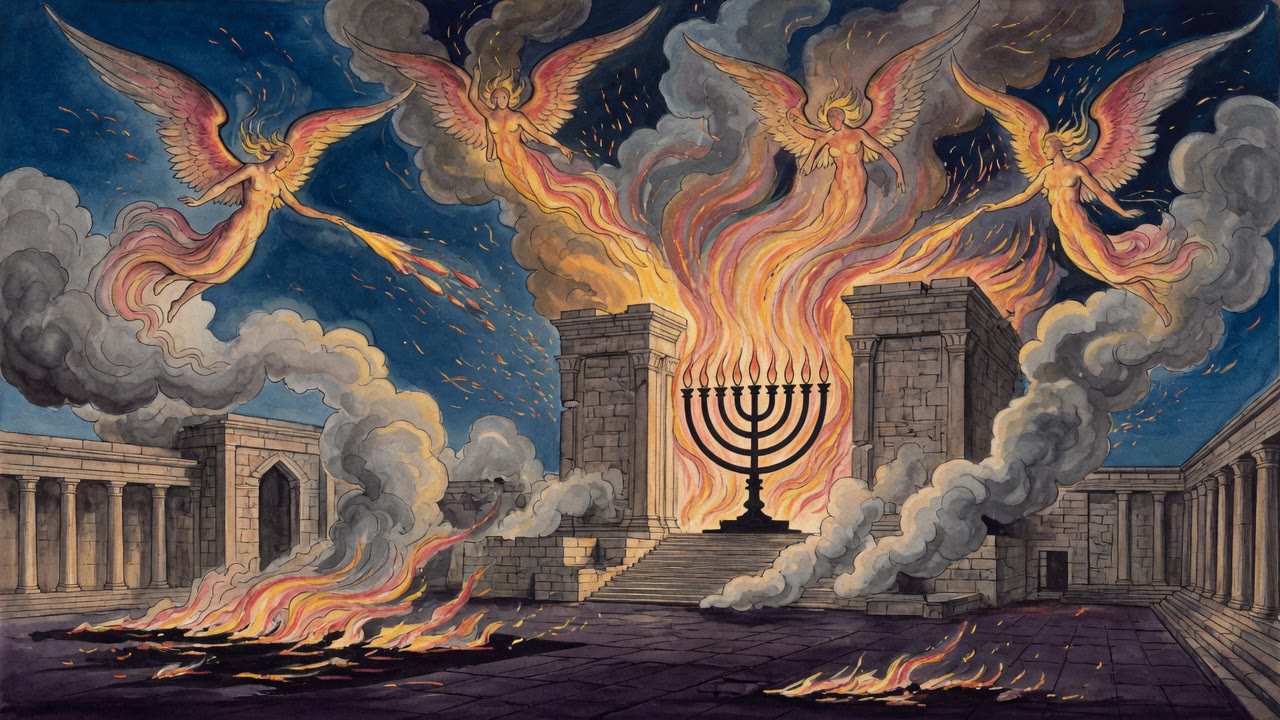
The night before the Babylonians breached Jerusalem, four angels descended to the Temple courts and started the burning themselves.

Curated by Arthur · Told by Maggid ·
Table of Contents
  1. The Night Before the Breach
  2. What Baruch Witnessed
  3. What the Angels Took First
  4. God Weeping Over What He Ordered
  5. What the Priests Did With the Keys

The Night Before the Breach

The Babylonian siege had gone on for months. The walls of Jerusalem still stood, but barely. Inside, the granaries were exhausted. Mothers whispered prayers over children who had stopped crying. On the streets near the Temple Mount, priests performed the daily offerings with trembling hands, because that was the one thing they could still do, the one act that said the covenant had not yet snapped.

Then, the night before the walls gave way, something happened inside the Temple courts that the people outside could not have seen.

What Baruch Witnessed

Baruch ben Neriah, the secretary of Jeremiah, slipped away from the city that evening. He found a place on a hill and sat down and wept. That is where the tradition places him: outside, watching, when a sound came from the direction of the sanctuary.

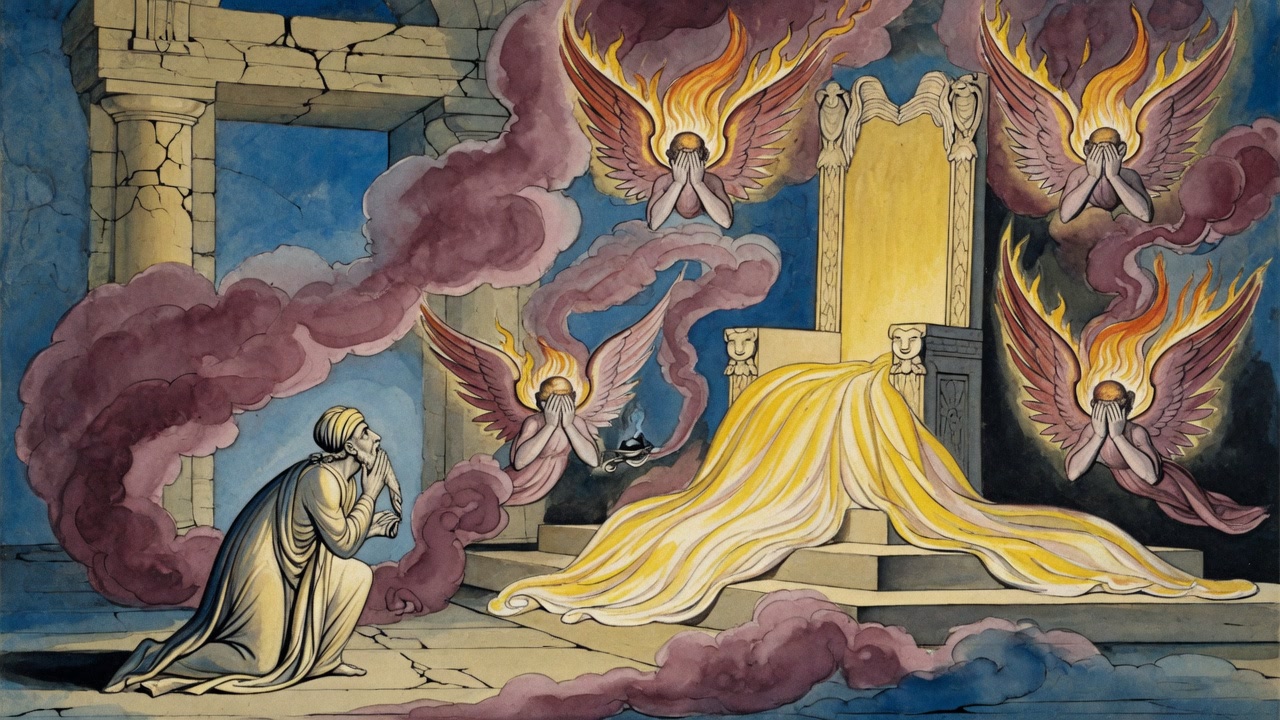
Four angels descended to the four corners of the building. They carried torches. They had been waiting for this command for a long time, held back by a divine restraint that had stretched almost to breaking with every generation Israel had strayed. Now the restraint was gone. Baruch heard a voice that shook the ground: the keys of the sanctuary are no longer needed. He watched as figures he could barely look at approached the walls.

Before the Babylonians ever lifted a torch, the Temple was already burning from within.

What the Angels Took First

But the angels did not simply destroy. Before the fire, they hid. The sacred vessels, the golden implements, the cherubim from the inner sanctum, were removed and buried or carried up, depending on which strand of tradition you follow. The earth swallowed them. Some say they were sealed underground to wait for a restoration that has not yet come. The Babylonians who entered the smoking ruin found emptied niches and scorched stone. What they looted was already the secondary layer, the things too heavy or too obvious to conceal in time.

Josephus records the sequence with a military historian's eye: Nebuchadnezzar's forces entered, the generals ordered the plundering, the fire spread to the porticoes and then to everything. But the tradition that runs deeper insists the fire had an earlier source. The Babylonians were not the cause. They were the occasion.

God Weeping Over What He Ordered

This is where the rabbis refused to let the story rest. They could not accept a God who watched the burning unmoved. The same tradition that placed angels at the Temple corners also placed God in mourning the moment the command was given. Not after. The instant the word went out, a grief entered the heavens that had no precedent.

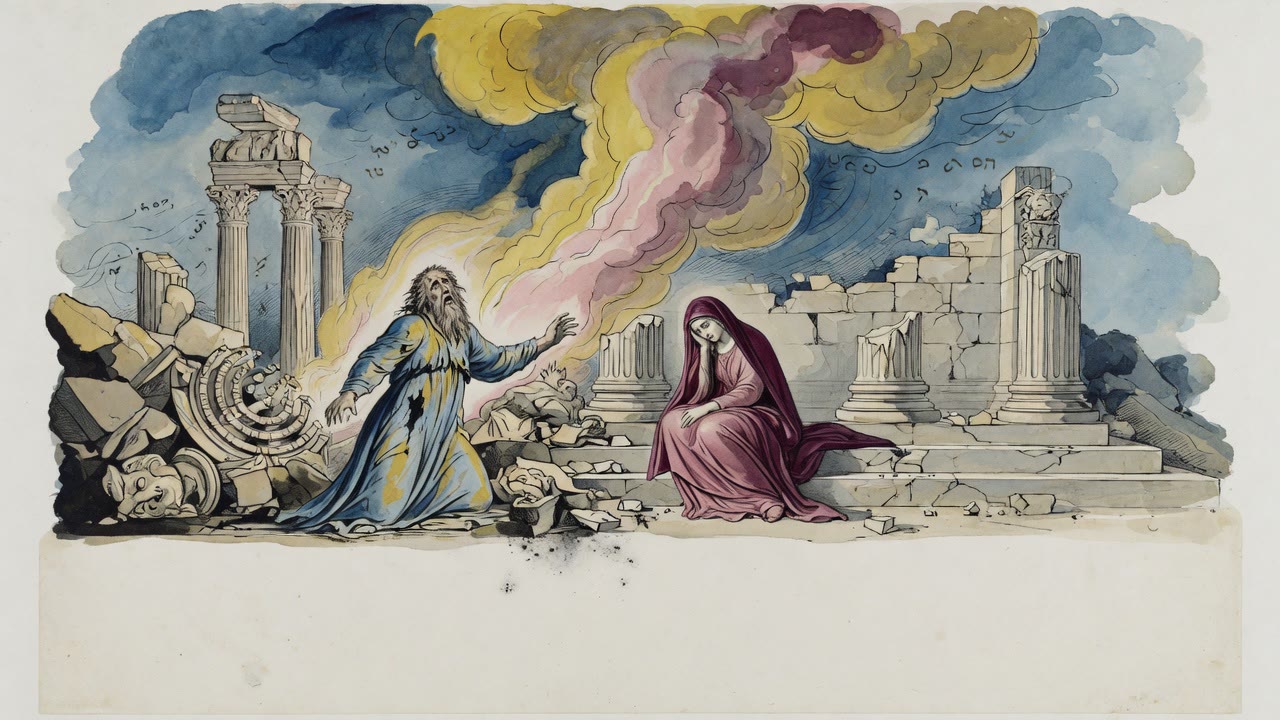
God called to the ministering angels: go down and see what the enemies have done to My house. The angels went and returned weeping. And the texts say God wept too, in a darkness that human language can only approximate. He wept for the priests who threw themselves into the flames rather than surrender the keys. He wept for the young women who jumped from the walls. He wept for the cohanim who had served faithfully in the courts for generations and now watched the courts collapse around them.

The weeping did not mean the destruction was a mistake. It meant it cost something. The tradition insists on that cost. A God who could burn His own house and feel nothing would be a God of pure mechanism, and that is not the God who had chosen this people and this city and this covenant.

What the Priests Did With the Keys

In the last hours, as the inner chambers were already collapsing, a group of young priests climbed to the roof of the Temple. They had the keys in their hands. They looked at the sky. One of them, or perhaps all of them at once, called out: Master of the Universe, we were not worthy to be your treasurers. Take back what belongs to You.

They threw the keys upward into the smoke. The tradition says a hand reached down from the smoke and took them.

Then the priests jumped.


← All myths

From the tradition

Sources

5 sources

The texts this telling draws on, in full. Open a card to read inline, or expand it for a wider, quieter read.

2 Baruch 6-82 Baruch

The Chaldean army surrounded Jerusalem. But the real destruction, the kind that shatters heaven, had already begun inside the walls.

On the evening before the siege tightened, Baruch slipped away from the people and stood alone beside an oak tree, grieving over Zion, mourning the captivity he knew was coming. Then something seized him. A powerful spirit lifted him bodily into the air, carrying him up and over the wall of the city. And what he saw on the other side changed everything he understood about the fall of Jerusalem.

Four angels stood at the four corners of the city. Each one held a torch of fire in his hands. They were waiting.

Then a fifth angel descended from heaven, not to save the city, but to save something far more precious. He commanded the four: "Hold your lamps. Do not light them until I tell you. I am first sent to speak a word to the earth."

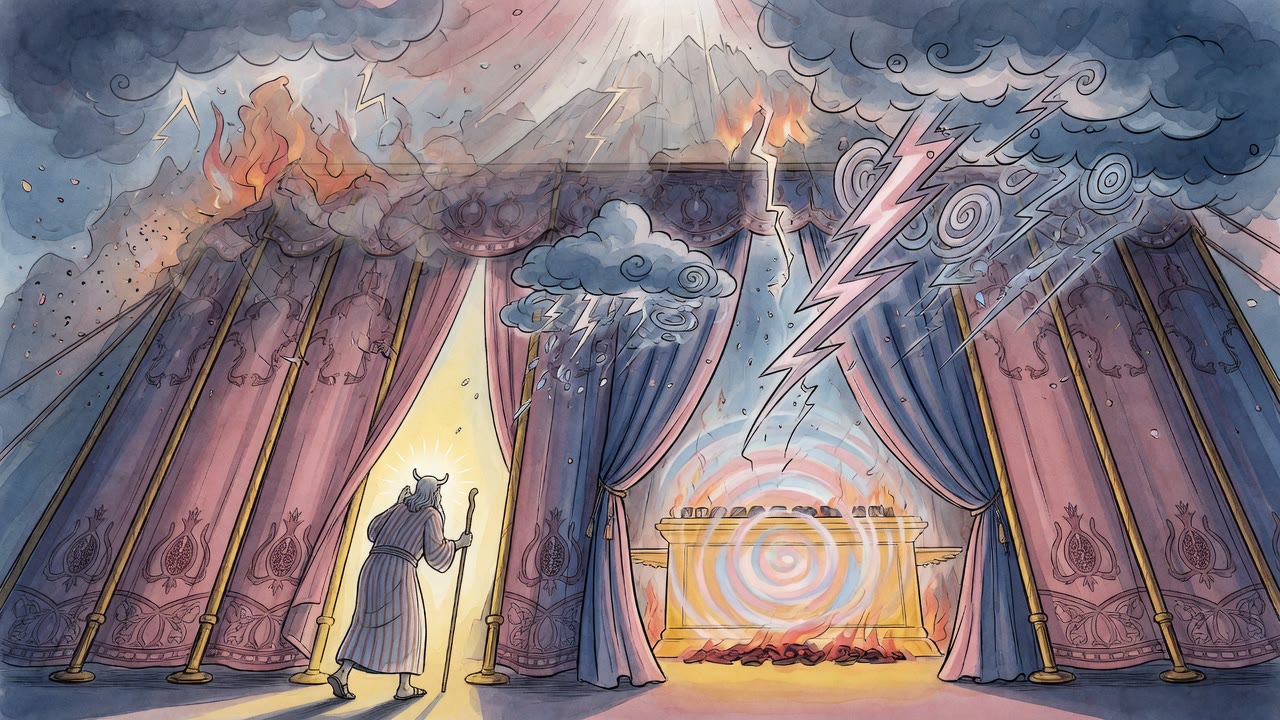
This angel entered the Holy of Holies. One by one, he gathered the sacred objects, the veil, the holy ark, the mercy seat, the two tablets of the covenant, the holy garments of the priests, the altar of incense, and the forty-eight precious stones of the priestly breastplate. Every vessel of the tabernacle. Everything that made the Temple the dwelling place of God on earth.

Then the angel spoke to the earth itself, and his voice shook the ground:

"Earth, earth, earth, hear the word of the mighty God! Receive what I commit to you, and guard them until the last times. When you are commanded, restore them. So that strangers may never possess them. For the time comes when Jerusalem will be delivered for a time, until it is said that it is restored forever."

And the earth opened its mouth and swallowed them all.

The holy vessels vanished into the ground. Hidden. Preserved. Waiting for a day that has not yet come.

Now the commanding angel turned to the four who held the torches. "Destroy the walls," he ordered. "Overthrow them to their foundations, lest the enemy boast and say, 'We have overthrown the wall of Zion. We have burned the place of the mighty God.'" The destruction would not be a Babylonian triumph. It would be an act of heaven. The angels tore the corners of the walls apart with their own hands.

And as the walls crumbled, a voice rose from the interior of the shattered Temple, a voice that belonged to no angel and no man:

"Enter, you enemies. Come, you adversaries. For He who kept this house has forsaken it."

God had left the building.

Only then did the army of the Chaldeans pour in. They seized the Temple and everything around it. They led the people away captive. They slew some and bound King Zedekiah in chains, sending him to the king of Babylon (2 Kings 25:7). The invaders believed they had conquered Jerusalem by force. They never knew that angels had beaten them to it. And that the only things worth taking were already buried beneath their feet.

Full source
Antiquities X.5-7Antiquities of the Jews (Josephus)

The kingdom that Josiah rebuilt fell apart the moment he died. Josephus records that when Pharaoh Neco marched through Judah on his way to fight the Babylonians at the Euphrates, Josiah refused to let him pass. Neco sent messengers pleading with him, this was not his war. Josiah ignored the warning. In the battle, an Egyptian arrow struck him down. He died at age thirty-nine, and the prophet Jeremiah composed an elegy for him.

What followed was a cascade of puppet kings and catastrophe. Josiah's son Jehoahaz reigned only three months before Neco hauled him to Egypt in chains and installed his brother Jehoiakim on the throne instead. Jehoiakim was, in Josephus's words, "of a wicked disposition, and ready to do mischief." He paid tribute to Babylon for three years, then foolishly rebelled.

Nebuchadnezzar came personally. He killed Jehoiakim and threw his body outside the city walls unburied, exactly as Jeremiah had prophesied (Jeremiah 22:19). Nebuchadnezzar installed young Jehoiachin, who lasted just three months before the Babylonian king changed his mind, dragged him to Babylon along with ten thousand captives, and placed Zedekiah on the throne instead.

Zedekiah was warned repeatedly. Jeremiah told him directly: surrender to Babylon and the city survives; resist and everything burns. Zedekiah secretly believed the prophet but feared his own officials who had defected to Babylon. He chose pride over survival. After an eighteen-month siege, the Babylonians breached Jerusalem on the ninth day of the fourth month. Zedekiah fled by night through the desert. They caught him near Jericho. Nebuchadnezzar forced him to watch his sons executed, then put out his eyes, fulfilling both Jeremiah's prophecy that he would see the king face to face, and Ezekiel's that he would be brought to Babylon but never see it. The Temple of Solomon was burned to the ground.

Full source
Legends of the Jews 10:29Legends of the Jews

Yet, the Jewish mystical tradition doesn't shy away from portraying God as deeply affected by the events of human history, especially the tragedies. And perhaps nowhere is this more poignant than in the legends surrounding the destruction of the Temple in Jerusalem.

In Ginzberg's retelling in, Legends of the Jews, God Himself was profoundly moved by the Temple's destruction. Imagine, if you will, God abandoning His own house, His Beit Hamikdash (the Holy Temple in Jerusalem), so that the enemy could enter and destroy it. A heartbreaking image, isn’t it? After the devastation, accompanied by His angels, God visits the ruins, and gives vent to His sorrow.

"Woe is Me on account of My house," He cries. "Where are My children, where My priests, where My beloved? But what could I do for you? Did I not warn you? But you would not mend your ways."

There’s a deep sense of anguish and almost paternal disappointment in those words. God, in this moment, is not a distant, unfeeling deity, but a parent grieving for lost children.

And the grief doesn't end there. God then turns to the prophet Jeremiah. "To-day," God says, "I am like a man who has an only son. He prepares the marriage canopy for him, and his only beloved dies under it." The imagery is devastating. A chuppah, a symbol of hope and new beginnings, transformed into a site of unimaginable loss.

God continues, feeling Jeremiah's grief is not enough. "Thou doest seem to feel but little sympathy with Me and with My children. Go, summon Abraham, Isaac, Jacob, and Moses from their graves. They know how to mourn."

Imagine being tasked with summoning the Patriarchs and Moses from their eternal rest! Jeremiah, understandably, is hesitant. "Lord of the world," he replies, "I know not where Moses is buried."

God then instructs him: "Stand on the banks of the Jordan, and cry: 'Thou son of Amram, son of Amram, arise, see how wolves have devoured thy sheep.'"

That image – the wolves devouring the sheep – is a stark and brutal depiction of the destruction and scattering of the Jewish people. And the call to Moses, specifically by his lineage, "son of Amram," emphasizes his role as the leader and protector of the people. It’s a call to witness the consequences of their actions, a call to mourn.

What does it mean that the tradition portrays God as capable of such deep sorrow? Perhaps it's a way of understanding the magnitude of the loss, the profound impact of the Temple's destruction on both the divine and the human. It reminds us that our actions have consequences, not just for ourselves, but for the entire cosmos. And perhaps, most importantly, it assures us that even in our darkest moments, we are not alone in our grief. God weeps with us.

Full source
Legends of the Jews 10:25Legends of the Jews

The Talmud, specifically Tractate Gittin 56b, recounts the horrific events surrounding the destruction of the First Temple in Jerusalem. It wasn't just a military defeat; it was a spiritual catastrophe, a moment of profound loss etched into the collective memory of the Jewish people.

The scene: the enemy, the Chaldeans (Babylonians), storming the Temple Mount. They reach the very spot where King Solomon himself, wisest of men, once sat in counsel with the elders. And there, instead of wisdom and justice, they plot the Temple's destruction. It's a stark contrast, isn't it? A symbol of everything sacred replaced by the machinations of war.

Then, a truly chilling image. The story tells us that four angels, each wielding a flaming torch, descended from the heavens and ignited the four corners of the Temple. – heavenly beings, agents of divine will, participating in this act of destruction. What does that say about the moment?

The Kohen Gadol, the High Priest, witnessing the inferno, makes a heartbreaking gesture. He casts the keys of the Temple heavenward, essentially surrendering them to God. "Here are the keys of Thy house," he cries, "it seems I am an untrustworthy custodian." (Gittin 56b) It's a moment of utter despair, a recognition of his own powerlessness in the face of divine judgment. And tragically, he's immediately seized and slaughtered, his blood mingling with that of his daughter on the very altar where he offered daily sacrifices. The horror unfolds relentlessly.

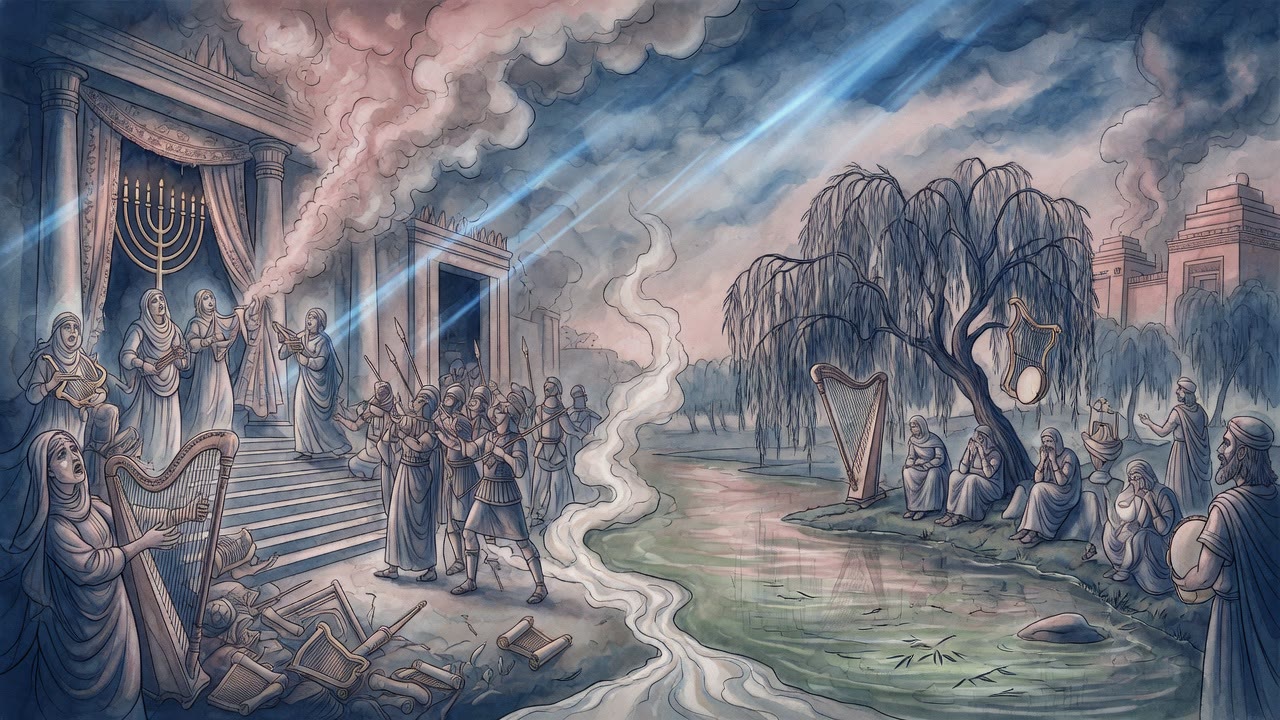
The priests and the Levites, the musicians of the Temple, throw themselves into the flames, clutching their harps and trumpets. And the young women who wove the sacred curtains, fearing the brutality of the invaders, follow their example. It's a mass act of sacrifice, a refusal to let the enemy desecrate their bodies and souls.

But the carnage doesn't end there. Nebuzaradan, the Babylonian general, is driven to a frenzy by a horrifying sight: the blood of the prophet Zechariah, murdered long ago for his prophecies of doom, still seething on the Temple floor. The blood wouldn't stop bubbling, wouldn't be quiet.

The Talmud (Gittin 57b) elaborates: at first, the Jews tried to hide the truth about the blood, but eventually, they confessed that it was the blood of a prophet who had warned of the Temple's destruction and was killed for his honesty.

Nebuzaradan, in a twisted attempt to appease the murdered prophet, orders the execution of the kingdom's scholars, then the schoolchildren, and finally the young priests – over a million souls, according to the account. Yet, even after all this bloodshed, Zechariah's blood continues to seethe and reek.

Finally, Nebuzaradan cries out in desperation, "Zechariah, Zechariah, the good in Israel I have slaughtered. Dost thou desire the destruction of the whole people?" And at that moment, the blood ceases to seethe.

What are we to make of such a gruesome tale? Is it a literal account, or a symbolic representation of the immense suffering endured during the Temple's destruction? Perhaps it's both. It's a reminder of the fragility of even the most sacred institutions, and the devastating consequences of internal strife and external aggression. It's also a evidence of the enduring spirit of the Jewish people, who, even in the face of unimaginable loss, found the strength to rebuild and continue their covenant with God. The destruction of the Temple wasn't the end of the story, but a painful chapter in an ongoing narrative.

Full source
Pesikta Rabbati 26:6Pesikta Rabbati

The Temple, the very center of Jewish life, engulfed in flames. What happens when the unthinkable becomes reality?

The Talmud (B. Ta'anit 29a) recounts a powerful image: the High Priest, standing on the roof of the burning Temple, the keys to the sanctuary clutched in his hand. This wasn't just any building; it was the house of God, the place where heaven and earth met. Now, it was being reduced to ashes.

In a moment of profound despair, the High Priest cries out, "Master of the Universe! The time has come to return these keys to You." And with that, he throws the keys into the air.

What happens next is extraordinary. According to Pesikta Rabbati 26:6 and Y. Shekalim 50a, a hand reaches down from heaven – a literal, giant hand – and catches the keys, taking them back into the celestial realm. image for a moment. A hand. The Hand of God. Reaching down.

It's a powerful, almost shocking, act of anthropomorphism – attributing human characteristics to the divine. But what does it mean?

The legend, as recorded in B. Ta'anit 29a, carries immense theological weight. It suggests that heaven wasn't just a passive observer in the Temple's destruction. It implies that this devastating event was, in some way, part of God's plan. A tragic plan, to be sure, but a plan nonetheless.

The High Priest's act of returning the keys is one of utter desolation. With the Temple gone, the rituals, the sacrifices, the very essence of Temple-based worship could no longer be performed. It was the end of an era.

Yet, even in this moment of ultimate loss, the story offers a glimmer of hope. The link between God and Israel remains. By accepting the keys, God acknowledges the bond, even in the face of destruction.

This motif of returning a precious object to heaven appears elsewhere in Jewish tradition. There's the tale of Rabbi Haninah ben Dosa, who, according to B. Tan. 24b-25a, returns the leg of a golden table to heaven. And in "The Soul of the Ari" found in Gabriels Palace, pp. 258-259, we find similar themes of celestial exchanges. We even see a parallel in 2 Baruch 6:8-9, where the High Priest casts the Temple vessels into the earth, which opens up and swallows them.

These stories all speak to the idea of sacred objects, meant for divine service, ultimately returning to their source.

So, what are we left with? A burning Temple, a heartbroken High Priest, and a divine hand reaching down from the heavens. It's a story of loss, of despair, but also of enduring connection. It's a reminder that even in the darkest of times, the relationship between God and people, though tested, can remain. And perhaps, that even in destruction, there is a strange kind of acceptance, a handing back of something precious, knowing that it ultimately belongs to something greater than ourselves.

Full source