5 min read

God Put On Black and Asked the Angels How Kings Mourn

After Jerusalem fell, God summoned the angels and asked how a king of flesh and blood mourns, then clothed the heavens in sackcloth and sat silent.

Curated by Arthur · Told by Maggid ·
Table of Contents
  1. The Lights Go Out
  2. Silence That Answers Lament
  3. Wrath Poured Like Wine
  4. Throne Without a Queen

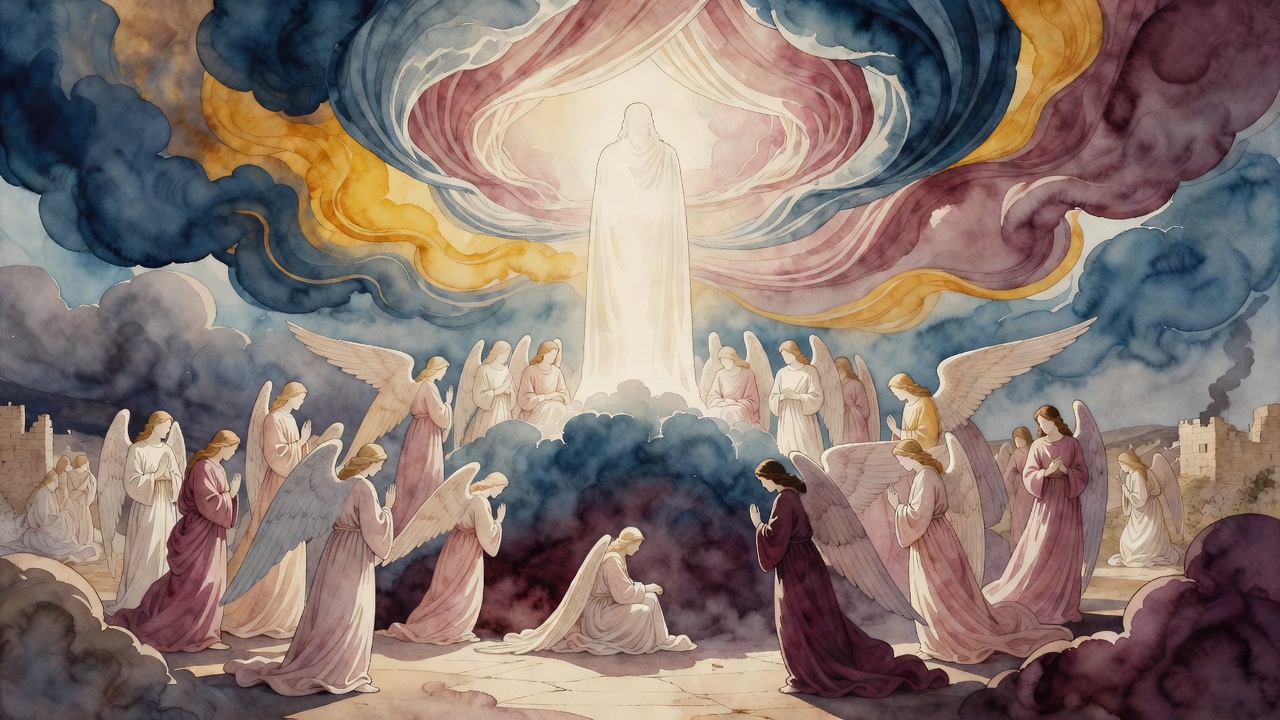
God did not open the court with a decree. He summoned the ministering angels and asked a question that bent every wing in the chamber.

God Put On Black and Asked the Angels How Kings Mourn Click for full size

"A mourning king of flesh and blood," He said. "What does he do?"

They answered as servants answer a master they dare not misread. "He dons black. He covers his head with sackcloth."

"I, too, will do so."

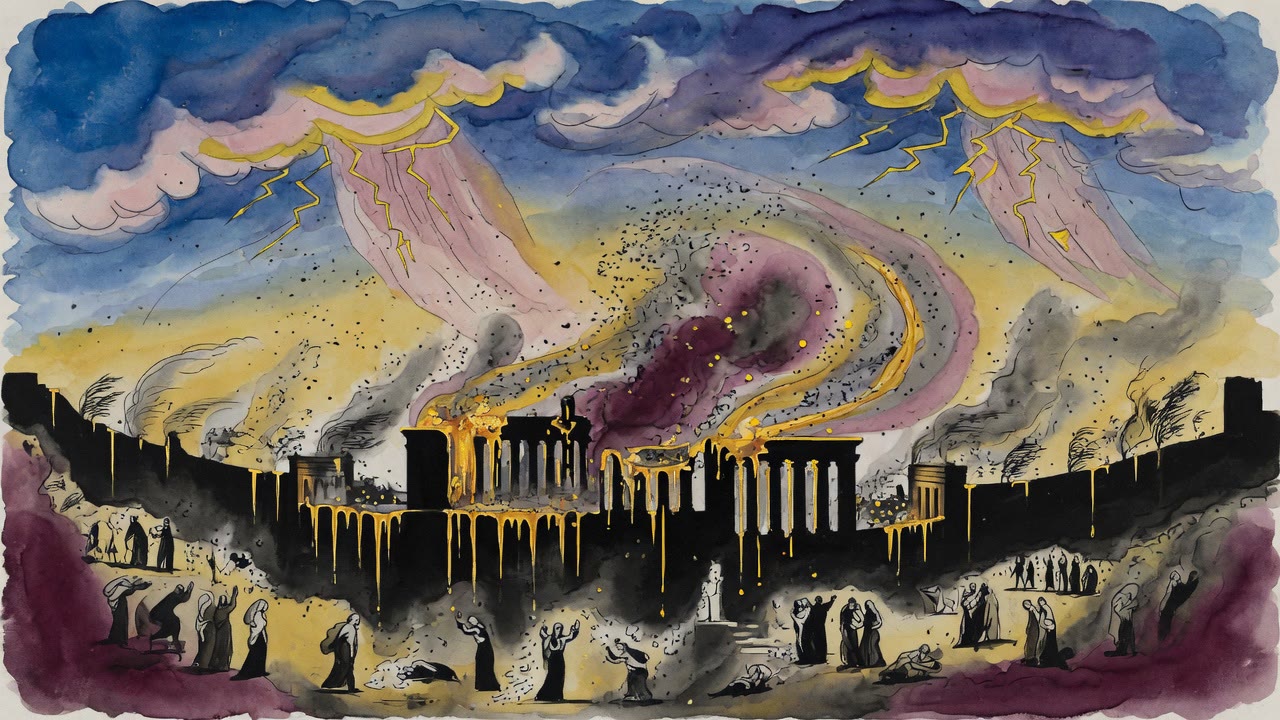
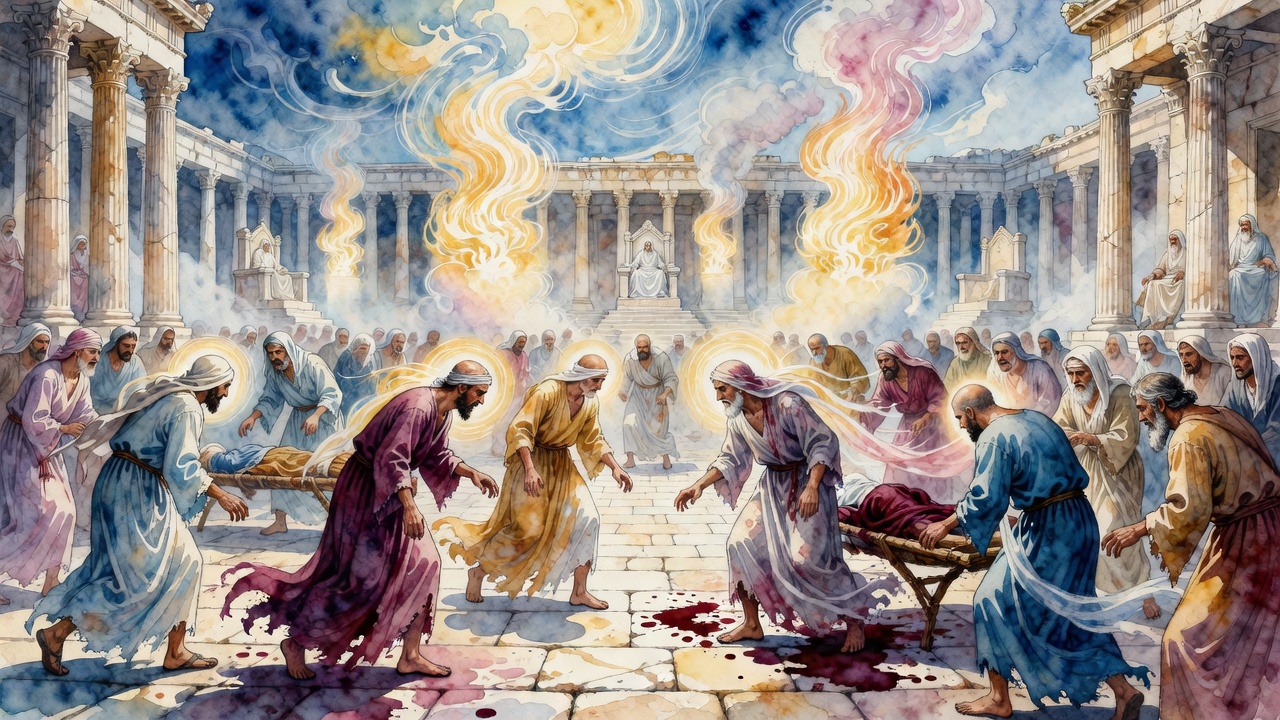
The sky went dark the way a garment is drawn over a body. Blackness clothed the heavens. Sackcloth became the garment of the heights (Isaiah 50:3). Below, the city still smoked. Above, the King of kings dressed for a funeral He had brought upon Himself.

The Lights Go Out

He asked again. "What else does a mourning king do?"

"He extinguishes the lights."

"I, too, will do so."

The sun withdrew. The moon went dim. The stars pulled their shine back into themselves as if light itself had become indecent (Joel 2:10). Angels who had never known night stood in a dusk that had no evening. On the ground, ash still drifted through alleys where children had run the week before. In heaven, the lamps of the world were put out by hand.

He asked a third time. "What else?"

"He walks barefoot."

"I, too, will do so."

Clouds became the dust of His feet. Storm and tempest marked His way (Nahum 1:3). No gold sandals on a palace floor. No calm procession. Only the slow, bare tread of a King who would not stand above the ruin He had allowed.

Silence That Answers Lament

He asked once more. "What else does a mourning king do?"

"He sits. He is silent."

"I, too, will do so."

So the verse that survivors would chant for centuries already had a scene behind it: "Let him sit alone and be silent, because He has laid it upon him" (Lamentations 3:28). The silence was not indifference. It was the silence of a King who had put the mourning on His own shoulders and then refused to fill the air with explanations.

In the city, mouths filled with dust. Cheeks turned toward blows that still fell. Hope thinned to a single word: "perhaps" (Lamentations 3:29-30). Heaven matched the posture. No trumpet. No speech. Only a seated God and a black sky.

Wrath Poured Like Wine

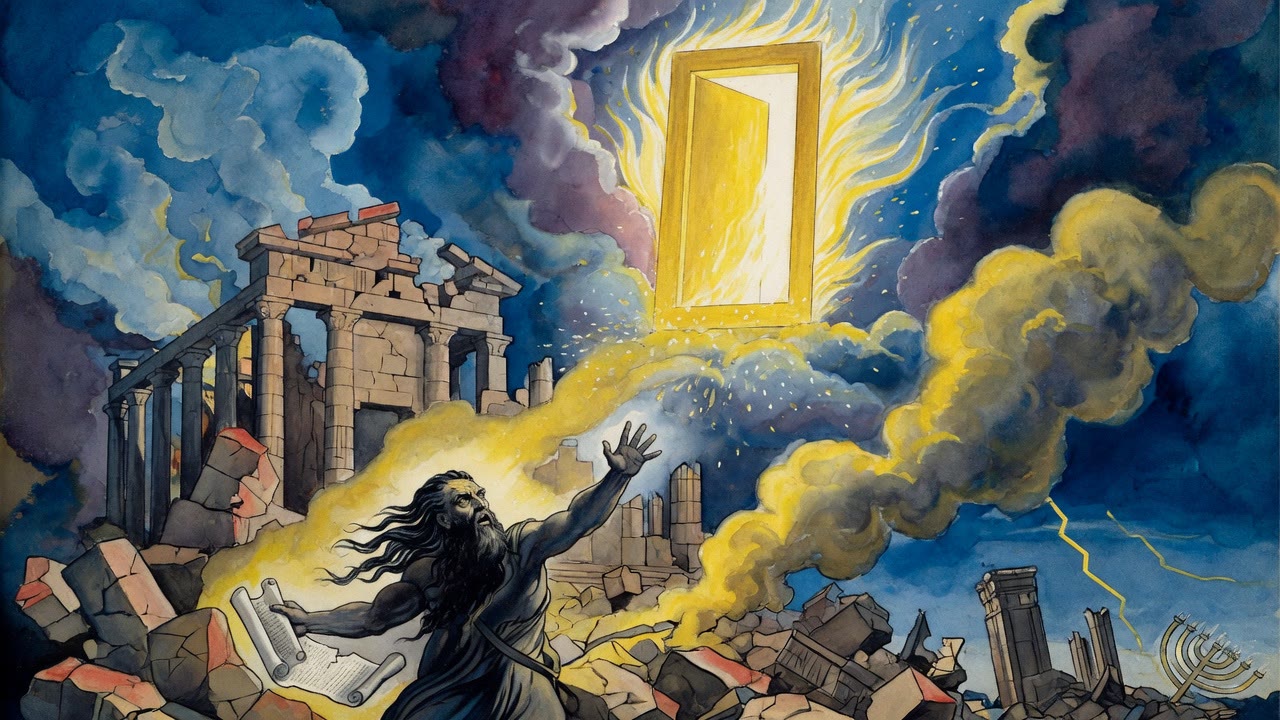
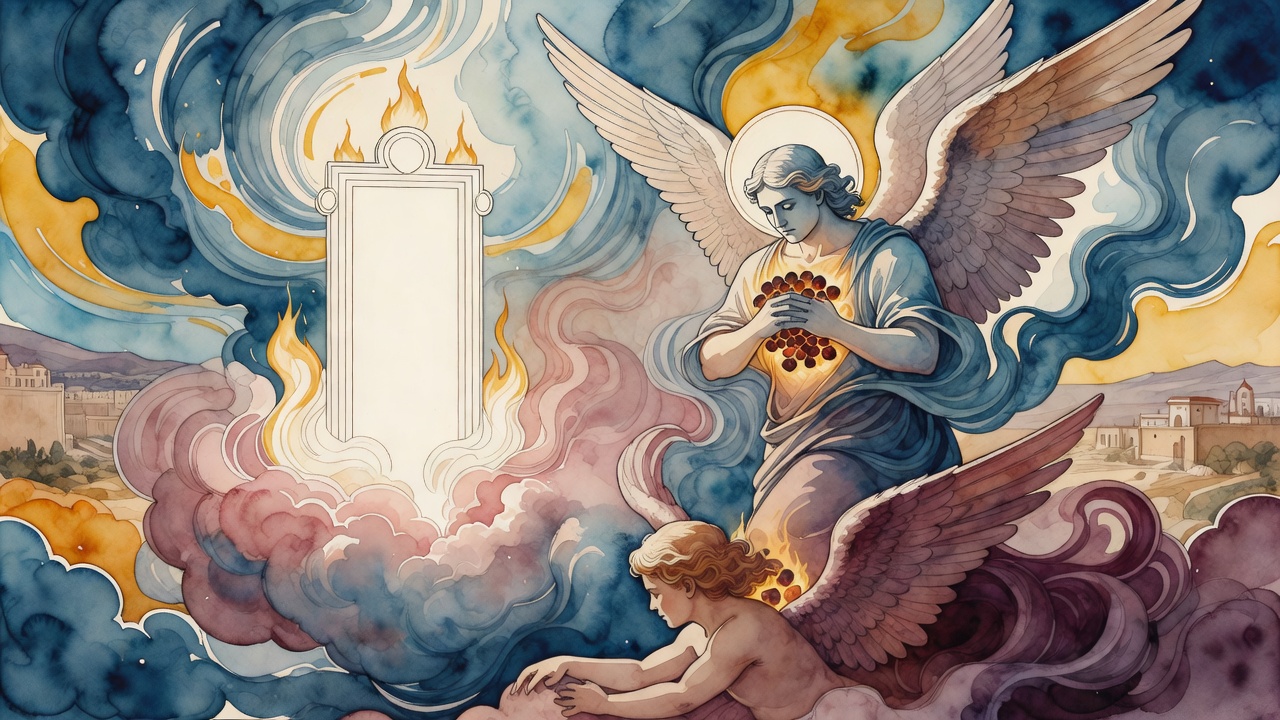
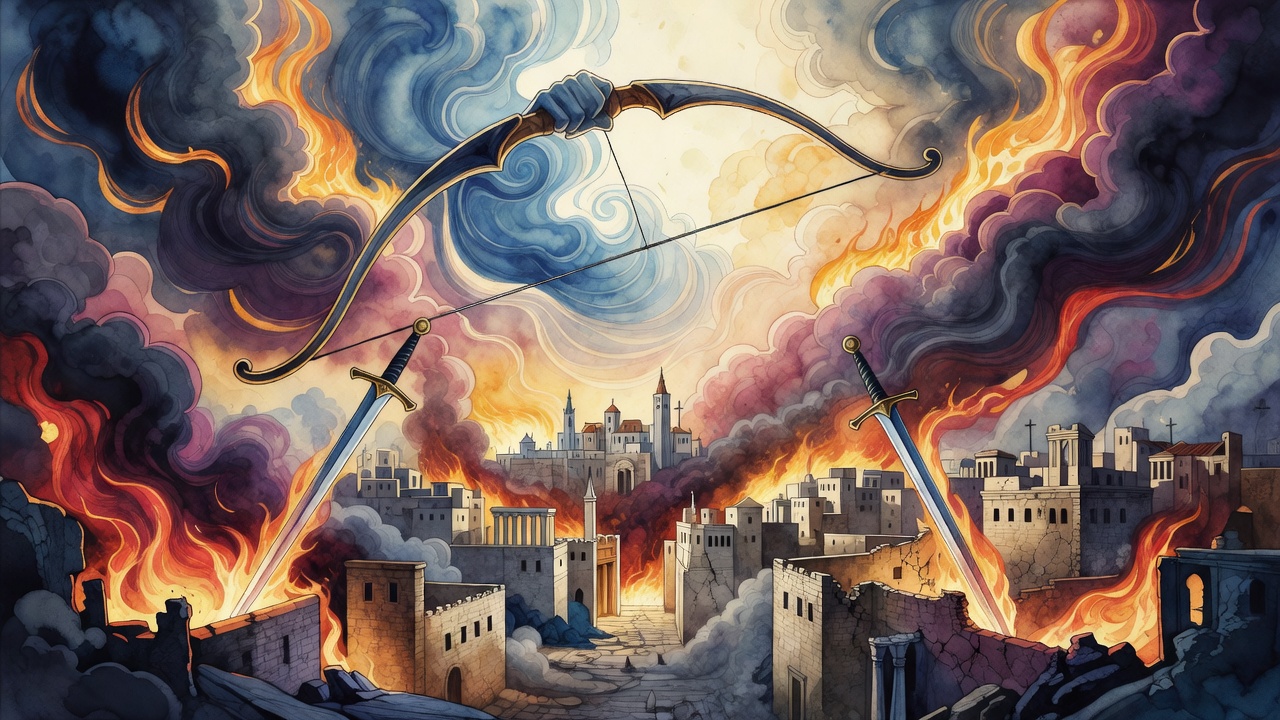
The same court that dressed for mourning had already poured fury. Fire took Zion and ate her foundations (Lamentations 4:11). The sages later counted the pourings. Four times spirit is poured as gift: grace on David's house, spirit on all flesh, spirit on slaves and maidservants, spirit on the house of Israel. Four times fury is poured as judgment, and this fire in Zion stands among them.

Outpouring is the same motion. One hand pours life. The same hand pours wrath. The difference is the cup. When the foundations of the Temple burned, the cup was judgment, and the city drank until the stones themselves blackened.

Angels who had answered the mourning questions still smelled that smoke. They had watched the King put on black after He poured the fire. Sequence mattered. Wrath first. Then the clothes of grief. Heaven did not pretend the two were strangers.

Throne Without a Queen

Far below, a people sat among broken walls and still said the hardest line in the scroll: "You, Lord, are enthroned forever; Your throne is from generation to generation" (Lamentations 5:19). The confession was true and incomplete at once.

A sitting king needs a throne. A king needs a queen. The earthly Temple had been the visible seat. Israel had been the bride. With the Temple down, the throne on earth lay broken. With Israel scattered, the queen walked the roads of exile. Eternity remained. Full kingship in the world waited for two returns: stones rebuilt, and a people brought home.

So the mourning King sat alone, black against a dimmed firmament, while the bride He would not renounce still wandered without her palace. The angels kept their silence because He had chosen silence. The city kept its dust because the blow had already fallen. Between them hung one unfinished claim: the throne endures, but the court is not yet whole.

Night held. No one moved to relight the stars.

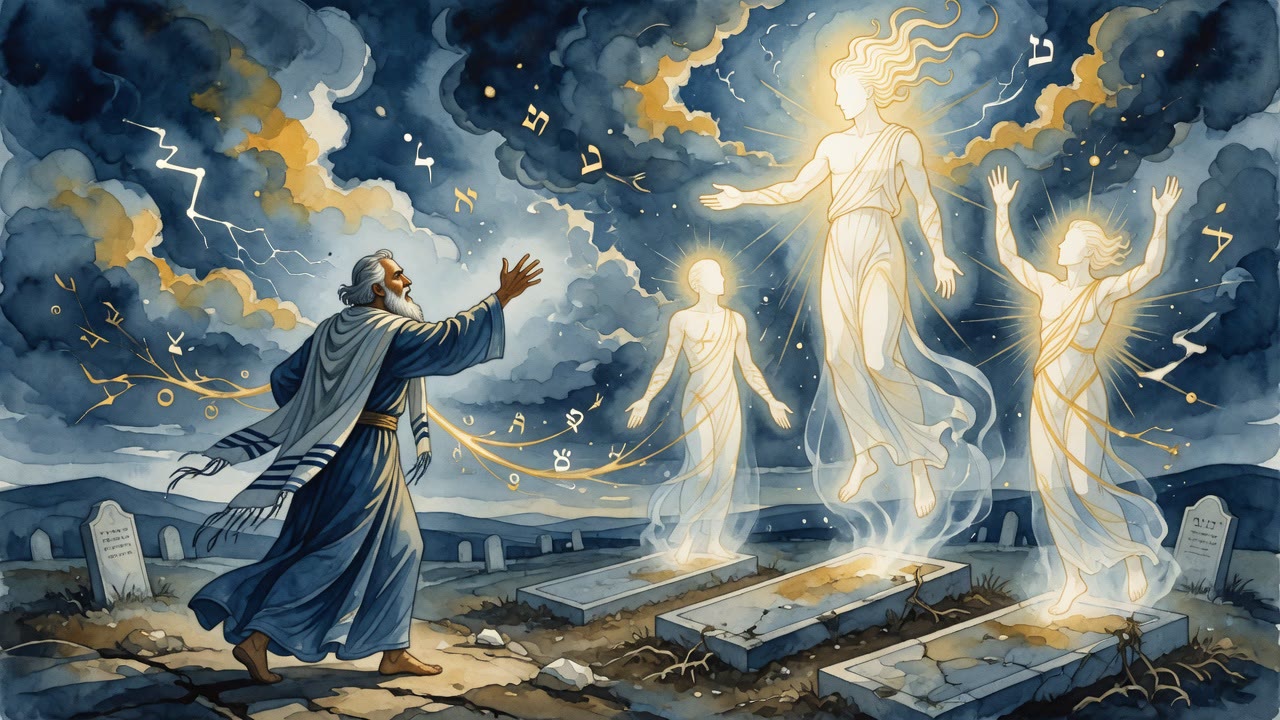
An angel who had sung without pause since the first light tried to open its mouth and found no hymn left that fit the room. Another lowered its face until fire touched the floor. The questions had been simple. The answers had dressed the cosmos. Now the simple King sat as mourners sit, and the court learned that omnipotence can choose the posture of a widow.

In the ruined streets a woman scraped ash with her nails and did not look up. She did not know the sky had been told to wear sackcloth. She only knew the cold. The match between her dust and His silence was exact enough to frighten any witness who could see both worlds at once.


← All myths

From the tradition

Sources

3 sources

The texts behind this telling. Some cards carry a translation of the source; others are our own retelling of it, and each card says which. Every card links out to the original.

Eikhah Rabbah 3:10Eikhah Rabbah

Retold in our words. Read the original at the link below.The Sefaria Midrash Rabbah, 2022 · CC-BY

“Let him sit alone and be silent, because He has laid it upon him” (Lamentations 3:28).“Let him sit alone and be silent” – Rabbi Shmuel bar Naḥman said: The Holy One blessed be He summoned the ministering angels and said to them: ‘A mourning king of flesh and blood, what does he do?’ They said to Him: ‘He dons black and covers his head with sackcloth.’ He said: ‘I, too, will do so.’ That is what is written: “I clothe heavens with blackness and I make sackcloth their garment” (Isaiah 50:3).Moreover, He asked them: ‘A mourning king of flesh and blood, what [else] does he do?’ They said to him: ‘He extinguishes the lights.’ He said to them: ‘I, too, will do so.’ That is what is written: “The sun and the moon darkened, and the stars withdrew their shine” (Joel 2:10).Moreover, He asked them: ‘A mourning king of flesh and blood, what [else] does he do?’ They said to him: ‘He walks barefoot.’ He said to them: ‘I, too, will do so.’ That is what is written: “The Lord, in a tempest and in a storm is His way, and clouds are the dust of His feet” (Nahum 1:3).Moreover, He asked them: ‘A mourning king of flesh and blood, what [else] does he do?’ They said to him: ‘He sits and is silent.’ He said to them: ‘I, too, will do so.’ That is what is written: “Let him sit alone and be silent, because He has laid it upon him.”57The verse is understood to mean that God will be silent because He has brought the mourning upon Himself.“Let him put his mouth in the dust, perhaps there is hope. Let him offer his cheek to one who strikes him; let him be filled with disgrace” (Lamentations 3:29–30).“Let him put his mouth in the dust, perhaps there is hope. Let him offer his cheek to one who strikes him; let him be filled with disgrace” – Rabbi [Yehuda HaNasi] was interpreting verses and when he reached the following verses, he would weep: “Samuel said to Saul: Why did you disturb me to bring me up?” (I Samuel 28:15).58The Gemara (the rabbinic commentary on the Mishnah) in Ḥagiga (4b) indicates that Samuel thought he was being summoned to a heavenly judgement and was scared. If Samuel, the great prophet, was scared of heavenly judgement, all the more so those of lesser stature should be scared. This is why Rabbi Yehuda HaNasi cried when reading this verse. And it is written: “For behold, He forms mountains and creates winds; He recounts to a person what were his deeds [seḥo]” (Amos 4:13) – even matters lacking substance are written for a person in his ledger.59This is derived from the term seḥo, which can be interpreted to mean speech [siḥo]; God keeps track even of every frivolous comment a person might make (see Ḥagiga 5b). Who writes them? “He who turns dawn into darkness…[the Lord, the God of hosts, is His name]” (Amos 4:13). “Seek the Lord all you humble of the earth…” (Zephaniah 2:3). And it is written: “Hate evil, and love good, [and display justice at the gate; perhaps the Lord, God of hosts, will be gracious to the remnant of Joseph]” (Amos 5:15).60Despite there being an abundance of virtue, nevertheless, only perhaps “He will be gracious”? Why? “For every action God will bring to judgment [for every unknown]” (Ecclesiastes 12:14).61God will bring judgment even for unknown, that is, unwitting, transgressions. And this, “let him put his mouth in the dust [perhaps there is hope].”62Only perhaps there is hope? And it is written: “Let him offer his cheek to one who strikes him; let him be filled with disgrace.”63After all this, the end result could very well be disgrace.

Full source
Eikhah Rabbah 5:19Eikhah Rabbah

Retold in our words. Read the original at the link below.The Sefaria Midrash Rabbah, 2022 · CC-BY

The book of Lamentations closes with a verse that the rabbis of Eikhah Rabbah read as the hinge of the whole lament: "You, Lord, are enthroned forever; Your throne is from generation to generation" (Lamentations 5:19). On the surface this is a confession of God's unchanging sovereignty, declared by a shattered people sitting amid the ruins of Jerusalem. The midrash, however, presses on the imagery hidden in the words. A king who is enthroned implies a throne, and the throne implies a court, and the court implies a queen who reigns alongside him.

So the rabbis ask their pointed question: is there a sitting king without a throne, and is there a king without a queen? The question is not idle. It establishes that the verse, even as it praises God's eternity, exposes a present incompleteness. In this reading the earthly Temple is the king's throne, the visible seat of His glory among Israel, and the people of Israel themselves are the queen, the bride wedded to God at Sinai. With the Temple destroyed, the throne lies broken, and with Israel scattered into exile, the queen is sent away from the palace.

The consolation embedded in the lament is therefore conditional and forward looking. God's kingship endures from generation to generation, but its full manifestation in the world awaits two restorations: the rebuilding of the Temple, that the throne may stand again, and the renewal of His covenant bond with Israel, that the queen may return to His side. Only when both are restored is the kingdom complete.

Full source
Eikhah Rabbah 4:14Eikhah Rabbah

Retold in our words. Read the original at the link below.The Sefaria Midrash Rabbah, 2022 · CC-BY

“The Lord vented His fury; He poured out His enflamed wrath. He ignited a fire in Zion, and it consumed her foundations” (Lamentations 4:11).“The Lord vented His fury; He poured out His enflamed wrath.” Rabbi [Yehuda HaNasi] said: There are four outpourings that are positive and four outpourings that are negative. Four outpourings that are positive, as it is stated: “I will pour upon the house of David and upon the inhabitants of Jerusalem a spirit of grace and supplication” (Zechariah 12:10). “It will be thereafter, I will pour My spirit upon all flesh…” (Joel 3:1). “In those days, I will pour My spirit upon the slaves and upon the maidservants, as well” (Joel 3:2). “I will no longer hide My face from them, as I will pour My spirit upon the house of Israel, the utterance of the Lord God” (Ezekiel 39:29). And four outpourings that are negative, as it is stated: “He poured upon it the fury of His wrath” (Isaiah 42:25). And in Ezekiel it is written: “As You pour Your fury upon Jerusalem” (Ezekiel 9:8). And it is written: “He poured out His fury like fire” (Lamentations 2:4). And this one: “The Lord vented His fury; He poured out His enflamed wrath.”“He ignited a fire in Zion.” It is written: “A psalm of Asaf: God, peoples have invaded Your inheritance” (Psalms 79:1). The verse should have said weeping of Asaf, wailing of Asaf, lamentation of Asaf. Why does it say: “A psalm of Asaf”? This is analogous to a king who prepared a wedding house for his son and he plastered it, carved wall sculptures in it, and made drawings in it. His son went astray. Immediately, the king ascended to the wedding house, ripped the curtains, broke the poles. [The son’s] mentor took a reed flute and began playing. They said to him: ‘The king overturned his son’s wedding house, and you are sitting and playing?’ He said: ‘I am playing because he overturned his son’s wedding canopy and he did not vent his rage on his son.’ So too, they said to Asaf: ‘The Holy One blessed be He destroyed the Sanctuary and the Temple, and you are sitting and playing?’ He said: ‘I am playing because the Holy One blessed be He vented His wrath on the wood and stones and did not vent His wrath on Israel.’ That is what is written: “He ignited a fire in Zion, and it consumed her foundations.”

Full source