5 min read

Isaiah Found Every Heavenly Gate Locked Against Prayer

Isaiah climbed to heaven and found every door bolted shut. Angels who carry prayers up were stuck outside. Only the gate of tears still opened.

Curated by Arthur · Told by Maggid ·
Table of Contents
  1. Two Departures, One Throat
  2. What Still Opens
  3. Outside the Chambers
  4. A Prophet's Report

Isaiah did not arrive in heaven as a tourist. He arrived as a man who had already heard cities scream, and he expected the upper rooms to be open for business.
Isaiah Found Every Heavenly Gate Locked Against Prayer Click for full size

They were not.

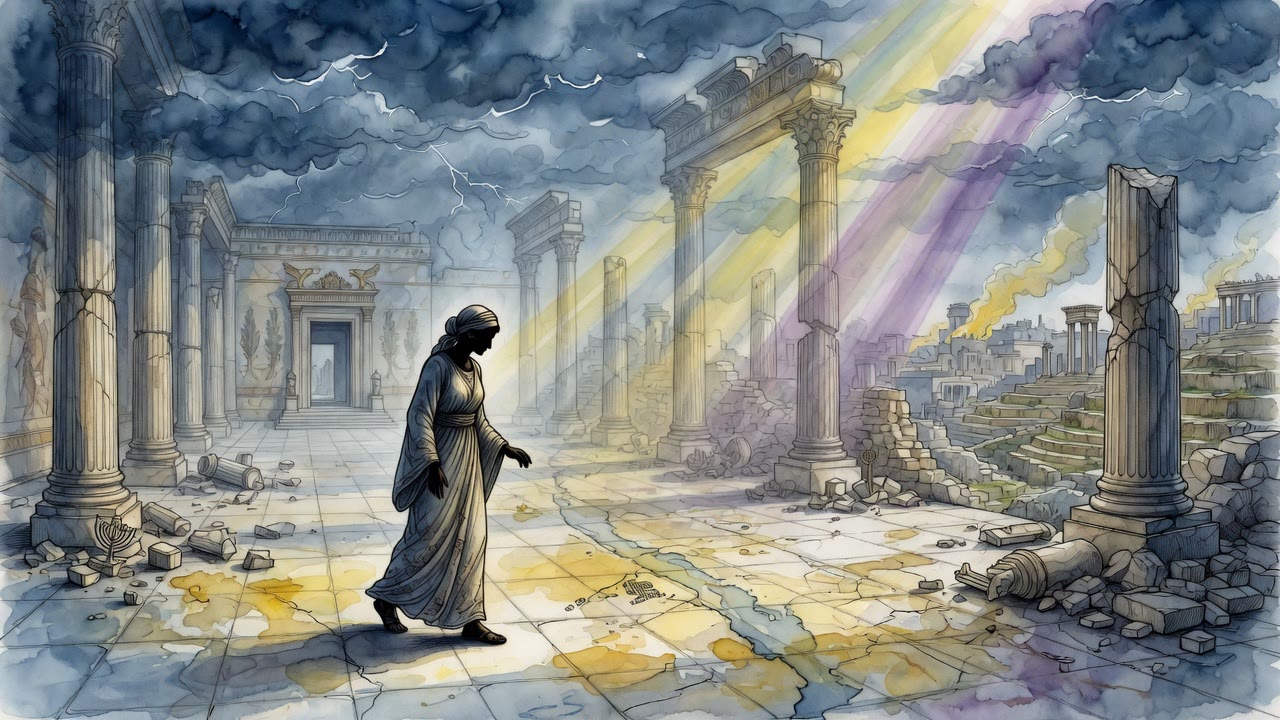
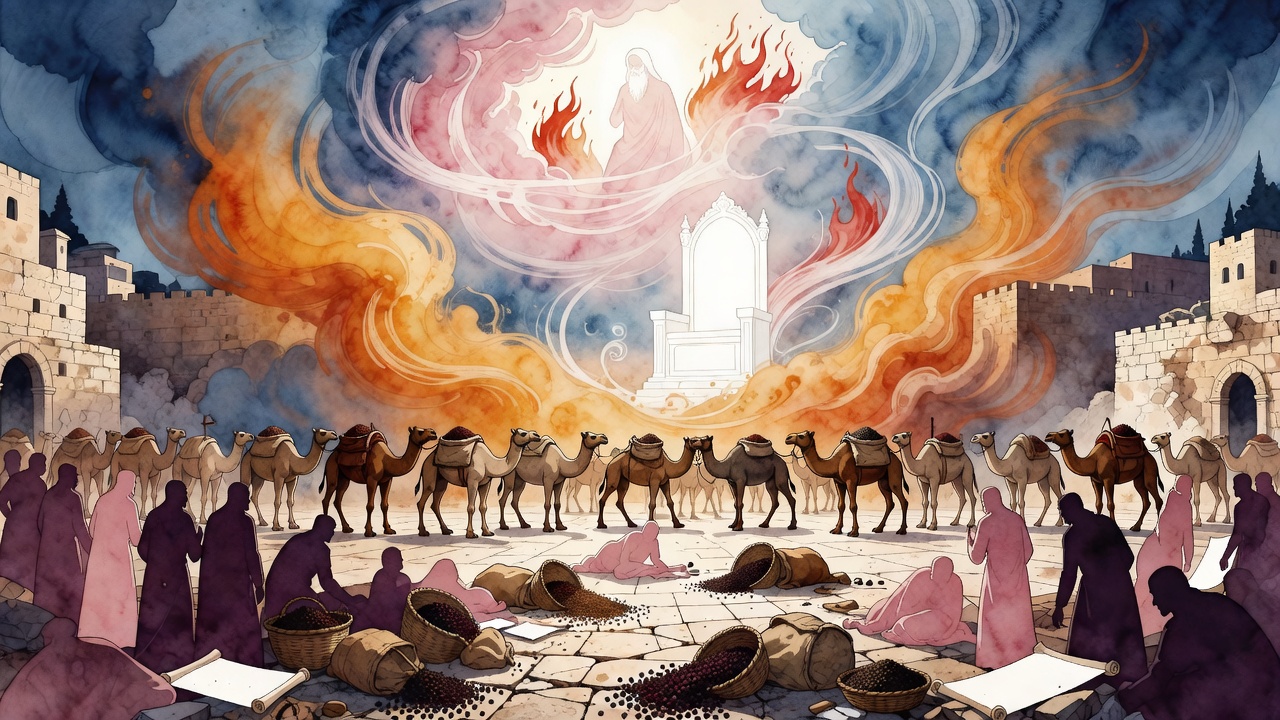
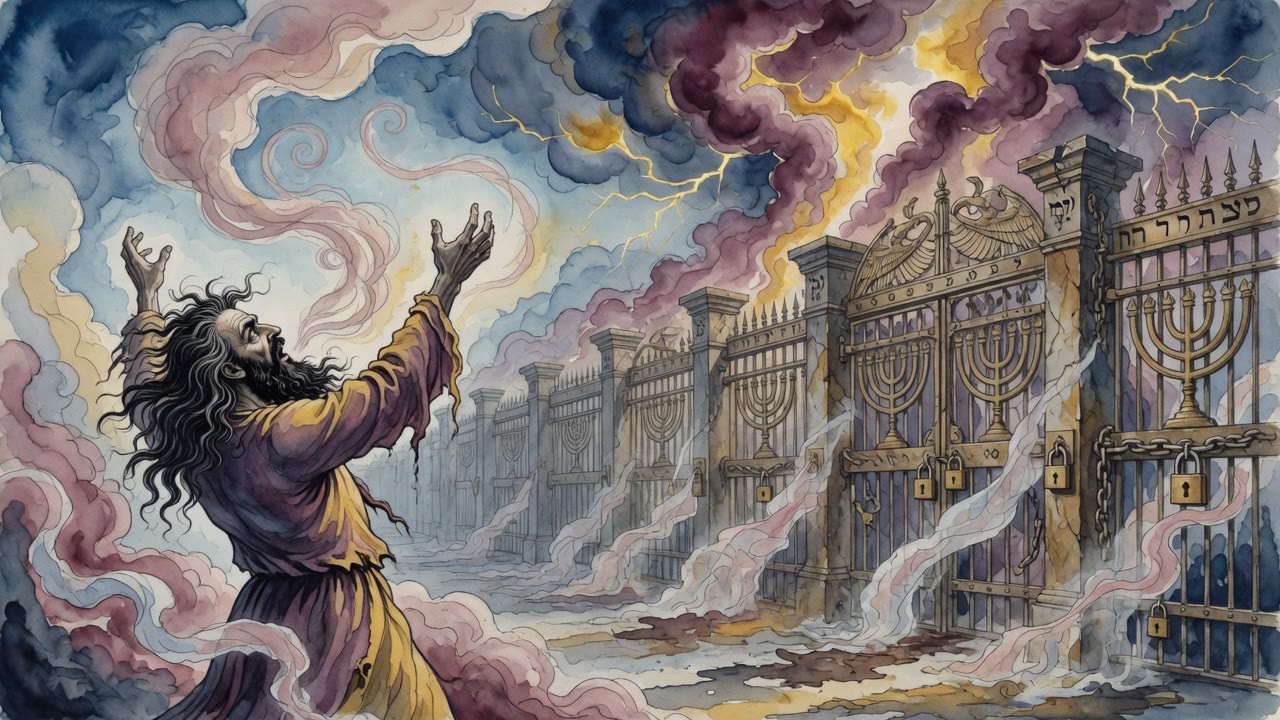
Every chamber that once widened when Israel prayed now stood sealed. Bolts that had no metal still held. The Shekhinah (God's indwelling presence) stood outside Her own room. The Blessed Holy One stood outside His. Angels whose only craft was to carry human words up the ladder of speech found themselves locked in the corridor, wings folded against doors that would not answer.

Isaiah heard them shout the way mighty ones shout when the street is all that is left (Isaiah 33:7). The sound was not music. It was unemployment made holy and terrible.

Two Departures, One Throat

He remembered, against his will, another exit. When Israel left Egypt, mouths opened into song. Moses and the people sang at the sea as if freedom itself had learned Hebrew (Exodus 15:1). Going out had meant going toward. Joy had been the correct temperature of the throat.

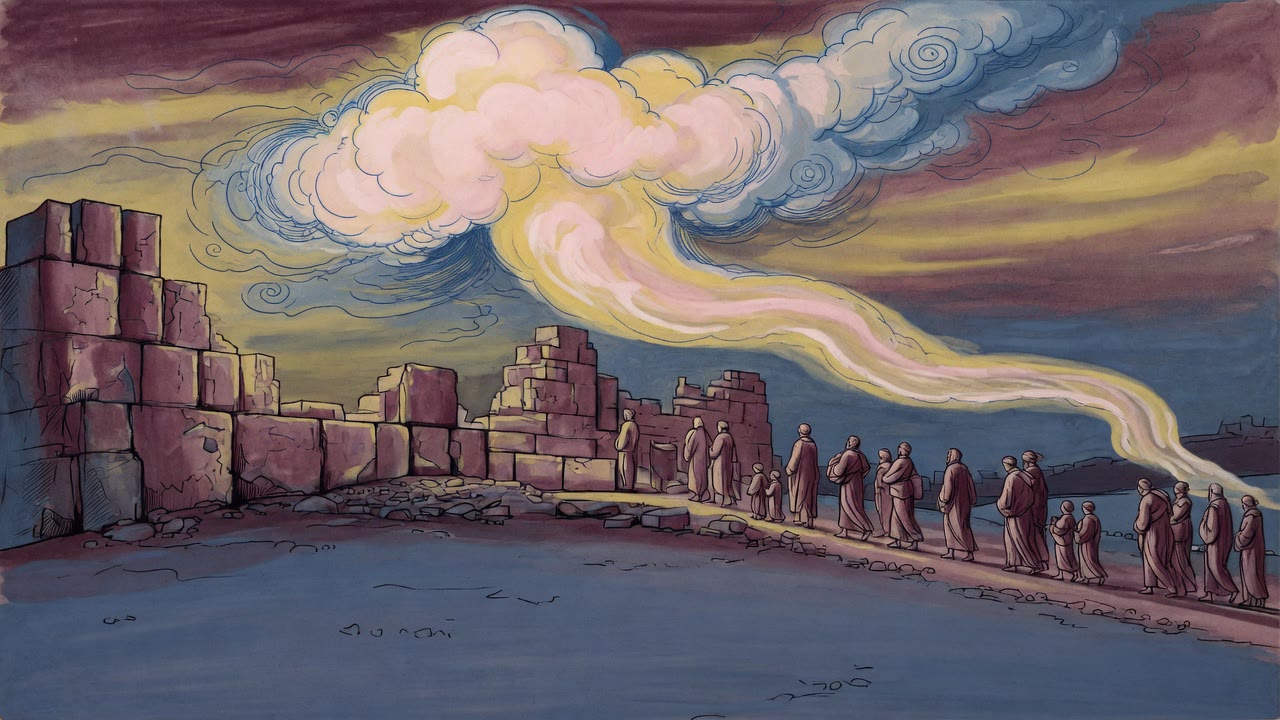
When Jerusalem fell, going out meant going away. No song rose. Cheeks wet themselves in the night (Lamentations 1:2). The same nation that once left a house of slaves singing now left a house of God weeping. Isaiah stood between those two exits in the upper world and understood the bolts. Exile was not only geography. It was a closed architecture.

An angel beat once on a door and then stopped, ashamed of hope.

What Still Opens

"All the gates are closed," the vision said without kindness, "but the gates of tears are not closed."

Isaiah put his face in his hands and tested the claim. Salt found a seam the liturgy could not find. Somewhere a hinge moved that no key of clean praise had moved in years. The rooms did not throw themselves wide. They admitted wetness. That was enough to keep the covenant from becoming a museum.

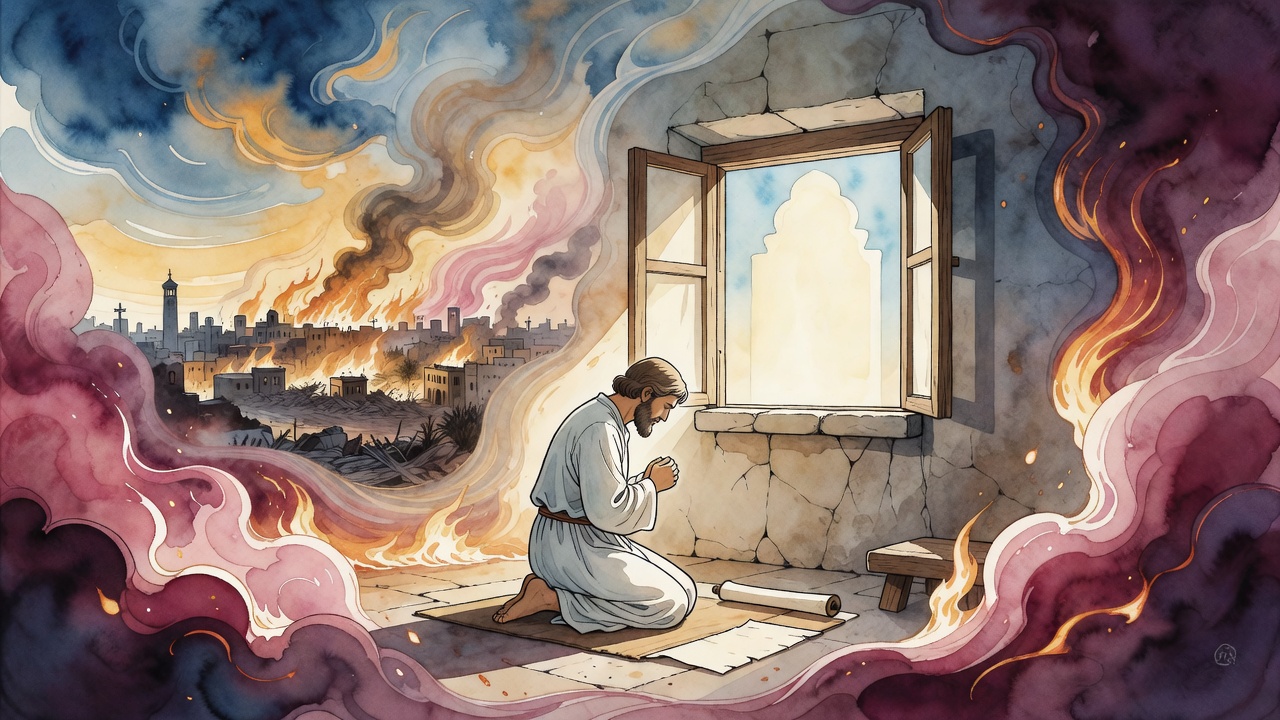
He saw, far below, a man in Babylon open a window toward a ruined direction and fall to his knees three times in a day. Daniel prayed with his body aimed at a city that no longer held its Temple, offering heart where incense once rose (Daniel 6:11). David had already named the exchange: prayer as incense, lifted hands as the evening offering (Psalms 141:2). Service of the heart was not a soft substitute invented for comfort. It was the only legal tender left when altars went cold.

Isaiah watched Daniel's tears join the seam. The angel in the corridor straightened, not because a gate had become a boulevard, but because work had returned in a thinner form.

Outside the Chambers

The Shekhinah (the Divine Presence) did not pace like a prisoner. She waited like a mother locked out of her own kitchen while the house still burned somewhere downstairs. The Blessed Holy One did not thunder the doors down. Presence accepted the terms of exile it had allowed, and the acceptance was part of the grief.

Isaiah wanted to demand a reopening on the strength of old miracles. The sea had split. The mountain had smoked. Why should bolts hold now? The answer came as image, not debate: a people that leaves Egypt singing and leaves Jerusalem weeping cannot pretend the upper house is unchanged. Heaven mirrors the throat of Israel. When the throat only sobs, the wide gates of ordinary prayer go off duty, and only the tear-gates keep a night shift.

He tried to sing anyway. The song hit wood. He wept, and the wood remembered water.

A Prophet's Report

When the vision released him, Isaiah carried no diagram of keys. He carried a single operational fact. In the long galut, do not trust the polished gate. Trust the wet face. Do not wait for the chamber to look like the good years. Aim the body toward Jerusalem even when the stones are down. Offer the heart as service when the altar is ash.

In the corridor the angels of prayer still stood outside, but they were no longer idle. They collected tears the way they had once collected clean words. Mighty ones still shouted. The shout had become part of the liturgy of exile, a noise that refused to pretend the house was in order.

Isaiah wiped his mouth and tasted salt and smoke. Behind him the sealed rooms kept their seals. Ahead of him a people would need to learn that weeping was not the failure of prayer. It was prayer's last open door.

Night in the upper world had no stars he recognized. He walked down the vision the way a man walks down a stair he does not trust, one hand on a wall that might not be there, and every few steps he let his eyes burn so the hinge would remember him.


← All myths
From the tradition

Sources

3 sources

The texts behind this telling. Some cards carry a translation of the source; others are our own retelling of it, and each card says which. Every card links out to the original.

Tikkunei Zohar 52:6Tikkunei Zohar

Retold in our words. Read the original at the link below.Sefaria-hosted English translation · CC-BY

The Tikkunei (spiritual repair) Zohar, a central text of Kabbalah, paints a powerful picture of what happens when things aren't quite right with the world, and how it affects our connection to the Divine. It speaks of a time when, in the "good old days," when Israel prayed, all the heavenly chambers – the spiritual conduits – would open wide.

Now? Oy vey. Now, during this long, drawn-out exile – this galut, as we call it – things are different. Very different. The Tikkunei Zohar tells us that all the gates are closed. It's not just difficult; it’s as if the whole system is offline.

It gets worse. The Shekhinah (the Divine Presence) – that indwelling Divine Presence, the feminine aspect of God – is outside Her chamber. The Blessed Holy One, Kadosh Barukh Hu, is outside His. Even the angels whose job it is to handle our prayers are locked out.

This image echoes the lament in (Isaiah 33:7): "Behold, their mighty ones are shouting outside…" Can you hear the echoes of that desperation? The feeling of being cut off?

The Talmud, in Berakhot 32b, also touches on this idea of closed gates. It’s a recurring theme when we talk about times of spiritual hardship.

So, what are we supposed to do? If everything is locked down, if the spiritual infrastructure is crumbling, is there any hope for our prayers to be heard?

Well, here's the lifeline. The Tikkunei Zohar offers a glimmer of hope amidst the gloom. It says: "All the gates are closed, but the gates of tears are not closed."

Shaarei dima’ot ain ne’elam – the gates of tears are never locked. What does it mean? It means that even when everything else is blocked, when the normal channels are unavailable, sincere emotion, raw vulnerability, the outpouring of the heart – that always gets through.

Tears, born of genuine remorse, of heartfelt longing, of unadulterated pain – these are the keys that unlock the heavens. They bypass the bureaucracy, the red tape, the celestial gatekeepers. They go straight to the Source.

Ginzberg, in his monumental Legends of the Jews, expands on this idea of the power of heartfelt prayer, and how even the most hardened decrees can be overturned by sincere repentance. Midrash Rabbah is also full of stories illustrating this very point.

Don’t despair. Let your heart break open. Let the tears flow. Because those gates? They are always open. And sometimes, they're the only way in.

Full source
Yalkut Shimoni on Nach 1026:14Yalkut Shimoni

Retold in our words. Read the original at the link below.Sefaria Community Translation · CC0

This midrash from the Yalkut Shimoni places two departures side by side to expose how Israel's fortunes reversed across history. When the people left Egypt, freed from bondage at the sea, their first response was praise. The verse cited is the opening of the Song at the Sea, where it is written, Then Moses and the children of Israel sang this song (Exodus 15:1). Going out of Egypt meant going out toward redemption, and song poured forth as the natural voice of a people lifted from slavery into freedom.

The contrast is the going out of Jerusalem. When the city fell and the people were driven into exile, there was no song, only weeping. The proof verse is from the prophet Jeremiah's lament, bitterly she weeps in the night, her cheek wet with tears (Lamentations 1:2). The same nation that once left a place rejoicing now leaves a place grieving, and the comparison sharpens the loss.

The rabbis read the two exoduses as mirror images. One departure carried Israel into the wilderness and ultimately to Sinai and the Land; the other carried them away from the Temple and into the scattering among the nations. By binding the two verses together, the midrash teaches that the destruction of Jerusalem was not merely a defeat but the undoing of the very freedom won in Egypt, and that the tears of Lamentations are the inverse of the joy of the Song at the Sea.

Full source
Sifrei Devarim 41:18Sifrei Devarim

Retold in our words. Read the original at the link below.Sifrei by Rabbi Shraga Silverstein · CC-BY

The Sifrei Devarim, a collection of early rabbinic legal interpretations on the Book of Deuteronomy, digs deep into what it truly means to "serve Him." We find a fascinating discussion surrounding the verse that commands us "to serve Him." But how do we really serve God? Is it all about sacrifices and temple rituals? Or is there something more profound at play?

The passage poses a pointed question: If the verse says "to serve Him with all your heart," how can service be literal? I mean, is there actual "service" in the heart? Probably not.

So, what's the answer? According to the Sifrei Devarim, the true intent of "and to serve Him with all your heart" is… prayer. Prayer isn't just reciting words. It's a heartfelt connection, an offering of our innermost selves. King David understood this when he said in (Psalms 141:2), "Let my prayer stand as incense before You; the lifting of my hands, as an evening offering." He saw prayer as a direct substitute for the Temple service, a way to connect with the Divine.

What about Daniel? Remember Daniel in the lion's den? The Sifrei Devarim points to his story as further proof. Daniel, even in exile in Bavel (Babylon), continued his practice of praying three times a day towards Jerusalem. (Daniel 6:11) tells us, "And when Daniel learned that the writing had been inscribed, he went home. He had windows open in his upper storey, facing Jerusalem, and three times a day he fell to his knees and gave thanks before his G-d, exactly as he used to do before this." Even the king recognized this devotion, asking (Ibid. 21), "Daniel, servant of the living G-d, was your G-d, whom you serve continually, able to save you from the lions?"

But wait a minute... was there actually Temple service in Bavel? Of course not! So, what did the king mean by "whom you serve continually?" The answer, again, is prayer. Just as the sacrificial service in the Temple was called avodah (service), so too, is prayer.

Prayer, in this light, becomes more than just asking for things. It's an act of devotion, a way of offering our time, our thoughts, and our very selves to the Divine. It's a way to connect, to serve, even when we can't physically be in a Temple or perform a sacrifice. It’s as potent and powerful as any ritual.

So, the next time you find yourself in prayer, remember Daniel, remember King David, and remember the wisdom of the Sifrei Devarim. You’re not just talking; you're serving. You’re engaging in an ancient and sacred form of connection that transcends place and time. And maybe, just maybe, that connection is the most powerful offering of all.

Full source