6 min read

Job and Jerusalem Matched Wound for Wound

God sent Abraham to comfort the burned city. She threw his own life back at him and refused. So did Isaac, Jacob, and Moses.

Curated by Arthur · Told by Maggid ·
Table of Contents
  1. Every Bruise on Job Had Its Twin
  2. No Other City Was Ruined Enough
  3. Abraham Came First and She Sent Him Away
  4. The Queen Named Her Price
  5. Whoever Kindles the Fire Shall Pay
Job and Jerusalem Matched Wound for Wound Click for full size

Every Bruise on Job Had Its Twin

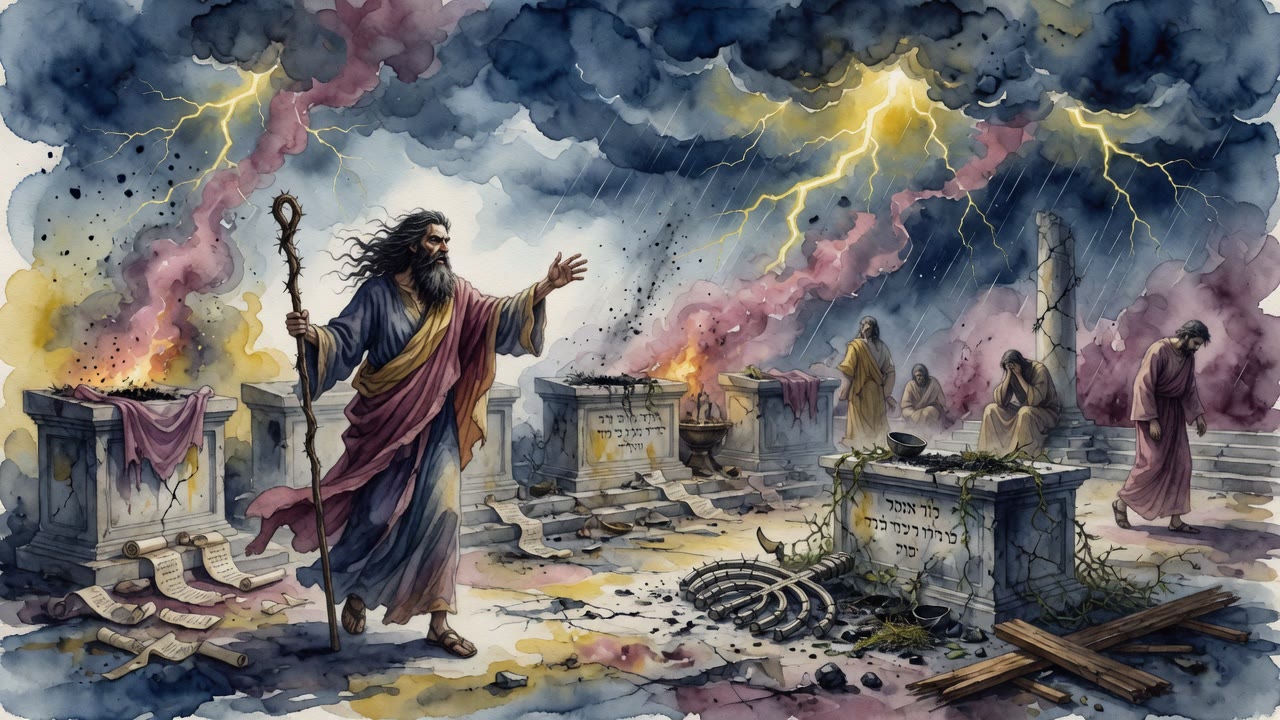
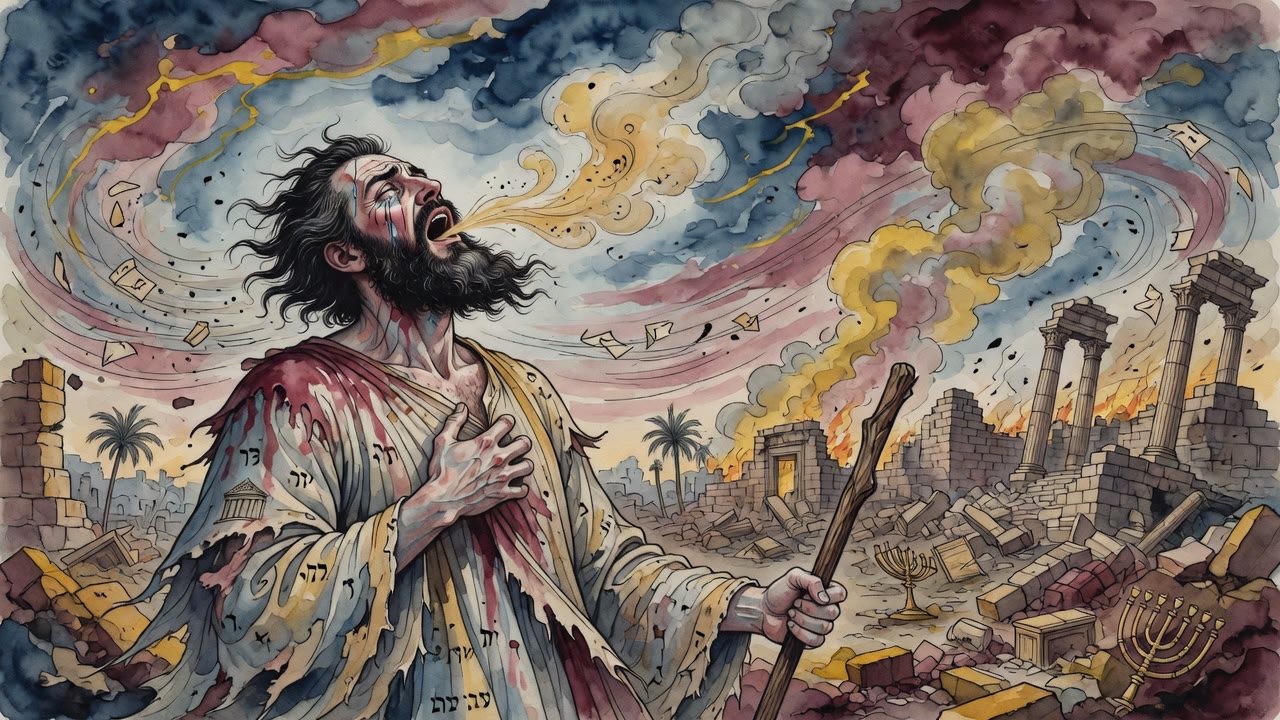
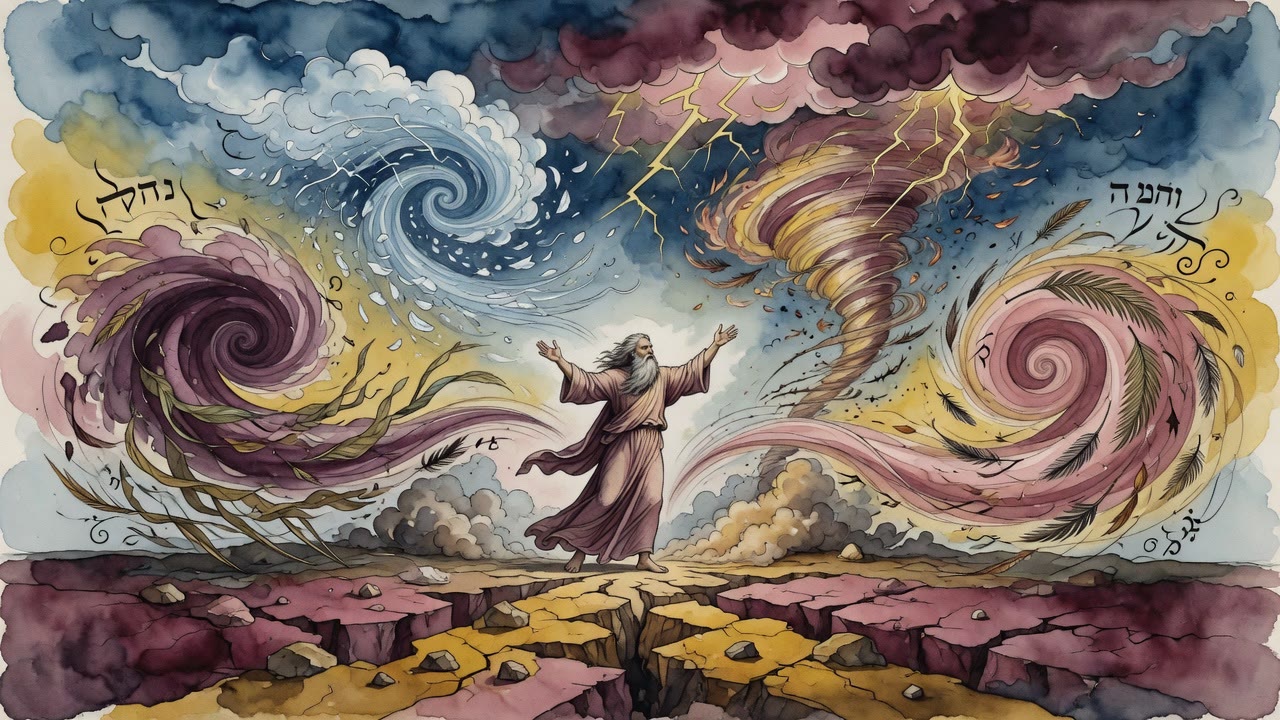
Chaldean raiders came at Job's camels in three companies and left him nothing. Chaldean armies came through the wall of Jerusalem. Fire of God fell out of the sky onto Job's flocks. From on high He sent fire into the bones of the city.
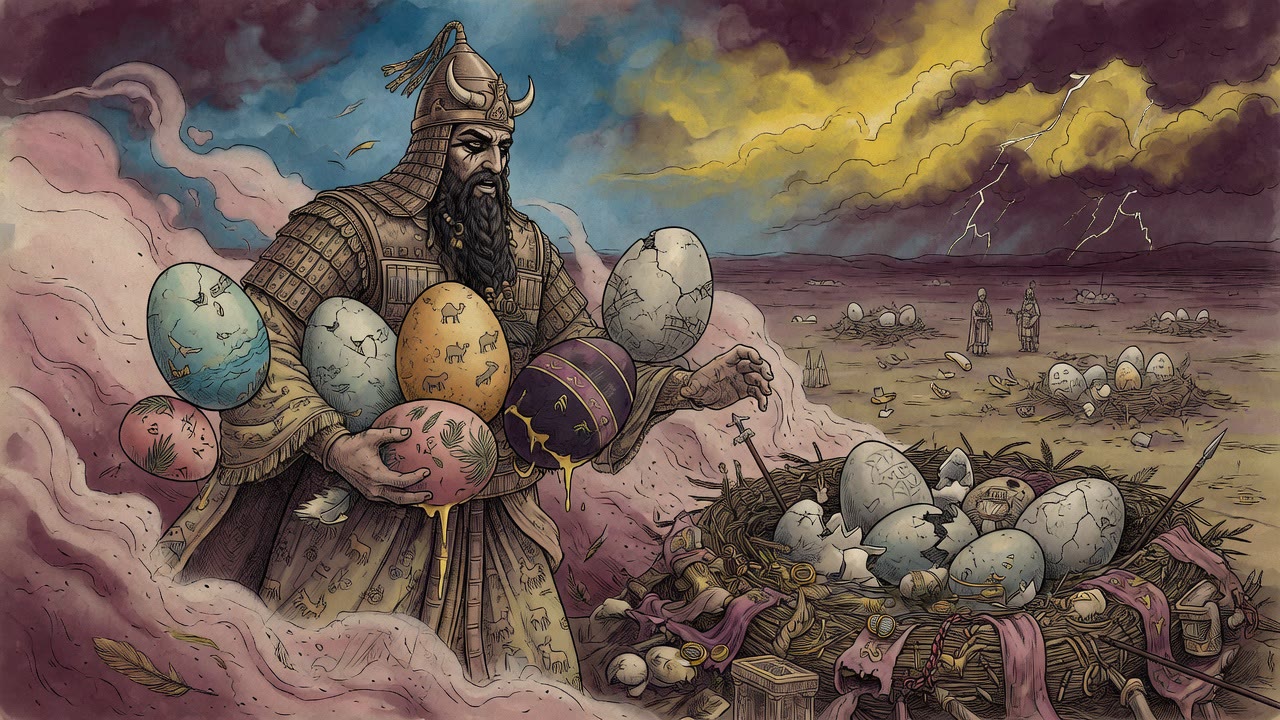
Lay the man and the city down next to each other and the pairs will not stop coming. Job sat in the ashes and scraped himself with a piece of broken pot. The children of Zion, worth their weight in fine gold, were counted as clay jugs. Job's friends sat down with him on the ground and for seven days nobody said anything. The elders of the daughter of Zion sat on the ground and kept silent. Sackcloth on the skin. Dust on the head. Job begging his friends, have pity on me, have pity on me, and getting nothing back. The hand of God laid on him.

The city got the same hand. She received from the hand of the LORD double for all her sins.

Rabbi Yehoshua ben Nehemiah did the arithmetic out loud. Job was struck twice over and was paid back twice over, everything restored and doubled. So the same must hold for Jerusalem. The blow came doubled, and the comfort therefore has to come doubled, which is why the prophet says it twice: comfort, comfort my people.

Saying it was easy. Delivering it turned out to be the hard part.

No Other City Was Ruined Enough

Comforters work by comparison. A man buries his wife and will not be consoled, and his friends say, was your wife more beautiful than the wife of so and so, who died, and he accepted comfort? A man buries his son and cannot stop, and they say, was your son finer than that man's son? The whole trade depends on finding somebody whose loss will stand next to yours.

So when God ruins a province, He sets another ruined province beside it. Nineveh fell, and Alexandria in Egypt was set down alongside her.

Every prophet went looking for the city that could stand next to Zion, and no prophet found one. What shall I take to witness for you? What shall I compare to you? Nothing on the map matched.

God tried a different offer. Name whichever of your fathers you want, He said, and I will bring him up out of his grave and he will walk at the head of you. Abraham, Isaac, Jacob. Moses and Aaron. David and Solomon. Choose.

Israel said they did not want any of them. You are our father, they said, and Abraham does not know us, and Israel does not recognize us, and Your name from of old is our redeemer.

Abraham Came First and She Sent Him Away

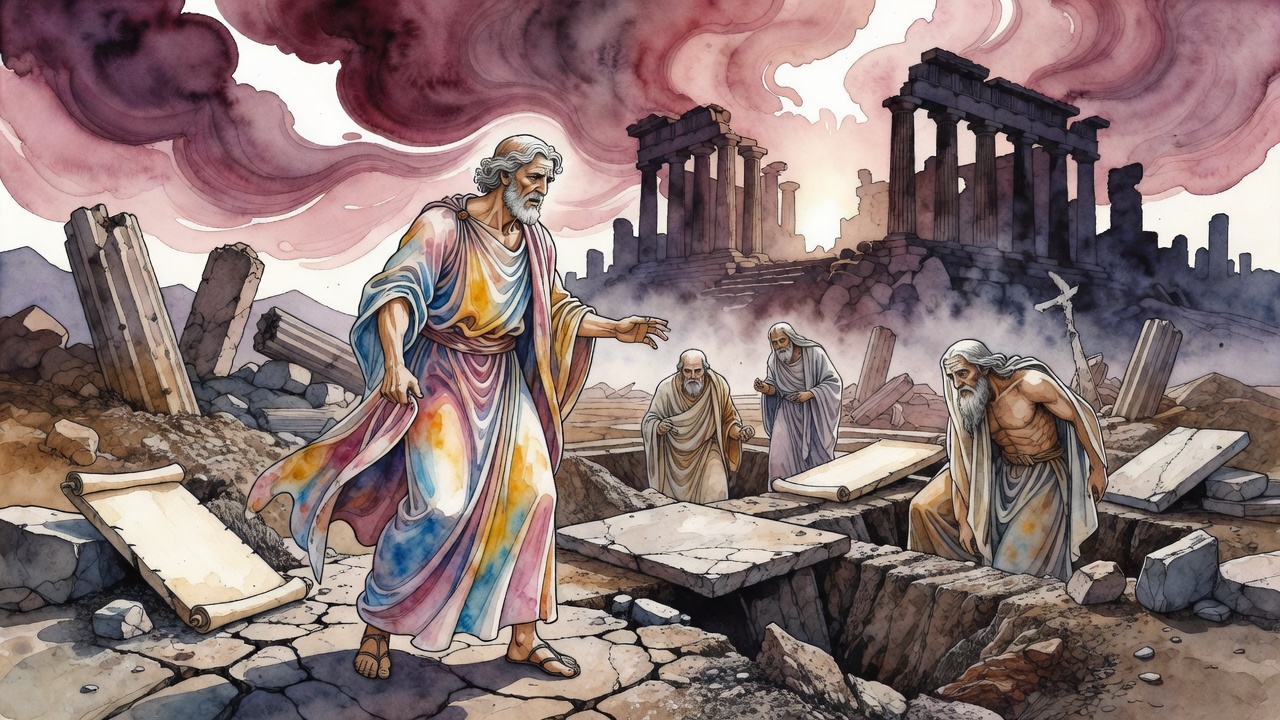
God sent Abraham anyway. Go and comfort Jerusalem, He said. Perhaps she will take comfort from you.

Abraham stood in the smoke and said, accept comfort from me.

"How am I supposed to take comfort from you," she said, "when you are the one who turned me into a mountain? On the mountain of the LORD it shall be seen. That is your line. You did that."

God sent Isaac. Isaac, who had been on the wood.

"From you? Esau came out of you. Esau made me a field. Esau went out to the field, and it is his sons who burned me."

God sent Jacob, who had slept on a stone at that exact place and woken up shouting about a gate of heaven.

"You made me into something that was only ever a doorway," she said. "This is none other than the house of God. As though I had never been anything on my own account."

God sent Moses. The mouth that split the sea. The man who had argued heaven out of a decree before.

She did not let him start. "You wrote the curses. You put them in writing against me. Wasting of hunger, and devoured by burning heat, and bitter destruction. Comfort me with what, exactly?"

The four of them went back together and stood in front of God and said the same sentence. She would not accept comfort from us. The prophet already had the phrase for what they left behind them: afflicted one, storm tossed, not comforted.

The Queen Named Her Price

There was a king once who lost his temper at his queen and put her out of the palace. Days went by. He wanted her back.

She sent word. Double my marriage contract first, and then he may bring me home.

God said to Israel, my children, at Sinai I said it to you once. I am the LORD your God. One I. In Jerusalem, in the time that is coming, I will say it to you twice. I, I am the one who comforts you.

Two of everything. Two blows, two payments, two names, two words at the head of the prophecy. A city wrecked on a doubled account was not going to come home for a single soft syllable, and God did not pretend otherwise. He agreed to the terms.

Whoever Kindles the Fire Shall Pay

Then He said the rest of it, and He said it the way a man says it who has read the ruling and knows exactly how it applies to him.

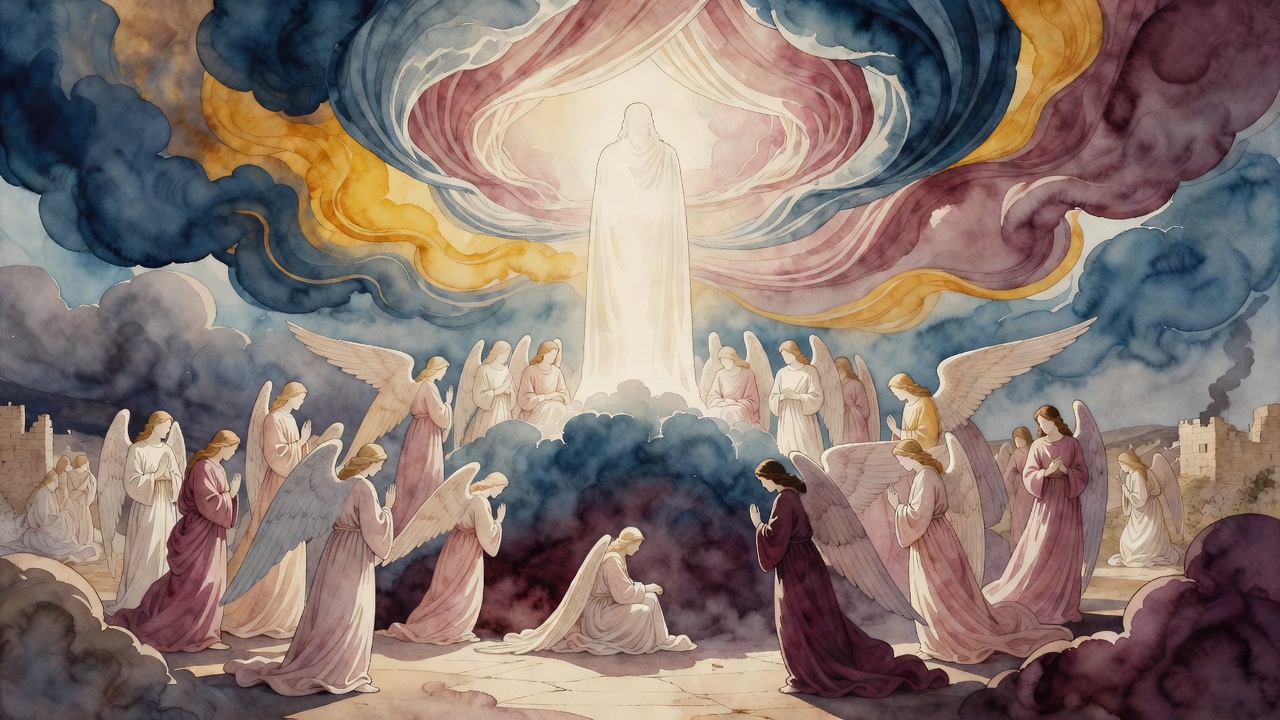
It falls to Me to comfort Jerusalem. I am the one who wrote, he who kindles the fire shall surely make restitution. I set her on fire. From on high I sent fire into her bones. So I pay.

What He offered in payment was more fire. I will be to her, says the LORD, a wall of fire all around.

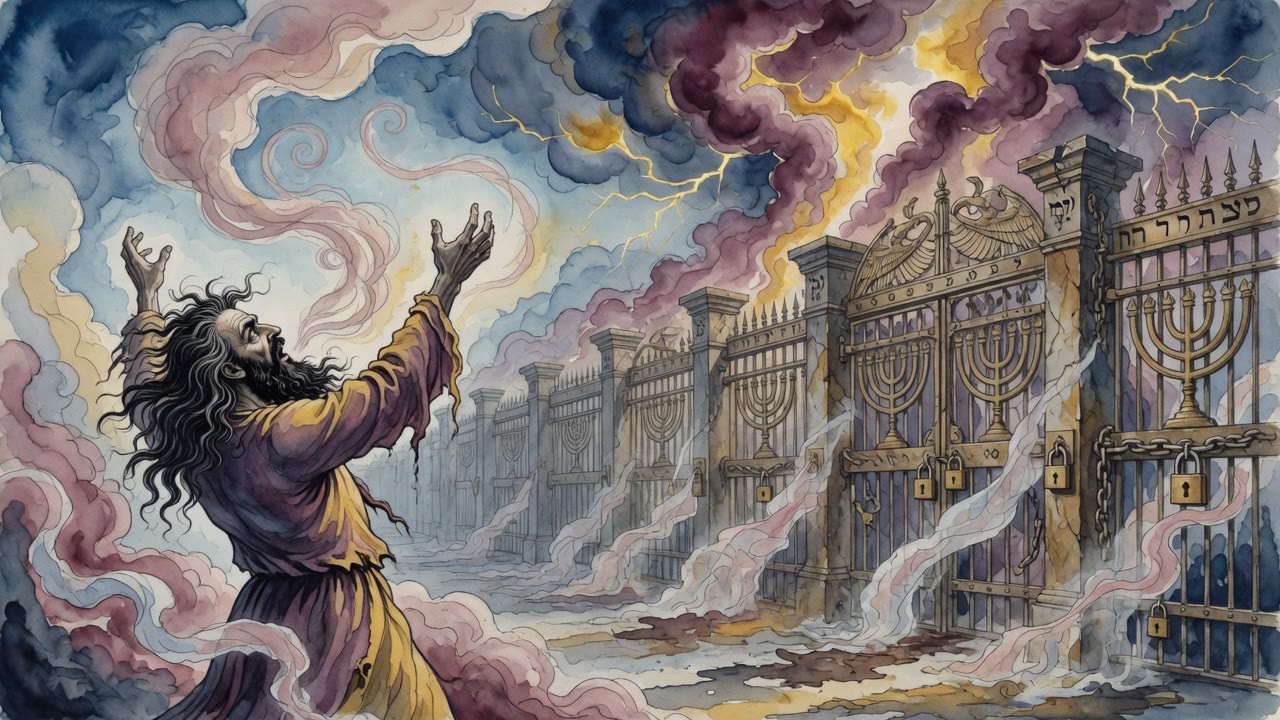
The element that came down through her roof would stand up around her walls. Nobody had been able to reach her with a word of comfort. Now nobody would be able to reach her at all.


← All myths
From the tradition

Sources

3 sources

The texts behind this telling. Some cards carry a translation of the source; others are our own retelling of it, and each card says which. Every card links out to the original.

Pesikta DeRav Kahana 16:6Pesikta de-Rav Kahana

Translation of the source text.Pesikta de Rav Kahana according to an Oxford manuscript, Dov Mandelbaum ed., N.Y. 1987 · CC-BY

"All your lovers have forgotten you; they do not seek you, for I have struck you with the wound of an enemy" (Jeremiah 30:14). Read not "the wound of an enemy" (makkat oyev) but "the wound of Job" (makkat Iyyov) have I struck you. For concerning Job it is written, "The Chaldeans formed three bands" (Job 1:17), and concerning Jerusalem it is written, "The city is given into the hand of the Chaldeans" (Jeremiah 32:24). Concerning Job it is written, "The fire of God fell from heaven" (Job 1:16), and concerning Jerusalem it is written, "From on high He sent fire into my bones and it overcame them" (Lamentations 1:13). Concerning Job it is written, "He took a potsherd to scrape himself with it" (Job 2:8), and concerning Jerusalem it is written, "How are they reckoned as earthen jars of potsherd" (Lamentations 4:2). Concerning Job it is written, "They sat with him on the ground seven days" (Job 2:13), and concerning Jerusalem it is written, "The elders of the daughter of Zion sit on the ground in silence" (Lamentations 2:10). Concerning Job it is written, "I have sewn sackcloth upon my skin" (Job 16:15), and concerning Jerusalem it is written, "They have girded on sackcloth" (Lamentations 2:10). Concerning Job it is written, "I have laid my horn in the dust" (Job 16:15), and concerning Jerusalem it is written, "They have cast dust on their heads" (Lamentations 2:10). Concerning Job it is written, "Pity me, pity me, you my friends" (Job 19:21), and concerning Jerusalem it is written, "I will not grant you pity" (Jeremiah 16:13). Concerning Job it is written, "For the hand of God has touched me" (Job 19:21), and concerning Jerusalem it is written, "For she has received from the hand of the LORD double" (Isaiah 40:2). Rabbi Yehoshua son of Rabbi Nehemiah said: If Job, who was stricken double, was given his reward double, then Jerusalem too is comforted double, "Comfort, comfort My people" (Isaiah 40:1).

Full source
Pesikta Rabbati 30:3Pesikta Rabbati

Translation of the source text.OYW · Public Domain

"Comfort, comfort My people, says your God" (Isaiah 40:1). This is what is said by the Holy Spirit: "What shall I take to witness for you, what shall I liken to you?" (Lamentations 2:13). Concerning whom did Jeremiah speak this verse? He spoke it only concerning Jerusalem, for all the prophets sought a match for Jerusalem and did not find one. A parable of a man whose wife died, and his companions came in to comfort him. If they comfort him over his wife and he is not comforted, they say to him: "Was your wife more beautiful than the wife of so-and-so, who died, and he accepted comfort over her?" And if it is over his son, they say to him likewise: "Was your son more beautiful than the son of so-and-so?" So too you find that when the Holy One, blessed be He, brings calamity upon a province, He matches it with another province in order to comfort it. When He brought the calamity upon Nineveh, He matched it with Alexandria of Egypt.

But for the Assembly of Israel He found nothing with which to match it, until Israel said: "Behold, as the eyes of servants look to the hand of their masters, and as the eyes of a maidservant to the hand of her mistress, so our eyes look to the LORD our God, until He is gracious to us" (Psalms 123:2). When Israel were exiled from their land, the Holy One, blessed be He, said to them: "In whom do you wish? In your earliest forefathers, that I should raise one of them from his grave and he shall go at your head? Whether in Abraham, Isaac, and Jacob; whether in Moses and Aaron, that I should raise him from his grave and he shall go at your head; whether you wish in David and Solomon, that I should raise him from his grave and he shall go at your head?" Israel said to Him: "Master of the universe, we do not wish in these, but in You," as it is said: "For You are our Father, though Abraham does not know us, and Israel does not recognize us; You, O LORD, are our Father, our Redeemer from of old is Your name" (Isaiah 63:16).

Another interpretation: The Holy One, blessed be He, said to Abraham: "Go and comfort Jerusalem; perhaps she will accept comfort from you." Abraham went and said: "Accept comfort from me." She said to him: "How shall I accept comfort from you, who made me like a mountain," as it is said: "On the mount of the LORD it shall be seen" (Genesis 22:14). He said to Isaac: "Go and comfort Jerusalem; perhaps she will accept comfort." Isaac went and spoke. She said to him: "How shall I accept comfort from you, from whom came forth Esau the wicked, and who made me like a field," as it is said: "And Esau went out to the field" (Genesis 27:5), "and his sons burned me with fire."

He said to Jacob: "Go and comfort Jerusalem." She said to him: "How shall I accept comfort from you, who set me as though I had never been," as it is said: "This is none other than the house of God" (Genesis 28:17). He said to Moses: "Go and comfort." She said to him: "How shall I accept comfort from you, who wrote against me curses and harsh decrees: 'wasting of hunger, and devouring of the fiery bolt' (Deuteronomy 32:24)." Immediately they all returned and said to the Holy One, blessed be He: "She did not accept comfort from us," as it is said: "O afflicted one, storm-tossed, not comforted" (Isaiah 54:11). Immediately the Holy One, blessed be He, said: "It falls to Me to comfort Jerusalem, for thus I wrote: 'He who kindled the fire shall surely make restitution' (Exodus 22:5). I set her ablaze with fire," as it is said: "From on high He sent fire" (Lamentations 1:13). "I will comfort her," as it is said: "And I will be to her, says the LORD, a wall of fire round about" (Zechariah 2:9).

Full source
Pesikta DeRav Kahana 19:5Pesikta de-Rav Kahana

Translation of the source text.Pesikta de Rav Kahana according to an Oxford manuscript, Dov Mandelbaum ed., N.Y. 1987 · CC-BY

Another interpretation: "I, even I, am He who comforts you" (Isaiah 51:12). Rabbi Avun in the name of Resh Lakish: A parable to a king who grew angry with a noblewoman and drove her out of his palace. After some days he wished to bring her back. She said, "Let him double my marriage contract, and then he may bring me back." So the Holy One, blessed be He, said to Israel, "My children, at Sinai I said to you one time, I am the LORD your God (Exodus 20:2), but in Jerusalem in the time to come I will say to you twice, I, even I, am He who comforts you" (Isaiah 51:12). Rabbi Menachma in the name of Rabbi Avin: From that comfort with which you comforted Me at Mount Sinai when you said, "All that the LORD has spoken we will do and we will hear" (Exodus 24:7). "Who are you that you should be afraid?" (Isaiah 51:12), are you not the one who said to Me at the sea, "Who is like You?" (Exodus 15:11). "That you fear man who shall die" (Isaiah 51:12), or rather, "and the son of man who shall be made as grass" (Isaiah 51:12). Rabbi Berekhyah in the name of Rabbi Chelbo, Rabbi Shmuel bar Nachman in the name of Rabbi Yonatan: Israel deserved to be destroyed in the days of Haman, had they not relied on the opinion of the elder [Jacob], who said, "If our father Jacob, whom the Holy One, blessed be He, assured, saying, Behold, I am with you and will keep you wherever you go (Genesis 28:15), was afraid, how much more are we." This is why the prophet rebukes them and says, "And you have forgotten the LORD your Maker, who stretched out the heavens and laid the foundations of the earth" (Isaiah 51:13). You have forgotten what He said to you, "If the heavens above can be measured and the foundations of the earth searched out below, then also I will cast off all the seed of Israel for all that they have done, says the LORD" (Jeremiah 31:36). Have you seen heavens that were measured or earth that collapsed? From the stretching out of heaven and earth you should have learned. Instead, "You are afraid continually all the day because of the fury of the oppressor" (Isaiah 51:13). Rabbi Yitzchak said: troubles oppressed them one after another. "And where is the fury of the oppressor?" (Isaiah 51:13), that is Haman and his crew. "Who prepared to destroy" (Isaiah 51:13), "in the first month, which is the month of Nisan" (Esther 3:7). "The captive in chains shall speedily be released, that he should not die and go down to the pit" (Isaiah 51:14). Rabbi Abbahu said: this is one of six things that are a good sign for a sick person, sneezing, sweating, sleep, seminal emission, a dream, and the working of the bowels. Sneezing, from where? "His sneezings flash forth light" (Job 41:10). Sweating, from where? "In the sweat of your brow you shall eat bread" (Genesis 3:19). Emission, from where? "He shall see seed and prolong his days" (Isaiah 53:10). Sleep, from where? "I would have slept, then it would be at rest for me" (Job 3:13). A dream, from where? "You restored me and made me live" (Isaiah 38:16). The working of the bowels, from where? "The captive in chains shall speedily be released, that he should not die and go down to the pit" (Isaiah 51:14). Rabbi Chaggai said: provided that his bread is not lacking.

Full source