5 min read

Daniel Opened His Window Toward a City Already Burned

When the ban on prayer was signed, Daniel went home, opened his windows toward Jerusalem, and knelt three times as if the Temple still held its fire.

Curated by Arthur · Told by Maggid ·
Table of Contents
  1. Service Without an Altar
  2. Where the Name Is Placed
  3. A King Who Would Not Sleep
  4. Lions as the Last Congregation

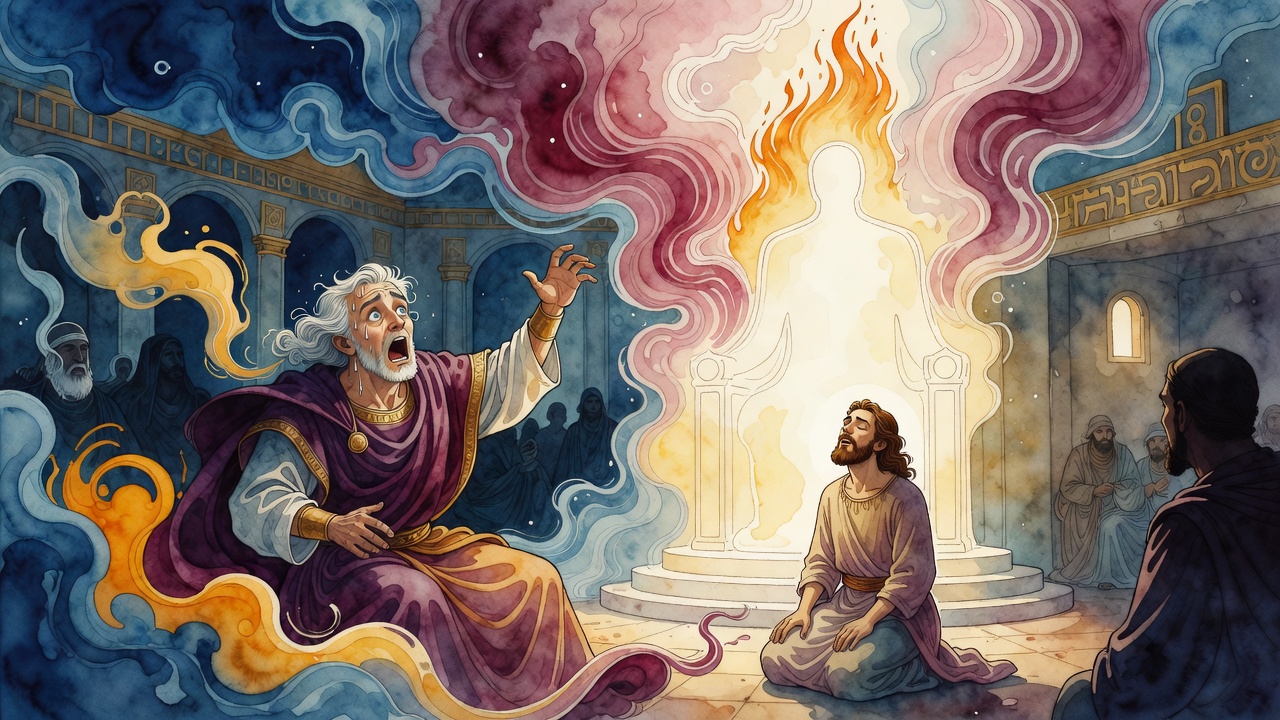
The ink on the ban was still wet when Daniel climbed the stairs to his upper room.
Daniel Opened His Window Toward a City Already Burned Click for full size

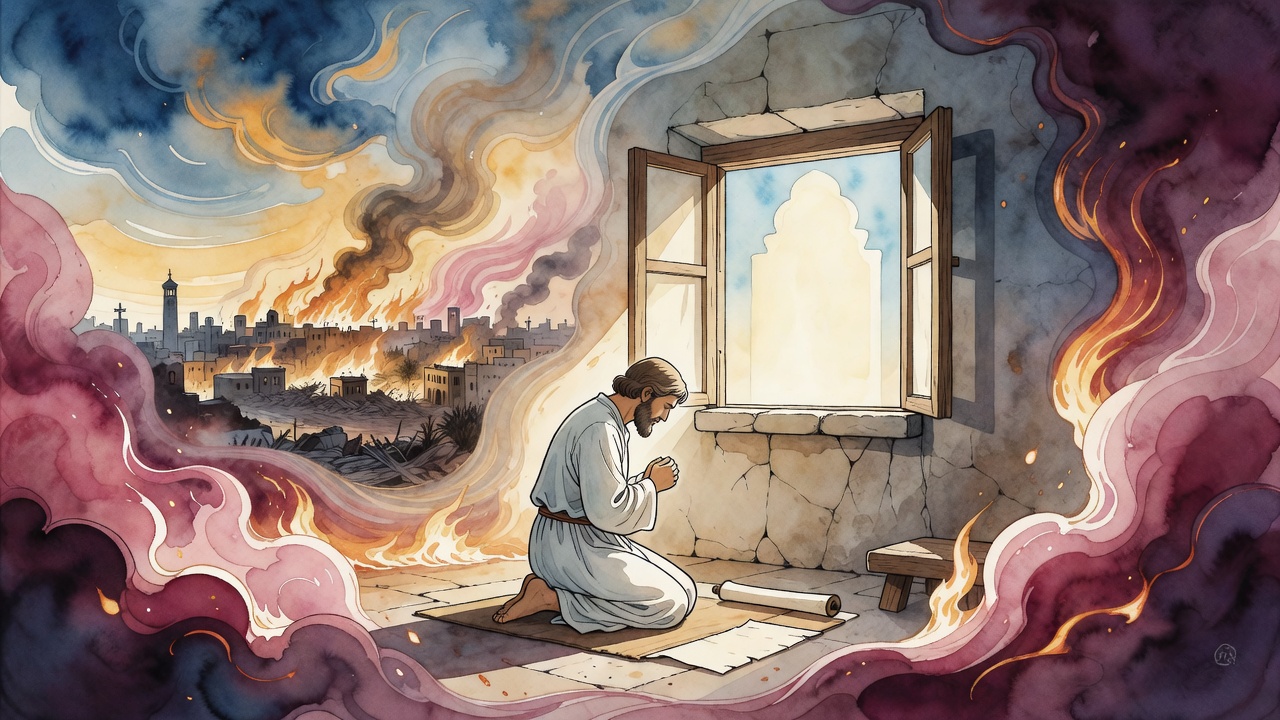
He did not stop to argue in the street. He did not gather a minyan (a prayer quorum of ten) of excuses. He put his hand on the latch of the window that faced west of hope, toward a Jerusalem that already smelled, in memory, of ash, and he opened it as wide as the frame allowed.

Air from Babylon came in, dry and imperial. He knelt anyway. Three times a day he had done this before the writing. Three times a day he would do it after the writing (Daniel 6:11). The decree had changed the risk. It had not changed the direction of his face.

Service Without an Altar

How do you serve God with all your heart when the heart has no hands? The old question waited in the room like a second ban. Blood on an altar is service you can photograph. A heart cannot lift a basin. A heart cannot arrange wood.

Daniel answered with his knees. Prayer was the service left when the service of fire was taken away. David had already written the exchange rate: let prayer stand as incense, let lifted hands stand as the evening offering (Psalms 141:2). Daniel lived the rate. Each bow was a portion. Each thanksgiving was a smoke that needed no coal.

Below in the city, men who loved the new law watched the open window and smiled the smile of hunters.

Where the Name Is Placed

He was not aiming at stone for stone's sake. He was aiming at the place where God had said He would place His Name (Deuteronomy 12:11). Priests had once placed that Name on Israel with lifted hands (Numbers 6:27). The Temple had been the focused point. Exile had smashed the point without smashing the promise.

In every place where the Name is mentioned, the older word still stood, blessing would come (Exodus 20:21). Daniel mentioned the Name in a rented upper room of a foreign capital and treated the mention as architecture. The window was his doorway into a geography larger than Babylon's maps.

When his forehead touched the floor, he smelled dust that was not Judean and prayed as if it were.

A King Who Would Not Sleep

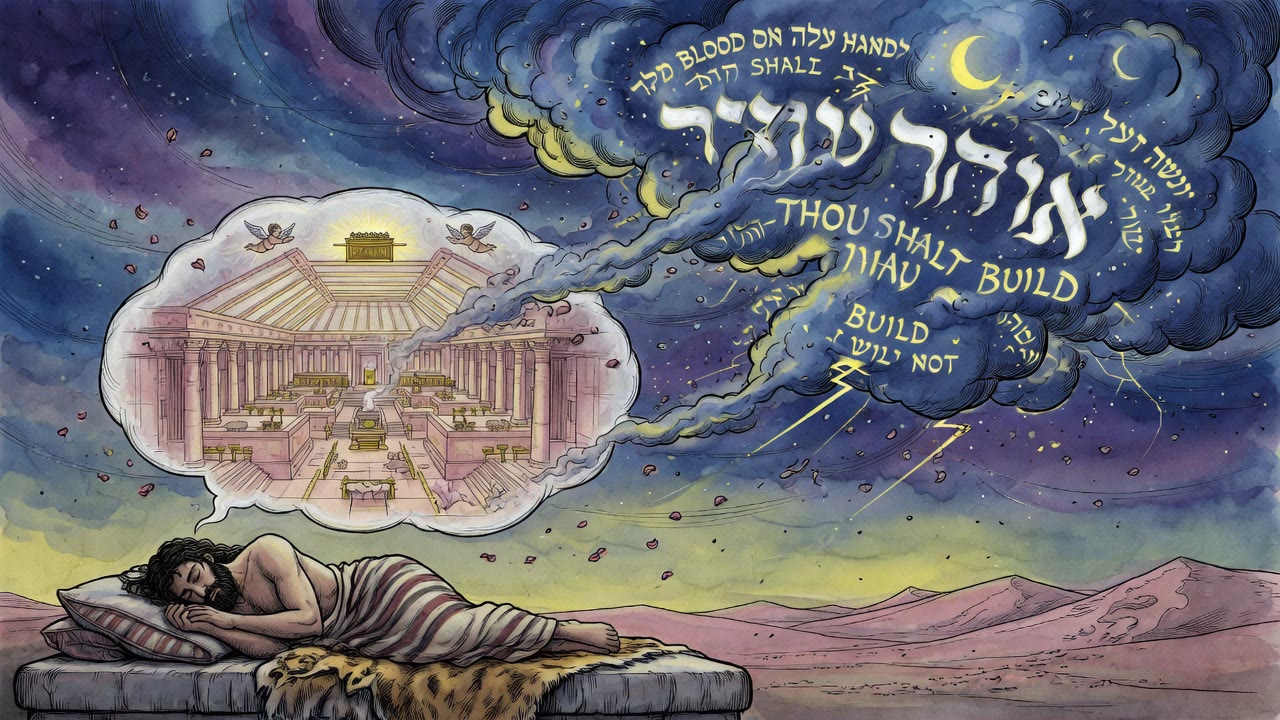
Far behind him in the story of Israel, David had once refused sleep until he found a place for the Lord, a dwelling for the Mighty One of Jacob (Psalms 132:1-5). Affliction over the Temple had kept the king's eyes open. God had answered by sending Gad to the threshing floor of Aravnah, the old altar-ground where Adam and Noah and Abraham had already burned offerings, and David had gone up at once (2 Samuel 24:18-19).

Daniel had no prophet at his elbow and no threshing floor to buy. He had a window and a habit and a death threat dressed as civic order. He used them as David had used insomnia: as loyalty that would not wait for comfortable conditions.

The men who watched the window did not know that lineage. They only knew a Jew was still bowing.

Lions as the Last Congregation

They took him when the count of days made their case. The den smelled of fur and old meat. Daniel went down into it with the same face he had turned toward Jerusalem, because direction is a kind of courage that does not require an audience.

Night in the den was long. Breath of beasts warmed his ankles. He did not stand to preach to them. He waited the way prayer waits, which is not passive. Waiting can be a form of aim.

Morning found him unopened by teeth. The ban looked suddenly like a small paper against a large Name. He climbed out and did not spit on the decree. He went home, when they let him, and the window was still there. He opened it. He knelt. The city of the Name was still burned and still the correct direction.

Babylon continued its markets. Daniel continued his three times. The service of the heart outlasted the service of the hunters.

In later years, when other exiles asked how to keep a Temple without walls, someone would point at an upper room and a man who treated a window like a court gate. The answer was never that danger was fake. The answer was that aim matters more than safety when the Name has already chosen a place, and the body can still turn toward it.

Daniel's knees darkened the same boards year after year. The boards did not become Jerusalem. They became honest.

On ordinary afternoons, when no decree pressed, he still opened the same window. Habit is how exile stays oriented. Neighbors learned the hours by the creak of his shutters. Some mocked. Some timed their own quiet words to his. A city can learn a Jew's calendar by sound alone.


← All myths

From the tradition

Sources

3 sources

The texts behind this telling. Some cards carry a translation of the source; others are our own retelling of it, and each card says which. Every card links out to the original.

Sifrei Devarim 41:18Sifrei Devarim

Retold in our words. Read the original at the link below.Sifrei by Rabbi Shraga Silverstein · CC-BY

The Sifrei Devarim, a collection of early rabbinic legal interpretations on the Book of Deuteronomy, digs deep into what it truly means to "serve Him." We find a fascinating discussion surrounding the verse that commands us "to serve Him." But how do we really serve God? Is it all about sacrifices and temple rituals? Or is there something more profound at play?

The passage poses a pointed question: If the verse says "to serve Him with all your heart," how can service be literal? I mean, is there actual "service" in the heart? Probably not.

So, what's the answer? According to the Sifrei Devarim, the true intent of "and to serve Him with all your heart" is… prayer. Prayer isn't just reciting words. It's a heartfelt connection, an offering of our innermost selves. King David understood this when he said in (Psalms 141:2), "Let my prayer stand as incense before You; the lifting of my hands, as an evening offering." He saw prayer as a direct substitute for the Temple service, a way to connect with the Divine.

What about Daniel? Remember Daniel in the lion's den? The Sifrei Devarim points to his story as further proof. Daniel, even in exile in Bavel (Babylon), continued his practice of praying three times a day towards Jerusalem. (Daniel 6:11) tells us, "And when Daniel learned that the writing had been inscribed, he went home. He had windows open in his upper storey, facing Jerusalem, and three times a day he fell to his knees and gave thanks before his G-d, exactly as he used to do before this." Even the king recognized this devotion, asking (Ibid. 21), "Daniel, servant of the living G-d, was your G-d, whom you serve continually, able to save you from the lions?"

But wait a minute... was there actually Temple service in Bavel? Of course not! So, what did the king mean by "whom you serve continually?" The answer, again, is prayer. Just as the sacrificial service in the Temple was called avodah (service), so too, is prayer.

Prayer, in this light, becomes more than just asking for things. It's an act of devotion, a way of offering our time, our thoughts, and our very selves to the Divine. It's a way to connect, to serve, even when we can't physically be in a Temple or perform a sacrifice. It’s as potent and powerful as any ritual.

So, the next time you find yourself in prayer, remember Daniel, remember King David, and remember the wisdom of the Sifrei Devarim. You’re not just talking; you're serving. You’re engaging in an ancient and sacred form of connection that transcends place and time. And maybe, just maybe, that connection is the most powerful offering of all.

Full source
Sifrei Devarim 62:4Sifrei Devarim

Retold in our words. Read the original at the link below.Sifrei by Rabbi Shraga Silverstein · CC-BY

Sifrei Devarim, a collection of legal interpretations on the Book of Deuteronomy, offers a fascinating insight. It hinges on a seemingly simple phrase: "to place His name there" (Deuteronomy 12:11). This verse speaks about bringing offerings to the place God will choose, a place where He will "place His name."

What does it mean to "place His name"?

The text draws a parallel to another verse, (Numbers 6:27): "And they (the Cohanim, the priests) shall place My name on the children of Israel." The connection is powerful: just as the priests invoke God's name upon the Israelites, so too is God's name "placed" in the Temple. This, the Sifrei suggests, implies a specific presence, a focused point of connection.

So, is this divine presence limited to the Temple in Jerusalem? Is that the only place where God’s name truly dwells?

Thankfully, no. The Sifrei expands the concept, drawing on (Exodus 20:21): "In every place in which I mention My name I shall come to you and I shall bless you." Every place. This verse explodes the idea of a singular, geographically-bound divine presence. It tells us that God's presence can be found anywhere His name is invoked. It’s radical! It transforms our understanding of where and how we can connect with the divine.

But then the Sifrei throws a curveball. If God is present in every place where His name is mentioned, why the specific instruction, "to place His name there, His dwelling shall you seek"? What's so special about the Temple then?

The answer lies in how we pronounce the Divine Name, the Tetragrammaton (the four-letter name of God, often written as YHWH). The Sifrei tells us that "In the Temple you pronounce it as it is written; outside it, by epithet."

This is key. In the Temple, the holiest of spaces, the Divine Name could be uttered in its fullness, its unadulterated form. Outside the Temple, however, we use substitutes, epithets, ways of referring to God that acknowledge the sacredness and ineffability of the true Name.

Why the distinction? Perhaps it's about creating a focal point for intense spiritual connection. The Temple, with its rituals and its permitted utterance of the Tetragrammaton, served as a kind of spiritual high-voltage center. But the Sifrei, in its wisdom, reminds us that the current flows everywhere.

The lesson? We can find God's presence in every place, in every moment. We just need to be mindful of how we approach that presence, honoring its mystery and its power. Whether in the grandest synagogue or in the quiet of our own hearts, the Divine Name, spoken or unspoken, connects us to something far greater than ourselves.

Full source
Pesikta Rabbati 43Pesikta Rabbati

Retold in our words. Read the original at the link below.Rabbi Mike Feuer, Jerusalem Anthology · CC0

“He does the will of those who fear Him…” (Tehillim 145:19) Meaning that Gd does not annul his prayers and gives him what he requests. This refers to David, of whom it is written “I am a companion to all who fear You…” (Tehillim 119:63) at the time when he was troubled over the Holy Temple, as it is written “Remember, O Lord, onto David all his affliction. That he swore to the Lord, he vowed to the Mighty One of Jacob; That I shall not come into the tent of my house, and I shall not go up on the bed that was spread for me. I shall not give sleep to my eyes nor slumber to my pupils, Until I find a place for the Lord, dwellings for the Mighty One of Jacob.” (Tehillim 132:1-5) Since the Holy One saw that he stood there, troubled over the Holy Temple, He immediately sent Gad the prophet to him and showed him the place of the Holy Temple, as it is written “And Gad came to David on that day, and said to him, ‘Go up to erect an altar to the Lord in the threshing-floor of Aravnah the Jebusite.’” (Shmuel II 24:18) David went there immediately, as it says “And David went up according to the word of Gad, as the Lord had commanded. (Shmuel II 24:19) He found there the altar where Adam, the first man, made offerings, where Noach made offerings, where Avraham made offerings. Once he found it he began to measure, saying ‘from here to here will be the Courtyard, from here to here will be the Holy of Holies’ as it says “And David said, ‘This is the House of the Lord God…” (Divre HaYamim I 22:1) And how could he declare “…and this is the altar for burnt offerings for Israel” (ibid.)? This is what is meant that the Holy One does not nullify the desire of the righteous, but rather gives them what they seek in order to fulfill “He does the will of those who fear Him…” (Tehillim 145:19)

Full source