5 min read

Pepper Sold Out Before Jerusalem Fell Silent

A tailor in Tyre asked the pepper merchant for a pinch and was refused. A tailor in Jerusalem walked him into a courtyard and bought all of it.

Curated by Arthur · Told by Maggid ·
Table of Contents
  1. Keep Cutting, Keep Sewing
  2. A Grain Measure Full of Coin
  3. Bent Like Stalks Before the Reapers
  4. What a King Does When He Mourns
  5. The City That Sits Alone

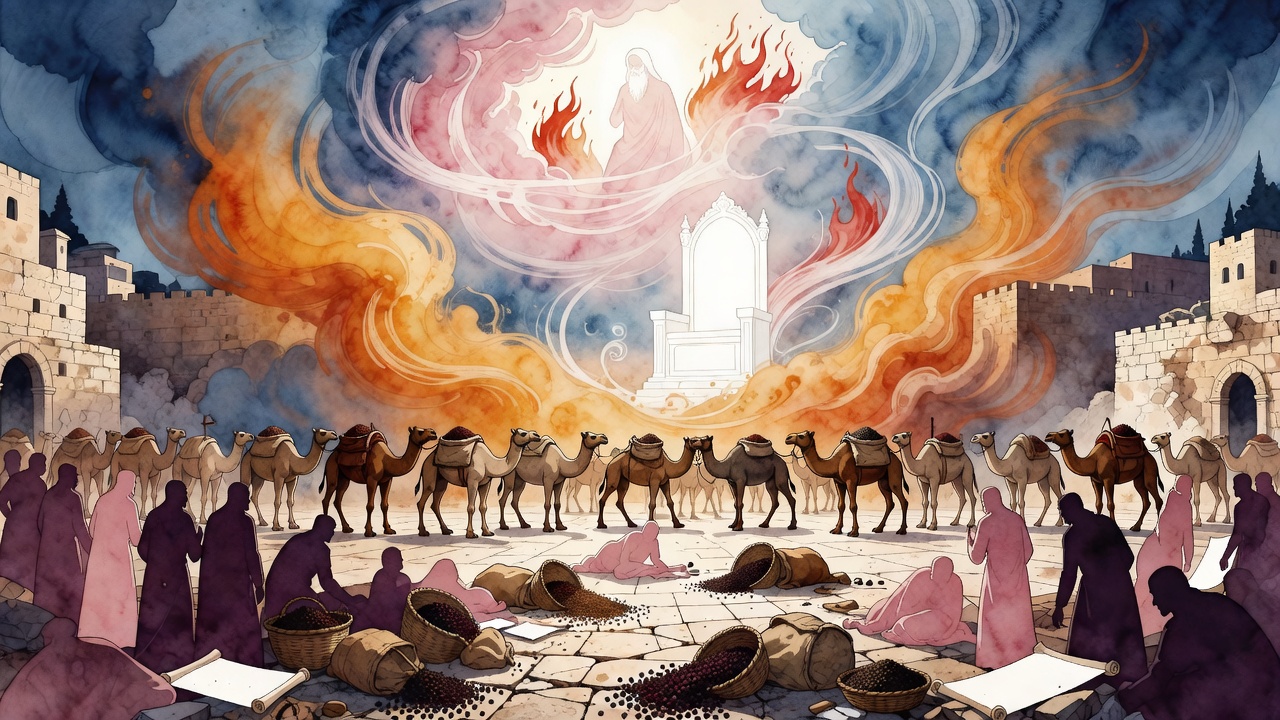
The merchant came into Tyre with two hundred camels behind him and would not break the load for anybody.
Pepper Sold Out Before Jerusalem Fell Silent Click for full size

A tailor sitting by the gate looked up from his work at the line of animals going past. "What are you carrying?"

"Pepper."

"Give me a little."

"No."

The tailor bent back over his seam. "Then you will find your buyer in some other city," he said.

Keep Cutting, Keep Sewing

He took the inland road up to Jerusalem and halted the caravan under the wall, where another tailor was sitting in the shade of the gate.

"What are you carrying?"

"Keep cutting," the merchant said, and walked on.

A little further along the wall, another one. "What are you carrying?"

"Keep sewing."

This one put the needle down. "If I can buy it, I will buy it," he said. "If I cannot, I will bring you a man who can buy all of it."

A Grain Measure Full of Coin

The tailor walked him in through a gate and across a courtyard and showed him the money. Not a purse and not a chest. A kor, the measure they use for wheat, filled to the rim with dinars.

"Look at these," the tailor said. "If they pass for money where you come from, take what you need out of it."

The pepper changed hands that night. In the morning the merchant went out to walk the market and ran into a man he knew, who asked him what he was carrying.

"Pepper."

"Sell me a hundred dinars' worth. I have a feast today."

"I sold it all last night."

The friend went to the buyer. The buyer had already moved it on to a tailor. The tailor had it in a back room and was measuring it out to a line of people that went into the street. The first ones through took an ounce apiece. The ones behind them took half an ounce. The men who came third never knew there had been a shortage at all, and the merchant stood in the road doing arithmetic on two hundred camels.

Twenty four thoroughfares in that city. Twenty four streets off each thoroughfare, twenty four market rows off each street, twenty four lines of shops off each market, twenty four courtyards behind each line of shops, twenty four houses around each courtyard. On a feast day one courtyard alone emptied out twice the number of people who walked out of Egypt.

Bent Like Stalks Before the Reapers

Then the year came when the city fell, and the strong men of it went down the way a field of standing grain goes over under bad weather. Bent. Combed flat. Curled at the neck. Not one of them upright.

Somebody proclaimed a festival, and what the festival was for was the breaking of the young men, and losing them was counted as heavy a wound as the burning of the house itself. The crowd that could swallow two hundred camel loads of pepper before breakfast went into the winepress, and what came out of it was not wine.

What a King Does When He Mourns

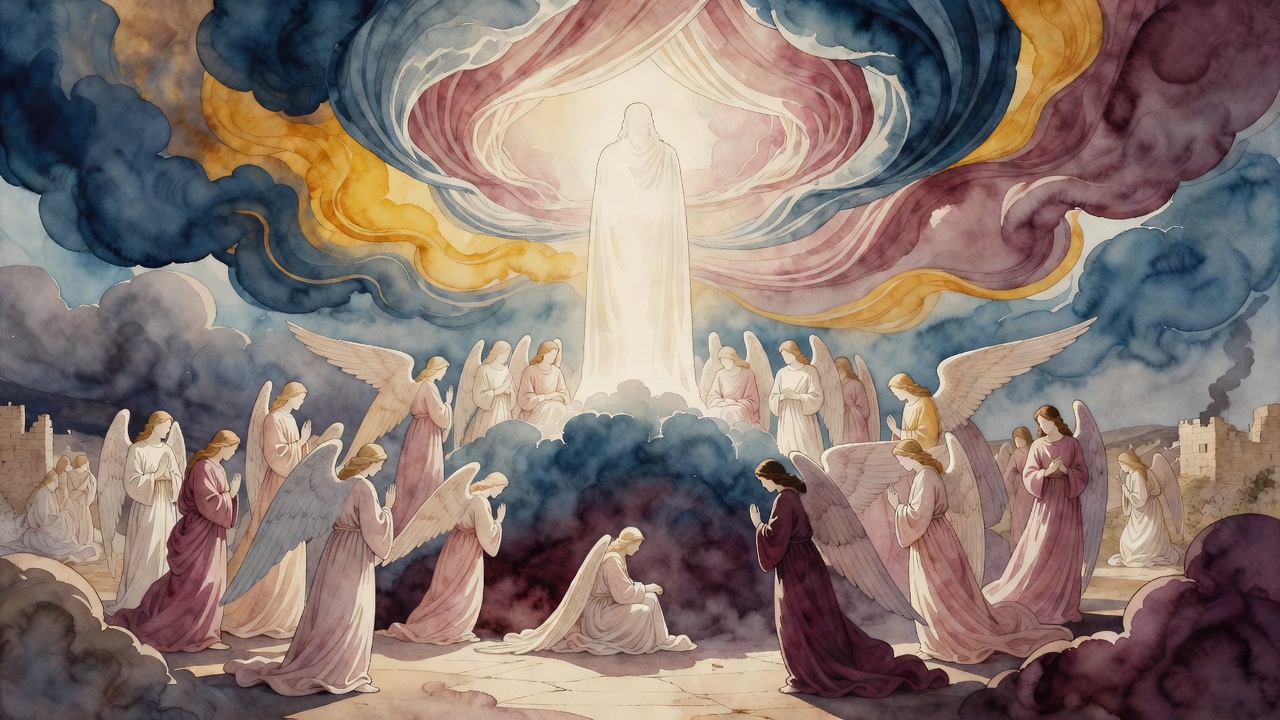
God came down and looked at the burned house and asked the ministering angels a question.

"When a king of flesh and blood is in mourning, what does he do?"

"He hangs sackcloth over his door."

"Then I will do that." And the sky over the ruins went the color of sacking.

"What else does he do?"

"He puts out the lamps."

"Then I will do that." Sun and moon went dark and the stars gave up.

"What else?"

"He walks barefoot."

"Then I will do that." The whirlwind and the storm became the road He walked on.

"What else?"

"He sits down alone and stays silent."

"Then I will do that."

"He turns the couches over."

"Then I will do that." And the thrones were thrown down.

"And after all that?"

"He sits and he laments."

The City That Sits Alone

"Then I will do that," God said, and the lament He picked was one word long, and every survivor sitting in the rubble already knew it.

How. How does she sit alone, the city that was so full of people.

Alone was the word that had never once fitted her. Not on any feast day, not in any courtyard, not in any of the twenty four thoroughfares where a man could lose two hundred camels of cargo in a single night and go out the next morning and find that the third line of buyers had not even noticed the market was short.


← All myths
From the tradition

Sources

3 sources

The texts behind this telling. Some cards carry a translation of the source; others are our own retelling of it, and each card says which. Every card links out to the original.

Eikhah Rabbah 1:2Eikhah Rabbah

Retold in our words. Read the original at the link below.The Sefaria Midrash Rabbah, 2022 · CC-BY

“The greatly crowded city,” Rabbi Shmuel taught: There were twenty-four thoroughfares in Jerusalem, each and every thoroughfare had twenty-four streets, each and every street had twenty-four market streets, each and every market street had twenty-four store streets, each and every store street had twenty-four courtyards, each and every courtyard had twenty-four houses, and each and every courtyard would have twice the number of those who departed from Egypt emerging from it.Know that it is so, as Rabbi Elazar said: There was an incident involving a traveler who was ascending to Jerusalem who took with him two hundred camels laden with pepper. He passed Tyre and found a certain tailor who was sitting near the city gates. He said to him: ‘What are you carrying?’ He said to him: ‘Pepper.’ He said to him: ‘Will you not give me a bit?’ He said to him: ‘No.’8The tailor asked to purchase a small amount, but the traveler wanted to sell his entire stock to one customer. He said to him: ‘Then you will have a purchaser only in another city.’ When he arrived in Jerusalem, he found a certain tailor sitting at the gate of the walls, who said to him: ‘What are you carrying?’ He said to him: ‘Continue your cutting.’ He found another tailor who said to him: ‘What are you carrying?’ He said to him: ‘Continue your sewing.’ He said to him: ���If I can purchase them, fine. But if not, I will bring you a person who can purchase all of them.’ He said to him [again]: ‘What are you carrying?’ He said to him: ‘Pepper.’ He took him and brought him into a certain courtyard and he showed him a kor of dinars. He said to him: ‘Look at these coins. If they are currency in your land, take from them.’ In the morning, [the visiting merchant] went to stroll in the marketplace and one of his friends encountered him. He said to him: ‘What are you carrying?’ He said to him: ‘Pepper.’ He said to him: ‘Do you not have any that you could give me for one hundred dinars, for I have a feast today!’ He said: ‘I already sold it to so and so.’ He went to him. He said to him: ‘Do you have the pepper that you purchased? Give me a bit as I have a feast.’ He said to him: ‘What can I tell you? I already sold it to a certain tailor. However, I will tell him and he will give it to you.’ He went and he found it in a certain residence. Those who were in the first line [or purchasers] took one ounce each. Those who were in the second line took one-half ounce each. Those who were in the third line did not sense that there had been any at all, to realize what is stated: “The greatly crowded city.”If you wish to ascertain how many multitudes there were in Jerusalem, you can ascertain it from the priests. Rabbi Yehoshua of Sikhnin [said] in the name of Rabbi Yehoshua ben Levi: [This is analogous] to a pile of grain that was located in the grain marketplace. Everyone came to measure it but could not. There was one clever man there. He said to them: ‘If you seek to measure it, you can calculate it on the basis of its teruma.’ So too, if you wish to ascertain how many multitudes there were in Jerusalem, you can ascertain it from the priests. That is what is written: “Solomon slaughtered the peace-offering that he slaughtered to the Lord, cattle, twenty-two thousand, and of the flock, one hundred and twenty thousand” (I Kings 8:63). And we have learned: A bull is sacrificed by twenty-four [priests] and a ram by eleven.9Mishna Yoma 2:7. The reference is to the number of priests who participated in all the rituals involved in the sacrifice of these offerings.That is what is said of the first Temple. However, in the second Temple, one time King Agrippa sought to ascertain the number of the multitudes that were in Jerusalem. He said to the priests: ‘Set aside for me one kidney from each and every paschal offering.’ They set aside six hundred thousand pairs of kidneys, twice the number of those who departed from Egypt, and there was not any paschal offering that did not have more than ten registrants.10One had to register in advance for a paschal offering, and such offerings were generally divided between numerous individuals. Rabbi Ḥiyya taught: Even forty and even fifty. Bar Kappara said: Even one hundred, [and this is] not including one who was impure or on a distant journey. One time, they entered the Temple Mount and it could not hold them. There was one elderly man there and they trampled him. They called that Passover the Passover of the crushed, because they crushed the elderly man.How did Israel procreate? A person would marry off his son at the age of twelve to a woman fit to bear children. He would then marry off his grandson at the age of twelve. One would not reach the age of twenty-six until he saw children of his children, to realize what is stated: “May you see the children of your children. Peace to Israel” (Psalms 128:6).

Full source
Eikhah Rabbah 1:44Eikhah Rabbah

Retold in our words. Read the original at the link below.The Sefaria Midrash Rabbah, 2022 · CC-BY

“The Lord trampled all my mighty in my midst; He proclaimed a festival against me to break my young men; the Lord has trodden the maiden daughter of Judah in a winepress” (Lamentations 1:15).“The Lord trampled [sila] all my mighty,” they were made to be bowed, like a stalk of grain before [the enemies]. Rabbi Abba bar Kahana said: In bar Gamza they call a stalk of grain, comb [sarakei]. Rabbi Levi said: In Arabia they call a comb, curler [mesalsela].165Thus, the word sila in the verse implies something that is curled or bent over. “He proclaimed a festival against me to break my young men.” We find that the expulsion of the young men is as calamitous as the destruction of the Temple, as it is written: “the Lord has trodden the maiden daughter of Judah in a winepress.”166The midrash (rabbinic interpretive commentary) interprets this phrase as a reference to the destruction of the Temple; see, similarly, Sanhedrin 96b. Likewise, He proclaimed a festival against me to break my young men.”

Full source
Pesikta de-Rav Kahana 13:9, 15:3Pesikta de-Rav Kahana

Translation of the source text.Pesikta de Rav Kahana according to an Oxford manuscript, Dov Mandelbaum ed., N.Y. 1987 · CC-BY

Another interpretation. Jeremiah. The Holy One, blessed be He, said to Jeremiah: Either go down with them to Babylon and I will remain here, or you remain here and I will go down with them. Jeremiah said before the Holy One, blessed be He: Master of the worlds, if I do not go down, what benefit am I to them? Rather, let their Creator go down with them, for He is the one who benefits them. "The word that came to Jeremiah from the LORD after Nebuzaradan had sent him away" (Jeremiah 40:1). "And he was bound in chains" (Jeremiah 40:1). What is meant by "and he"? Rabbi Aha said: As it were, both he and He. And on the way back he saw fingers of hands and feet cut off and cast onto the roads, and he would gather them up and embrace them and kiss them and place them inside his cloak, and he would say to them: My children, did I not say this to you: "Give glory to the LORD your God before it grows dark, and before your feet stumble" (Jeremiah 13:16)?

Bar Kappara opened: "And on that day the Lord, the LORD of hosts, called for weeping and for mourning, and for baldness, and for girding with sackcloth" (Isaiah 22:12). The Holy One, blessed be He, said to the ministering angels: A king of flesh and blood, when he is in mourning, what does he do? They said to Him: He hangs sackcloth over his doorway. He said to them: I too will do so, "I clothe the heavens with blackness" (Isaiah 50:3). And He further asked them: A king of flesh and blood, when he is in mourning, what does he do? They said to Him: He extinguishes the lamps. He said to them: I too will do so, "the sun and the moon have grown dark" (Joel 4:15). And He further asked them: A king of flesh and blood, when he is in mourning, what does he do? They said: He walks barefoot. He said to them: I too will do so, "the LORD, His way is in the whirlwind and in the storm, and the clouds are the dust of His feet" (Nahum 1:3).

And He further asked them: A king of flesh and blood, when he is in mourning, what does he do? They said to Him: He sits in silence. He said to them: I too will do so, "Let him sit alone and keep silent, for He has laid it upon him" (Lamentations 3:28). And He further asked them: A king of flesh and blood, when he is in mourning, what does he do? They said to Him: He overturns the couches. He said to them: I too will do so, "I beheld until thrones were cast down" (Daniel 7:9). And He further asked them: A king of flesh and blood, when he is in mourning, what does he do? They said to Him: He sits and laments. He said to them: I too will do so, "How does she sit solitary" (Lamentations 1:1).

Full source