5 min read

Job Blessed God for the Evil Measure Too

When the last report of ruin finished, Job blessed the Name for the measure of evil as for the good. Akiva heard that love in the word soul.

Curated by Arthur · Told by Maggid ·
Table of Contents
  1. Both Measures
  2. With All Your Soul
  3. Those Ruined by Good
  4. The Soul Spent Standing
  5. Love That Does Not Renegotiate

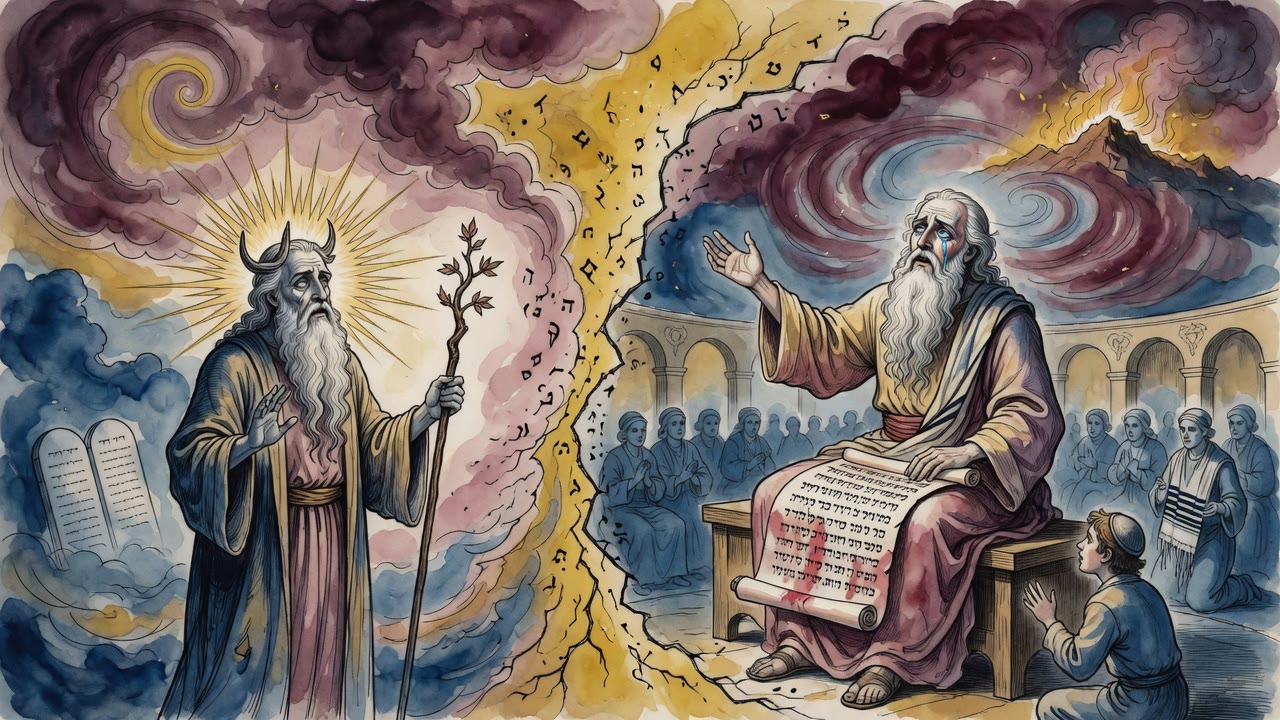
The messengers came in a chain that left no breath between blows. Herds gone. Servants gone. A house fallen on sons and daughters. Job stood up, tore his robe, shaved his head, fell to the ground, and did not curse. "The Lord has given and the Lord has taken away; blessed be the name of the Lord" (Job 1:21).

Job Blessed God for the Evil Measure Too Click for full size

Both Measures

The midrash hears in that blessing the full weight of "with all your might." Rabbi Akiva taught that meodecha, your might, means every middah, every measure God metes out, whether for good or for evil. Love is not a fair-weather contract. It is a stance that names God in the bitter cup and in the cup of salvation alike.

David had already practiced the pattern. Affliction and sorrow found him, and he called on the Name. Later he lifted the cup of salvation and called on the same Name (Psalms 116). One voice. Two weathers.

Job's wife looked at the ash and the sores and said what fear often says: blaspheme God and die (Job 2:9). Job answered that she spoke like the coarse women. Shall we accept only the good of God and not the evil? The question is not abstract. It is a man covered in boils refusing a smaller god.

With All Your Soul

Deuteronomy commands love with all your heart, with all your soul, and with all your might (Deuteronomy 6:5). The heart, the sages said, must stay whole, undivided, not split among other powers. The soul is costlier. "With all your soul" means even if it costs your life. Psalms already knew the price: because of You we are killed all day long, reckoned as sheep for slaughter (Psalms 44:23).

Rabbi Shimon ben Menassia pressed the verse. Are we really killed the entire day? He tied the idea to circumcision, a cut that marks a body as willing to pay. Ben Azzai went further: love God up to the last breath, so that even the extraction of the soul does not diminish the love.

Rabbi Eliezer sorted the pair of phrases by what a person values most. For those who cling to the body more than to wealth, the Torah says "with all your soul," be ready to give life. For those who cling to property more than to flesh, it says "with all your might," be ready to empty the storehouse. The command finds the tender place and asks for it.

Those Ruined by Good

The Sifrei does not stop with the righteous sufferer. It turns to the generation of the Flood and the people of Sodom, spoiled by the good bestowed on them, then forced to accept punishment without understanding. If even the corrupt finally swallow judgment, how much more should those who receive good with thanks also receive the hard measure without tearing up the covenant.

Job becomes the counterimage. He was not ruined by ease into blasphemy when ease ended. He blessed on the way down.

The Soul Spent Standing

Centuries later Rabbi Akiva would live the soul-clause in a Roman execution, the word "One" still on his lips as iron combs worked his flesh. The Sifrei's reading of the Shema (Hear O Israel) and Job's ash-heap blessing share a spine: love that does not renegotiate when the measure turns.

On the ground of Uz, Job's friends would soon arrive with speeches that sounded right and landed wrong. Before they spoke, the essential act was already done. A ruined man had blessed the Name for the evil measure too. Heaven had heard a love that did not wait for restoration to become honest.

The sores still burned. The children were still dead. The blessing stood.

Love That Does Not Renegotiate

The Shema's demand is easy to recite and hard to inhabit. An undivided heart is already work. A soul offered up to the last breath is another order of demand. Might poured out when wealth is the true idol is a third. Job's ash heap becomes a narrative proof that the midrash's legal reading of Deuteronomy is not cruel theory. Someone has lived the clause.

His friends will try to protect God's reputation by blaming Job. The Sifrei's line runs elsewhere. It does not need Job guilty to keep God just. It needs Job willing to bless without a full explanation. The evil measure is still a measure from the same hand that gave the flocks and the children.

Akiva's later death does not cancel Job's earlier blessing. It rhymes with it. Two men, different centuries, same refusal to let pain write a smaller theology. The soul is spent standing, not bargaining for a softer verse.

Before the sores, before the friends, the blessing already stood as a legal precedent for the heart. Sifrei will later parse syllables of the Shema as if they were statutes. Job supplies the case law. A man can lose the visible goods of the covenant and still refuse to shrink the Name. The evil measure does not get the last word over the mouth. That is why the midrash can yoke Job to Akiva without embarrassment. Different deaths, same grammar of love under pressure.


← All myths

From the tradition

Sources

2 sources

The texts behind this telling. Some cards carry a translation of the source; others are our own retelling of it, and each card says which. Every card links out to the original.

Sifrei Devarim 32:7Sifrei Devarim

Retold in our words. Read the original at the link below.Sifrei by Rabbi Shraga Silverstein · CC-BY

The Sifrei Devarim, a collection of legal midrashim (rabbinic interpretive commentary) on the Book of Deuteronomy, grapples with this very question in a powerful passage. It all starts with the verse urging us to love God "with all your soul" (Deuteronomy 6:5). Rabbi Akiva, that towering figure of Jewish wisdom, then asks a compelling question: If we're commanded to love God with all our soul, how much more so should we love God "with all your might" (meodecha)?

What does "with all your might" even mean? Rabbi Akiva explains that meodecha implies that we should thank God for every measure (middah) that He metes out to us, "whether for good or for evil." We’re called to recognize God's presence and purpose in everything, not just the pleasant experiences.

King David understood this deeply. As he says in Psalm 116, "Affliction and sorrow did I find, and in the name of the L-rd I called." Even in the midst of suffering, David turned to God. Later in that same Psalm, he proclaims, "I shall lift up the cup of salvation, and in the name of the L-rd will I call." He acknowledged God in both the bitter and the sweet.

Then there’s Iyyov, or Job, a figure synonymous with enduring hardship. When tragedy struck, wiping away his family and possessions, what did he say? "The L-rd has given and the L-rd has taken away; blessed be the name of the L-rd." (Job 1:21). He blessed God "both for the measure of good and for the measure of evil.”

Talk about a powerful response! But his wife… well, she had a slightly different perspective. "Do you still persist in your integrity?" she asks him. "Blaspheme God and die!" (Job 2:9).

Iyyov's response is legendary: "You speak as one of the coarse women. Shall we accept only the good of God and not the evil?" It’s a sharp rebuke, but it gets to the heart of the matter: Can we truly claim to believe in God if we only acknowledge Him when things are going well?

The Sifrei Devarim doesn't let us off the hook there. It brings up the generations of the Flood and the people of Sodom and Amorah. They were "degenerate by reason of the good bestowed upon them." They became complacent, perhaps even arrogant, because of their prosperity. And when punishment came, they "accepted it perforce" – begrudgingly, without understanding or repentance.

The text then delivers a powerful a fortiori argument – a logical deduction that goes something like this: If even those who are corrupted by good ultimately accept punishment (albeit resentfully), how much more should those who readily accept good also accept punishment with understanding and faith?

That brings us back to Iyyov and his unwavering faith. He understood that true belief isn't conditional. It isn't dependent on a life free of pain or suffering. It's about acknowledging God's presence in all aspects of our lives, the good and the bad.

Remember Rabbi Akiva's words: "For every measure that He metes out to you, whether for good or for evil, (thank Him)." It's a radical idea, accepting the difficult alongside the pleasant. But perhaps, in doing so, we can find a deeper, more resilient faith – a faith that truly loves God with all our soul, and with all our might.

Full source
Sifrei Devarim 32:6Sifrei Devarim

Retold in our words. Read the original at the link below.Sifrei by Rabbi Shraga Silverstein · CC-BY

Deuteronomy, or Sifrei Devarim in Hebrew, commands us to love God "with all your heart, with all your soul, and with all your might" (Deuteronomy 6:5). Seems straightforward enough. But the rabbis of old, they just couldn't leave it at that. They dove deep, wrestling with what those words truly demand of us.

The phrase "with all your heart"… well, that’s about keeping your heart whole, undivided. It means not entertaining other gods, not letting your loyalties get split. As the Sifrei Devarim itself suggests, it's about avoiding polytheism, the belief in multiple gods. It's about a singular, unwavering focus.

"with all your soul"… now that's where it gets intense. The text suggests it means loving God so much, even if it costs you your life. It brings to mind the verse in Psalms (44:23), "For because of You we are killed the entire day. We are reckoned as sheep for the slaughter. But Rabbi Shimon ben Menassia offers a different take. He asks, "Are we really killed the entire day?" He connects this idea to the mitzvah, the commandment, of circumcision. A ritual act that, in a way, symbolizes a willingness to sacrifice.

Ben Azzai takes it even further, suggesting that "with all your soul" means loving God right up until your very last breath. Loving so intensely that even the extraction of your soul doesn't diminish that love.

And then there's the question: Why both "with all your soul" and "with all your might"? Rabbi Eliezer grapples with this. He posits that it depends on what we value most. For some, their physical well-being, their body, is more precious than their possessions. For them, the Torah says, "with all your soul" – meaning, be prepared to give up your very life. But for others, their wealth, their "might," is what they hold dearest. For them, the Torah says, "with all your might" – be prepared to surrender everything you own.

That the Torah tailors its message to our individual struggles, recognizing that sacrifice takes different forms for different people.

So, what does all this mean for us today? Are we being asked to literally give up our lives or fortunes? Maybe, in extreme circumstances. But perhaps it's more about the daily choices we make. Where do we invest our time, our energy, our resources? What do we prioritize? Are we living with an undivided heart, a soul ablaze with love, and a willingness to sacrifice for what we believe in? Are we ready to give up what is most precious to us, whether that be our comfort, our security, or our ego, for something greater?

These are difficult questions, questions that have echoed through generations. And they're questions worth wrestling with, because in that wrestling, we just might discover the true meaning of loving with all our heart, soul, and might.

Full source