Joseph Hid a Cup in Benjamin's Sack to Ask One Question
Joseph has the power to keep Benjamin forever. He wants to know what his brothers will do when given the chance to abandon the youngest.
Table of Contents
 Click for full size
The One Question Left Unanswered
Joseph had wept in private rooms, turned his face away when the feelings overwhelmed him, watched his brothers' faces for twenty years' worth of change without them knowing who they were looking at. He had the grain. He had the power. He had already put their money back in their sacks on the first visit, and they had arrived for the second visit more frightened than grateful.
He needed to know one thing. When he had been in the pit, he was the beloved son, the one with the coat, the one their father could not stop speaking about. Benjamin was now that son. Benjamin now wore the face of Jacob's excessive love. Joseph had been sold when he was that child. He needed to know whether his brothers were capable of doing it again.
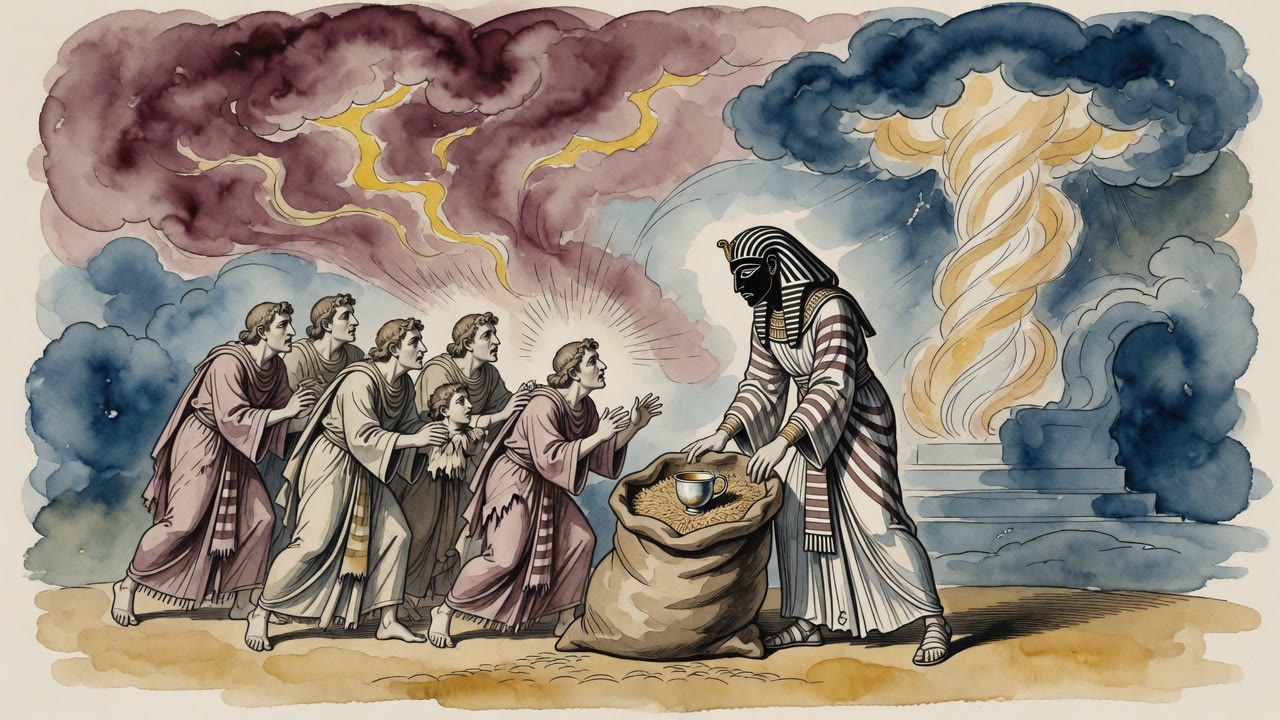
He planted the cup in Benjamin's sack. He sent them home. He waited the exact right interval, enough time for them to feel the relief of leaving, of clearing the city gates and breathing outside air again, before he sent his steward after them.
The Trap Sprung on the Road
Manasseh, Joseph's son and steward, caught up with them before they were far. The brothers denied the accusation with total confidence, because they were innocent. They had not taken the cup. They offered the death of any man found with it, and the enslavement of the rest. It was the kind of offer only innocent people make.
The steward searched from the oldest to the youngest. Every sack was opened and found clean until he reached Benjamin. The cup was there.
The brothers tore their garments. Every one of them turned back toward the city. Not one of them kept walking. The sages noticed this: they had asses loaded with grain they had come to buy for their starving households. Not one of them thought of putting his brother on his own animal and continuing to Canaan. They all came back.
What Heaven Was Prying Open
The sages reading the brothers' cry, "God has found out the iniquity of your servants," did not take their words at face value. The brothers were crying about Benjamin's innocence. But Heaven was doing something else entirely. A voice from above was using that moment to force an older guilt into the open.
Consider the strangeness: these brothers, who avoided sitting at a single table together because they feared the evil eye of communal attention, were now crowded into a single accusation. They were being herded together under one charge, like seedlings crammed into a single garden bed. The thing that bound them was not the cup. The cup was new. The thing that bound them was what they had done to Joseph in a pit more than twenty years before.
God has found out the iniquity of your servants. Their words were right even though their reference was wrong. Something had been found out. Just not what they thought.
Benjamin and the Shekhinah
The tradition preserved a detail about what happened to Benjamin in that moment that the text does not record. When the cup was found in his sack and his brothers turned on him, stricken with grief and guilt and fear, some of that grief expressed itself in violence. They beat him. He had brought this on them, somehow. He had the cup.
The Shekhinah, the divine presence, rested on Benjamin at that moment. The one being struck was innocent. The striking repeated the brothers' first crime, a second younger brother being punished by the older ones for something he had not done.
A heavenly voice answered the blow: you tore your father's garment once for a lie, when you dipped Joseph's coat in blood and let your father mourn over nothing. Now you tear your garments for nothing, for a brother who is innocent. Measure for measure. The punishment for what you did to Joseph is experienced in what you are now doing for Benjamin.
Judah's Answer
Judah stepped forward. This was the test Joseph had been running. Judah was the one who had proposed selling Joseph rather than killing him, the one whose idea it had been to profit from the betrayal rather than simply commit murder. Now Judah stood before the disguised brother he did not recognize and offered himself instead of Benjamin.
He laid out his father's love for Benjamin in precise, painful detail. He explained that Jacob could not survive the loss of this son, that the boy's life was bound up with his father's life, that if Benjamin did not come home the old man would die. He said: take me instead. Let Benjamin go back to his father. I pledged my life for the boy. If I come back without him, I bear the fault forever.
Joseph could not maintain the disguise any longer. He sent everyone out of the room and wept aloud.
← All myths