5 min read

Joseph's Cloak, Zuleika's Lie, and the Sea That Fled

Joseph fled Zuleika's grasp and left his cloak behind. Her lie sent him to prison, but his flight later opened the sea for Israel.

Curated by Arthur · Told by Maggid ·
Table of Contents
  1. The House Stayed Home From the Festival
  2. The Vision Pointed at the Wrong Woman
  3. Joseph Would Not Trade Fear of God
  4. The Cloak Became a False Witness
  5. The Sea Remembered the Flight

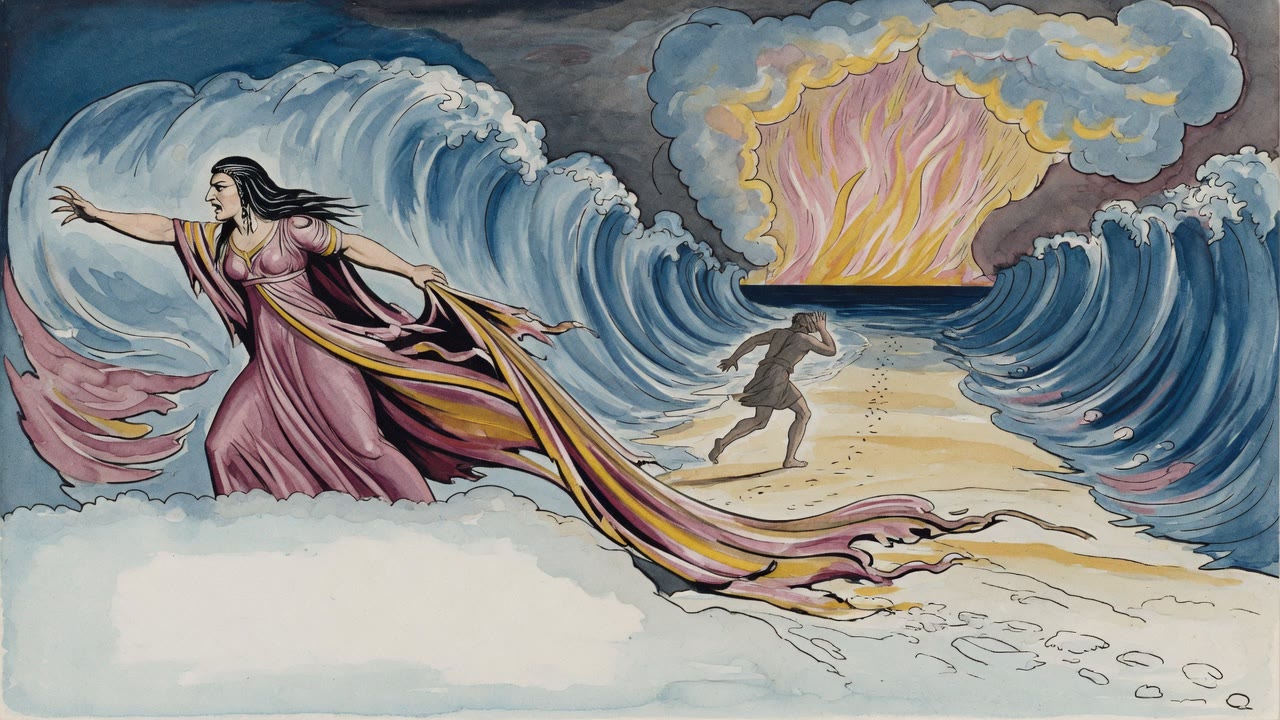
The cloak stayed in her fist after Joseph ran.
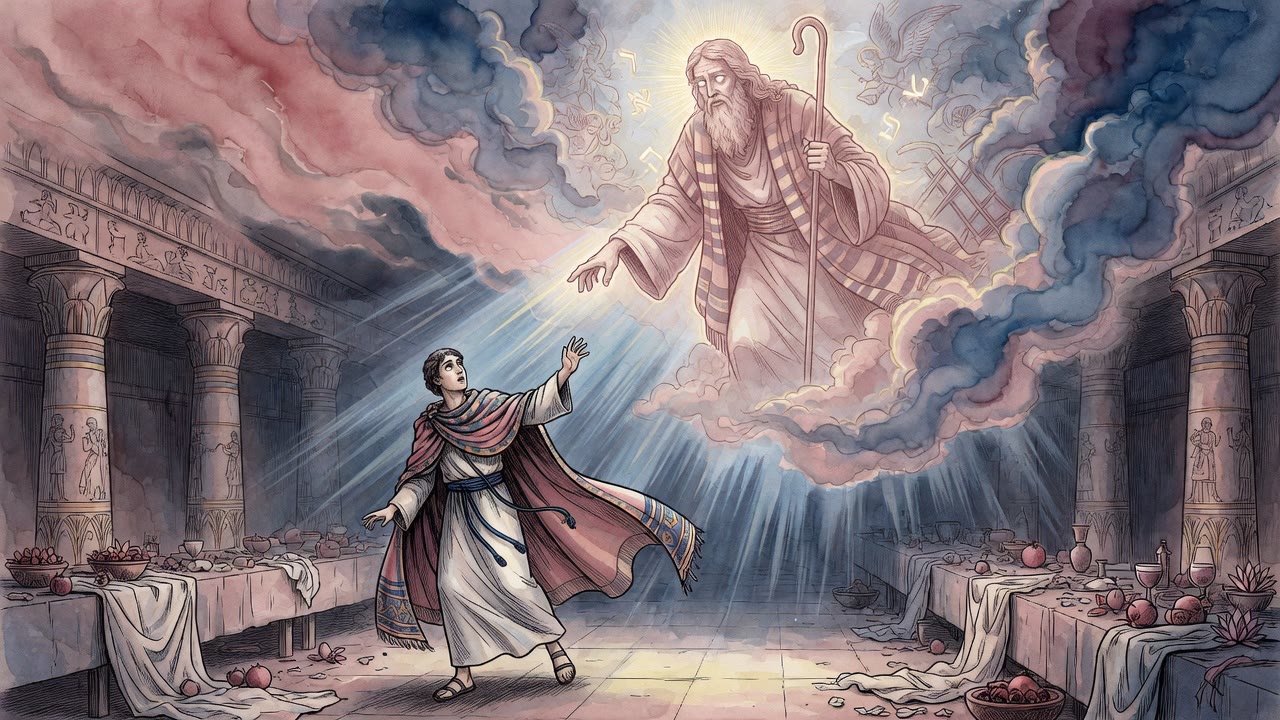
The house had emptied toward music and water. Egypt kept festival by the Nile, and servants who normally filled the halls had gone out to celebrate the river that fed the land. Zuleika, Potiphar's wife, stayed behind with sickness on her lips and a plan dressed in royal cloth.

The House Stayed Home From the Festival

She had prepared the room before he entered it. Jewels caught the light. Princely garments rustled around her. Perfumes rose from the walls and cushions, cassia and frankincense, myrrh and aloes, thick enough to turn work into a trap. Joseph had come to do the labor of the house. She had made the whole house lean toward one doorway.

He stopped at the sight of her waiting in the vestibule. The silence gave her too much space. Every other voice had gone to the Nile, every footstep had vanished into the street, and the woman who held authority over the household stood between Joseph and his daily work.

He turned back.

She called him forward anyway. A master can order a slave to enter a room. A lonely woman can make refusal look like insult. Zuleika had tried tears, pleas, and pressure before. This time she wanted the empty house to finish what her words had failed to do.

The Vision Pointed at the Wrong Woman

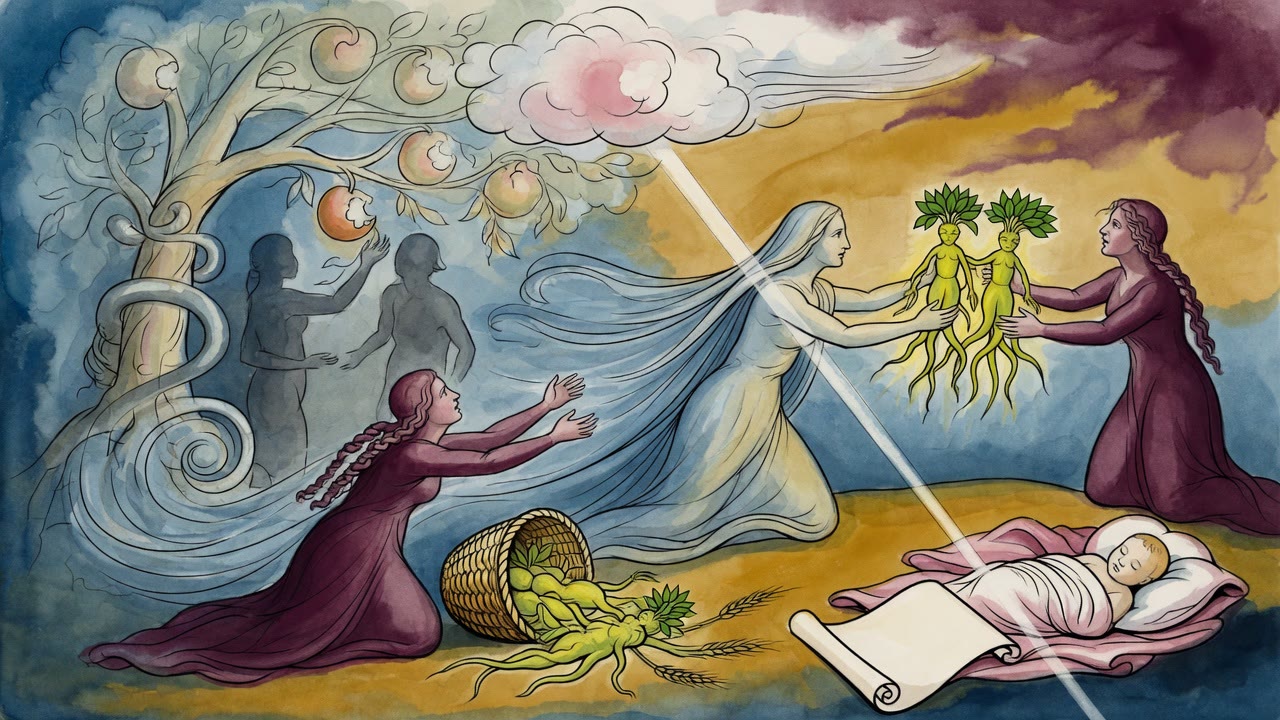
Before the perfumes, before the garments, before the door closed around them, a future had reached her, and she read it crooked. The stars, or a dream, or some secret knowledge of fate had told her that descendants would come from Joseph through her house. She thought the message meant her own body.

It did not.

The future was walking a harder road. Joseph would one day marry Asenath, her daughter, and children would come through that bond. Zuleika had been given a sliver of truth, sharp enough to cut the hand that held it. The end came to her as if it were hers, and she tried to seize the path.

Joseph's beauty made the vision burn hotter. He had Rachel's brightness on his face, the kind of beauty that made people stare too long and then blame him for being seen. In Potiphar's house he was more than handsome. He was competent, trusted, blessed. Every room arranged itself around his success. That kind of blessing can frighten the people who own the keys.

Joseph Would Not Trade Fear of God

Zuleika did not come only with softness. When pleading failed, she sharpened her voice. If Joseph would not give her what she wanted, she threatened to kill the Egyptian and marry him under law. Desire had turned into a courtroom where she appointed herself judge, witness, and executioner.

Joseph tore his garment in distress. Cloth split before flesh did. He begged her to fear God, and he named her plan as evil before it could dress itself as love. If she went through with it, he warned, he would cry it out in public.

That answer left her no victory. She could not have his body. She could not have his silence. She could not make his fear of God bow before her rank. So she reached for the one thing still close enough to hold.

The Cloak Became a False Witness

Her hand closed on his garment.

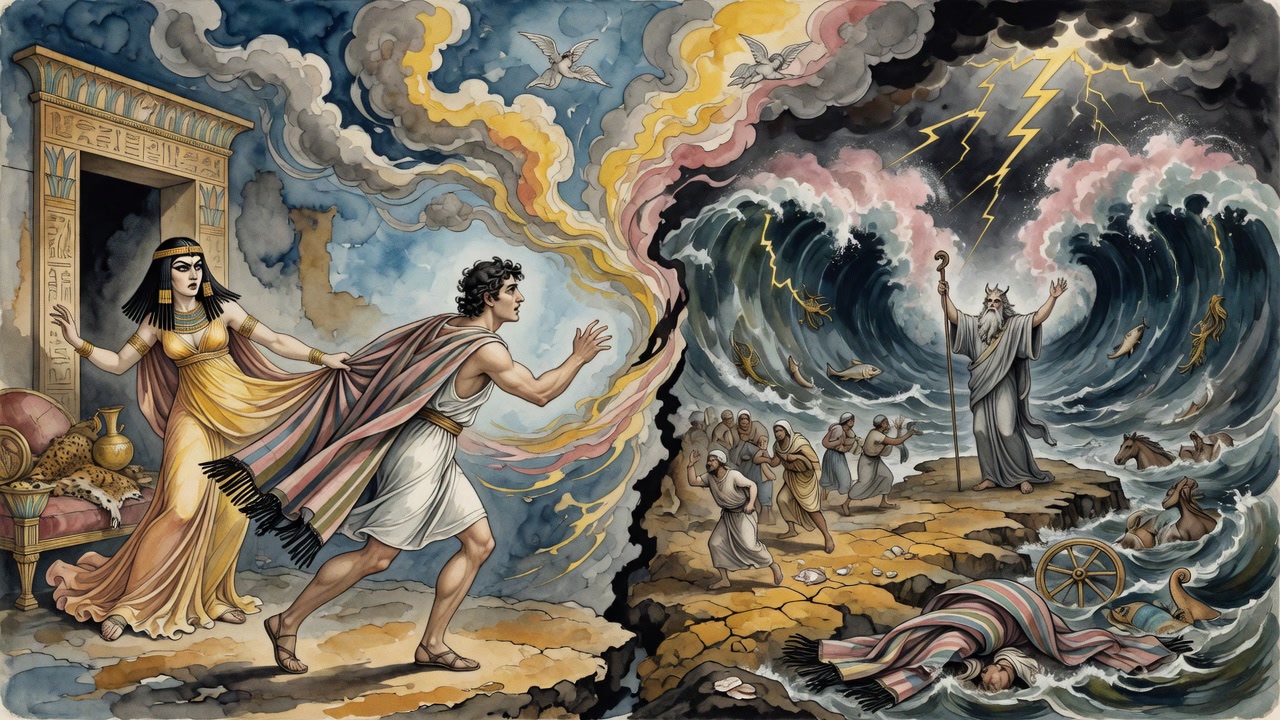
For one breath Joseph had a choice between keeping his cloak and keeping his soul clean. The cloak lost. He slipped free and fled into the open air, leaving cloth behind like a shed skin. Zuleika stood in the emptied house with proof that proved nothing, a slave's garment in a mistress's hands.

She screamed until the house filled again. Servants returned to a new claim. The Hebrew slave had come to mock her. He had tried to force himself on her. She had cried out, and he had run, and look, here was the garment he abandoned beside her.

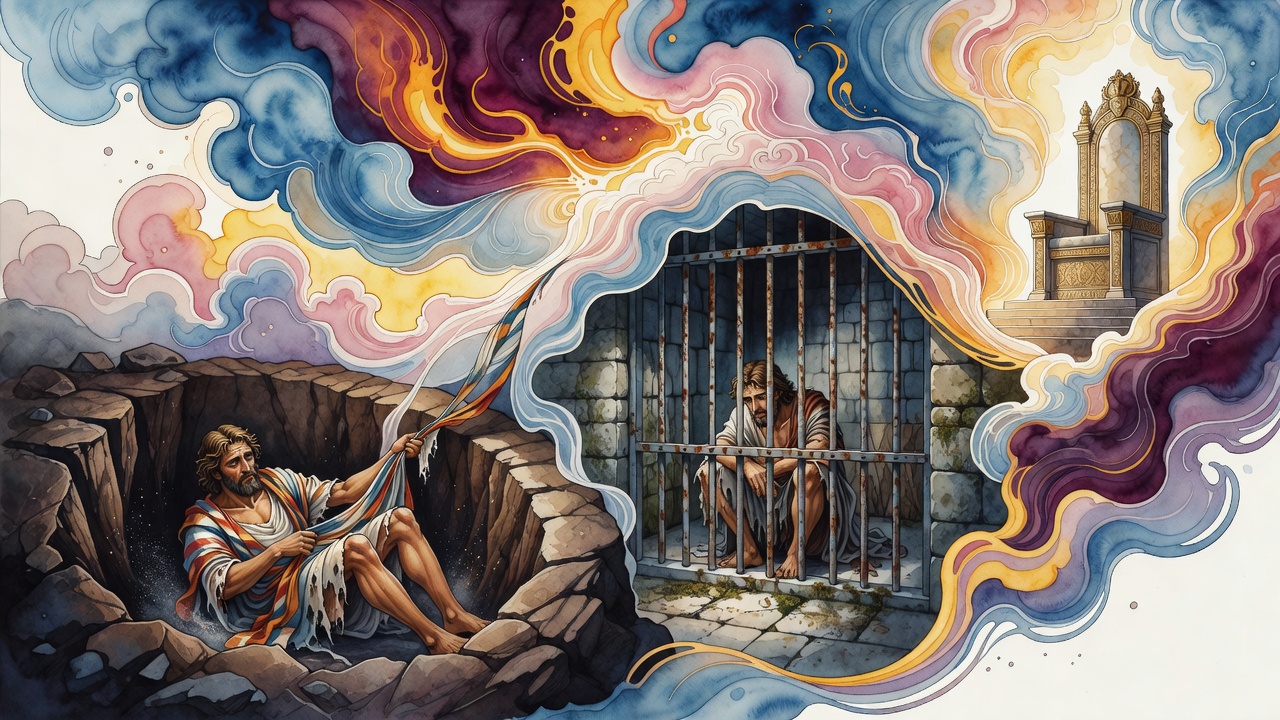
Potiphar came home to the same kind of evidence Jacob once received. A garment. A lie. Blood in one household, accusation in another. Joseph's brothers had used his coat to erase him from Canaan; Zuleika used his cloak to erase his honor in Egypt. Twice, cloth carried false testimony into the hands of a man willing to believe the worst.

Joseph went down again. Not into a pit this time, but into prison, where stone replaced the master's house and iron replaced the perfume of the vestibule.

The Sea Remembered the Flight

The cloak stayed with Zuleika. The flight stayed with heaven.

Generations later, Joseph's bones left Egypt with Israel. The people carried him toward water with Egypt behind them and the sea standing in front of them like a locked gate. The people waited between death and death.

Then the sea fled.

The old word for Joseph's escape had returned. Joseph fled from sin, and the waters fled from Israel. A man once abandoned his garment rather than betray his master and his God; now the sea abandoned its place rather than block his children. The prison door had not been the end of the matter. The empty house by the Nile had sent an echo forward until it struck the water and split it.


← All myths
From the tradition

Sources

5 sources

The texts this telling draws on, in full. Open a card to read inline, or expand it for a wider, quieter read.

Legends of the Jews, I. Joseph, Joseph And ZuleikaLegends of the Jews

"Throw the stick up in the air," goes the saying, "it will always return to its original place." And perhaps that's how Zuleika, Potiphar's wife, felt about her growing desire for Joseph. According to Ginzberg's retelling in Legends of the Jews, Joseph, much like his mother Rachel, possessed a captivating beauty. And Zuleika? Well, she was consumed by an "invincible passion" for him.

Some even say that Zuleika's feelings were intensified by astrological predictions. The stars, it was said, foretold that she would have descendants through Joseph. Though, as we'll see, the prophecy unfolded in a way she never expected: Joseph later married her daughter Asenath, who bore him children.

Initially, Zuleika didn't reveal her feelings directly. Instead, she tried to use trickery. Under the guise of visiting him, she'd approach Joseph at night. And, because she had no sons of her own, she would pretend that she wanted to adopt him. Joseph, being the kind soul he was, even prayed to God on her behalf, and she eventually did bear a son. But even then, she continued to embrace Joseph, though he remained oblivious to her true intentions.

Eventually, Joseph recognized her "wanton trickery" and was deeply saddened. He tried to dissuade her from her sinful desires by speaking to her about God. But she, in turn, threatened him with death, even resorting to physical punishments to bend him to her will. When those tactics failed, she tried seduction. "I promise thee," she'd say, "thou shalt rule over me and all I have, if thou wilt but give thyself up to me… and thou shalt be to me the same as my lawful husband."

But Joseph wouldn't budge. Mindful of the teachings of his fathers, he retreated to his chamber to fast and pray, begging God to deliver him from the clutches of the Egyptian woman. Despite his self-denial, his master believed he was living a life of luxury, because, as the stories say, those who fast for the glory of God are made beautiful of countenance.

Zuleika, in a twisted game, would praise Joseph's chastity to her husband, ensuring he wouldn't suspect anything. And secretly, she'd encourage Joseph, telling him not to fear her husband, that Potiphar was convinced of his purity. She even claimed that if anyone tried to spread rumors about them, Potiphar wouldn't believe a word of it.

When she realized her words were having no effect, Zuleika changed tactics. She asked Joseph to teach her about the word of God. "If it be thy wish that I forsake idol worship," she pleaded, "then fulfil my desire, and I will persuade that Egyptian husband of mine to abjure the idols, and we shall walk in the law of thy God." Joseph's response was firm: "The Lord desireth not that those who fear Him shall walk in impurity, nor hath He pleasure in the adulterer."

On another occasion, she threatened, "If thou wilt not do my desire, I will murder the Egyptian and wed with thee according to the law!" Joseph, horrified, tore his garment and cried out, "O woman, fear the Lord, and do not execute this evil deed, that thou mayest not bring destruction down upon thyself, for I will proclaim thy impious purposes to all in public."

Even magic didn't work. She sent him a dish prepared with spells, hoping to ensnare him. But when the eunuch presented it, Joseph saw a vision of a man offering him a sword along with the dish. Warned, he refused to taste it. Later, when Zuleika questioned him, Joseph rebuked her, revealing that God had shown him her treachery through an angel. To prove that "the malice of the wicked has no power over those who fear God in purity," he ate the food before her eyes, trusting in the protection of God and the angel of Abraham.

Humiliated, Zuleika fell at Joseph's feet, promising to never repeat her sin. But her unholy passion persisted, and her distress made her visibly ill. When her husband noticed her decline, she feigned a pain in her heart.

In a moment of desperation, when alone with Joseph, she threatened suicide if he wouldn't yield to her. Joseph, attempting to calm her, warned that her rival, Asteho, would mistreat her children and erase her memory from the earth. But his words backfired, fueling her hope that he cared for her.

Day after day, Zuleika, whose name, according to some traditions, was indeed Zuleika, pursued him with flattery and amorous talk. "How fair is thy appearance, how comely thy form! Never have I seen so well-favored a slave as thou art." Joseph, unwavering, would reply, "God, who formed me in my mother's womb, hath created all men."

She'd compliment his eyes, his words, his hair, but Joseph remained steadfast, never even raising his gaze to meet hers. Gifts and threats were equally ineffective. He knew, "The Lord executeth judgment for the oppressed… The Lord giveth food to the hungry… The Lord looseth the prisoners… The Lord raiseth up them that are bowed down… The Lord openeth the eyes of the blind."

When she resorted to seductive behavior, he rejected her, proclaiming, "I fear my master." Zuleika, in a fit of passion, would retort, "I will kill him!" Joseph, appalled, exclaimed, "Not enough that thou wouldst make an adulterer of me, thou wouldst have me be a murderer, besides?" And then, he would declare, "I fear the Lord my God!"

Zuleika, unable to grasp his devotion, dismissed his fear of God. But Joseph countered, "Great is the Lord and highly to be praised, and His greatness is unsearchable." One time, she even took him into her chamber and covered the idol hanging above the bed, so it wouldn't witness their actions. Joseph responded, "Though thou coverest up the eyes of the idol, remember, the eyes of the Lord run to and fro through the whole earth."

He continued, "Adam was banished from Paradise on account of violating a light command; how much more should I have to fear the punishment of God, were I to commit so grave a sin as adultery! The Lord is in the habit of choosing a favorite member of our family as a sacrifice unto Himself… Also the Lord is in the habit of appearing suddenly, in visions of the night, unto those that love Him… Were I to fulfil thy desire, I would share the fate of my brother Reuben."

With these words, Joseph sought to cure Zuleika of her lust, not out of fear of punishment or public opinion, but because he desired to sanctify the Name of God before the entire world.

Finally, when she declared her desires in unmistakable terms, Joseph recoiled. "Why dost thou refuse to fulfil my wish? Am I not a married woman? None will find out what thou hast done." Joseph replied, "If the unmarried women of the heathen are prohibited unto us, how much more their married women? As the Lord liveth, I will not commit the crime thou biddest me do." This, it is said, was an example of pious men uttering an oath when tempted, seeking moral courage to control their instincts.

When persuasion failed, Zuleika's desire plunged her into a deep sickness. The women of Egypt came to visit, questioning her languid state. Zuleika devised a plan. She prepared a feast, placing knives at each setting to peel oranges. Then, she ordered Joseph to appear, adorned in costly garments, and serve her guests.

As Joseph entered, the women were captivated by his beauty. They became so entranced that they cut their hands with the knives, and the oranges in their hands were covered with blood, yet they were oblivious. Zuleika then revealed the reason for her suffering, explaining how she constantly saw Joseph and could not control her feelings.

The women, now understanding, suggested she simply reveal her feelings to Joseph. But Zuleika explained that she had tried everything, promising him everything, yet he remained unmoved.

Her sickness worsened. While her husband remained oblivious, Zuleika's female friends, aware of her love for Joseph, continued to encourage her to entice him. One day, she seized Joseph, but he was stronger and pushed her to the ground. Weeping and pleading, Zuleika begged him to consider the honor she had bestowed upon him and to end her suffering.

But Joseph remained steadfast. Zuleika, undeterred, persisted for an entire year, but Joseph, in his chastity, refused to even look at her. In a final act of desperation, she placed an iron shackle on his chin, forcing him to look her in the face.

What does this story tell us about temptation, resilience, and the unwavering commitment to one's beliefs? Joseph's journey is a evidence of the power of faith and the strength of character in the face of overwhelming odds. It's a reminder that even when the world tries to pull us in different directions, we have the capacity to choose our own path, guided by our principles and our connection to something greater than ourselves.

Full source
Legends of the Jews, I. Joseph, Joseph Resists TemptationLegends of the Jews

We all face temptations, big and small. But It's a story of desire, power, and ultimately, unwavering faith.

In Legends of the Jews, compiled by Rabbi Louis Ginzberg, Zuleika didn't just casually flirt. She was persistent. She tried everything – entreaties, tears, and finally, outright force. One day, seizing an opportunity when everyone was at the annual Nile festival, Zuleika feigned illness and plotted her move.

She transformed the house into a sensory overload. She adorned herself in princely garments, precious jewels, and fragrant perfumes – cassia, frankincense, myrrh, and aloes. She waited for Joseph in the vestibule, the path he had to take to do his daily work. Can you picture the scene? The air thick with perfume, Zuleika radiant, and Joseph walking in from the fields, completely unsuspecting.

When Joseph saw her, he turned back. But Zuleika called out, urging him to continue. He entered, trying to focus on his work, but Zuleika stood before him, repeating her desires. For a fleeting moment, Joseph wavered. This was the first and last time his steadfastness deserted him, even if it was just for an instant.

What snapped him out of it? According to Ginzberg's retelling, the images of his mother Rachel, his aunt Leah, and his father Jacob appeared before him. Jacob's image spoke, reminding Joseph that his brothers' names would be engraved on the breastplate of the High Priest. Did he want his name to be among them, or would he forfeit this honor through sinful conduct?

Wow. The weight of family, of legacy, pressing down on him in that moment.

This vision, especially the image of his father, brought Joseph back to his senses. Zuleika, startled by the sudden change in his face, asked what was wrong. Joseph exclaimed, "I see my father!" Zuleika scoffed, "Where is he? There is none in the house." Joseph replied, "Thou belongest to a people that is like unto the ass, it perceiveth nothing. But I belong to those who can see things." It's a powerful statement about spiritual awareness, about seeing beyond the immediate.

He fled, but the temptation returned. The text says that the Lord Himself appeared to Joseph, holding the Eben Shetiyah (אֶבֶן שְׁתִיָּה), the Foundation Stone, and warned him that if he touched her, He would cast away the stone upon which the world is founded, and the world would fall to ruin. The stakes couldn't be higher!

As Joseph tried to escape again, Zuleika grabbed his garment. She threatened him with a sword, demanding he submit to her desires. Joseph, with a quick, energetic motion, wrenched himself free, leaving a piece of his garment in her hand.

Imagine the turmoil. Zuleika, rejected, heartbroken, and now exposed. She kissed and caressed the fragment of cloth, but quickly realized the danger she was in. She feared Joseph would betray her. So, she concocted a story, accusing him of attempted assault.

Her friends, returning from the Nile festival, advised her to accuse Joseph before her husband, Potiphar. She even enlisted their help, having them falsely claim that Joseph had made improper advances toward them as well.

She further staged the scene, putting on ordinary clothes, lying in bed, and placing Joseph's torn garment beside her. She summoned the men of her house and told them a fabricated story of Joseph's alleged outrage. The men, enraged, reported the false accusation to Potiphar.

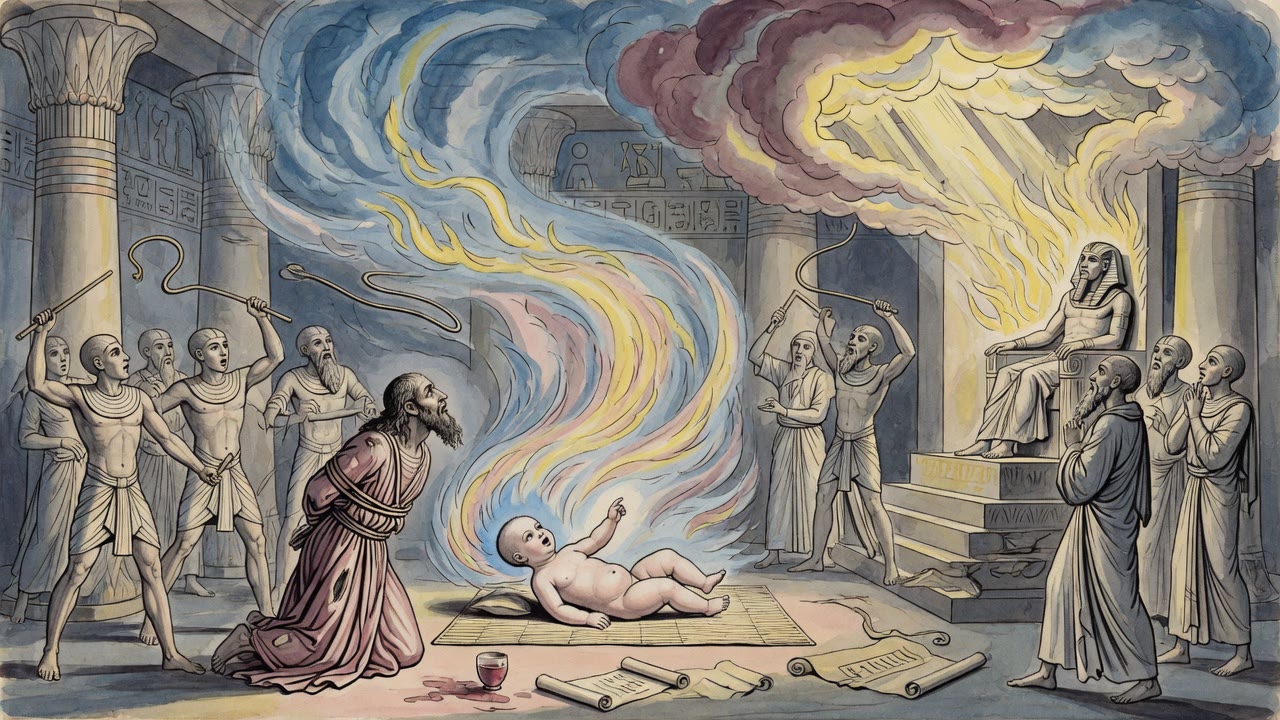
Potiphar, influenced by his wife's accusations and the complaints of other men, had Joseph flogged. While being beaten, Joseph cried out to God, proclaiming his innocence and questioning why he should die for a false accusation.

Then, in a twist worthy of a divine intervention, God opened the mouth of Zuleika's eleven-month-old child. The baby spoke, revealing Zuleika's lies and recounting the true events. The people were astonished, and Potiphar, abashed, stopped the beating.

The matter was brought to court, where priests served as judges. The torn garment was examined, and the location of the tear suggested that Zuleika had tried to hold Joseph fast. The judges concluded that Joseph was not deserving of the death penalty but sentenced him to incarceration for staining Zuleika's name.

Even Potiphar, convinced of Joseph's innocence, admitted that he had to imprison him to protect his children from any lingering suspicion.

So, what are we to make of this story? It's a reminder that temptation can come in many forms, that even the most righteous among us can waver. But it's also a evidence of the power of faith, family, and divine intervention in helping us overcome our weaknesses. And perhaps, most importantly, it is a reminder that even when falsely accused, as Joseph was, truth and justice will eventually prevail. The story of Joseph isn't just an ancient tale; it's a timeless lesson for us all.

Full source
Legends of the Jews 1:99Legends of the Jews

The familiar story is this: – Joseph, sold into slavery, rises through the ranks in the house of Potiphar, an Egyptian official. But it wasn't all smooth sailing. Potiphar's wife, well, she took a liking to Joseph. A strong liking.

The Legends of the Jews retells this episode with details that are just astonishing. It wasn't just a passing fancy on her part. According to Ginzberg's retelling, one day she approached Joseph with a chilling proposition. "If thou wilt not do my desire," she threatened, "I will murder the Egyptian and wed with thee according to the law."

That for a moment. Murder? Marriage? Joseph's response? He tore his garment, a sign of distress and mourning still practiced today, and rebuked her. "O woman, fear the Lord," he pleaded, "and do not execute this evil deed.for I will proclaim thy impious purposes to all in public."

She wasn't easily deterred. Next, she tried a more subtle approach: magic. She sent him a dish, prepared with spells intended to ensnare him. Think of it as ancient Egyptian love potion number nine! But here's where it gets really interesting. When the eunuch, a castrated man, presented the dish to Joseph, he had a vision. He saw a man handing him a sword along with the food.

Talk about a warning sign! Joseph, wise to the potential danger, refused to eat it.

A few days later, Potiphar's wife, puzzled, asked him why he hadn't touched her offering. Joseph didn't hold back. He rebuked her, reminding her of his devotion to God. "How couldst thou tell me, I do not come nigh unto the idols, but only unto the Lord?" he exclaimed. "The God of my fathers hath revealed thy iniquity to me through an angel."

Then, in a moment of incredible faith, Joseph declared that he would eat the food, to prove that the wicked have no power over those who fear God. "I shall eat thy food before thine eyes, and the God of my fathers and the angel of Abraham will be with me."

The result? According to the Legends, Potiphar's wife, overwhelmed, fell at his feet, weeping and promising to never repeat her sin.

What a story! It's a reminder that temptation comes in many forms, from blatant threats to subtle enchantments. And it speaks to the power of faith, not as a passive belief, but as an active force that can protect us, even in the face of the seemingly impossible. What do you think – could you have shown that much restraint?

Full source
Mekhilta Tractate Vayehi Beshalach 4:19Mekhilta DeRabbi Yishmael

The Mekhilta DeRabbi Yishmael preserves a remarkable teaching by Shimon of Kitron about why God split the Red Sea for Israel. The answer has nothing to do with Moses raising his staff or the Israelites crying out in prayer. It goes back to a single act of moral courage performed by one man generations earlier: Joseph.

Shimon of Kitron taught that God said: "In the merit of the bones of Joseph, I will split the sea for them." The connection between Joseph and the sea is established through a pair of verses linked by a single Hebrew word. In (Genesis 39:12), when Potiphar's wife grabbed Joseph's garment and tried to seduce him, the Torah says "he left his garment in her hand and he fled", vayanas, he fled. In (Psalms 114:3), describing the splitting of the sea, the text says "the sea saw and it fled", vayanos, it fled.

The same Hebrew root, nus, meaning "to flee," appears in both verses. Joseph fled from sin. The sea fled from Israel. Shimon of Kitron reads this verbal parallel as a causal connection: because Joseph fled from temptation, the sea would later flee before his descendants.

This teaching carries a powerful moral lesson. The greatest miracle in Israelite history, the splitting of the Red Sea, was earned not by military might or political negotiation but by one man's private decision to resist temptation. Joseph was alone in a room with Potiphar's wife. No one was watching. He could have given in and no human would have known. But he fled, and that act of fleeing rippled forward through the centuries until the waters of the sea fled in response. In rabbinic thought, the merit of the righteous does not expire. It accumulates, and at the right moment, it splits oceans.

Full source
Targum Pseudo-Jonathan on Genesis 39:14Targum Pseudo-Jonathan on Genesis

When Joseph flees, leaving his garment in her hand (Genesis 39:12), Potiphar's wife does not sit in silence. The Targum reports her pivot: she called the men of the house and said, See this, which the Hebrew man hath done whom your master hath brought to mock us. He came in to lie with me, and I cried with a high voice (Genesis 39:14).

Pseudo-Jonathan preserves the three weapons in her speech. First, the Hebrew man, she names him by his ethnicity, not by his role as steward, because a foreigner is easier to convict. Second, whom your master hath brought to mock us, she turns the blame back on her own husband for bringing a Hebrew into the house at all, binding the servants to her by making them victims of Potiphar's judgment. Third, I cried with a high voice, she pre-empts any challenge to her story by insisting she did the thing an innocent woman would do.

The Sages read this speech as a study in the anatomy of a false accusation. Bereshit Rabbah 87 notes that she tells the story to the servants first, not to her husband. Why? Because when Potiphar arrives she needs a chorus ready to nod. The manipulator arranges witnesses before the verdict is even asked.

The Targum, redacted in Eretz Yisrael in the early common era, preserves another bitter detail. Joseph's very virtue is what she uses to convict him. He fled because he would not sin. She turns the flight into evidence of the sin. The midrash teaches that the righteous are often framed not by their failures but by the precise shape of their refusals. The space where Joseph's integrity stood is exactly the space into which she pours her lie.

The lesson is old and still useful. Good behavior does not guarantee good reputation, and the honest person is often the one with the least footing when someone powerful decides to rewrite the story. Joseph will lose the case he should win. The Targum wants us to notice: he loses it because he was innocent. That is the whole point.

Full source