Parshat Miketz5 min read

Joseph Ruled Egypt Without Ever Taking Pharaoh's Throne

The magicians who failed to read the king's dream watched a prisoner take their place at court. Then they began carrying stories to Pharaoh.

Curated by Arthur · Told by Maggid ·
Table of Contents
  1. One Part in Five
  2. The Line Pharaoh Would Not Cross
  3. The Chartumim Load Their Tongues
  4. What the Storehouses Answered
Joseph Ruled Egypt Without Ever Taking Pharaoh's Throne Click for full size

One Part in Five

They shaved him in the corridor. Joseph had come up out of the prison that morning, and now he stood on stone polished for kings, wearing borrowed linen that was still stiff at the shoulders.

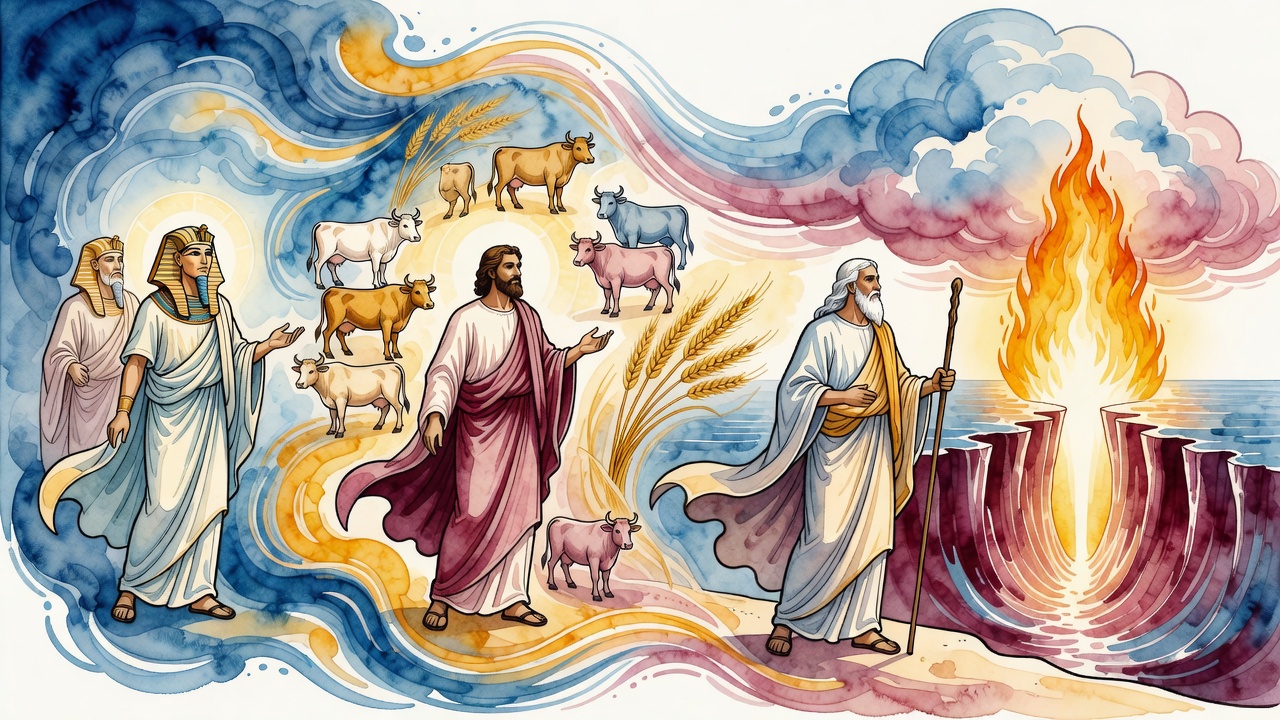
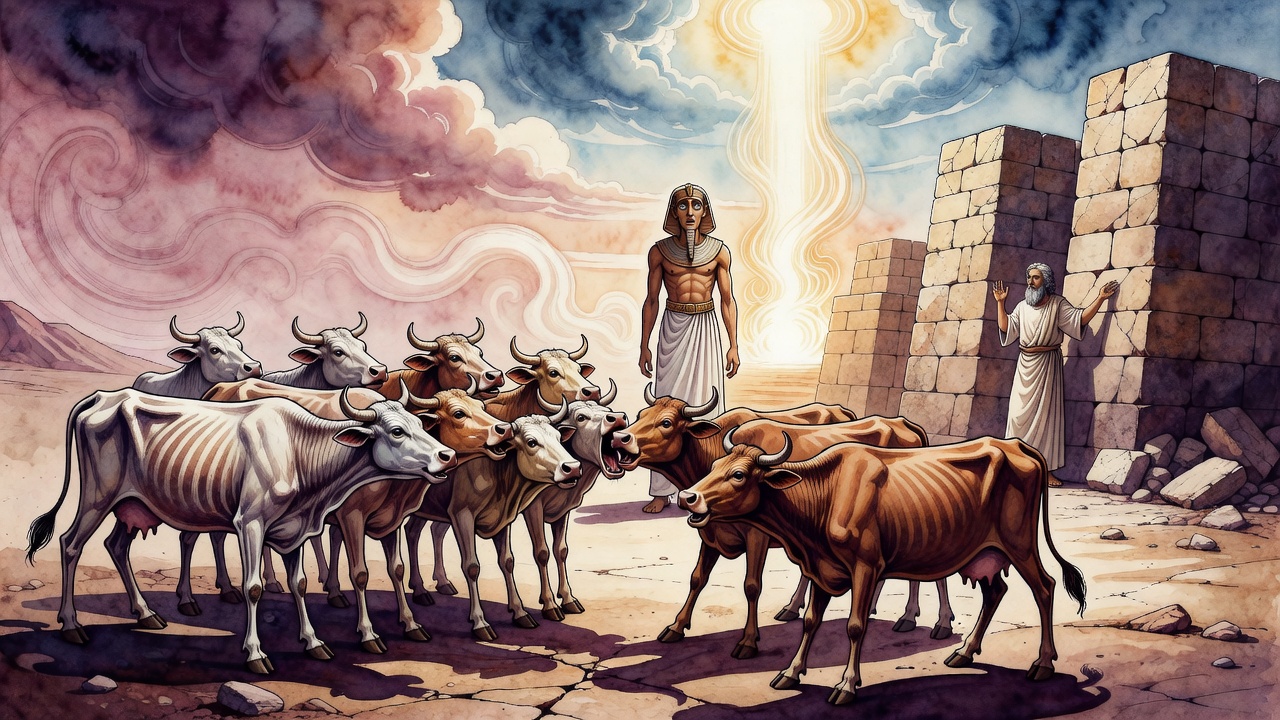
Pharaoh told him the dream. Seven fat cows swallowed whole by seven starved ones. Seven full ears of grain eaten by seven thin. The court magicians had already had their turn and come back with nothing a king could use.

Joseph gave him the reading. Then he kept talking, which nobody had asked him to do.

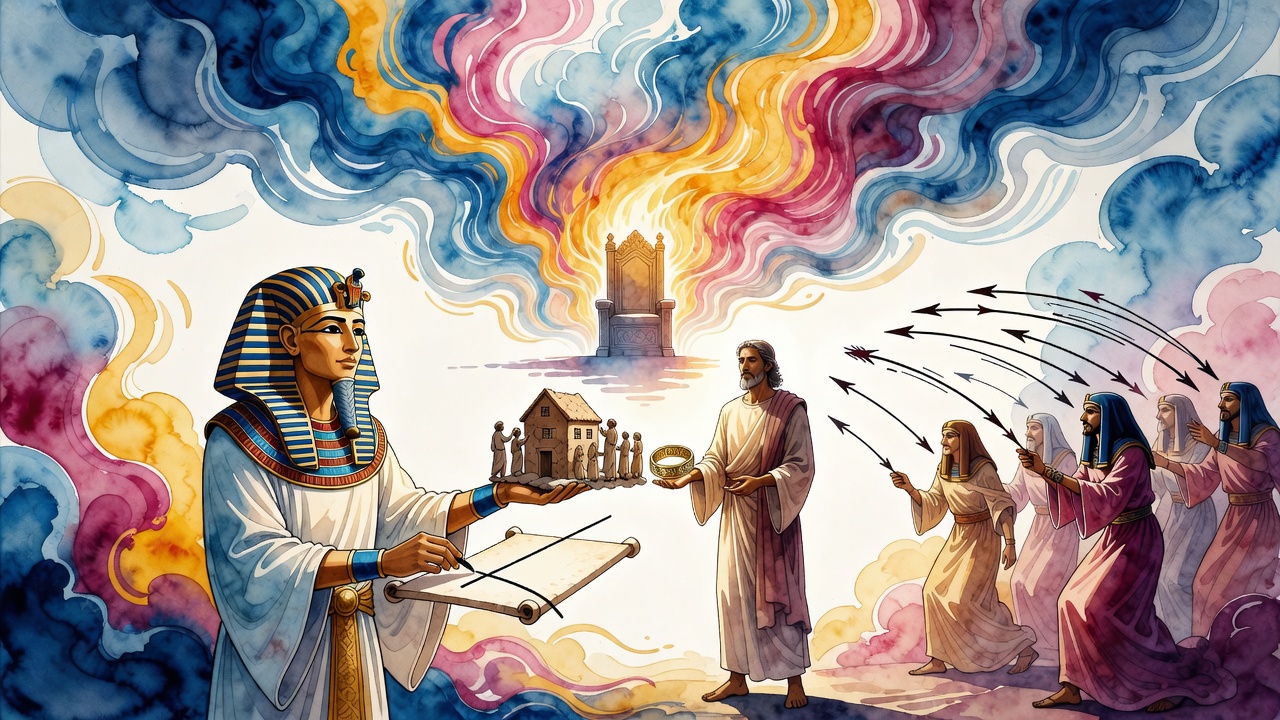
"Let Pharaoh appoint superintendents over the land," he said, "and let them take out one part in five of all the produce of the land of Mizraim in the seven years of plenty."

A fifth. Not a tithe and not a seizure. Small enough that a farmer would still plant the following spring, large enough to carry a country through seven years of nothing. The number was the smallest part of it. A fifth of everything meant officers in every district, storehouses in every city, wagons, scales, seals, and a chain of men reporting upward until the reports reached one desk.

The magicians along the wall listened to a prisoner design their government in a single breath.

The Line Pharaoh Would Not Cross

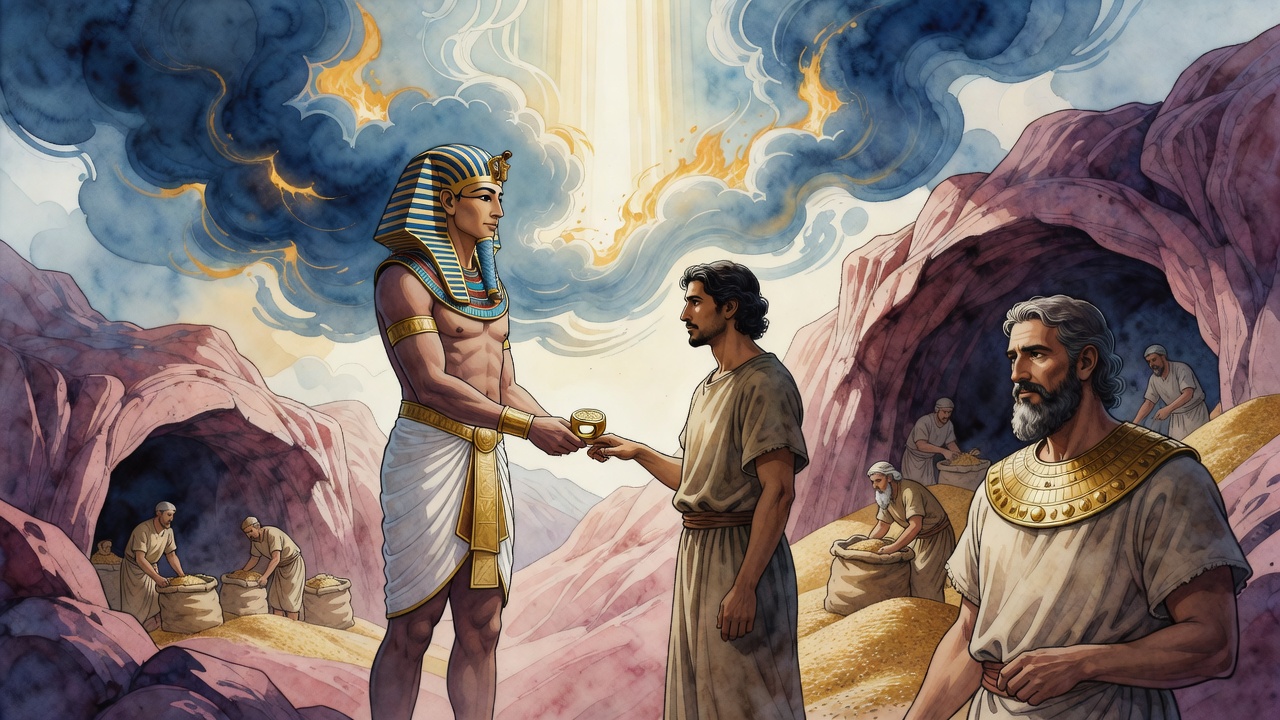
Pharaoh worked the ring off his own finger and pressed it into Joseph's hand.

"You shall be superintendent over my house," he said, "and by the decree of your mouth shall all my people be armed."

Armed. Not only fed and taxed and judged. Joseph's voice would put weapons into Egyptian hands and take them out again. The room heard what that sentence gave away, and so did the man saying it, because he did not stop there.

"Only in the throne of the kingdom will I be greater than you."

One line, held back. Pharaoh handed over the house, the people, the grain, the arms, and the right to say no, and kept a chair.

Joseph did not argue for the chair. He had been sold by his brothers, bought by a household, accused by a woman, and forgotten in a cell by a cupbearer with a short memory, and not one of those things had needed a throne to happen or a throne to undo. He wanted rooms and roads and the authority to lock a door. He took the ring.

The Chartumim Load Their Tongues

The chartumim had advised that throne for generations. Reading dreams was their profession, and the one dream that mattered had beaten them in open court on the same morning a Hebrew slave came up off a prison floor and solved it.

They did not challenge him in the open. They went to Pharaoh in private, singly and then in groups, bitter and angry, and brought accusations against him, expecting to bring him down from his honor. They spoke against him with the slanderous tongue that is severe as arrows.

Every rumor was a shaft. The man was a foreigner. The man had been a slave, and before that a convict, and nobody walks out of an Egyptian cell into the second seat of the kingdom in one morning unless something has been arranged behind a curtain. His reading of the cows was a guess that a frightened king had mistaken for wisdom. Give it two seasons and the storehouses would stand empty in every city while the fifth went somewhere no scribe could follow.

Arrows need a soft target. Joseph gave them a schedule.

What the Storehouses Answered

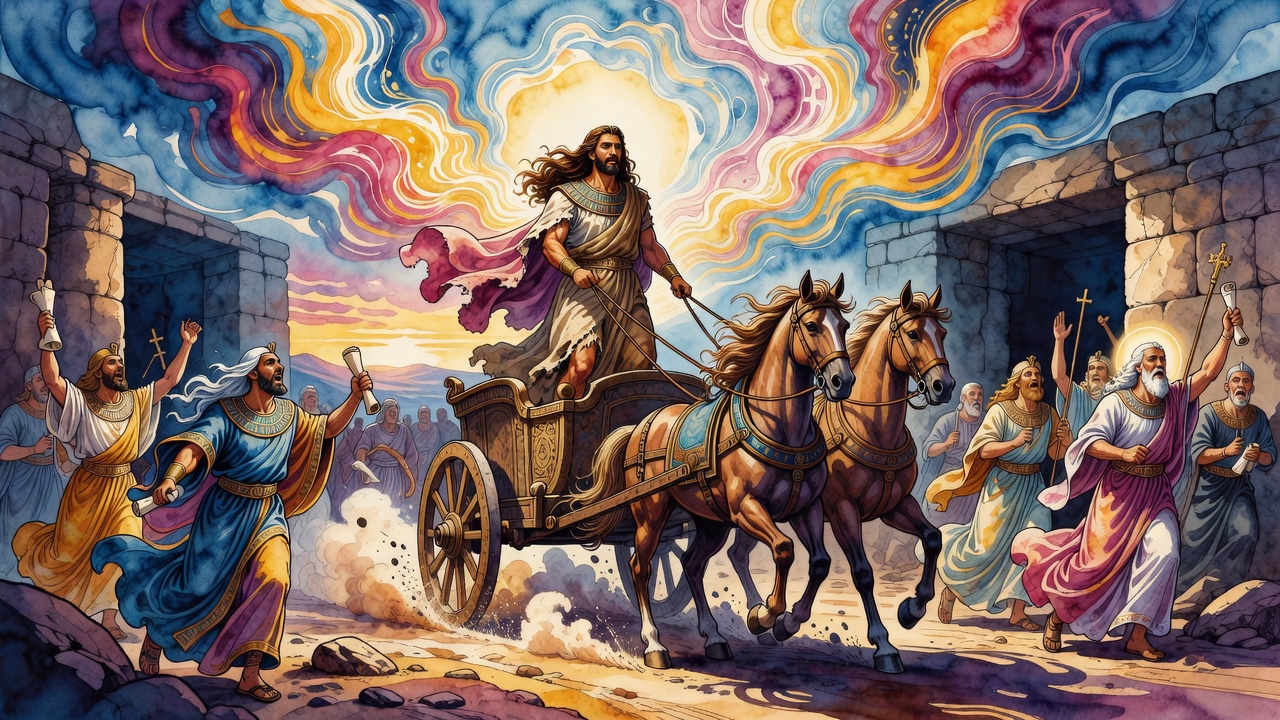
He rode the districts. He watched the fifth come in off seven heavy harvests and he sealed it city by city, keeping each region's grain inside that region's walls so that wheat stayed with the soil that had grown it and did not rot in a foreign air.

Farmers laughed at the caution while the fields were full. Officials asked him what he intended to do with rooms of grain nobody would ever need. He went on counting, and the chartumim went on talking, and for seven years the two sounds ran alongside each other and neither one decided anything.

Then the rain failed.

Egypt opened rooms it had spent seven years filling. The lands around it had no rooms to open. Carts came down from Canaan and up from the desert and in from the coast, and every one of them stopped in front of a man who had been sitting in a cell on the morning the fat cows first walked out of the river in a king's sleep.

The chartumim were still at court. They had nothing left to sell but bitterness, and bitterness feeds nobody. The arrows had been in the air for seven years and had not moved him down from his honor by a single step.

The ring stayed on Joseph's hand. The chair stayed under Pharaoh. He ruled the country from storehouses and roads without ever taking the seat, and neither man found out what would have happened if that arrangement had broken. Egypt ate.


← All myths
From the tradition

Sources

3 sources

The texts behind this telling. Some cards carry a translation of the source; others are our own retelling of it, and each card says which. Every card links out to the original.

Targum Pseudo-Jonathan on Genesis 41:40Targum Pseudo-Jonathan on Genesis

Retold in our words. Read the original at the link below.The Targum of Jonathan ben Uzziel, trans. J. W. Etheridge, London, 1862 · Public Domain

Pharaoh handed over almost everything. House, people, signet, authority. But one line held back: "only in the throne of the kingdom will I be greater than thou." Targum Pseudo-Jonathan on (Genesis 41:40) renders the elevation of Joseph with the exact boundary a monarch must keep if he is to remain a monarch.

Viceroy, not king

The Aramaic paraphrase, whose final redaction belongs to the Land of Israel around the seventh or eighth century CE, uses the phrase "by the decree of thy mouth shall all my people be armed." Armed. Mobilized. Fed. Judged. Joseph's voice becomes Egyptian law. And yet the throne itself stays with Pharaoh. The midrashic tradition reads this line as the establishment of the category that would later shape Jewish political thought: the mishneh la-melekh, the second to the king, the one who governs in the monarch's name without displacing him. Joseph is the first in the Hebrew Bible to hold this position, and the Torah is precise about where the line is drawn.

Why the limit matters

A trustworthy official is one who knows what is not his. Joseph had every reason to resent Pharaoh's boast, he had just saved Egypt with his interpretation. And yet he accepts the throne's boundary. The story works only because he does.

The takeaway

Real authority is confident enough to be delegated without being dissolved. Pharaoh kept his throne; Joseph gained a kingdom. Both understood the difference.

Full source
Targum Pseudo-Jonathan on Genesis 49:23Targum Pseudo-Jonathan on Genesis

Retold in our words. Read the original at the link below.The Targum of Jonathan ben Uzziel, trans. J. W. Etheridge, London, 1862 · Public Domain

Power draws enemies. Joseph rose from a prison cell to the second throne of Egypt in a single day (Genesis 41:40), and the men he displaced never forgave him. Targum Pseudo-Jonathan pictures the aftermath. "All the magicians of Mizraim were bitter and angry against him, and brought accusations against him before Pharoh, expecting to bring him down from his honour. They spake against him with the slanderous tongue which is severe as arrows" (Genesis 49:23).

The magicians had failed to interpret Pharaoh's dreams. Joseph had succeeded. The chartumim, the professional dream-readers who had advised the throne for generations, suddenly watched a Hebrew slave take their place at court. The Aramaic captures the vindictive politics of it. They did not challenge Joseph in public. They whispered in Pharaoh's ear.

The Targum's phrase is pointed. The slanderous tongue is as severe as arrows, an echo of (Psalm 120:3-4), where the lashon hara is compared to "sharp arrows of the mighty." Jewish ethical tradition takes this seriously: slander is a weapon that draws blood without touching skin. Joseph, the Targum implies, survived the arrows because of character, not cunning. The arrows flew. They did not land.

Full source
Targum Pseudo-Jonathan on Genesis 41:34Targum Pseudo-Jonathan on Genesis

Retold in our words. Read the original at the link below.The Targum of Jonathan ben Uzziel, trans. J. W. Etheridge, London, 1862 · Public Domain

When the dream was decoded, Joseph did not stop at interpretation. He handed Pharaoh a policy. Targum Pseudo-Jonathan on (Genesis 41:34), the Aramaic paraphrase of the Torah that took its final form in the Land of Israel around the seventh or eighth century CE, renders the proposal with administrative precision: "Let Pharoh make superintendents over the land, and let them take out one part in five of all the produce of the land of Mizraim in the seven years of plenty."

One in five, the first famine levy

The number matters. A fifth, twenty percent, is not confiscation; it is calibrated. Enough to survive seven lean years without crushing the farmers in seven fat ones. The Targum's word for superintendents signals that Joseph is not only forecasting weather; he is designing a civil service. Tax collectors, regional inspectors, a chain of command that reports upward to a single administrator. In later Jewish law, the model was not forgotten. The Mishnah (Peah 8:7) and Rambam's Mishneh Torah both draw on the logic that surplus years carry a civic obligation to the lean years that follow.

The takeaway

Joseph's twenty percent is the Torah's first budget. Prophecy told him what was coming; bureaucracy was how he met it.

Full source