Parshat Miketz5 min read

Pharaoh Slipped His Signet Onto Joseph's Hand

At thirty Joseph left prison for a ring, a gold collar, and power so total no Egyptian could arm or ride without his word, then buried grain in caverns.

Curated by Arthur · Told by Maggid ·
Table of Contents
  1. No Hand, No Horse, Without His Word
  2. Grain Under the Earth
  3. The Ride That Taught Egypt His Face
  4. What the Ring Really Bought

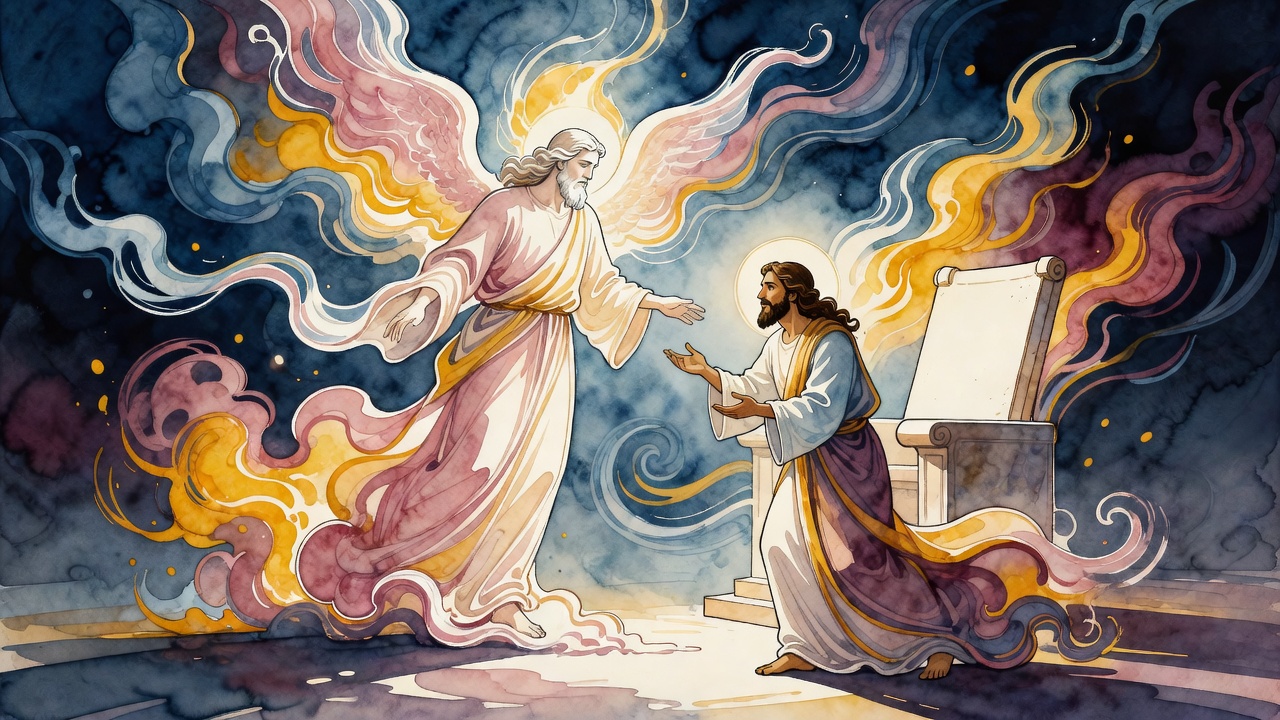
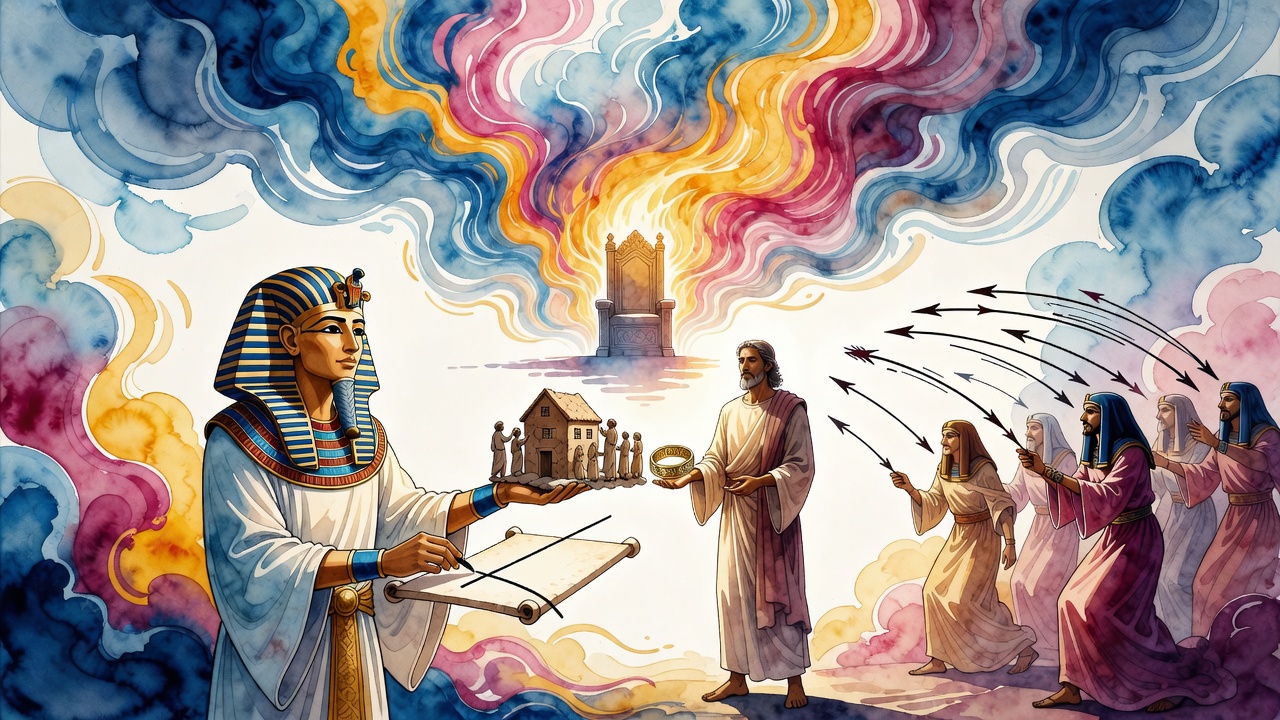
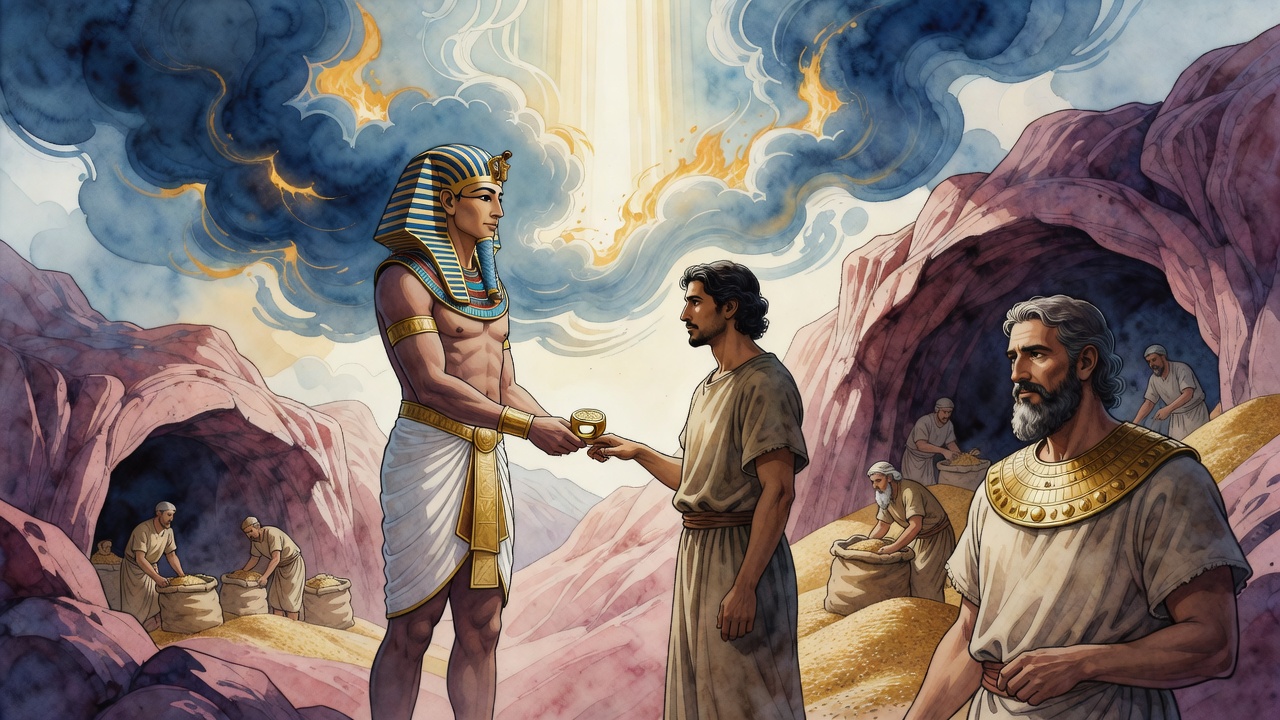
Pharaoh pulled the ring from his own finger while the court still smelled of river panic. Magicians had failed. Advisers had failed. A Hebrew pulled from the house of the bound had just mapped seven fat years and seven lean ones as if he were reading a ledger already written. The king did not debate committee structure. He took the signet off his hand and set it on Joseph's (Genesis 41:42).
Pharaoh Slipped His Signet Onto Joseph's Hand Click for full size

Fine linen followed. A collar of gold closed around a neck that had worn iron. Each piece was law. The ring sealed decrees. The linen marked rank. The gold told every doorway which body to bow for. Joseph felt the metal settle and knew the difference between a gift and a transfer of force. This was not jewelry for a favorite. This was the tool by which Egypt would learn to move when he spoke.

No Hand, No Horse, Without His Word

"I am Pharaoh the king, and you are viceregent," the throne said. "Without your word a man shall not lift up his hand to gird on arms, or his foot to mount a horse in all the land of Mizraim" (Genesis 41:44).

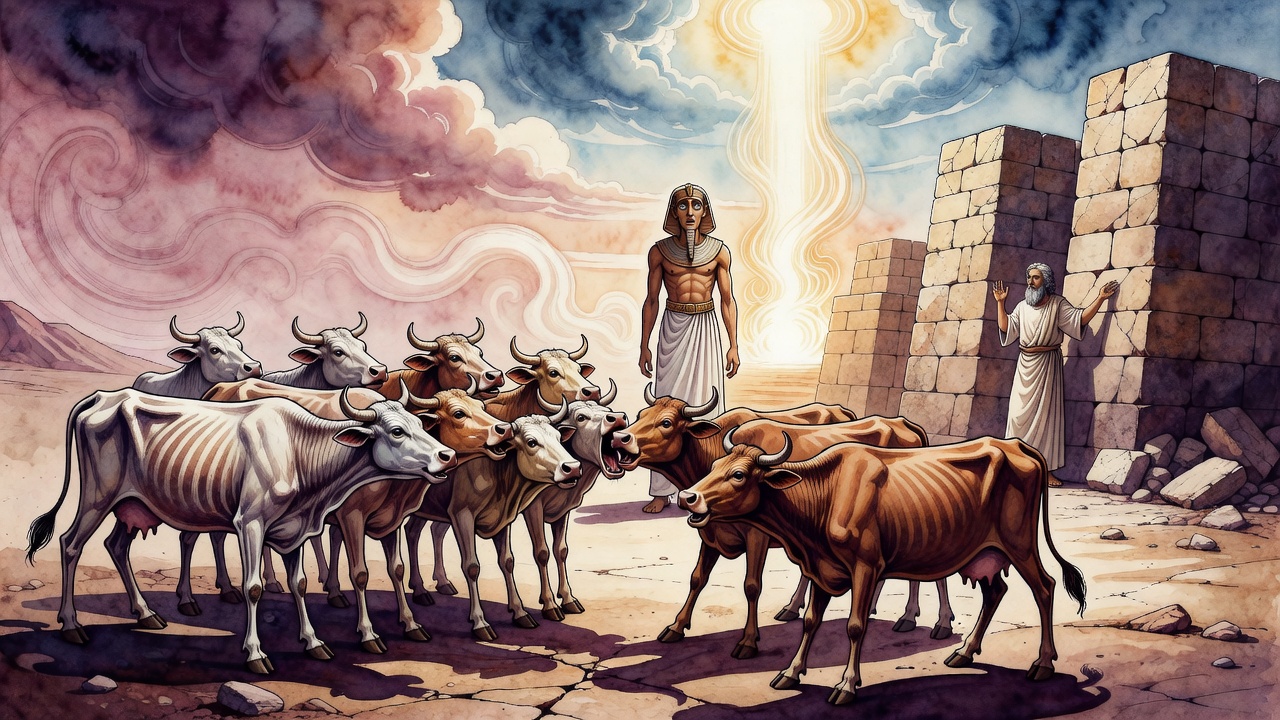
Soldiers waited for Joseph before they buckled. Couriers waited before they swung into the saddle. Nobles who had sneered at a foreign prisoner yesterday now measured their steps against his nod. The grant was almost comic in its total reach, until famine made comedy into policy. Egypt would not move steel or horseflesh unless the Hebrew who once counted pots for Potiphar allowed it.

Joseph was a son of thirty years when he stood before Pharaoh. He went out from the king as a prince and a ruler through all the land (Genesis 41:46). Thirty is the age the Torah treats as full adult weight for service and rule. He did not look like a man who had spent years under stone. He looked like a man who had practiced locked rooms and open ledgers until both felt like the same skill. The chariot wheels bit the road. Dust rose. Children pointed. Joseph did not wave like a festival. He watched the fields.

Grain Under the Earth

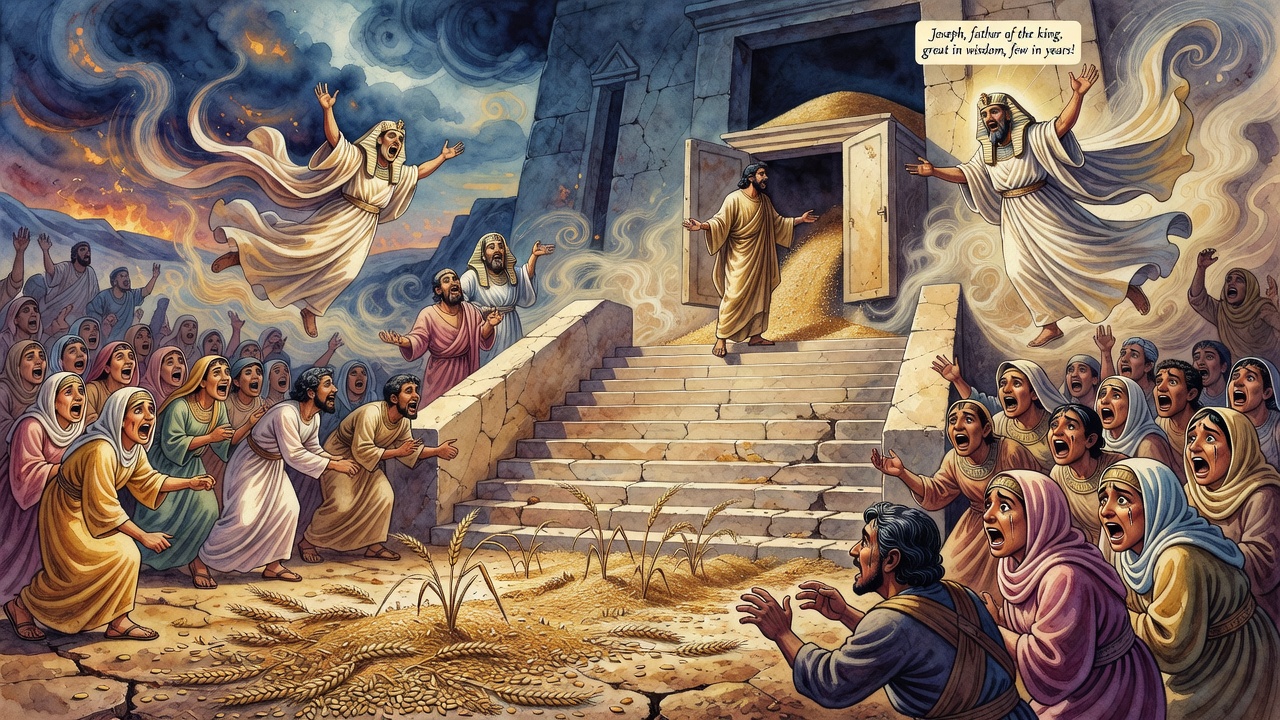
Seven good years began to pile. Joseph did not build one glamorous vault for poets to praise. He ordered provision laid up as in a cavern in the earth, so that in the famine years the people of Mizraim would not perish (Genesis 41:36). Cool dark. Rodent-hard. Hard for thieves to empty in a night. The land itself became a silo, and the silo became a politics of survival.

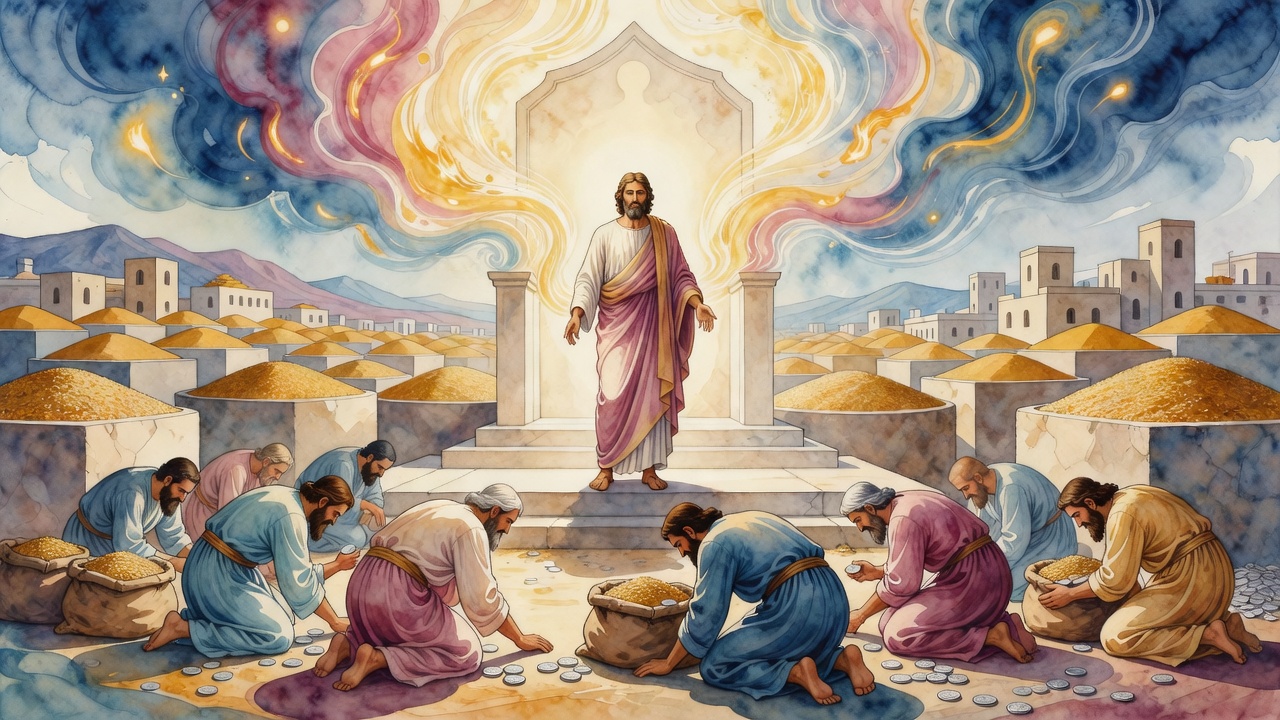
He laid produce in the cities according to the fields around each city (Genesis 41:48). Grain grown near a place stayed near that place. When hunger came, roads would not need to carry the whole kingdom's bread across a desert of bureaucracy. Local earth would answer local mouths. Superintendents learned his voice. Priests watched a foreigner touch storage with a precision that made their own temple granaries look like afterthoughts. In the fat years people mocked storage that looked like fear. In the lean years they stood in lines outside cavern mouths and called the same storage salvation.

The Ride That Taught Egypt His Face

He passed through the land as ruler while the harvests still laughed. The signet that had slid onto his finger in one ceremonial second spent seven years pressing clay on orders that kept cities from eating their seed. No hand lifted a weapon without him. No foot mounted a horse without him. And under those sweeping verbs he buried wheat where famine could not easily find it until he said open.

Power without a plan is theater. Joseph took absolute military and civilian leave from Pharaoh and spent it on dirt, darkness, and boring logistics. He had once refused one room in a private house. Now he claimed every road that mattered in a public empire, not to steal what was not his, but to keep a people from vanishing when the river's mood turned. The boy who lost a coat in a corridor wore the king's seal and still measured success by whether children would eat in year six of the lean.

What the Ring Really Bought

It bought the right to be hated by men who preferred short memory. It bought the right to move populations of grain before anyone believed hunger. It bought a Hebrew the authority to tell Egyptians when to arm and when to ride, which is a strange destiny for a man sold by his brothers. Joseph rode out at thirty with gold at his throat and caverns on his mind, and Egypt learned that the ring on his hand was only as good as the wheat under its fields.


← All myths
From the tradition

Sources

5 sources

The texts behind this telling. Some cards carry a translation of the source; others are our own retelling of it, and each card says which. Every card links out to the original.

Targum Pseudo-Jonathan on Genesis 41:42Targum Pseudo-Jonathan on Genesis

Retold in our words. Read the original at the link below.The Targum of Jonathan ben Uzziel, trans. J. W. Etheridge, London, 1862 · Public Domain

The moment is cinematic. Pharaoh pulls his signet ring from his own finger and slides it onto Joseph's. He drapes him in fine linen. He fastens a collar of gold around his neck. Targum Pseudo-Jonathan on (Genesis 41:42) preserves each gesture with ceremonial care, vestments, collar, ring, because each one carries legal weight.

Three tokens of office

The ring is not jewelry. In Egyptian administrative practice, the signet was the instrument by which royal decrees were authenticated. To wear Pharaoh's ring meant to speak in Pharaoh's voice on parchment. The fine linen, the shesh of priestly dress, marked Joseph as belonging to the governing class that stood closest to sacred authority. The gold collar, the manikha in the Aramaic, was the pharaonic "collar of honor," a decoration Egyptian reliefs routinely show the king bestowing on his highest officials. The Targum, whose final redaction belongs to the Land of Israel around the seventh or eighth century CE, is faithful to the Egyptian context the Torah assumes.

From pit to palace

The rabbinic imagination is alive to the irony. Joseph had been stripped of his coat of many colors by his brothers (Genesis 37:23) and stripped again of his garment by Potiphar's wife (Genesis 39:12). Now he is clothed by a king.

The takeaway

Joseph's rise is measured in garments. Each one he lost was a step down; each one he now wears is the reversal. The God who undresses also clothes.

Full source
Targum Pseudo-Jonathan on Genesis 41:44Targum Pseudo-Jonathan on Genesis

Retold in our words. Read the original at the link below.The Targum of Jonathan ben Uzziel, trans. J. W. Etheridge, London, 1862 · Public Domain

Pharaoh's grant of power to Joseph sounds almost absurd when read slowly. Targum Pseudo-Jonathan on (Genesis 41:44) renders it: "without thy word a man shall not lift up his hand to gird on arms, or his foot to mount a horse in all the land of Mizraim."

Total military authority, total civilian authority

The two verbs are carefully chosen. Girding on arms is the action of a soldier. Mounting a horse is the action of a courier or a nobleman. The Aramaic paraphrase, which reached its final form in the Land of Israel around the seventh or eighth century CE, is saying that both the war machine and the civil service of Egypt answered to Joseph's voice. No one drew a sword without his approval. No one rode out on royal business without his authorization. Pharaoh kept the throne; Joseph held everything attached to it.

Why the Torah is this extreme

The rabbinic tradition reads this not as Egyptian absolutism but as divine providence at work. Joseph needed this level of authority because the famine would require decisions, about grain, travel, borders, and eventually the arrival of his own family, that only a single unchallenged executive could make fast enough. The Torah gives him the power because the crisis would demand it.

The takeaway

Providence sometimes arranges authority before we can see the emergency that will require it. Joseph's total command looked like a reward; it was also a preparation.

Full source
Targum Pseudo-Jonathan on Genesis 41:46Targum Pseudo-Jonathan on Genesis

Retold in our words. Read the original at the link below.The Targum of Jonathan ben Uzziel, trans. J. W. Etheridge, London, 1862 · Public Domain

The number is almost casual in the text, but the sages could not stop noticing it. Targum Pseudo-Jonathan on (Genesis 41:46) records it: "And Joseph was a son of thirty years when he stood before Pharaoh, king of Mizraim." Thirty.

A meaningful age in the Hebrew Bible

David became king at thirty (2 Samuel 5:4). The Levites entered sacred service at thirty (Numbers 4:3). The Torah treats thirty as the age of full adult competence, old enough to have earned wisdom, young enough to carry the physical demands of the role. Joseph's elevation at exactly this age is not coincidence. The rabbinic tradition reads it as confirmation that his rise was ordered by divine timing, not Egyptian whim.

Riding a circuit, not a chariot of display

The Aramaic paraphrase, finalized in the Land of Israel around the seventh or eighth century CE, adds that Joseph "passed, a prince and a ruler, through all the land of Mizraim." This was not a coronation lap. It was a working inspection. He was surveying fields, counting granaries, selecting cities for storage, meeting local officials. The seven years of plenty had a clock on them, and Joseph rode out to use every one.

The takeaway

Thirteen years earlier, Joseph had been seventeen and in a pit. At thirty, he is riding Egypt's roads as its ruler. The Targum's small biographical note is a standing reminder: God's timing is rarely visible from inside the pit.

Full source
Targum Pseudo-Jonathan on Genesis 41:36Targum Pseudo-Jonathan on Genesis

Retold in our words. Read the original at the link below.The Targum of Jonathan ben Uzziel, trans. J. W. Etheridge, London, 1862 · Public Domain

The Torah says Joseph stored grain in cities. Targum Pseudo-Jonathan on (Genesis 41:36) adds a detail that changes the picture entirely: the provision was laid up "as in a cavern in the earth." The Aramaic paraphrase, which took its final form in the Land of Israel around the seventh or eighth century CE, pictures underground chambers, cool, dark, rodent-resistant, dug into the soil itself.

Underground wheat, ancient science

This was not folklore. Archaeology confirms that Egyptian and Near Eastern societies stored grain in subterranean silos precisely because the earth's steady temperature slowed spoilage and the darkness discouraged insects. Joseph's plan was scientifically sound by the standards of every era. The Targum's phrasing, "a cavern in the earth", gives the midrashic imagination a picture to hold: Egypt's wealth tucked beneath Egypt's feet, waiting for the seven lean years "that the people of the land perish not through the famine."

Why the detail matters

The verse's climax is the purpose clause: so that the people perish not. The Targum insists the storage plan had one goal, and it was not tax revenue. It was survival. Every buried bushel was an argument against the famine's consuming power.

The takeaway

Joseph's cavernous granaries are a reminder that wisdom sometimes looks like a hole in the ground, patient, hidden, and exactly where you need it when the sky turns against you.

Full source
Targum Pseudo-Jonathan on Genesis 41:48Targum Pseudo-Jonathan on Genesis

Retold in our words. Read the original at the link below.The Targum of Jonathan ben Uzziel, trans. J. W. Etheridge, London, 1862 · Public Domain

Seven harvests, gathered with deliberate care. Targum Pseudo-Jonathan on (Genesis 41:48) records the logistics Joseph used: "he laid up the produce in the cities; the produce of the fields which were round about a city he laid up therein."

The principle of local storage

The detail reads like a throwaway, but it is a policy. Grain grown near city A was stored in city A. Grain from the fields of city B stayed in city B. The Aramaic paraphrase, which reached its final form in the Land of Israel around the seventh or eighth century CE, preserves this because the rabbinic tradition saw its practical wisdom. Bereishit Rabbah 90:5, a rabbinic commentary on Genesis compiled in the Land of Israel around the fifth century CE, offers a complementary reason: grain keeps better among its own soil and climate, because the land's own air preserves it. Modern agronomy would call it micro-climate acclimation.

Why distribution outperforms centralization

Joseph's system meant that when the famine arrived, every Egyptian city could open its own reserves without waiting for a caravan from a distant capital. Transportation would collapse during the famine years anyway, hungry animals cannot pull wagons far. Local storage was the only storage that would still be reachable when things got bad.

The takeaway

Joseph's second instinct, after collecting the grain, was not to hoard it centrally but to keep it close to the people who would need it. The best plan is one that still works when transportation fails.

Full source