Parshat Noach5 min read

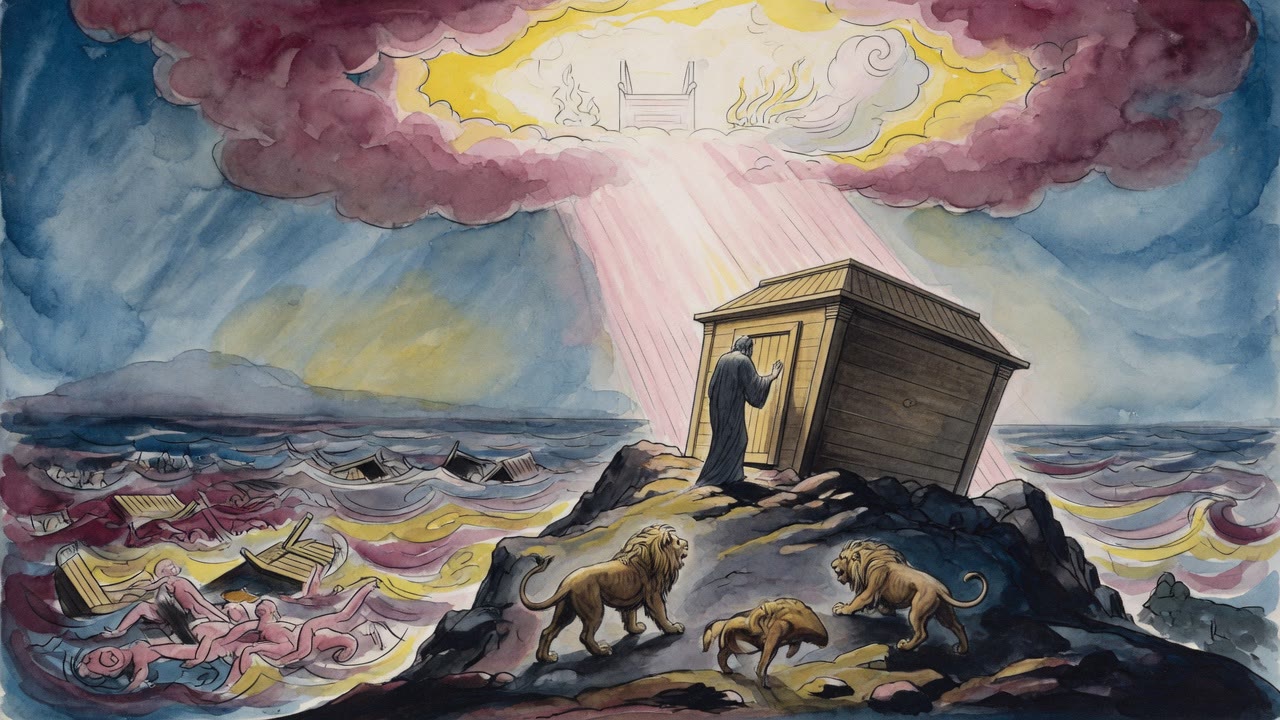
Lions Ringed Noah's Ark Against the Drowned

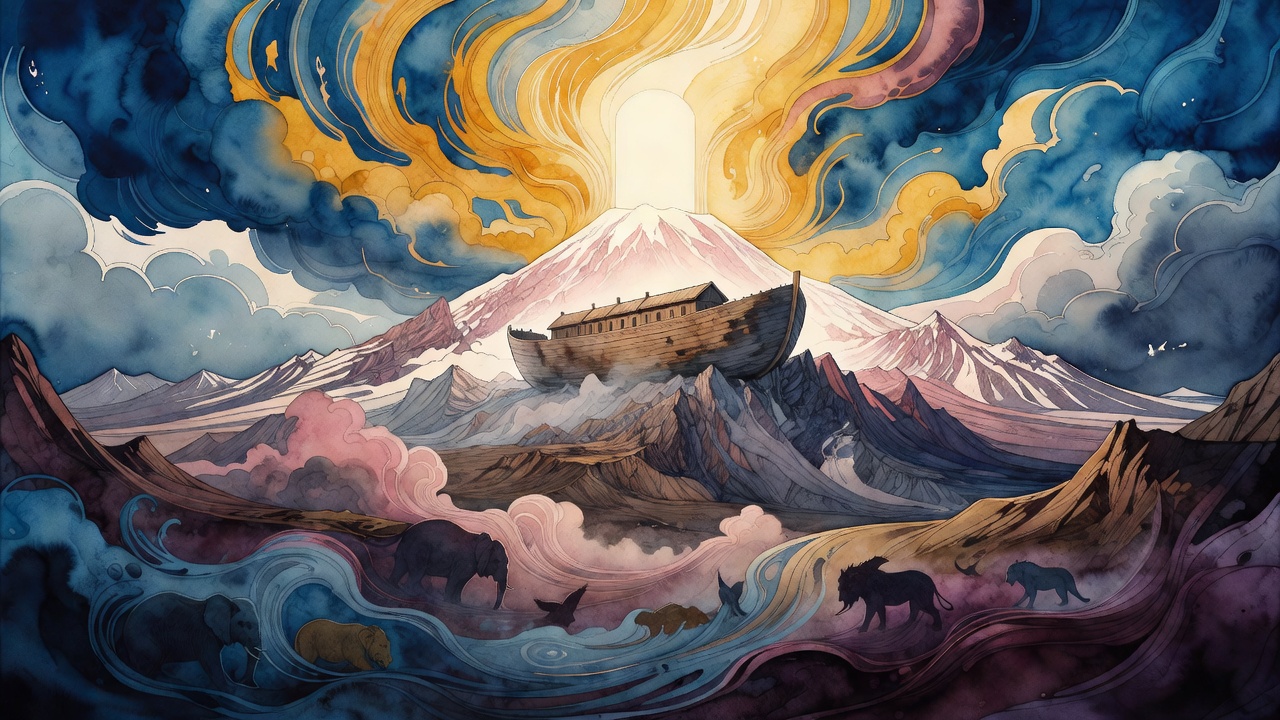
The sun and moon went out for twelve months. Noah worked by a glowing stone while the doomed clawed at the hull and tried to roll the ark over.

Curated by Arthur · Told by Maggid ·
Table of Contents
  1. The Door Shut and the Sky Went Out
  2. Hands on the Hull From the Wrong Side
  3. A Year Without a Calendar
  4. Shem's Sons Walked Out Into a Map
  5. A Sign Between the Word and Every Breathing Thing
Lions Ringed Noah's Ark Against the Drowned Click for full size

The Door Shut and the Sky Went Out

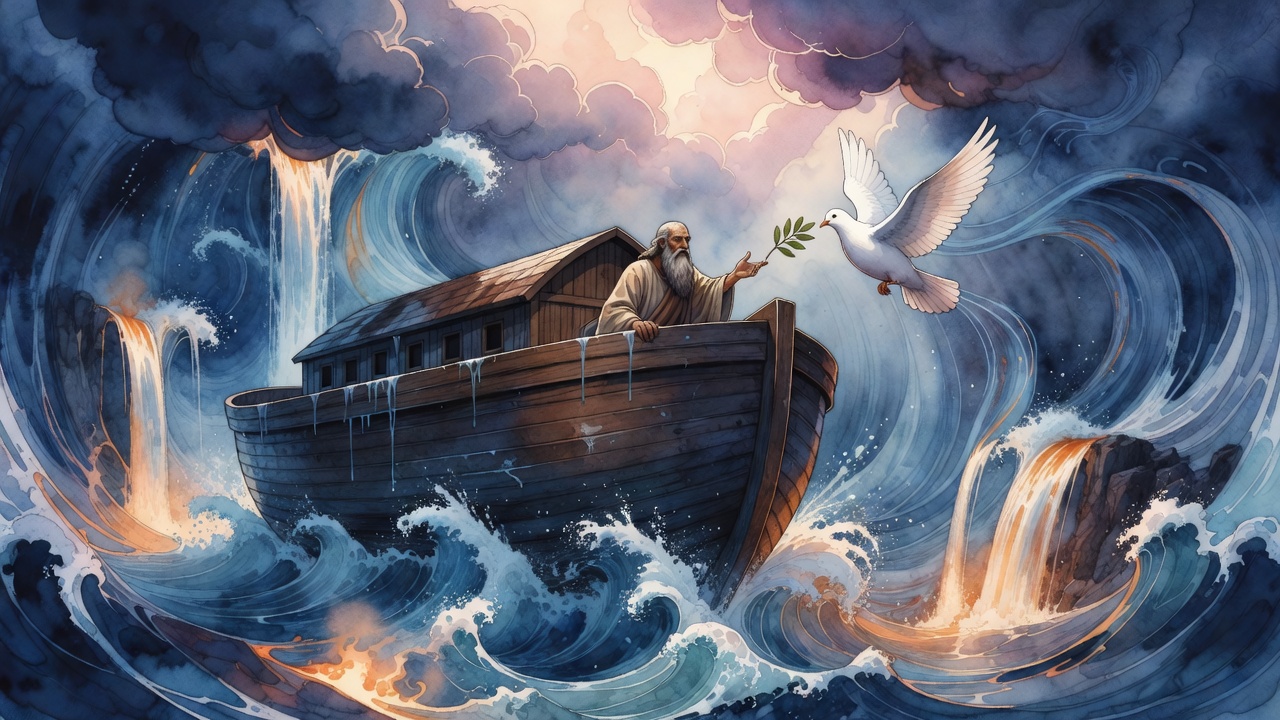
The door thudded shut from the outside and the last dry air in the ark tasted of pitch and animal breath. Noah put his palm flat on the timber and felt the whole hull lift and settle as the water came up under it.

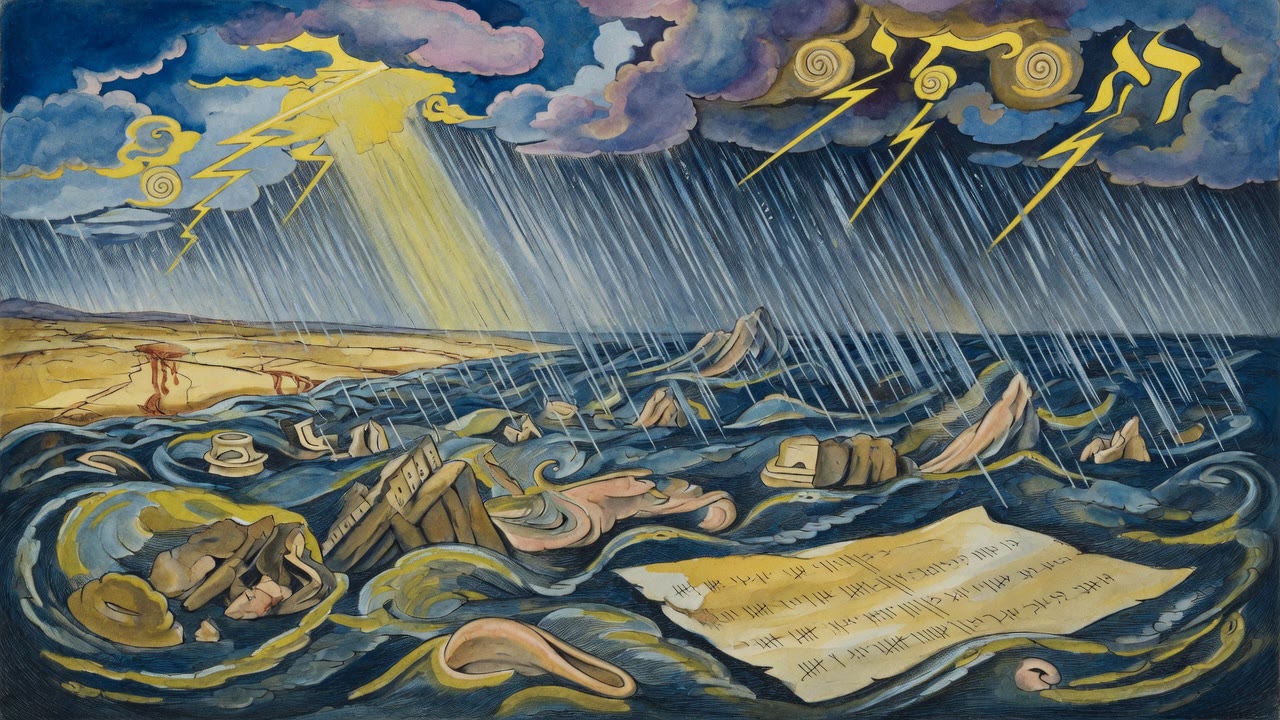
Then the sun went out. The moon went out with it. For twelve months the sky did no work at all, and the only light left anywhere in the world was a stone.

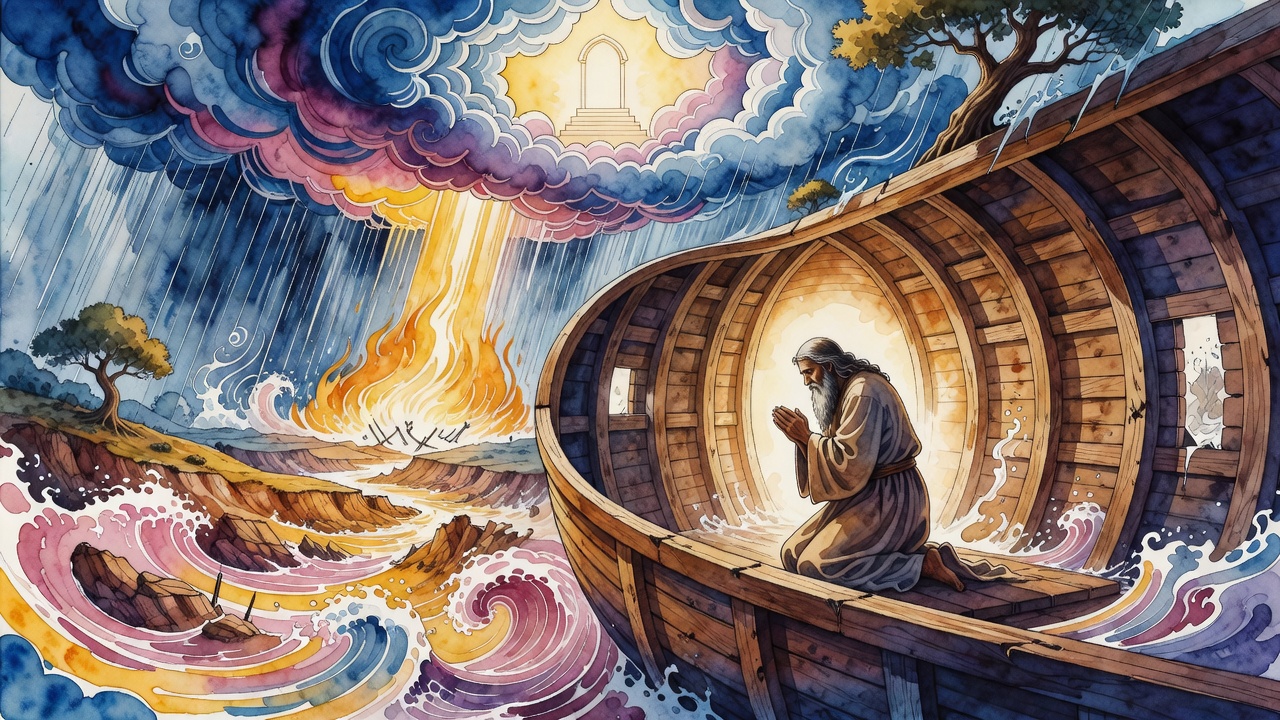
It had been set there before the door closed, a precious stone that gave off its own light, and by it Noah found the ladder between decks and the water jars and the eyes of animals that had walked up a ramp on his word. He counted feedings by it. He measured out fodder by it. A man with a lamp in a dark house is not calm, but he is working.

Hands on the Hull From the Wrong Side

Outside, the people in the water finally understood.

They did not pray. They got their hands on the hull and tried to roll it. If a decree had been written against them, they would take the household inside down under the same line of it, and there were enough of them in the water to do it. Fingers scraped along the pitch looking for a seam. Voices came up at the timber like men still trying to bargain in a market that had closed.

Heaven did not answer with a speech. It put lions around the ark.

They took anyone who came near. The same jaws that would one day be held shut around a man in a Babylonian pit were held open here, and for the same reason. What locked Noah in was never only a bolt of wood.

He heard it happen without seeing any of it. The stone lit the inside. The outside belonged to the sentence. He went on feeding.

A Year Without a Calendar

There was no way to tell morning from midnight for twelve months, so the ark grew its own clock out of appetite. Clean animals and unclean animals still had to be measured out. Sleep came in shifts. Shem, Ham, and Japheth passed each other on the ladders carrying the one light between them.

Nothing on board could argue with the decree and nothing on board had to. They ate on schedule while the world they had come out of went quiet under the keel.

Shem's Sons Walked Out Into a Map

When the water finally let go, the ground it uncovered was not the ground anybody remembered, and it had to be divided.

Arpachshad took the land of the Chaldees east of the Euphrates, the desert waters that face toward Egypt, and Lebanon and the ranges that lean back toward the river. Aram took Mesopotamia, the country caught between the Tigris and the Euphrates, north of the Chaldees to where the mountains of Asshur begin.

Two brothers off one boat, walking out in different directions across a drowned world with their portions named. The flood had not erased the future. It had made everyone redraw it, and the lines they drew that year still have their names on them.

A Sign Between the Word and Every Breathing Thing

Then the promise, and it needed a marker, because a promise without one gets forgotten as soon as the mud dries.

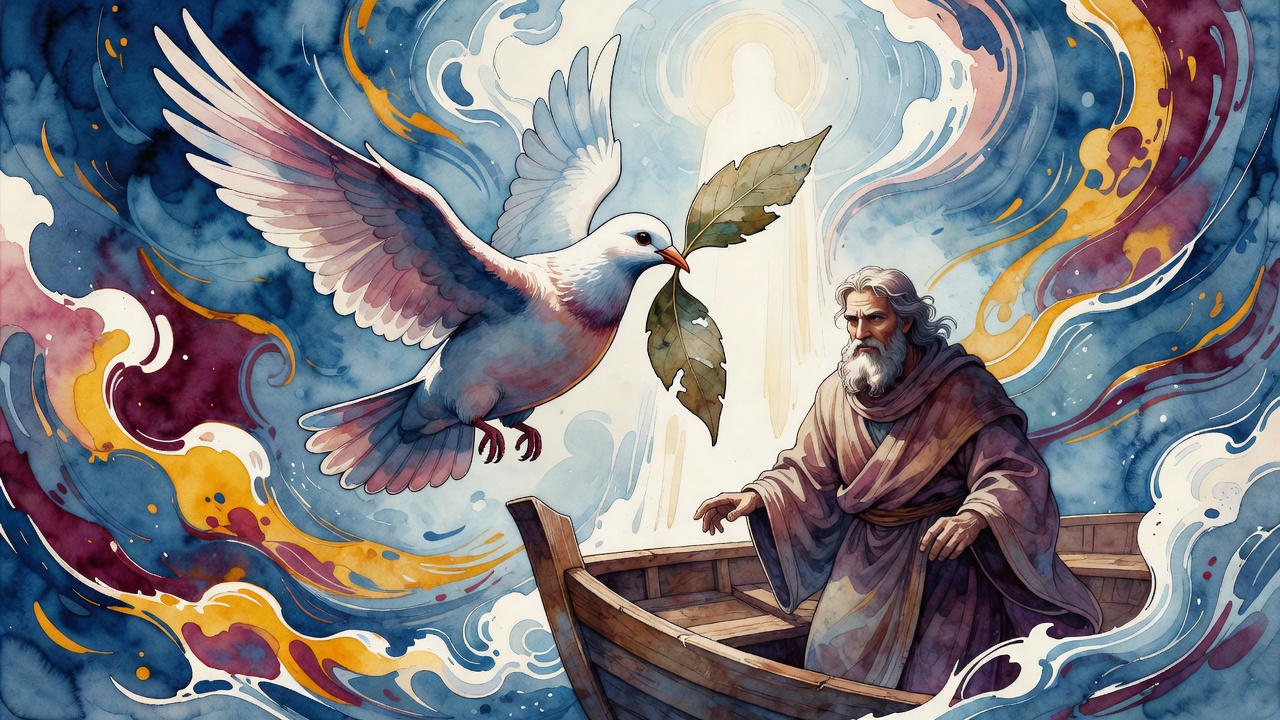
This is the sign of the covenant which I establish between My Word and you and every living soul that is with you, unto the generations of the world. The Aramaic slips in that one phrase, between My Word, so the agreement is not sealed in an empty chamber. It runs between the Word that spoke the world up out of nothing and the breath still moving in a goat, a child, a bird on a wet branch.

Unto the generations of the world. Not for Noah. Not for his sons. For as long as there are people left to look up and count.

The sages set one more thing beside it. If the windows of heaven could open and pour out that much destruction, then the doors of heaven, which are larger, can pour out that much good. They pictured the manna Israel would later find on the ground heaped sixty cubits high, high enough that kings in the east and kings in the west could see the pile from where they stood.

Noah had lived the first half of that arithmetic with his hand on a glowing stone and lions walking a circuit between him and the drowning. He came out into wet light and a world with fresh borders, and the marker went up in the sky where his great-great-grandchildren would have to see it whether or not anyone told them the story.


← All myths
From the tradition

Sources

3 sources

The texts behind this telling. Some cards carry a translation of the source; others are our own retelling of it, and each card says which. Every card links out to the original.

Yalkut Shimoni on Torah 57:1Yalkut Shimoni on Torah

Translation of the source text.Torat Emet (Yalkut Shimoni) · CC-BY-NC

"And the LORD shut him in" (Genesis 7:16). The Holy One, blessed be He, shut up the sun and the moon, and they did not give light all twelve months, as it is said, "Who commands the sun [cheres] and it does not shine." And how did Noah see to function? The Holy One, blessed be He, prepared for him a precious stone, and he made use of its light. When the wicked saw that they were lost, they sought to overturn the ark; He surrounded the ark with lions, and they devoured them, as it is said, "And the LORD shut him in," just as it says, "My God sent His angel and shut the mouths of the lions, and they did not harm me" (Daniel 6:23). "Fifteen cubits upward did the waters prevail," and so forth (Genesis 7:19-20). And which measure is greater, the measure of good or the measure of punishment? You must say the measure of good is greater. Regarding the measure of punishment He says, "And the windows of heaven were opened"; regarding the measure of good He says, "And He commanded the skies above and opened the doors of heaven, and rained down manna upon them to eat, and gave them the grain of heaven" (Psalms 78:23-24). How many windows are in a door? Four and four, hence eight. It is found that the manna that fell for Israel was sixty cubits high. Are they comparable? There it was over forty days, here in a single hour; there for the whole world, here for Israel alone. Rather, Rabbi Elazar of Modi'in derives it by a verbal analogy of "opening" with "opening." Issi ben Yehuda says: The manna that came down for Israel kept rising up higher until all the kings of east and west could see it, as it is said, "You prepare before me a table in the presence of my enemies; You anoint my head with oil, my cup overflows" (Psalms 23:5). Abaye said: Learn from this that the cup of David in the world to come holds two hundred and twenty-one log, as it is said, "my cup overflows [revayah]"; revayah in gematria equals this.

Full source
Targum Pseudo-Jonathan on Genesis 9:12Targum Pseudo-Jonathan on Genesis

Retold in our words. Read the original at the link below.The Targum of Jonathan ben Uzziel, trans. J. W. Etheridge, London, 1862 · Public Domain

Targum Pseudo-Jonathan on (Genesis 9:12) introduces the idea of a sign, an ot, that will anchor the covenant through all time. This is the sign of the covenant which I establish between My Word and between you and every living soul that is with you, unto the generations of the world.

The Aramaic adds the phrase between My Word, bein Memri, to the biblical text. The covenant is not made in some abstract heavenly chamber. It is made between the Memra, the living Word of the Holy One that also spoke the world into being, and every creature that breathes.

Notice the time horizon: unto the generations of the world. Not for a century. Not for Noah and his sons. For as long as the world has generations to count. This is Torah's way of saying: whatever sign is about to be given, it has to be visible to your great-great-great grandchildren, and theirs after them.

The Maggid pauses here before the next verse reveals what the sign will be. A covenant without a sign is easy to forget. A covenant with a visible marker becomes part of the furniture of the world.

The takeaway: when God makes a promise, God also makes a reminder. The reminder is the mercy. Look up, it is coming in the very next verse.

Full source
Book of Jubilees 9:7Book of Jubilees

Retold in our words. Read the original at the link below.Sefaria Community Translation · CC-BY

Book of Jubilees turns to Arpachshad and the Dreamer.

This ancient Jewish text, considered apocryphal by some but deeply revered by others, offers a unique perspective on biblical history. And chapter 9 gives us the breakdown of the post-Flood world.

So, who got what?

Well, the passage you mention deals with the portions allotted to Arpachshad and Aram, two sons of Shem, one of Noah’s three sons. Remember, after the Flood, Noah’s sons repopulated the earth, so understanding their inheritance is crucial.

For Arpachshad, the text says he got "all the land of the region of the Chaldees to the east of the Euphrates, bordering on the Red Sea." That's a pretty significant chunk of real estate. We’re talking about the area that would later become known for its advanced civilization, its contributions to mathematics and astronomy. Not bad. The text continues, specifying "all the waters of the desert close to the tongue of the sea which looketh towards Egypt, all the land of Lebanon and Sanîr and ’Amânâ to the border of the Euphrates." Imagine drawing a map based on that description! It paints a picture of a vast territory stretching from Mesopotamia down towards Egypt, encompassing the fertile lands of Lebanon.

Then there’s Aram. His portion was "all the land of Mesopotamia between the Tigris and the Euphrates to the north of the Chaldees to the border of the mountains of Asshur and the land of ’Arârâ." So, another prime piece of Mesopotamian real estate, north of where Arpachshad settled. This is the land of the Aramaeans, whose language, Aramaic, would eventually become a lingua franca of the ancient Near East. – the words they spoke shaped much of the region.

Now, why is this detailed geographical breakdown important?

It's more than just ancient cartography. The Book of Jubilees isn’t just giving us a history lesson. It's grounding the narrative in specific locations, connecting the descendants of Noah to particular lands. It's about establishing a divinely ordained order, a sense of purpose and destiny tied to the land itself.

How were these boundaries determined? What were the criteria? We aren't told the specifics, but the implication is clear: this division was part of a larger cosmic plan.

The Book of Jubilees chapter 9 reminds us that even the most ancient of stories are rooted in the physical world. It invites us to consider the deep connections between people, places, and destiny. It's a reminder that history isn't just about names and dates, but about the land itself, the rivers, mountains, and deserts that shape our lives and our stories.

Full source