Parshat Chukat6 min read

When Miriam Died, the Well Vanished and Moses Struck the Rock

Miriam died, her well vanished, and Moses wept six hours before the thirsting camp dragged him to a rock that would not give water.

Curated by Arthur · Told by Maggid ·
Table of Contents
  1. The Gift No One Counted
  2. Six Hours of Weeping
  3. The Rock That Hid Itself
  4. Hear Now, You Rebels
  5. Two Blows and a Flow of Blood

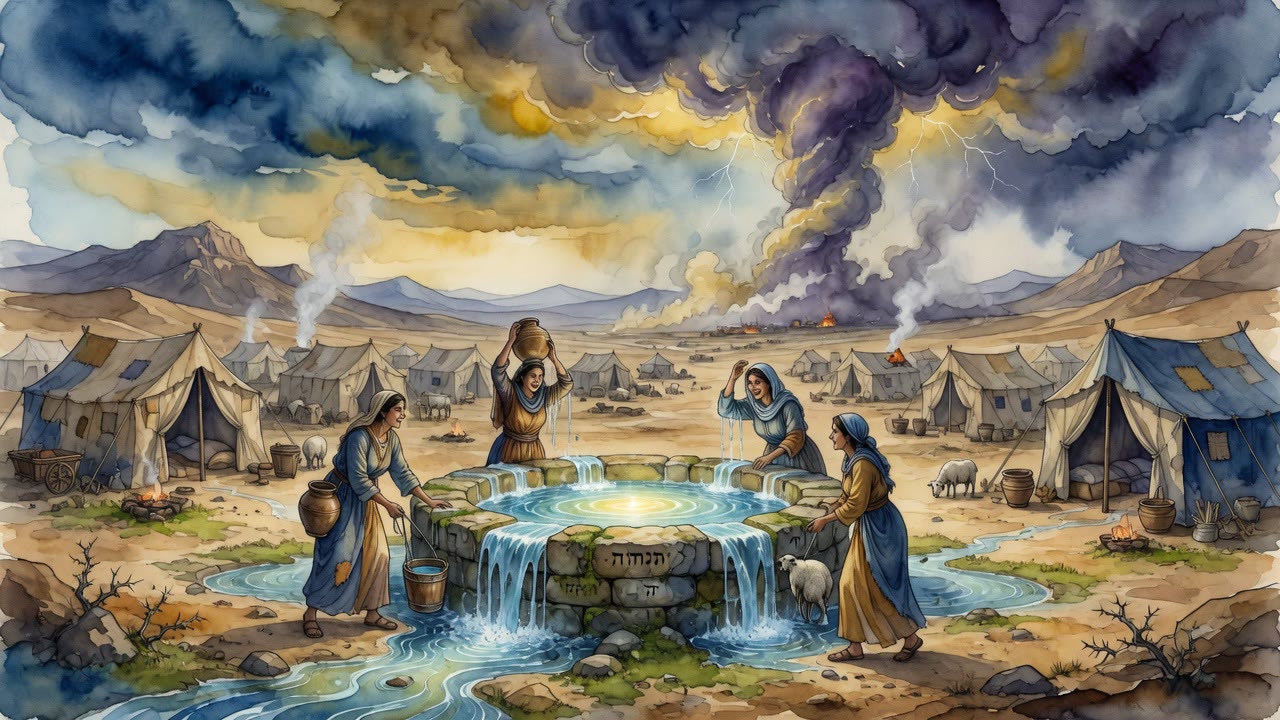
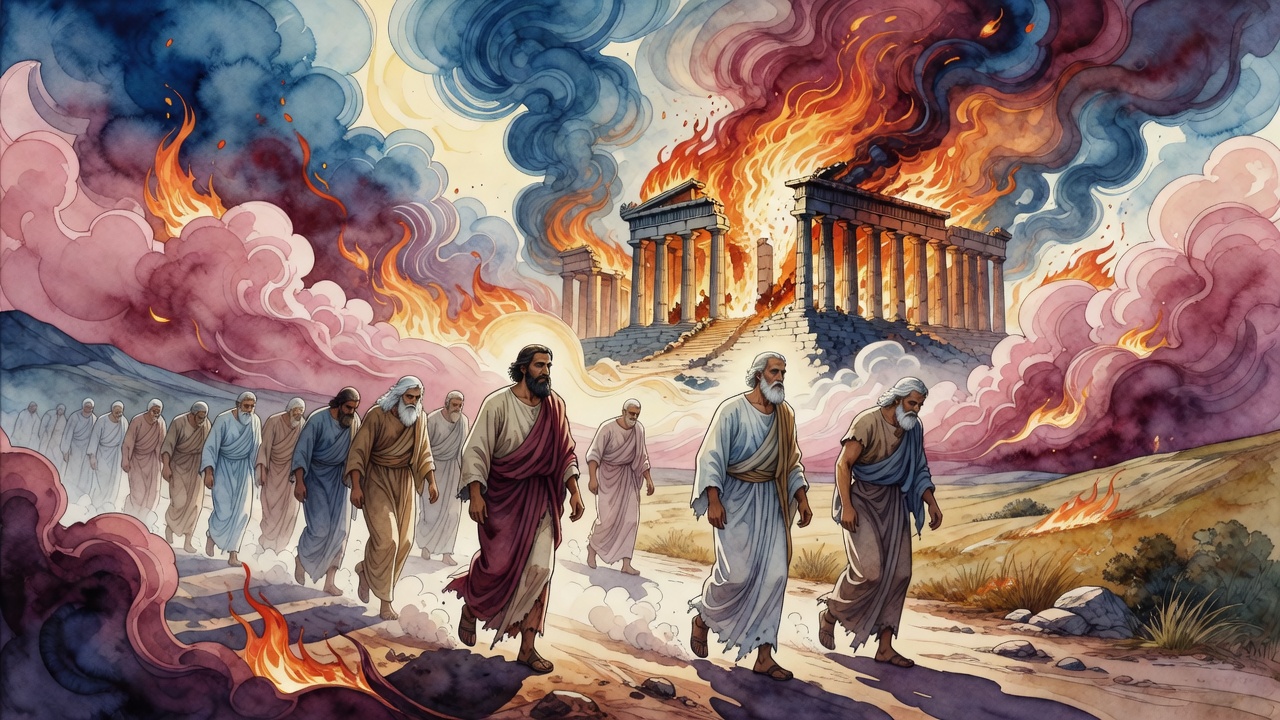
The water was gone before anyone noticed the body had stopped breathing. Miriam died at Kadesh in the wilderness of Zin (Numbers 20:1), and somewhere in the dry hours after, a sound the camp had stopped hearing simply ended. The well that had walked with them for forty years went quiet. No one ran to announce it. The animals went to drink and found stone.
The Gift No One Counted

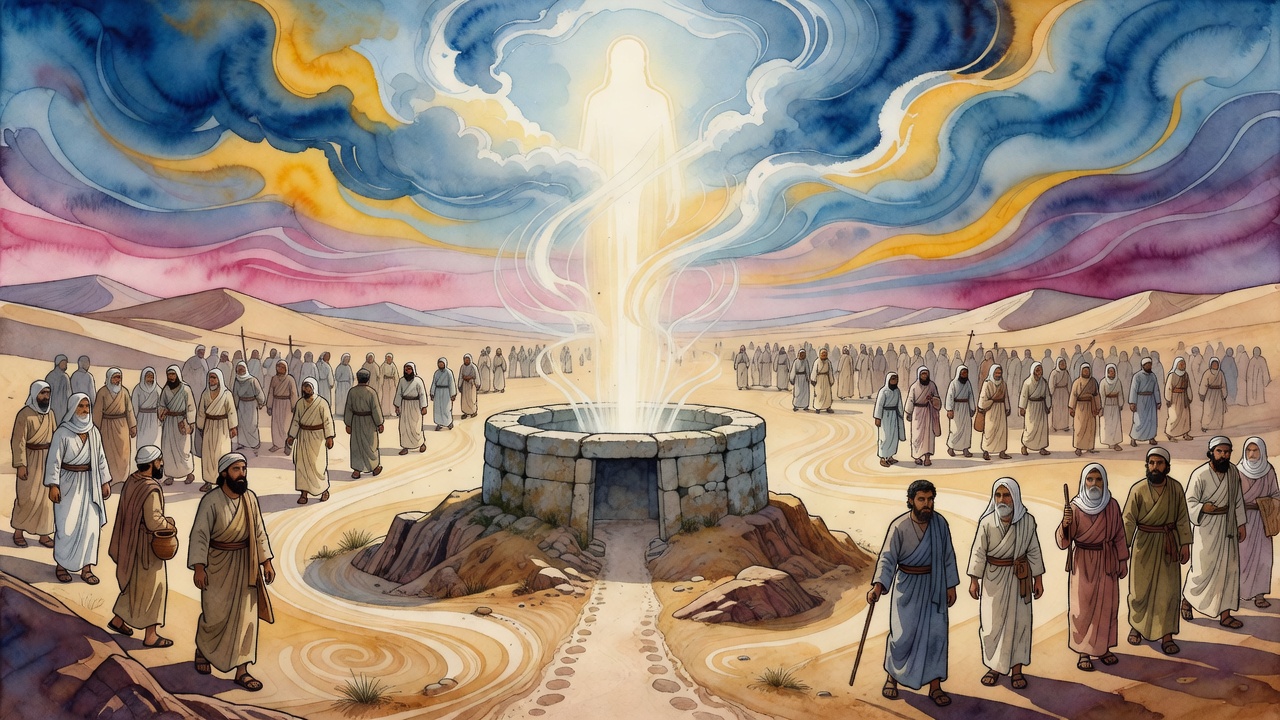
Three people had carried Israel through the desert without anyone naming the debt. Moses brought bread out of an empty sky. Aaron walked under a cloud that shaded the whole camp from the white heat. And Miriam brought water. Wherever the tribes pitched their tents, the well arrived, a spring that followed her like a dog, and the people drank and washed and cooked and watered their flocks and forgot to be amazed.

That is how the well disappeared from their attention long before it disappeared from the ground. It did not split the sky open the way Sinai had. It did not march at the head of the column like a pillar of fire. It came as the next mouthful, and the next, until the camp treated it like the tent poles and the banners, a thing that was simply there.

Then she was gone, and it was gone, and the two facts arrived together so fast that the people felt the second one in their throats before they had mourned the first.

Six Hours of Weeping

Moses did not know. He and Aaron had withdrawn from the camp to grieve their sister in private, the woman who had stood among the reeds at the Nile to watch over an infant in a basket, the woman who had lifted the timbrel at the sea and sung while the water still ran off the chariots. The two brothers wept where the people could not see them. Outside, in the streets between the tents, the mourning was loud and public, and under the mourning a different fear was rising.

For six hours Moses sat with his face wet and never once thought about the well. The camp thought about nothing else. By the time the people came for him, their patience had burned down to nothing.

"How long will you sit here and weep?" they demanded.

He answered the only way a brother can. "Shall I not weep for my sister, who has died?"

Their reply cut straight through the grief. "While you weep for one soul, weep at the same time for us all." They were saying it plainly. The water is gone. We are dying. He rose and went to look, and where the spring had been he found nothing but a dry mouth in the earth.

The Rock That Hid Itself

There was supposed to be an answer. A rock, promised to him, that would open and pour. The trouble was that when the well departed, the rock that had fed it pulled itself back into the crowd of ordinary stones and refused to be known. It was indistinguishable from every other rock in the vast plain. Moses, with the whole nation at his back, walked the field of stones looking for the one that mattered, and they all looked the same.

The people came with him, tired and cracked-lipped, and they came grumbling. "How long will you lead us on?" Moses kept his voice level. "Until I bring you water out of the rock." But the words sounded thin even to him, because he did not know which rock he meant.

They found one that was already weeping a little moisture at its face, and the whole crowd stopped, hoping, pressing in close around it. The rock's surface was small and all Israel somehow stood gathered at it, the multitude crowding onto a thing the size of a doorstep.

Hear Now, You Rebels

Something broke in Moses then. He lifted his voice over the thirsty thousands and called them what the desperate get called. "Hear now, you rebels!" The word he used, morim (a word the coast-dwellers carried in the Greek tongue, meaning fool), landed on the people like a slap, the prophet who had once pleaded for them now spitting their stubbornness back at them.

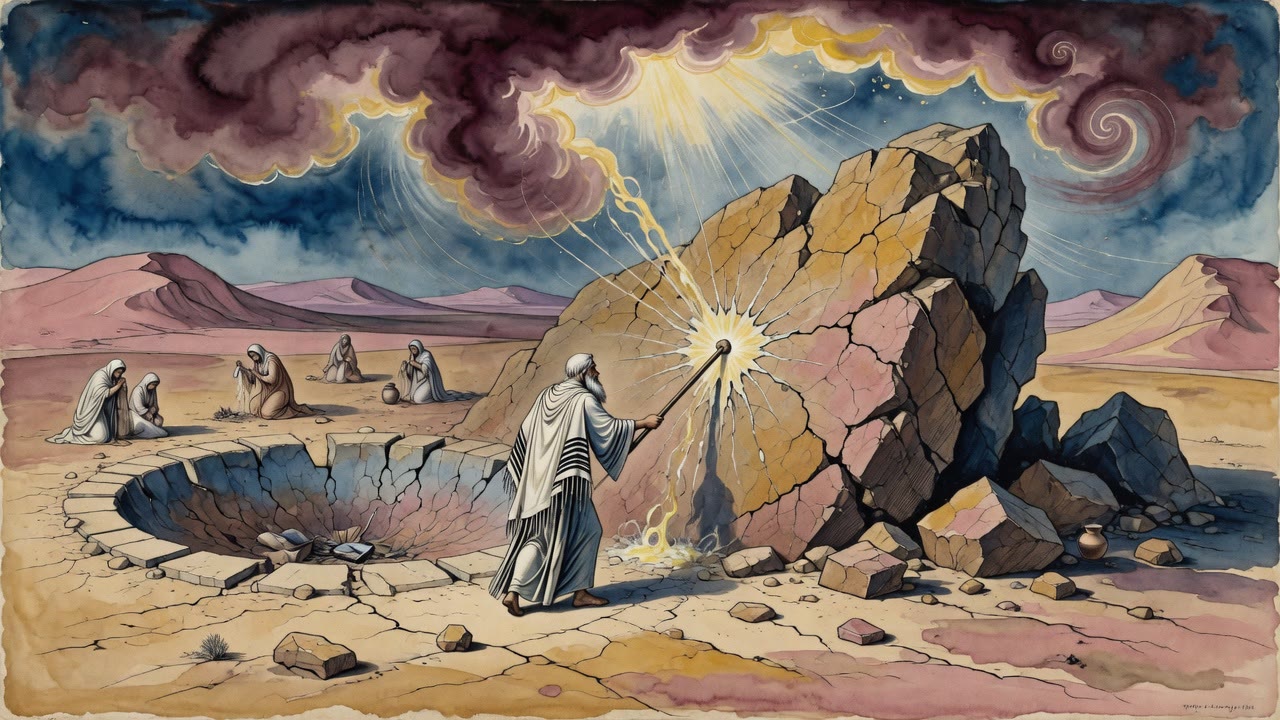
He raised the staff, the one engraved with the holy Name, and he touched the weeping stone, and he said, "Shall we bring water from this rock?" He did not even mean that rock. He did not recognize it. It was a guess, an exhausted man's gesture at a stone that happened to be damp.

And at the touch of the Name, the stone began to drip in earnest.

Two Blows and a Flow of Blood

The dripping should have been enough. It was the rock answering. But Moses had a memory in his hands, an old instruction from a different rock in a different year: strike the rock, and water shall come out. Seeing the drip, he reasoned the way he had been taught to reason. A blow was needed. So he raised his hand and brought the staff down. Once.

What came out was not water. It was blood. The first blow drew red from the stone, gushing as it gushed (Numbers 20:11), and the word for that gushing is the word used for the flow of a woman, blood pressed out of a wounded thing. The rock had refused him. It had been struck, not spoken to, and it bled before it would pour.

So Moses struck a second time. Only then did the water break loose, abundant and cold, enough for the whole congregation and their cattle to drink their fill. The people got their water. The camp lived. But two blows had fallen where words had been asked for, and the man who delivered them would not cross into the land he had spent forty years walking toward (Numbers 20:12). Miriam had died, and the cost of her death was still being counted out, stone by stone, blow by blow, in the body of her brother.


← All myths
From the tradition

Sources

4 sources

The texts this telling draws on, in full. Open a card to read inline, or expand it for a wider, quieter read.

Legends of the Jews 5:36Legends of the Jews

Miriam wasn't just Moses' sister; she was a pivotal figure in her own right. She was a prophetess, a leader, and, perhaps most importantly, she was the reason the Israelites had water in the desert. The Talmud (Taanit 9a) actually identifies three great leaders and benefactors of Israel, each providing a specific, essential gift: Moses brought them manna from heaven, Aaron brought them the protective cloud of glory, and Miriam brought them water.

The passage of this desert water was no ordinary well. Legend tells of a miraculous well that travelled with the Israelites throughout their forty years of wandering. It was a gift, a blessing, a evidence of Miriam's righteousness. But the moment Miriam died, the well vanished. Just like that. Poof!

The impact was immediate. Suddenly, the land was parched. The people were thirsty. And they knew, deep down, that this wasn't just a coincidence. As Ginzberg retells it in Legends of the Jews, the disappearance of the well served as a stark reminder: it was only owing to the merits of the pious prophetess that they had been spared a lack of water during those long forty years.

The scene: Moses and Aaron, already grieving the loss of their sister, see a massive crowd approaching. According to (Numbers 20:2-5), the people gathered together against Moses and Aaron. Understandably, they are distraught and desperate for water. But Moses, ever the keen observer, isn't convinced by their show of grief.

"What may all these multitudes desire?" he asks Aaron.

Aaron, perhaps trying to see the best in people, replies, "Are not the children of Abraham, Isaac, and Jacob kind-hearted people and the descendants of kind-hearted people? They come to express their sympathy."

But Moses isn't buying it. "Thou are not able to distinguish between a well-ordered procession and this motley multitude," he retorts. "Were these people assembled in an orderly procession, they would move under the leadership of the rules of thousands and the rulers of hundreds, but behold, they move in disorderly troops. How then can their intentions be to console with us!"

Moses, in his wisdom, sees the chaos, the lack of structure. He understands that grief and desperation can easily turn into anger and blame. The seeds of discontent are already sown. This wasn't a peaceful gathering of mourners; it was a mob, and their thirst for water would soon turn into a thirst for answers. and someone to blame.

What does this ancient story tell us? Perhaps it is a reminder to appreciate the blessings in our lives while we have them. Maybe it's a lesson about the importance of recognizing true leadership and the dangers of succumbing to mob mentality. Or maybe, just maybe, it's a evidence of the power of one righteous person, and the profound impact their absence can have on the world.

Full source
Legends of the Jews 5:53Legends of the Jews

Legends of the Jews turns to Moses Mourns Miriam and the Well Disappears for Hours.

The grief was immense. That Miriam's death plunged everyone into mourning. Moses and Aaron wept in their private spaces, while the people mourned in the streets. But something else happened – something deeply unsettling. According to Legends of the Jews, for six hours, Moses remained unaware that Miriam's well, a miraculous source of water that had sustained them in the desert, vanished with her passing.

Can you imagine the Israelites' panic? They approached Moses, their patience wearing thin. "How long will you sit here and weep?" they asked, their voices laced with desperation. Moses, understandably, responded, "Shall I not weep for my sister, who has died?" But their reply revealed a deeper crisis: "While you are weeping for one soul, weep at the same time for us all.” They were without water.

Moses, still reeling from grief, went to investigate. He found the well completely dry. A wave of frustration washed over him, and he lashed out. "Have I not told you, 'I am not able to bear you myself alone'?" he demanded, reminding them of the structure he’d put in place: "You have rulers of thousands, rulers of hundreds, rulers of fifties, and rulers of tens, princes, chiefs, elders, and magnates, let these attend to your needs!"

But the people weren't having it. As we find in Ginzberg's retelling in Legends of the Jews, they insisted that the responsibility rested solely with Moses. "All rests with thee," they argued, "for it is thou who didst lead us out of Egypt and brought us unto this evil place; it is no place of seed or of figs, or of vines, or of pomegranates; neither is there any water to drink. If thou wilt give us water, it is well, if not, we shall stone thee."

Stoning. The ultimate rejection of leadership.

Overwhelmed and perhaps terrified, Moses fled to the Mishkan, the Tabernacle – that portable sanctuary that served as the dwelling place of God. He cried out, "O Lord of the world! Thy children want to stone me, and had I not escaped, they would have stoned me by now."

God's response is fascinating. "Moses, how much longer wilt thou continue to calumniate My children?" God asks, reminding him of a previous incident at Horeb. "Is it not enough that at Horeb thou didst say, 'They be ready to stone me,' whereupon I answered thee, 'Go up before them and I will see whether they stone thee or not!'" God then instructs him: "Take the rod and assemble the congregation, thou and Aaron thy brother, and speak ye unto the rock before their eyes, that it give forth its water."

What does this all mean? It's easy to focus on the miraculous elements – the well, the water from the rock. But perhaps the true miracle lies in the enduring, albeit strained, relationship between Moses and his people. It's a reminder that leadership is often a thankless task, fraught with challenges and misunderstandings. It shows us that even the greatest of leaders, like Moses, can falter, can feel overwhelmed, and can even despair. And yet, despite the accusations, despite the threat of violence, Moses remains committed to his people, and God remains committed to both. The story highlights the delicate balance between divine intervention, human agency, and the enduring need for faith, even in the face of profound loss and uncertainty. How often do we forget that even our leaders are human beings, and that we are all in this together?

Full source
Legends of the Jews 5:54Legends of the Jews

Legends of the Jews turns to Moses Searches for the Right Rock After Miriam's Death.

In Legends of the Jews, Louis Ginzberg tells how the miraculous well that had sustained the Israelites in the desert disappeared. For forty years, water flowed thanks to Miriam’s merit, and now, suddenly, it’s gone. The people are understandably anxious, and Moses is tasked with finding a new source – a rock that God promised would provide water.

Here's the kicker: Moses didn’t know which rock it was! The special rock blended in with all the others; it was indistinguishable from any other rock in the vast desert.

Moses, leading the entire nation, searching for this elusive rock. They come across one that’s already dripping a bit, and everyone stops, hopeful. The people are tired, parched, and their patience is wearing thin.

Then the grumbling starts. "How long wilt thou lead us on?" they demand. Moses, trying to remain calm, replies, "Until I fetch ye forth water out of the rock."

But the people aren’t having it. "Give us water at once, that we may drink!" they retort. Can you feel the tension building?

Moses, frustrated and perhaps a little hurt, responds, "How long do ye quarrel? Is there a creature in all the world that so rebels against its Maker as ye do, when it is certain that God will give ye water out of a rock, even though I do not know which one that may be!" He’s basically saying, “Have a little faith! God promised, so it will happen, even if I don’t have all the answers right now.”

The people, however, are unmoved. They shoot back, "Thou wert a prophet and our shepherd during our march through the desert, and now thou sayest, 'I know not out of which rock God will give ye water.'" Ouch. They’re questioning his leadership, his prophetic abilities, his very competence. They are essentially saying, "You were so sure before, what's changed?"

This passage, found within Legends of the Jews, reveals a very human moment in a sacred story. It highlights the constant push and pull between faith and doubt, between divine promise and human impatience. It reminds us that even the greatest leaders, like Moses, can face moments of uncertainty and challenge.

It makes you wonder, doesn’t it? How often do we demand immediate answers, forgetting to trust in the process, in something larger than ourselves? And how often do we judge others, especially those in positions of leadership, forgetting that they, too, are working through the unknown? Perhaps the lesson isn’t just about finding water, but about finding faith, even when the path ahead seems unclear and the source is hidden among the rocks.

Full source
Midrash Aggadah, Numbers 20:10Midrash Aggadah

"And Moses and Aaron gathered the assembly together, etc." From here we learn that the small holds the much. Come and see: the face of the rock was only small, yet the whole assembly of Israel stood upon the face of the rock.

"Hear now, you rebels (ha-morim)." For so they call a fool in the coastal cities, morah, and it is in the Greek tongue.

"Shall we bring forth water for you from this rock (ha-min ha-sela ha-zeh)?" He did not know which rock it was, because at the time when the well departed, the rock had gone and seated itself among the other rocks. Moses took the staff and touched a rock and said, "What do you suppose, shall we bring forth water for you from this rock?" And they supposed he was telling them that that rock would bring forth water for them, but he did not say it with that intent, because he did not recognize it. As soon as he laid the staff upon the rock, the rock began to drip, because of the Name that was engraved upon the staff. When Moses saw that it dripped, Moses thought that it needed a blow with the staff, as it had been at first, as it is said, "and you shall strike the rock, and water shall come out of it, etc." (Exodus 17:6). At once Moses raised his hand and struck the rock with the staff twice.

And why was it necessary to strike it twice? Because the first time it brought forth blood, and because it did not do the bidding of the Omnipresent, he struck it a second time, so that it would bring forth water; and on account of Moses' honor it brought forth water. And whence do we know that the first time it brought forth blood? As it is said, "Behold, He struck the rock, and waters gushed out (va-yazuvu), etc." (Psalms 78:20), and "va-yazuvu" means nothing but blood, as it is said, "And if a woman has a flow (yazuv) of her blood, etc." (Leviticus 15:25). And whence do we know that the blood turned into water? As it is said, "Who turned the rock into a pool of water" (Psalms 114:8). At the first blow it brought forth blood, just as Moses our teacher, peace be upon him, struck the Nile in Egypt, and the waters too turned to blood. At the second blow the Holy One, blessed be He, turned the blood before them, and many of the Israelites who quarreled with Moses went out and were swept away, as it is said, "and streams overflowed (u-nechalim yishtofu)" (Psalms 78:20).

Full source