5 min read

Mordecai Waited at the Gate of Esther's Palace

Mordecai waited outside Esther's palace not as a distant guardian but as husband and Torah teacher, until danger forced her toward the king.

Curated by Arthur · Told by Maggid ·
Table of Contents
  1. The Gate Became a Study Hall
  2. A Marriage Hidden by Stone
  3. The Queen Was Taken Inward
  4. The Message Cut Through Fear
  5. The Fast Crossed Passover

Every day Mordecai walked the same strip of stone outside the women's house. The palace had taken Esther inside, dressed her, watched her, renamed her life by royal schedule and locked doors. Mordecai could not enter. So he made the gate do what a gate rarely does. He made it hold a marriage together.
The Gate Became a Study Hall

The court was built to swallow difference. Food arrived from royal kitchens. Servants came and went under orders. The hours belonged to the king. Inside that machinery, Esther still needed halakhah, Jewish law, for a life that had become almost impossible to live openly.

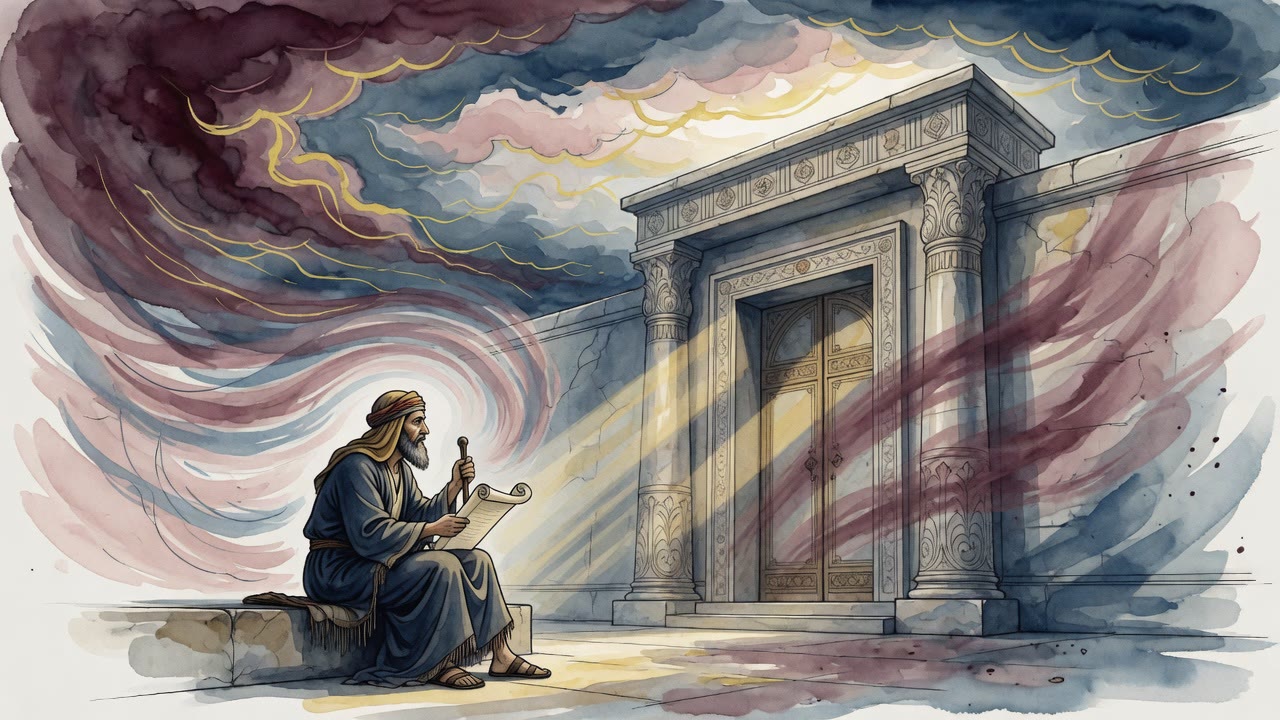
Mordecai stood where messages could pass. A question would leave the women's house in a whisper or through a trusted hand. The answer would return from the gate. What could she eat? How could she keep herself from being absorbed by the palace? Which line could bend under force, and which line had to hold even in danger?

The gate became a narrow study hall with stone for walls and suspicion for a roof. No benches. No scrolls spread across a table. Only a man outside, a woman inside, and the law of Israel moving between them like a hidden flame.

A Marriage Hidden by Stone

The bond between them was not only guardianship. Mordecai had raised her when she was orphaned, and when she came of age he took her as his wife. That changed the shape of his vigil. He was not merely an anxious kinsman asking whether the queen was well. He was a husband kept outside while empire claimed the woman who belonged to his house.

No royal pageantry could make that wound clean. The palace could perfume its rooms, polish its vessels, and call the king's desire law. Mordecai still knew what had been taken. Esther knew it too. Her silence was not consent dressed in gold. It was survival under a power that could turn refusal into death before anyone outside the chamber heard her name.

The Queen Was Taken Inward

Esther would have chosen death before betraying Mordecai willingly. The force around her was larger than a single person could resist. Doors closed. Women disappeared into the royal house and came out only if summoned. Ahasuerus did not need to argue with a Jewish wife. The empire argued for him with guards, walls, servants, and fear.

Still, God did not vanish from those rooms. The palace thought it was collecting beauty. Heaven was placing a hidden Jewish woman where a decree would later have to be broken from the inside. Mordecai did not know every turn ahead. He knew enough to keep watch, keep teaching, and keep Esther tied to the law even when the world around her insisted that she had become only queen.

The Message Cut Through Fear

Then Haman's decree went out. The words did not merely threaten Mordecai. They named a date for the destruction of every Jew in the king's provinces. Shushan tightened. Grief tore through the streets. Mordecai put on sackcloth and came near the gate, but the palace rules would not let mourning enter dressed as mourning.

Esther hesitated because she knew the law of the throne. No one came before Ahasuerus uncalled and expected to live. The golden scepter could spare a body, but only if the king extended it. Without that gesture, even a queen could be dead before her plea reached the air.

Mordecai sent back the harder truth. Rescue would come for Israel, with her or without her. Her crown was not an escape hatch from the fate of her people. Her rise might be the opening placed before her, the one door that fear would rather leave shut. The old wound of Saul's house still hung over the struggle with Agag's line, and Esther stood where that account could be answered.

The Fast Crossed Passover

Esther answered with command. Gather the Jews. Fast for three days. No food. No drink. She and her maidens would do the same. Then she would go to the king, though the law did not call her, and if she was lost, she was lost.

The days cut across Passover, the festival of deliverance. Mordecai felt the collision. Israel was supposed to eat the signs of redemption, not refuse bread and water in terror. Esther's answer carried the force of the hour. If the decree stood, there would be no people left to keep the festival. Better to break the table for one year than leave it empty forever.

So Mordecai obeyed her. The teacher at the gate became the messenger of her command. The husband outside accepted the queen's sentence from within. Across the locked stones of the palace, their hidden bond became public action, and Shushan began to fast.


← All myths
From the tradition

Sources

2 sources

The texts this telling draws on, in full. Open a card to read inline, or expand it for a wider, quieter read.

Legends of the Jews 12:66Legends of the Jews

Legends of the Jews turns to Mordecai's Daily Vigil at the Palace Gate for Esther.

some rabbinic sources suggest that Esther and Mordecai were not just cousins, but husband and wife. Ginzberg, in his Legends of the Jews, explores this idea, explaining that Mordecai's daily visits weren't just about checking on Esther; they were about providing her with guidance on Jewish law, halakha, amidst the unfamiliar customs of the Persian court. It was about maintaining their connection.

Why all the secrecy? Why not just refuse to marry Ahasuerus?

Well, that's where the story gets even more fascinating. If Esther was already married to Mordecai, wouldn't she have resisted being taken into the king's harem? According to this thread in the tradition, absolutely! She would have gladly died rather than betray her marriage vows.

But here's where divine intervention, the hand of God working behind the scenes, comes into play. The tradition suggests that Esther's marriage to Ahasuerus was never consummated in the way you might expect. Instead, God sent a ru’ah, a female spirit, in Esther's form to take her place with the king. Esther herself, according to this telling, never actually lived with Ahasuerus as his wife.

Now, that's a twist, isn't it? A divine substitution, a celestial body double, all to protect Esther's purity and ensure the safety of the Jewish people. It highlights the extraordinary measures taken in this story, the hidden depths of devotion and sacrifice.

What does it all mean? Perhaps it's a way of emphasizing the sanctity of marriage, the lengths to which one should go to uphold its vows. Or maybe it's a evidence of God's power to intervene in the most intimate aspects of our lives, to protect us even when we face impossible choices. It certainly adds another layer of complexity to an already compelling narrative, doesn't it?

Full source
Legends of the Jews 12:171Legends of the Jews

The story of Esther in the Megillah, the Book of Esther, wrestles with just that. But it's not just her story; it's about the fate of an entire people, hanging in the balance.

Esther, as you likely know, became queen of Persia. But her cousin, Mordecai, understood something crucial: her position wasn't just about luck or beauty. As Ginzberg beautifully retells in Legends of the Jews, Mordecai impressed upon Esther that God would deliver Israel, whether she intervened or not. The real question was: would she seize the moment? God's plan will unfold, regardless. But what role will we play?

Mordecai argued that Esther's elevated position was an opportunity, perhaps the only one she’d have, to atone for the past transgressions of her lineage, the house of Saul. Heavy stuff. A whole dynasty's worth of baggage resting on her shoulders.

Initially, Esther hesitated, understandably afraid. But ultimately, she yielded to Mordecai's arguments. She was prepared, says the text, to risk her life in this world to secure life in the world to come. A powerful statement about priorities.

Esther had one request of Mordecai: that the Jewish people spend three days in prayer and fasting on her behalf. She hoped this collective act would grant her favor in the eyes of the king, Ahasuerus. Can you imagine the pressure?

Here's where things get really interesting. Mordecai initially resisted proclaiming a fast. Why? Because it was Pesach (Passover), Passover! Jewish law generally prohibits fasting on holidays.

But Esther countered with some profound logic. "Of what avail are the holidays," she asked, "if there is no Israel to celebrate them?" Without Israel, there would be no Torah, no continuation of the sacred traditions. As Esther so poignantly put it, according to Ginzberg, it was advisable to transgress one law to ensure that God would have mercy upon them.

Think about the weight of that decision. Breaking a law, even a seemingly less important one, to potentially save the entire nation. It speaks to the idea that sometimes, the bigger picture requires us to re-evaluate our understanding of the rules.

This moment highlights a core tension within Jewish thought: the balance between adherence to halakha, Jewish law, and the preservation of Jewish life itself. The decision to fast on Passover wasn't taken lightly; it was a recognition that survival sometimes necessitates difficult choices.

So, what does Esther's story tell us today? Perhaps it's a reminder that we each have a role to play, even when we don't realize it. And that sometimes, the most courageous thing we can do is to step outside our comfort zone, even bend the rules a little, for the greater good. It encourages us to ask ourselves: What am I willing to risk to make the world a little brighter, a little more just?

Full source